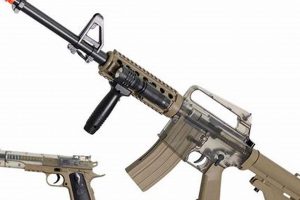
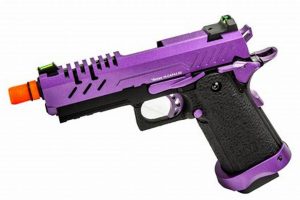
The outlay required to acquire a reliable airsoft weapon is a frequent point of inquiry for both newcomers and seasoned players. The price is influenced by several factors, including the type of gun (e.g., AEG, gas blowback, spring-powered), its manufacturer, the materials used in its construction, and the features it offers. For instance, a basic spring-powered pistol might be significantly less expensive than an advanced electric rifle with programmable features.
Understanding the investment involved is crucial for making informed decisions. A higher initial expenditure can often translate to improved durability, performance, and overall enjoyment of the sport. Historically, airsoft guns were simpler and less expensive, but advancements in technology and manufacturing have led to a wider range of options at varying price points. This expansion allows players to select equipment that aligns with their budget and playing style.
Therefore, an examination of the various price ranges and the corresponding quality and features associated with each level is warranted. This analysis will provide a clearer understanding of the financial commitment necessary to participate effectively in airsoft activities and acquire a weapon that meets individual needs and expectations.
Acquiring an Airsoft Weapon
Selecting a suitable airsoft gun involves careful evaluation of several factors. Prioritizing quality and features that align with individual needs and playing style is paramount.
Tip 1: Determine the Intended Use: Consider the type of games planned. CQB (Close Quarters Battle) environments may benefit from a smaller, more maneuverable gun, while outdoor games may necessitate a rifle with greater range and accuracy.
Tip 2: Research Reputable Brands: Established manufacturers often provide better quality control, warranties, and readily available replacement parts. Investigate brands known for reliability and performance within the airsoft community.
Tip 3: Read Reviews and Seek Recommendations: Consult online forums, watch video reviews, and ask experienced players for advice on specific models. This can offer valuable insights into the pros and cons of different options.
Tip 4: Establish a Budget and Stick to It: The price range for airsoft guns varies significantly. Defining a maximum expenditure and adhering to it will help narrow down choices and prevent overspending.
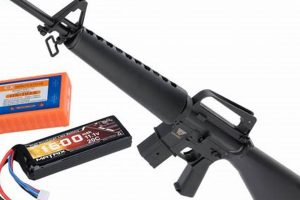
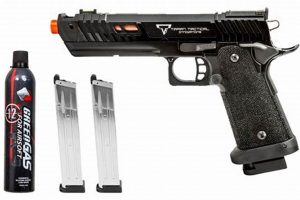
Tip 5: Factor in Additional Costs: Remember to account for essential accessories, such as batteries, magazines, BBs, protective gear, and maintenance supplies. These expenses can add significantly to the overall investment.
Tip 6: Inspect the Gun Before Purchase: If possible, physically examine the airsoft gun before buying it. Check for any signs of damage, ensure all components are functional, and assess the overall build quality.
Tip 7: Understand the Warranty and Return Policy: Familiarize yourself with the manufacturer’s or retailer’s warranty and return policy in case of defects or dissatisfaction with the product.
By carefully considering these aspects, individuals can make a more informed decision and acquire an airsoft gun that provides a satisfying and reliable experience.
Armed with this knowledge, the next step involves exploring specific models and price points to find the optimal balance between cost and performance.
1. Build Quality

The build quality of an airsoft gun directly impacts its price. Higher-grade materials, such as reinforced polymers, metal alloys (aluminum, steel), or even carbon fiber, necessitate increased manufacturing costs, which are reflected in the final retail price. Superior build quality often translates to improved durability, resistance to wear and tear, and overall longevity. For example, an airsoft rifle with a full metal receiver and barrel assembly will typically command a higher price than one constructed primarily of plastic, due to the material cost and the increased labor involved in its production.
Moreover, the precision of assembly contributes significantly to the build quality. Tighter tolerances and more meticulous construction processes, often involving skilled technicians and advanced machinery, result in greater consistency and reliability. An airsoft gun with precise internal alignment and a robust external structure is less likely to experience malfunctions or require frequent repairs, justifying the higher initial expenditure. Real-world examples include airsoft guns from manufacturers known for their stringent quality control, which consistently perform better and last longer, despite being more expensive than their counterparts.
In summary, build quality is a crucial determinant of the outlay required for an airsoft gun. While a lower price point may be attractive, compromising on build quality can lead to increased maintenance costs, reduced performance, and a shorter lifespan. Therefore, understanding the relationship between build quality and price is essential for making an informed purchasing decision and ensuring a worthwhile investment in the long run. Balancing cost with the desired level of durability and reliability remains a key challenge for airsoft enthusiasts.
2. Internal Components

The internal components of an airsoft gun are pivotal in determining its cost. A direct correlation exists between the quality of these components and the overall price. Higher-grade materials and more complex designs increase manufacturing expenses, subsequently impacting the final retail price. For instance, in electric airsoft guns (AEGs), the gearbox, motor, hop-up unit, and internal wiring constitute significant cost factors. A gearbox constructed with reinforced steel gears, a high-torque motor, a precision inner barrel, and low-resistance wiring will invariably elevate the gun’s price. Similarly, in gas blowback (GBB) pistols and rifles, the quality of the gas valve, nozzle, and internal seals determines performance and durability, thus influencing the price.
The type of internal components directly influences the gun’s performance metrics, such as rate of fire, accuracy, and consistency. An airsoft gun with upgraded internal components is likely to exhibit enhanced performance compared to a model with standard parts. Consider, for example, two AEGs: one equipped with a basic motor and plastic bushings versus another featuring a high-performance motor and steel bearings. The latter will offer a higher rate of fire, improved trigger response, and greater longevity, justifying its higher price point. Furthermore, internal upgrades often contribute to increased reliability and reduced maintenance requirements, making them a worthwhile investment despite the initial higher cost.
In conclusion, understanding the significance of internal components is crucial when assessing the financial outlay. Opting for an airsoft gun with higher-quality internals, while potentially more expensive upfront, can result in superior performance, increased durability, and reduced long-term maintenance costs. The specific components that contribute most significantly to both price and performance vary depending on the type of airsoft gun, but prioritizing quality internals is a reliable strategy for acquiring a worthwhile airsoft weapon. Selecting internal components also often includes the added benefit of upgrade options if the user needs more performance, extending the product’s usability.
3. Performance Expectations

Performance expectations directly influence the financial outlay required for an airsoft gun. The desired level of performance, encompassing accuracy, range, rate of fire, and overall reliability, dictates the necessary investment in components and construction.
- Accuracy and Range Requirements
A need for high accuracy and extended range necessitates precision-engineered components, such as tight-bore inner barrels, enhanced hop-up units, and consistent air compression systems. These components, often manufactured with stricter tolerances and higher-quality materials, increase the cost. For instance, an airsoft sniper rifle designed for long-range engagements requires a significantly greater investment than a standard assault rifle intended for close-quarters combat.
- Rate of Fire (ROF) Desires
A higher rate of fire demands robust internal mechanisms capable of withstanding increased stress and cycling at a faster pace. This typically involves reinforced gearboxes, high-torque motors, and low-resistance electrical components. These upgrades, essential for achieving a high ROF without compromising reliability, contribute to a higher price point. An AEG designed for sustained rapid firing will inherently cost more due to the necessary internal reinforcements.
- Environmental Operating Conditions
The intended environment in which the airsoft gun will operate significantly impacts performance expectations and, consequently, cost. For example, if the gun is intended for use in varied weather conditions, components that are resistant to moisture, temperature fluctuations, and physical impacts are required. This might include weather-sealed gearboxes, rust-resistant metal parts, and durable polymer bodies, all of which increase the overall expenditure. Adapting performance characteristics to external conditions necessitates increased financial outlay.
- Durability and Longevity Demands
A desire for long-term reliability and minimal maintenance necessitates the use of durable materials and robust construction techniques. This often translates to full-metal construction, reinforced internal components, and meticulous assembly processes. While a lower initial investment may be tempting, sacrificing durability can lead to more frequent repairs and replacements, ultimately increasing the total cost of ownership. Prioritizing long-term performance and durability directly influences initial expenses.
In summary, the interplay between desired performance levels and “how much does a good airsoft gun cost” is undeniable. Achieving higher accuracy, faster rates of fire, environmental resistance, and long-term durability all necessitate investments in quality components and construction. Consequently, individuals must carefully assess their performance expectations and budget accordingly, balancing their desires with their financial constraints to acquire an airsoft gun that meets their needs without exceeding their means.
4. Desired Features
The incorporation of specific features into an airsoft gun exerts a tangible influence on its overall cost. The relationship is fundamentally causal: the addition of advanced functionalities necessitates more complex engineering, higher-quality components, and increased manufacturing costs. This, in turn, results in a higher retail price point. The presence or absence of these features fundamentally differentiates airsoft guns, leading to a wide range of prices on the market.
Consider the case of electronic trigger units (ETUs). These systems offer programmable firing modes, improved trigger response, and enhanced battery protection. Implementing an ETU requires sophisticated electronic components and skilled installation, increasing the production cost. Consequently, airsoft guns equipped with ETUs typically command a higher price than those with standard mechanical triggers. Similarly, adjustable stocks, railed handguards, and integrated MOSFETs are all features that add to the complexity and expense of the gun. For example, many higher end airsoft guns include pre-installed mosfets to regulate current and protect electronic components.
Understanding the impact of desired features on the price of an airsoft gun is practically significant for consumers seeking to make informed purchasing decisions. This knowledge enables individuals to prioritize features based on their playing style and budget, allowing them to optimize their investment. Those who prioritize advanced functionalities, such as programmable firing modes and enhanced trigger response, must be prepared to allocate a larger portion of their budget. Conversely, individuals seeking a more basic airsoft gun can save money by forgoing these advanced features. Balancing individual preferences with fiscal constraints is vital to a satisfactory purchase.
5. Market Value

Market value significantly impacts the monetary outlay for a functional airsoft weapon. Brand recognition, reputation, and prevailing supply and demand dynamics collectively influence pricing structures. Established manufacturers, recognized for reliability and performance, often command higher prices. Conversely, newer or less established brands may offer comparable products at lower prices to gain market share. Scarcity of specific models or high demand driven by popularity can artificially inflate prices, exceeding the inherent value based on materials and construction alone. For example, limited edition or discontinued airsoft guns frequently accrue significant value within collector communities, driving prices far beyond their original retail cost. Ultimately, market forces, not solely intrinsic qualities, dictate the investment required.
Understanding market value is crucial for prospective purchasers. Comparing prices across different retailers and considering the reputation of both the manufacturer and the seller is essential. Online forums and communities often provide insights into the prevailing market rates for specific models, enabling informed decision-making. Furthermore, recognizing that marketing and brand perception contribute significantly to price allows individuals to assess whether the added cost aligns with their personal preferences and priorities. A higher price does not automatically equate to superior performance, necessitating careful evaluation of specifications and reviews in conjunction with market trends. Examples may include certain Tokyo Marui models which, despite being older designs, hold significant value due to their reputation for reliability and performance, commanding higher prices than more modern offerings from other manufacturers.
In conclusion, market value acts as a modifier on the base cost of an airsoft gun, reflecting external factors beyond material composition and technical specifications. A comprehensive understanding of market dynamics, encompassing brand reputation, supply constraints, and community perceptions, is essential for navigating the airsoft market effectively. This knowledge empowers purchasers to discern genuine value from inflated pricing and to make informed decisions that align with their budgets and performance expectations. Ignoring market value considerations risks overpaying for a product that may not warrant the elevated cost, ultimately diminishing the value proposition.
Frequently Asked Questions
This section addresses common inquiries regarding the investment required for acquiring a capable airsoft weapon. It aims to provide clarity on the factors influencing pricing and to offer guidance on making informed purchasing decisions.
Question 1: What constitutes a “good” airsoft gun, and how does this definition affect the price?
A “good” airsoft gun typically exhibits reliability, acceptable accuracy, and sufficient durability for the intended use. This definition significantly impacts cost, as achieving these qualities necessitates higher-grade materials and more precise manufacturing, thereby increasing the price.
Question 2: Is it possible to acquire a competitively viable airsoft gun on a limited budget?
Yes, it is feasible. Focusing on essential features and prioritizing durability over advanced functionalities allows for the acquisition of a functional airsoft gun within a restricted budget. Researching entry-level models from reputable brands is crucial.
Question 3: How do the different types of airsoft guns (AEG, gas blowback, spring-powered) compare in terms of cost?
Generally, spring-powered airsoft guns are the least expensive, followed by gas blowback models. Automatic electric guns (AEGs) typically represent the highest initial investment due to the complexity of their internal mechanisms and the battery and charger requirements.
Question 4: Should one prioritize upgrading an inexpensive airsoft gun or purchasing a more expensive model outright?
The optimal approach depends on individual circumstances and technical aptitude. Upgrading can be cost-effective for experienced users, but a higher-quality model may offer superior performance and reliability from the outset, potentially saving time and money in the long run.
Question 5: What hidden costs are associated with airsoft gun ownership beyond the initial purchase price?
Significant hidden costs include batteries and chargers (for AEGs), gas (for gas blowback models), BBs, maintenance supplies (lubricants, cleaning tools), protective gear (eye protection, face masks), and potential repair expenses.
Question 6: Do airsoft gun prices vary significantly between different retailers, and if so, why?
Yes, price variations are common due to factors such as retailer markups, promotional offers, shipping costs, and warranty policies. Comparing prices across multiple sources is essential to ensure a competitive purchase.
In summary, the cost of an airsoft gun depends on multiple interrelated elements. Prioritizing individual needs and performing appropriate research is fundamental.
Transitioning to a discussion of where to buy.
Concluding Thoughts on Airsoft Gun Acquisition
This analysis has explored the multifaceted factors determining how much does a good airsoft gun cost. It is evident that the final expenditure is not solely dictated by the base price, but rather by a complex interplay of build quality, internal components, desired performance, added features, and prevailing market conditions. Understanding these elements is crucial for navigating the airsoft market effectively and making informed purchasing decisions.
The acquisition of a suitable airsoft weapon necessitates a careful balance between budgetary constraints and performance expectations. Prioritizing research, considering individual needs, and evaluating long-term costs will contribute to a satisfying and economically sound investment. As the airsoft market continues to evolve, ongoing evaluation of these factors remains essential for both seasoned players and newcomers to the sport.