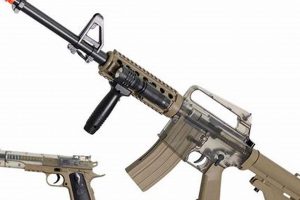
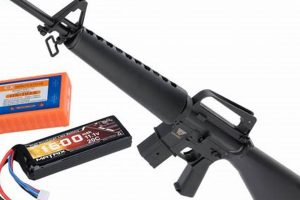
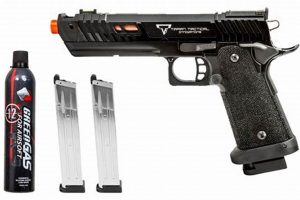
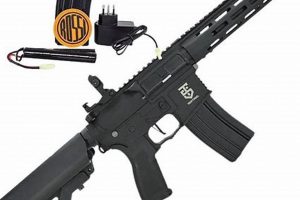
A high-end airsoft rifle, often constructed with durable metal components and featuring enhanced internal mechanisms, is designed for competitive play and serious enthusiasts. These devices prioritize accuracy, range, and reliability, often incorporating adjustable hop-up systems, reinforced gearboxes, and high-torque motors. For example, a player participating in a milsim event might utilize one of these replicas for its realism and performance capabilities.
The advantages of employing a superior-quality airsoft weapon include improved shot consistency, increased effective range, and greater longevity. Such tools offer a competitive edge in skirmishes and allow for more realistic training scenarios. Historically, these evolved from simpler, less robust designs to mirror real firearm advancements, incorporating similar materials and operating principles to provide a more authentic experience.
This understanding forms the foundation for discussing key aspects such as performance metrics, customization options, maintenance procedures, and regulatory considerations relevant to selecting and utilizing advanced airsoft replicas.
Guidance for Utilizing Advanced Airsoft Replicas
This section provides key recommendations for optimizing the performance and longevity of sophisticated airsoft weaponry. Adherence to these guidelines promotes safe and effective utilization.
Tip 1: Prioritize Regular Maintenance: Consistent cleaning and lubrication are essential. Disassemble the replica periodically to inspect and address wear on critical components such as the gearbox and hop-up unit. Use appropriate lubricants designed for airsoft mechanisms.
Tip 2: Optimize Hop-Up Adjustment: Proper hop-up setting is crucial for achieving maximum range and accuracy. Experiment with incremental adjustments to find the optimal backspin for the weight of BBs being used. Over-hopping reduces range; under-hopping causes BBs to drop prematurely.
Tip 3: Select High-Quality Ammunition: The quality of BBs directly impacts performance. Use precision-grade BBs of appropriate weight and material (e.g., biodegradable BBs for outdoor fields). Avoid using low-quality BBs, which can damage the internal components.
Tip 4: Upgrade Internal Components Strategically: When upgrading, focus on components that address specific performance bottlenecks. A high-torque motor and reinforced gearbox can enhance rate of fire and durability, while a precision inner barrel can improve accuracy.
Tip 5: Employ Proper Storage Techniques: Store airsoft replicas in a cool, dry environment to prevent damage from moisture and temperature fluctuations. Utilize a hard case for transportation to protect against impacts and damage.
Tip 6: Adhere to Field Regulations: Familiarize oneself with and strictly follow the rules and regulations of the airsoft field or event. This includes muzzle velocity limits, safety protocols, and acceptable behavior.
Tip 7: Utilize Appropriate Protective Gear: Full-seal eye protection is mandatory. Consider additional protective gear such as face masks, gloves, and body armor to minimize the risk of injury.
By diligently implementing these recommendations, users can maximize the performance, reliability, and safety of their advanced airsoft equipment.
The subsequent sections will delve into specific product reviews and comparative analyses to aid in the selection process.
1. Durability
Durability represents a critical factor in the selection and valuation of a high-caliber airsoft rifle. The ability of the device to withstand the rigors of competitive play, repeated use, and varying environmental conditions directly influences its longevity, performance consistency, and overall return on investment.
- Material Composition
The materials used in construction are paramount to determining structural integrity. High-quality airsoft rifles typically incorporate metal alloys (e.g., aluminum, steel) for critical components such as the receiver, barrel, and gearbox. These materials offer superior resistance to impact, stress, and wear compared to polymer or plastic alternatives. For instance, a steel gearbox casing is significantly less prone to cracking under the stress of a high-torque motor and high-tension spring, enhancing reliability during rapid firing cycles. The presence of robust materials ensures the weapon will endure the stress of intense skirmishes and long-term use.
- Reinforced Internal Components
Beyond external construction, the strength of internal components directly contributes to overall robustness. Reinforced gears, pistons, and springs are essential for withstanding the stresses associated with higher-performance configurations. A reinforced piston, for example, prevents premature failure under the repeated impacts of high-velocity air compression. Metal bushings and bearings reduce friction within the gearbox, minimizing wear and tear on the gears. These internal upgrades ensure a longer operational lifespan and reduced maintenance requirements.
- Environmental Resistance
Exposure to adverse environmental conditions can compromise the integrity of airsoft replicas. High-caliber airsoft rifles often incorporate features designed to mitigate these effects. Corrosion-resistant coatings protect metal surfaces from rust and degradation caused by moisture. Sealed gearboxes prevent the ingress of dirt and debris, which can accelerate wear on internal components. These protective measures are particularly important for players operating in outdoor environments or under varying weather conditions. These features help ensure consistent performance in diverse environments.
- Stress Testing and Quality Control
Reputable manufacturers subject their airsoft rifles to rigorous stress testing and quality control procedures to ensure compliance with durability standards. This includes subjecting the replicas to simulated battle conditions, drop tests, and sustained firing tests. Components are inspected for flaws and weaknesses, and designs are refined based on testing results. This commitment to quality control provides assurance that the rifle will perform reliably under demanding circumstances.
The aforementioned factors collectively determine the overall durability of a sophisticated airsoft rifle, significantly influencing its suitability for professional use. A robust construction translates to reduced maintenance requirements, improved reliability, and extended operational lifespan, representing a crucial consideration for players seeking a long-term investment in high-performance equipment.
2. Accuracy
Accuracy is a defining characteristic of a high-caliber airsoft rifle, directly impacting its effectiveness in competitive scenarios. Inaccurate shots negate the advantage of range and power, rendering the weapon ineffective. Enhanced accuracy stems from a combination of factors, including barrel quality, hop-up system efficiency, and the overall design intended to minimize variance in projectile trajectory. For example, a tightbore barrel reduces the space between the BB and the barrel’s inner surface, promoting consistent propulsion. The result of this precision engineering is target acquisition at extended ranges and reduced dispersion patterns.
The importance of accuracy is evident in organized airsoft events. Scenarios often demand precision shots to eliminate opposing players, secure objectives, or perform reconnaissance. A player equipped with a highly accurate rifle can engage targets from a concealed position, providing a tactical advantage to their team. The practical application of accuracy extends beyond competitive play. Law enforcement and military units utilize airsoft rifles for training purposes, simulating real-world engagement scenarios. Accurate replicas allow trainees to develop aiming skills, practice target identification, and refine their tactics in a safe and controlled environment.
Achieving consistent accuracy remains a challenge, as external factors such as wind and temperature can affect projectile flight. Maintaining consistent performance requires regular maintenance, proper hop-up adjustment, and the use of high-quality ammunition. In summary, accuracy is an indispensable attribute of a high-end airsoft rifle, enabling effective target engagement and providing a decisive advantage in competitive and training contexts. Its practical significance highlights the importance of investing in equipment that prioritizes precision and consistency.
3. Range
Effective range is a critical performance metric for advanced airsoft weaponry. A superior range capability allows for engagement of opponents from safer distances, tactical dominance on the field, and a higher degree of realism in simulated combat scenarios. The attainment of extended range necessitates a confluence of factors pertaining to design, construction, and operational parameters.
- Hop-Up System Efficiency
The hop-up system imparts backspin to the BB, creating a Magnus effect that counteracts gravity and extends projectile flight distance. In sophisticated airsoft guns, the hop-up is often adjustable, allowing for fine-tuning to optimize range based on BB weight and environmental conditions. For example, a well-adjusted hop-up can increase the effective range of a 0.28g BB by 20-30 meters compared to a system with no hop-up. High-quality hop-up buckings and nubs contribute to consistent backspin application, further enhancing range and accuracy.
- Inner Barrel Quality and Length
The inner barrel plays a vital role in guiding the BB and ensuring consistent propulsion. Precision inner barrels with tight bores (e.g., 6.03mm) minimize air leakage and maximize energy transfer to the BB. Longer inner barrels generally result in increased muzzle velocity and, consequently, greater range. A high-end airsoft rifle may feature a precision-grade inner barrel with a length optimized for the specific air volume and cylinder ratio, contributing to enhanced range performance.
- Air Compression System Optimization
The efficiency of the air compression system directly impacts the muzzle velocity of the BB, which, in turn, influences its range. Upgraded pistons, cylinder heads, and air nozzles minimize air leakage and maximize compression efficiency. Matching the cylinder volume to the inner barrel length is crucial for achieving optimal muzzle velocity and range. Properly sealed and optimized compression systems can significantly improve the range and consistency of shots.
- Muzzle Velocity Consistency
Consistent muzzle velocity is crucial for predictable projectile trajectory and effective range. Variations in muzzle velocity lead to shot-to-shot inconsistencies and reduced accuracy at longer distances. High-quality airsoft guns incorporate features such as regulated gas systems (in gas blowback models) and consistent spring tension (in electric models) to minimize muzzle velocity fluctuations. Chronographs are used to measure muzzle velocity and ensure compliance with field regulations and to identify any performance issues that may affect range.
The factors outlined above collectively influence the effective range of high-end airsoft replicas. Achieving superior range performance requires a comprehensive approach, encompassing optimized hop-up systems, high-quality inner barrels, efficient air compression, and consistent muzzle velocity. These characteristics contribute to the overall effectiveness of professional-grade airsoft equipment, enabling players to engage targets at extended distances and maintain a strategic advantage on the field.
4. Reliability

Reliability constitutes a cornerstone attribute of a professional airsoft gun, significantly impacting its suitability for competitive scenarios and realistic training exercises. A high-end replica must consistently perform within specified parameters, minimizing malfunctions and ensuring predictable operation under sustained use. Diminished reliability can directly translate to a disadvantage during gameplay, potentially costing a team victory or compromising the effectiveness of training simulations. The correlation between reliability and overall performance is therefore undeniable.
The factors contributing to reliability encompass internal component quality, design robustness, and manufacturing precision. For example, a reinforced gearbox, constructed from high-grade metal alloys, demonstrably reduces the likelihood of gear stripping or casing fractures under stress. Similarly, consistent air seal within the compression assembly ensures stable muzzle velocity, preventing erratic shot performance. Gas blowback models require durable valve systems to withstand repeated cycling without leakage or failure. In practical terms, a team relying on these weapons for a multi-day milsim event expects them to function flawlessly across diverse weather conditions and intensive operational periods. Frequent breakdowns necessitate repairs and detract from the overall experience.
Consequently, understanding the factors that influence reliability in airsoft guns carries significant practical weight. Selecting a model with proven durability, employing meticulous maintenance practices, and understanding the limitations of the equipment contribute to mitigating performance issues. Choosing a reliable rifle allows consistent shot power and target striking capabilities. Regular performance checks and swift replacements or repair of compromised parts further extends equipment usefulness. A greater sense of confidence and tactical control in skirmishes provides a critical advantage. The pursuit of reliability should be central to informed decision-making for competitive or training applications.
5. Customization

Customization is a significant element contributing to the utility and effectiveness of a high-caliber airsoft rifle. The capacity to modify various components allows players to tailor their equipment to specific roles, gameplay styles, and field conditions. This adaptability provides a considerable advantage over standard, non-customizable models. For instance, a sniper might prioritize accuracy upgrades, such as a precision inner barrel and a high-magnification scope, while a CQB (Close Quarters Battle) player might opt for a high rate of fire and a lightweight, maneuverable platform. This adaptability provides an advantage in different scenarios.
Practical applications of customization range from simple aesthetic modifications to comprehensive performance enhancements. The addition of a red dot sight improves target acquisition speed in close-range engagements, while a suppressor reduces the rifle’s acoustic signature, aiding in stealth operations. Internal upgrades, such as high-torque motors, reinforced gearboxes, and upgraded hop-up units, can significantly improve rate of fire, durability, and range. Many manufacturers provide complete upgrade kits designed to address specific performance bottlenecks, simplifying the customization process. An example is replacing a standard spring with a stronger one to increase FPS and reach, but it is important to make sure the upgrades doesn’t break the field regulations.
Customization allows players to adapt their equipment to suit specific gameplay needs and to optimize it for peak performance. Customization enables the rifle to perform well and increases the value of the item. Understanding the options available and their impact on performance is crucial for maximizing the potential of advanced airsoft rifles. The ability to fine-tune a rifle to personal preferences contributes significantly to the overall competitive edge. However, understanding the limitations is essential for a good performance. While performance increases, the overall build should be aligned, if some parts are not customized well, there might be malfunctions or broken rifles.
6. Realism
Realism in airsoft replicas represents a critical factor for professional training applications, historical reenactments, and immersive gameplay experiences. The degree to which an airsoft gun mirrors the appearance, weight, and operation of its real-world counterpart significantly impacts its effectiveness as a training tool and its appeal to discerning enthusiasts.
- External Replication
External replication involves the accurate reproduction of a firearm’s external features, including dimensions, markings, and material finishes. High-end airsoft guns often utilize the same manufacturing processes and materials as their real firearm counterparts to achieve a high level of visual fidelity. Examples include using stamped steel receivers, authentic polymer grips, and correctly replicated iron sights. The presence of licensed trademarks and accurate engravings further enhances the realism. For instance, a professionally manufactured M4 airsoft rifle will bear the Colt Defense markings and accurately replicate the dimensions of the original firearm. This level of detail is crucial for training exercises where familiarity with the weapon’s ergonomics is essential.
- Functional Mimicry
Functional mimicry pertains to the accurate reproduction of a firearm’s operating mechanisms. This includes features such as the bolt cycling, magazine release, fire selector, and disassembly procedures. Gas blowback (GBB) airsoft guns excel in this area, replicating the recoil and operational characteristics of real firearms. For example, a GBB pistol will feature a functioning slide that locks back on empty, requiring the user to insert a fresh magazine and release the slide to continue firing. This level of functional realism is invaluable for training scenarios where muscle memory and familiarity with weapon handling are paramount.
- Weight and Balance
The weight and balance of an airsoft replica significantly impact its handling characteristics and overall realism. High-quality airsoft guns strive to match the weight and balance of their real firearm counterparts as closely as possible. This involves using appropriately weighted components and distributing the weight in a similar manner to the real weapon. For instance, a realistic M16 airsoft rifle will have a similar weight distribution to the real M16, allowing the user to practice shouldering, aiming, and maneuvering with a realistic feel. This aspect is especially important for military and law enforcement training, where replicating the weight and balance of real firearms is crucial for developing proper weapon handling skills.
- Sound and Visual Effects
The sound and visual effects produced by an airsoft gun can significantly enhance its realism. GBB airsoft guns, in particular, offer realistic sound and visual effects, including the report of the gas release and the movement of the slide. Some models even incorporate features such as simulated muzzle flash and shell ejection. These effects contribute to a more immersive and engaging experience, making the airsoft gun a more effective training tool and a more appealing collectible. For example, a realistic AK-47 airsoft rifle will produce a distinct metallic sound when the bolt cycles, mimicking the sound of the real firearm.
These elements collectively contribute to the overall realism of a professional airsoft gun, making it an invaluable tool for training, historical reenactments, and immersive gameplay. The pursuit of realism drives manufacturers to continually refine their designs and incorporate increasingly accurate features, blurring the line between replica and real firearm.
7. Performance
Performance is paramount to the definition of a “professional airsoft gun.” The operational effectiveness of the device dictates its suitability for competitive play, training simulations, and demanding scenarios. Performance encapsulates several key metrics, including muzzle velocity, accuracy, rate of fire, and range. Superior components and design contribute directly to these measurable attributes, separating professional-grade replicas from standard models. For example, a high-torque motor, coupled with a reinforced gearbox, enables a faster rate of fire without compromising reliability. Similarly, a precision inner barrel and optimized hop-up system yield improved accuracy and range. These individual improvements coalesce to elevate overall operational capacity.
The practical significance of enhanced performance is evident in various applications. In competitive airsoft, a higher muzzle velocity and superior accuracy allow a player to engage targets from greater distances, providing a tactical advantage. A faster rate of fire can overwhelm opposing players in close-quarters combat. For military and law enforcement training, realistic performance is essential for simulating real-world engagement scenarios. Airsoft replicas are employed to develop weapon handling skills, practice target acquisition, and refine tactical maneuvers in a safe and controlled environment. Consistent and reliable performance is critical for building confidence and proficiency in these training exercises. Instances of malfunctioning or underperforming equipment can impede learning and compromise safety.
Achieving and maintaining optimal performance requires diligent maintenance, proper customization, and a thorough understanding of the equipment’s limitations. While upgrades can enhance specific performance characteristics, it is crucial to consider the overall system. Overpowering certain components without addressing others can lead to premature wear or failure. Furthermore, adherence to field regulations regarding muzzle velocity and safety protocols is essential. Ultimately, the value of a “professional airsoft gun” lies in its ability to consistently deliver superior performance, enhancing the user’s capabilities and providing a competitive edge in the field. The understanding of performance metrics allows the user to properly customize and maintain their devices, extending their overall operational life.
Frequently Asked Questions Regarding Professional Airsoft Guns
This section addresses common inquiries and concerns pertaining to high-end airsoft replicas designed for competitive play and training applications. The information provided aims to offer clarity and guidance for individuals seeking to acquire and utilize professional-grade airsoft equipment.
Question 1: What distinguishes a “professional airsoft gun” from a standard model?
Professional airsoft guns are distinguished by their superior construction materials, enhanced internal components, and refined performance characteristics. These replicas typically feature metal alloy bodies, reinforced gearboxes, precision inner barrels, and adjustable hop-up systems. They prioritize durability, accuracy, range, and reliability, making them suitable for demanding scenarios.
Question 2: What is the typical price range for a professional airsoft gun?
The price range for a professional airsoft gun varies depending on the manufacturer, model, and features. However, one can generally expect to pay between $300 and $1000 or more for a high-end replica. Factors such as the inclusion of upgraded components, licensed trademarks, and realistic functionality contribute to the overall cost.
Question 3: What are the key performance metrics to consider when selecting a professional airsoft gun?
Key performance metrics include muzzle velocity (measured in feet per second or FPS), accuracy (shot grouping at various distances), rate of fire (rounds per minute or RPM), and effective range. A well-rounded professional airsoft gun will excel in all these areas, providing a competitive advantage on the field.
Question 4: What maintenance is required to keep a professional airsoft gun in optimal condition?
Regular maintenance is crucial for prolonging the lifespan and maintaining the performance of a professional airsoft gun. This includes cleaning the inner barrel, lubricating internal components, inspecting for wear and tear, and properly storing the replica when not in use. Following the manufacturer’s recommendations and utilizing appropriate cleaning and lubrication products is essential.
Question 5: What are the legal considerations associated with owning and using a professional airsoft gun?
Airsoft guns are subject to various federal, state, and local regulations. These regulations may include restrictions on muzzle velocity, orange tip requirements, and minimum age limits. It is imperative to familiarize oneself with and comply with all applicable laws and regulations in the jurisdiction where the airsoft gun will be owned and used.
Question 6: Is it possible to upgrade or customize a professional airsoft gun?
Yes, customization and upgrading are common practices within the airsoft community. Numerous aftermarket components are available, allowing users to enhance performance, improve aesthetics, and tailor the replica to their specific needs. However, it is important to select compatible components and to ensure that any modifications comply with field regulations.
In summary, a professional airsoft gun represents a significant investment in high-quality equipment designed for demanding applications. Understanding the key features, performance metrics, maintenance requirements, and legal considerations associated with these replicas is essential for maximizing their value and ensuring safe and responsible use.
The subsequent section will provide a comparative analysis of specific professional airsoft gun models, offering insights into their strengths, weaknesses, and suitability for various applications.
Concluding Remarks on Professional Airsoft Guns
This exploration has detailed the multifaceted aspects of the professional airsoft gun, encompassing its defining attributes, performance characteristics, customization potential, and the factors influencing its reliability and realism. A careful consideration of these elementsdurability, accuracy, range, and the integration of quality componentsestablishes its value within competitive scenarios and training simulations. Understanding regulatory considerations and the importance of diligent maintenance ensures responsible ownership and sustained performance.
The informed selection and utilization of a professional airsoft gun represents a commitment to excellence and strategic advantage within the airsoft community. Further research and critical evaluation of specific models will undoubtedly enhance one’s understanding and refine their decision-making process. The evolution of airsoft technology ensures continuous advancements, warranting ongoing engagement with the latest innovations and best practices within this dynamic field.