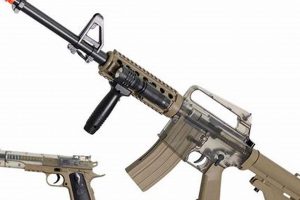
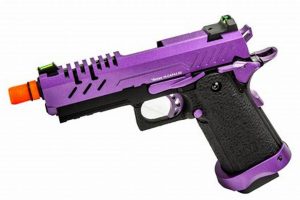
An electric airsoft gun utilizes a battery-powered motor to drive a piston, which in turn compresses air and propels a plastic projectile (BB) from the barrel. This mechanism provides a consistent power source and allows for semi-automatic or fully automatic firing modes, differentiating it from spring-powered or gas-powered alternatives.
The advantage of this type of airsoft gun lies in its reliability and ease of use. It offers a consistent firing rate and power output, reducing user fatigue compared to manual cocking mechanisms. Historically, electric airsoft guns have revolutionized the airsoft sport by introducing a more accessible and competitive platform, allowing for more dynamic and extended gameplay.
The following sections will elaborate on the internal components, the cyclical operation, and the various types of electric-powered airsoft mechanisms found in modern airsoft weaponry.
Electric Airsoft Gun Operation
Proper maintenance and understanding of electric airsoft gun operation are crucial for ensuring optimal performance and longevity of the equipment.
Tip 1: Battery Maintenance: Employing proper battery care significantly extends battery life and operational reliability. Always use the correct voltage and charging protocols specified by the manufacturer. Avoid overcharging or completely depleting the battery, as this can degrade its performance. Consider using a smart charger that automatically stops charging when the battery is full.
Tip 2: Gearbox Lubrication: The gearbox is the heart of this airsoft mechanism and requires regular lubrication. Apply silicone-based grease to the gears to minimize friction and wear. Inspect the gearbox periodically for debris and clean it thoroughly before re-lubricating. Insufficient or improper lubrication can lead to premature failure of internal components.
Tip 3: Motor Adjustment: The motor’s pinion gear must be properly meshed with the bevel gear inside the gearbox. Motor height adjustments ensure optimal contact and efficient power transfer. Incorrect motor height can result in excessive noise, increased battery drain, and eventual gear stripping.
Tip 4: Hop-Up Unit Calibration: The hop-up unit imparts backspin to the BB, increasing its range and accuracy. Proper adjustment of the hop-up is essential for achieving consistent shot trajectories. Over-hopping can cause the BB to curve upwards excessively, while under-hopping results in a shorter range and a downward trajectory. Experiment with different settings to find the optimal adjustment for the BB weight used.
Tip 5: Barrel Cleaning: Regular cleaning of the inner barrel is crucial for maintaining accuracy. Use a cleaning rod with a soft cloth to remove any dirt, debris, or residue from the barrel. A clean barrel ensures a consistent and unobstructed path for the BB, improving shot consistency.
Tip 6: Fuse Integrity: Check the fuse regularly to ensure it is in good condition. A blown fuse indicates a potential electrical problem. Replace a blown fuse with one of the correct amperage rating to prevent damage to the internal components.
Tip 7: Wiring Inspection: Inspect the wiring for any signs of wear, fraying, or damage. Damaged wiring can cause shorts, leading to reduced performance or complete failure. Replace any damaged wiring promptly to prevent further issues.
Adhering to these guidelines will promote consistent performance, reduce the likelihood of malfunctions, and ultimately extend the operational lifespan of the electric airsoft equipment.
The following sections will delve into advanced troubleshooting and customization options available for electric airsoft weapons.
1. Battery powers motor
The initial stage of electric airsoft gun operation centers on the battery providing power to the electric motor. This interaction is fundamental; without this electrical energy source, the subsequent mechanical processes necessary to propel the projectile would not occur. The efficient and reliable transfer of power from the battery to the motor is paramount for consistent functionality.
- Voltage and Current Supply
The battery supplies a specific voltage and current to the motor, dictated by the design parameters of the airsoft mechanism. Insufficient voltage can result in a weak motor response, leading to reduced firing power and cycle time. Conversely, excessive voltage can overheat and potentially damage the motor and associated electronic components. Correct voltage matching ensures optimal performance and longevity of the motor.
- Motor Torque and Speed
The electrical energy provided by the battery is converted by the motor into mechanical energy in the form of torque and speed. The motor’s torque dictates its ability to overcome the resistance within the gearbox, facilitating the compression of the piston spring. Motor speed directly impacts the rate of fire. Selecting a motor with appropriate torque and speed characteristics is crucial for achieving the desired performance characteristics of the airsoft gun.
- Electronic Speed Control (ESC)
In many advanced electric airsoft models, an Electronic Speed Control (ESC) regulates the power delivered to the motor. The ESC allows for variable motor speeds, enabling features such as adjustable rates of fire and burst modes. Additionally, the ESC often incorporates protective features, such as over-current protection and thermal shutdown, to safeguard the motor and battery from damage due to electrical faults or overheating.
- Wiring and Connectors
The electrical connection between the battery and the motor is facilitated by wiring and connectors. The quality and gauge of the wiring directly impact the efficiency of power transfer. Poor quality wiring can introduce resistance, reducing the voltage and current reaching the motor. Likewise, secure and properly rated connectors are essential for maintaining a reliable electrical connection. Loose or corroded connectors can cause intermittent power delivery, leading to inconsistent performance.
The effective conversion of electrical energy from the battery to mechanical energy by the motor, and the subsequent control and delivery of this power, are critical to understanding how an electric airsoft gun operates. Variations in battery type, motor design, and electronic control systems directly influence the airsoft gun’s firing characteristics and overall performance.
2. Motor drives gears

The electric motor within the airsoft gun initiates the mechanical process that leads to projectile propulsion. The motor’s primary function is to impart rotational force to a series of interconnected gears housed within the gearbox. This action is a critical juncture in the operation of the system, as the motor’s output directly influences the velocity and consistency of the subsequent stages. A weak or inefficient motor will result in a lower firing rate and reduced muzzle velocity, demonstrating a direct causal relationship. Conversely, a motor with high torque and speed characteristics enables higher rates of fire and potentially greater power output, within the limitations of other system components.
The gear train acts as a mechanical amplifier and translator, modifying the motor’s rotational speed and torque. Gears of varying sizes and ratios are strategically arranged to convert the motor’s high-speed, low-torque output into a slower, higher-torque force suitable for compressing the piston. For instance, a small pinion gear on the motor shaft engages with a larger bevel gear, which in turn drives a series of spur gears. This arrangement provides the mechanical advantage necessary to overcome the substantial spring resistance within the cylinder assembly. Incorrect gear ratios or damaged gear teeth can disrupt this process, leading to reduced performance, increased wear, and potential gearbox failure. The proper meshing and lubrication of these gears are vital for efficient power transmission and long-term reliability.
The interaction between the motor and gears is integral to the overall functionality of the electric airsoft gun. The motor provides the initial force, and the gears transform and transmit that force to the piston, ultimately driving the projectile. Understanding this relationship is crucial for diagnosing performance issues, selecting appropriate upgrade components, and maintaining the system in optimal operating condition. Failure to appreciate the interplay between these elements can result in improper modifications, component incompatibility, and ultimately, a non-functional or poorly performing airsoft gun.
3. Gears compress piston
Within the operational sequence, the gear set’s primary function is to engage and retract the piston, compressing the air within the cylinder. This mechanical action is a critical step in the airsoft gun’s functionality, as the compressed air is the driving force behind the projectile’s acceleration. The gears are designed to convert the motor’s rotational force into linear motion, pulling the piston against the resistance of a spring. This process stores potential energy in the compressed air, which is then rapidly released to propel the BB.
The efficiency and reliability of this system depend heavily on the quality and design of the gears and the piston assembly. Gears constructed from durable materials, such as hardened steel, are essential for withstanding the high stresses involved in compressing the piston. The piston must also be precisely engineered to maintain an airtight seal within the cylinder, preventing air leakage and maximizing the force applied to the BB. Any imperfections in the gear teeth or piston seal can significantly reduce the airsoft gun’s power and consistency. For example, worn or damaged gears may cause the piston to move erratically, resulting in inconsistent shots. Similarly, a leaking piston seal will reduce the amount of compressed air available, leading to lower muzzle velocity.
In conclusion, the interaction between the gears and the piston is a fundamental aspect of electric airsoft gun functionality. This mechanism converts rotational motor power into the linear movement required for air compression. The efficiency and reliability of this compression directly impact the gun’s performance. Ensuring proper maintenance, material quality, and design is paramount for optimizing the airsoft gun’s operation.
4. Piston releases air

The release of compressed air by the piston within an electric airsoft mechanism is a pivotal event in the firing sequence. This action directly translates the mechanical energy stored during compression into kinetic energy, which propels the projectile.
- Timing and Synchronization
The piston’s release must be precisely timed and synchronized with the other components of the firing system. This is often accomplished via a cutoff lever that disengages the gear train, allowing the compressed air to be released at the optimal moment for efficient projectile propulsion. Mismatched timing can result in reduced muzzle velocity, inconsistent shots, or even mechanical failure.
- Air Nozzle Interaction
As the piston releases the compressed air, the air nozzle, a component attached to the tappet plate, aligns with the hop-up chamber. This alignment creates a sealed pathway for the air to efficiently transfer from the cylinder to the BB. A poorly sealed or misaligned air nozzle will lead to air leakage, reducing the pressure behind the BB and decreasing its range and accuracy.
- Cylinder Volume and Airflow
The volume of the cylinder in which the piston operates determines the amount of air that can be compressed. The airflow characteristics of the cylinder head and air nozzle further influence the efficiency of the air delivery. Optimizing these parameters for the BB weight being used is critical for maximizing the airsoft gun’s performance. A cylinder with insufficient volume may not provide enough air to fully propel heavier BBs, while excessive volume can lead to wasted air and reduced efficiency.
- Pressure and Velocity Relationship
The pressure of the air released by the piston directly correlates with the projectile’s velocity. Higher pressure results in greater acceleration and higher muzzle velocity. However, exceeding safe pressure limits can damage the internal components of the airsoft gun or compromise its safety. The design and materials of the cylinder, piston head, and air nozzle must be capable of withstanding the stresses associated with high-pressure operation.
The efficient and controlled release of air by the piston is fundamental to the operation of the device. Careful consideration of timing, synchronization, airflow dynamics, and pressure limitations is crucial for optimizing its performance and ensuring its reliable function within the overall system.
5. Air propels BB
The propulsion of the BB by compressed air is the terminal action in electric airsoft gun operation, representing the conversion of stored mechanical energy into kinetic energy. This phase directly determines the projectile’s velocity, range, and trajectory. Understanding this interaction is crucial to understanding the overall functionality.
- Pressure Gradient and Acceleration
The compressed air, upon release from the piston, creates a pressure gradient behind the BB within the barrel. This pressure differential exerts a force on the BB, accelerating it down the barrel towards the muzzle. The magnitude of this force, and therefore the resulting acceleration, is directly proportional to the pressure of the compressed air. Higher pressure gradients result in greater acceleration and higher muzzle velocities, contributing to increased range and impact force. Barrel length and inner diameter also play a role in the amount of acceleration that can occur.
- Barrel Seal and Efficiency
A tight seal between the air nozzle, hop-up unit, and the BB is essential for maximizing the efficiency of the air propulsion system. Any leakage in this seal reduces the amount of pressure acting directly on the BB, resulting in decreased velocity and inconsistent performance. The material and design of these components must be carefully considered to ensure a reliable and consistent seal under the high-pressure conditions generated during firing.
- BB Weight and Velocity Relationship
The mass of the BB directly affects the resulting velocity achieved for a given pressure. Heavier BBs require a greater force to achieve the same acceleration as lighter BBs. Therefore, selecting an appropriate BB weight for the airsoft gun’s power output is crucial for optimizing its performance. Using BBs that are too heavy can result in reduced range and trajectory, while using BBs that are too light can lead to decreased accuracy and increased susceptibility to wind drift.
- Hop-Up Unit and Trajectory
While the compressed air provides the initial propulsion, the hop-up unit plays a critical role in shaping the BB’s trajectory. The hop-up applies backspin to the BB, creating an upward lift force known as the Magnus effect. This lift force counteracts gravity, allowing the BB to travel a greater distance and maintain a flatter trajectory. Proper adjustment of the hop-up is essential for achieving optimal range and accuracy. Overtightening the hop-up can cause the BB to curve upward excessively, while undertightening can result in a shorter range and a downward trajectory. The hop-up is what determines the effective range of an airsoft gun after the air has propelled the BB.
The air-propelled BB mechanism is the culmination of several synchronized actions. The interaction between air pressure, BB weight, barrel seal, and hop-up adjustment governs the airsoft gun’s performance and overall accuracy. An understanding of these interconnected elements is vital for optimizing the mechanism and achieving the desired results.
6. Hop-up enhances range
The hop-up unit is a critical component within an electric airsoft mechanism that significantly increases the projectile’s effective range. Its function is independent from the basic operation of the motor, gears, piston, and air propulsion, but is a necessary addition to an electric airsoft gun.
- Backspin Generation
The hop-up unit imparts backspin to the BB as it exits the barrel. This backspin is achieved through a small rubber nub or bucking that protrudes slightly into the barrel, creating friction against the top surface of the BB. The degree of backspin is adjustable, allowing users to fine-tune the projectile’s trajectory. An analogous real-world example is a golfer imparting backspin on a golf ball to control its flight.
- Magnus Effect Utilization
The backspin generated by the hop-up utilizes the Magnus effect, a phenomenon where a spinning object moving through a fluid (in this case, air) experiences a force perpendicular to both the direction of motion and the axis of rotation. The backspin creates a region of lower pressure above the BB and higher pressure below, resulting in an upward force that counteracts gravity. This lift extends the BB’s range considerably. A real-world example is the curveball in baseball, where the pitcher uses spin to alter the ball’s trajectory.
- Range Optimization
By counteracting gravity, the hop-up allows the BB to maintain a flatter trajectory for a longer distance. Without hop-up, the BB would drop quickly due to gravity, significantly limiting the effective range. This is analogous to adjusting the sights on a firearm to compensate for bullet drop at longer distances. The hop-up serves a similar function, extending the effective range without increasing the power output of the airsoft mechanism.
- Accuracy Influence
While primarily affecting range, the hop-up also influences accuracy. A properly adjusted hop-up can stabilize the BB’s flight path, reducing its susceptibility to wind drift and other external factors. Conversely, an improperly adjusted hop-up can cause the BB to curve erratically, decreasing accuracy. This relationship underscores the importance of fine-tuning the hop-up setting to match the BB weight and environmental conditions. A real-world analogy is the fletching on an arrow, which stabilizes its flight and improves accuracy.
In summary, the hop-up unit represents a crucial refinement to the basic principles of electric airsoft function, enabling greater range and improved accuracy. It functions separately but necessary from the basic operations of an electric airsoft gun.
Frequently Asked Questions
The following questions and answers address common inquiries regarding the operational principles and functionality of electric-powered airsoft weapons.
Question 1: What are the primary advantages of electric airsoft mechanisms compared to gas-powered or spring-powered alternatives?
Electric airsoft guns offer a consistent firing rate and power output due to their battery-operated mechanism. They provide both semi-automatic and fully-automatic firing modes, unlike spring-powered versions. Compared to gas-powered models, electric airsoft guns are less affected by temperature fluctuations and generally require less maintenance.
Question 2: What types of batteries are commonly used in electric airsoft mechanisms, and what are the key considerations for their care?
Nickel-Metal Hydride (NiMH) and Lithium Polymer (LiPo) batteries are frequently used. Proper care includes using appropriate chargers, avoiding overcharging or deep discharging, and storing batteries in a cool, dry place. LiPo batteries require additional caution due to their increased energy density and potential fire hazard if mishandled.
Question 3: How frequently should the gearbox be lubricated, and what type of lubricant is recommended?
Gearbox lubrication frequency depends on usage. A silicone-based grease is generally recommended. Regular inspection and lubrication minimize friction and wear on internal components. Insufficient or improper lubrication can lead to premature component failure.
Question 4: What is the purpose of the hop-up unit, and how does it affect the projectile’s trajectory?
The hop-up unit imparts backspin to the BB, utilizing the Magnus effect to generate lift and extend the projectile’s range. Proper adjustment is essential for achieving consistent shot trajectories. Overtightening or undertightening the hop-up can negatively impact accuracy and range.
Question 5: What factors can contribute to a decrease in muzzle velocity in electric airsoft weapons?
Several factors can contribute, including a weak battery, air leaks within the compression system, worn piston seals, incorrect motor height adjustment, or a damaged hop-up unit. Regular maintenance and inspection can mitigate these issues.
Question 6: What are the common signs of motor wear or failure in electric airsoft mechanisms?
Common signs include reduced firing rate, decreased trigger response, unusual motor noise, overheating, or complete motor failure. These issues can often be addressed through motor replacement or adjustment of the motor height.
These questions represent a general overview of how electric airsoft mechanisms operate and are maintained. It is important to consult the manufacturer’s documentation for specific recommendations.
The subsequent article section will address advanced modification strategies.
How Does An Electric Airsoft Gun Work
This exploration of how does an electric airsoft gun work reveals a complex interplay of electromechanical systems. The conversion of electrical energy into mechanical motion, the compression and release of air, and the application of backspin through the hop-up unit represent a carefully orchestrated sequence of events. Effective operation hinges upon the proper function and maintenance of each component, from the battery and motor to the gearbox and hop-up mechanism. Subtle adjustments to these elements determine velocity, range, and accuracy.
A comprehensive understanding of this process enables informed maintenance and modification decisions, allowing users to maximize the performance and longevity of their equipment. Continuous refinement and innovation in materials and design may further enhance the efficiency and capabilities of these devices in the future.