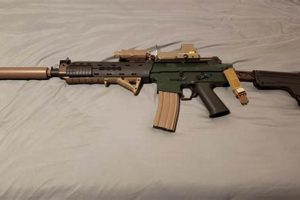
The M203 is a single-shot 40mm grenade launcher designed to attach to a rifle. Airsoft replicas of this launcher provide a means for players to simulate the use of explosive projectiles in airsoft skirmishes. These replicas typically fire 40mm airsoft grenades that launch a shower of BBs over a short range, adding a tactical element to gameplay. For example, an airsoft M203 can be mounted on an M4 platform, allowing a player to engage targets behind cover.
The inclusion of these grenade launchers enhances the realism and strategic depth of airsoft games. They allow for area denial, suppression of enemy positions, and provide a powerful offensive option. Historically, the real-world M203 saw widespread use in military operations, and its airsoft counterpart allows players to experience a similar level of tactical capability. Its simulated firepower offers a significant advantage in specific scenarios.
The following sections will detail the various types of airsoft grenade launchers, compatible grenade types, mounting options, and safety considerations for utilizing these devices in airsoft activities. We will also cover maintenance and common issues encountered with these launchers.
Tips for Using M203 Airsoft Launchers
These tips are intended to maximize the effectiveness and safety of grenade launchers in airsoft games.
Tip 1: Select Appropriate Grenades: Utilize grenades suited for the engagement range. Lower-powered grenades are better for close-quarters combat, while higher-powered options offer longer reach for outdoor fields.
Tip 2: Maintain Proper Launcher Alignment: Ensure the launcher is securely mounted and properly aligned with the rifle’s sights. Consistent alignment is vital for accurate grenade deployment.
Tip 3: Practice Trajectory Estimation: Grenades follow a ballistic arc; practice estimating the required angle for the intended target distance. This skill improves accuracy in the field.
Tip 4: Prioritize Field Safety: Adhere to all field rules regarding grenade launcher usage. Overshooting designated boundaries presents a safety hazard and violates fair play.
Tip 5: Clean and Maintain the Launcher Regularly: Consistent cleaning and lubrication of the launcher mechanism helps prevent malfunctions and ensures consistent performance. Check the grenade retention mechanism for wear.
Tip 6: Understand Grenade Capacity: Be aware of the number of BBs each grenade holds and the effective spread pattern. This knowledge enhances tactical decision-making during gameplay.
Tip 7: Communicate with Teammates: Inform teammates of grenade launcher usage, especially when targeting enclosed areas, to prevent friendly fire incidents. Clear communication is essential for coordinated attacks.
Adhering to these tips will increase the efficiency of grenade launcher employment, contributing to improved performance while ensuring participant safety.
The following sections will provide more in-depth information on specific launcher models and advanced usage techniques.
1. Compatibility

Compatibility is a paramount consideration when dealing with airsoft M203 grenade launchers. The real-world M203 is designed for specific weapon platforms, and its airsoft counterparts follow this principle. An airsoft M203 must be physically compatible with the host rifle for secure attachment and reliable operation. This involves ensuring the mounting system (often a barrel-mount or rail-mount) aligns with the rifle’s dimensions and attachment points. Incompatibility can lead to unstable mounting, misaligned aiming, and potentially, damage to both the launcher and the rifle. For example, attempting to mount an M203 designed for an M4-style rail system onto a rifle without such a rail will invariably fail.
Furthermore, compatibility extends beyond physical attachment. The dimensions of the grenade launchers trigger guard must allow for comfortable access to the host rifle’s trigger. Otherwise, the M203 can impede the operators ability to effectively use the primary weapon. The internal diameter of the M203 needs to accept standard 40mm airsoft grenades. Some lower-quality or older M203 models may have tolerances that are inconsistent, causing difficulty in loading or firing certain brands of grenades. A reliable M203 airsoft should adhere to standard measurements.
In summation, compatibility in an airsoft M203 context encompasses both physical and functional aspects. Matching the launcher to the rifle is crucial for secure attachment, ease of use, and overall effectiveness. Ignoring this aspect can result in reduced performance, potential damage to equipment, and a compromised tactical advantage on the airsoft field. Prioritizing compatibility ensures proper function and a more streamlined airsoft experience.
2. Gas Source

The “Gas Source” is a critical element in the operation of many airsoft M203 grenade launchers, influencing projectile launch velocity and overall performance. The type of gas used directly impacts the launcher’s power and consistency, ultimately affecting its utility in airsoft scenarios.
- Green Gas/Top Gas
Green gas, often referred to as Top Gas, is a common propellant for airsoft grenade launchers. It’s a pressurized gas mixture, typically propane-based with added silicone oil for lubrication. Green gas offers a balance between power and availability, making it a prevalent choice for airsoft players. The pressure of green gas varies with temperature, influencing the range and velocity of the launched projectile. For instance, in colder weather, green gas pressure decreases, resulting in reduced launch power.
- CO2 (Carbon Dioxide)
CO2 is another gas option, generally providing higher pressure and therefore greater launch power compared to green gas. CO2 is stored in small, disposable cartridges. Launchers designed for CO2 are built to withstand the increased pressure. Using CO2 in a grenade launcher not designed for it can lead to damage or failure. The consistency of CO2 pressure is generally stable across moderate temperature ranges, but it is more susceptible to rapid pressure drop as the cartridge empties.
- High-Pressure Air (HPA)
While less common for standalone M203 airsoft units, HPA systems can be adapted. HPA provides a highly consistent and adjustable gas source. This requires an external air tank and a regulator to manage the pressure delivered to the launcher. This system offers precise control over launch velocity and is less susceptible to temperature variations compared to green gas or CO2. However, it adds complexity and requires additional equipment.
- Integrated Gas Systems
Some M203 airsoft grenades utilize integrated gas reservoirs. These grenades contain a small chamber that is filled with gas (often green gas) prior to use. When the grenade is launched and impacts a surface, a valve is triggered, releasing the gas and propelling the BBs. These systems simplify the reloading process but are generally more expensive per shot than using a gas-powered launcher with reusable grenades.
The choice of gas source directly affects the performance, cost of operation, and maintenance requirements of an airsoft M203 grenade launcher. Each gas type has its advantages and disadvantages, and the selection should be based on the specific needs and playing style of the airsoft user. Understanding the characteristics of each gas source is essential for maximizing the effectiveness and lifespan of the launcher.
3. Projectile Type
The nature of the projectile fired from an airsoft M203 grenade launcher dictates its tactical application and potential impact on gameplay. The available projectile types offer varying degrees of area coverage, range, and effectiveness, requiring users to carefully consider their selection based on the engagement scenario.
- 40mm Airsoft Grenade Shells
These are the most common projectile type for airsoft M203 launchers. They typically contain a payload of BBs (6mm or 8mm) and a gas reservoir. Upon firing, the gas is released, propelling the BBs outwards in a shotgun-like spread. The number of BBs and the gas pressure determine the effective range and area of impact. A high-capacity grenade shell might contain over 100 BBs, capable of saturating a small room or clearing a corner. The shell is reloadable and reusable, making it a cost-effective option.
- Foam Rockets/Missiles
Some airsoft M203 launchers can fire foam rockets or missiles. These projectiles are larger and more visible than BBs, making them suitable for specialized game types or training scenarios where visual confirmation of impact is desired. Foam rockets generally have a limited range and are less accurate than BB-filled grenades. However, they provide a safer alternative in close-quarters engagements or when playing with less experienced individuals.
- Smoke Grenades/Distraction Devices (Airsoft Safe)
Certain airsoft-safe smoke grenades or distraction devices can be launched from an M203. These are designed to create visual or auditory distractions, providing cover for advancing teammates or disorienting opponents. These devices must be specifically designed for airsoft use, ensuring they are non-toxic and do not pose a fire hazard. The effect is temporary, but it can significantly alter the dynamics of a firefight.
- Chalk Rounds
These projectiles deliver a cloud of chalk dust upon impact. Chalk rounds can be useful for marking targets or verifying hits in situations where visual confirmation with BBs is difficult, or in training scenarios. The chalk is non-toxic and washes away with water. These rounds typically have a shorter range and are less impactful than traditional BB-filled grenades.
The selection of the appropriate projectile type for an airsoft M203 directly influences its tactical effectiveness. While 40mm grenade shells offer versatility and widespread BB coverage, foam rockets and distraction devices cater to specific niche roles. Understanding the characteristics and limitations of each projectile type allows airsoft players to adapt their tactics and maximize the potential of their M203 launcher.
4. Mounting System

The mounting system is integral to the effective utilization of any airsoft M203 grenade launcher. It represents the critical interface between the launcher and the host weapon, directly impacting stability, accuracy, and overall operability. An inadequately designed or improperly installed mounting system can render the M203 inaccurate, unreliable, or even unusable. The primary purpose of the mounting system is to securely affix the M203 to the rifle, ensuring minimal movement or wobble during operation. This secure attachment is essential for maintaining a consistent point of impact and preventing damage to either the launcher or the rifle. For instance, a loose or poorly fitted mount will cause the M203 to shift upon firing, resulting in unpredictable projectile trajectory.
Several types of mounting systems are prevalent in the airsoft M203 market, each with its advantages and disadvantages. Barrel-mounted systems clamp directly onto the rifle’s barrel, providing a relatively simple and cost-effective solution. However, they can sometimes interfere with the rifle’s iron sights and may not be compatible with all barrel profiles. Rail-mounted systems, which attach to the rifle’s accessory rails (such as Picatinny or KeyMod rails), offer greater versatility and compatibility. These systems often allow for adjustable positioning of the M203 and provide a more stable platform. Custom-designed mounting systems may be available for specific rifle models, offering a tailored fit and enhanced performance. The selection of a mounting system should consider the rifle’s configuration, the user’s preferences, and the intended use of the M203.
In conclusion, the mounting system is not merely an accessory but a fundamental component of the airsoft M203. Its selection and proper installation are essential for achieving optimal performance and reliability. Neglecting this aspect can negate the tactical benefits of the M203 and potentially lead to equipment damage or user frustration. Understanding the nuances of different mounting systems allows airsoft players to make informed decisions and integrate the M203 effectively into their loadout. Future developments may focus on more modular and adaptable mounting solutions, further enhancing the versatility of these airsoft grenade launchers.
5. Range Limitations
Range limitations are a defining characteristic of airsoft M203 grenade launchers, influencing their tactical deployment and effectiveness on the field. These limitations are dictated by several factors inherent in the design and operation of these devices. Understanding these factors is crucial for airsoft players to accurately assess and utilize these launchers in various engagement scenarios.
- Gas Pressure and Projectile Weight
The primary determinant of range is the gas pressure used to propel the projectile and the weight of the projectile itself. Lower gas pressures result in reduced muzzle velocity, thus limiting the effective range. Heavier projectiles also require more force to achieve comparable ranges. For instance, a grenade shell loaded with a large number of BBs will typically have a shorter range than one with fewer BBs, given the same gas pressure. This relationship necessitates a careful balance between payload and achievable distance.
- Aerodynamics of the Grenade Shell
The aerodynamic properties of the grenade shell significantly impact its flight path and, consequently, its range. Airsoft grenade shells are not designed for long-range accuracy, often featuring a rounded or blunt shape that generates significant air resistance. This resistance causes the projectile to decelerate rapidly, limiting its overall range. Compared to precision airsoft BBs, which are engineered for aerodynamic efficiency, grenade shells have a relatively short effective range.
- Hop-Up Systems (or Lack Thereof)
Many airsoft rifles utilize hop-up systems to impart backspin on the BB, extending its range and improving its trajectory. However, most airsoft M203 grenade launchers do not incorporate hop-up mechanisms. This lack of backspin means that the projectile follows a more pronounced ballistic arc, reducing the effective range and making it more difficult to accurately engage targets at longer distances. Some advanced grenade shells may include rudimentary hop-up features, but these are generally less effective than those found on standard airsoft rifles.
- Safety Regulations and Field Size
Airsoft fields often have specific regulations regarding the maximum range and power output of airsoft guns, including grenade launchers. These regulations are in place to ensure player safety and prevent injuries. Furthermore, the size and layout of the playing field can also dictate the practical range at which an M203 can be effectively used. In smaller, CQB (Close Quarters Battle) environments, the limited range of an M203 may be less of a disadvantage, while in larger outdoor fields, it becomes a more significant limitation.
These range limitations are inherent to the design and intended use of airsoft M203 grenade launchers. They are primarily designed for short to medium-range engagements, where their area-of-effect capabilities can be best utilized. Understanding and accounting for these limitations is essential for airsoft players to effectively employ these launchers and avoid overestimating their capabilities in dynamic field scenarios.
6. Safety Mechanisms
The implementation of safety mechanisms is paramount in the design and operation of airsoft M203 grenade launchers. These mechanisms serve to mitigate the risk of accidental discharge, prevent unauthorized use, and generally enhance user safety during airsoft activities. Their presence and proper function are crucial for responsible and ethical gameplay.
- Trigger Locks and Safeties
Trigger locks and safeties are fundamental safety features integrated into many airsoft M203 launchers. The trigger lock physically prevents the trigger from being pulled, rendering the launcher inoperable. Safeties, on the other hand, typically block the firing mechanism internally. These mechanisms are designed to prevent accidental discharge during handling, transportation, or storage. For instance, a user might engage the safety before holstering the launcher or while navigating obstacles on the field. A malfunctioning safety mechanism defeats its intended purpose and can lead to hazardous situations.
- Gas Release Valves
Some airsoft M203 grenade launchers incorporate gas release valves to safely vent any remaining gas pressure within the system. This is particularly important when the launcher is not in use or during maintenance procedures. Releasing the gas pressure reduces the risk of accidental discharge due to temperature fluctuations or internal component failures. An example is a valve that allows a user to slowly bleed out any remaining green gas after a game, preventing the grenade shell from accidentally firing when stored.
- Double-Action Triggers
Double-action triggers require a deliberate and firm pull to both cock and release the firing mechanism. This reduces the likelihood of accidental discharge compared to single-action triggers, which require only a light pull. The longer trigger travel and increased resistance of a double-action trigger necessitate a conscious effort to fire the launcher, thereby minimizing the risk of unintentional activation. These triggers are more common on gas-powered launchers.
- Projectile Retention Mechanisms
These mechanisms are designed to prevent the unintended release of the grenade from the launcher. These mechanisms prevent the projectile from dislodging due to movement. Retention mechanisms help to prevent accidental discharges. These mechanisms provide safety for the user as they are using this equipment.
The integration of these safety mechanisms is a critical factor in the responsible use of airsoft M203 grenade launchers. These features minimize the risk of accidents and contribute to a safer playing environment. Regular inspection and maintenance of these mechanisms are essential to ensure their proper function and continued effectiveness. The presence and diligent use of these safety features demonstrate a commitment to responsible airsoft practices and help mitigate potential hazards.
7. Maintenance Needs
The operational lifespan and consistent performance of airsoft M203 grenade launchers are intrinsically linked to adherence to proper maintenance procedures. The mechanical complexity, gas-powered mechanisms (in many models), and exposure to environmental factors inherent in airsoft gameplay necessitate regular inspection, cleaning, and lubrication. Failure to address these maintenance needs directly correlates with decreased performance, increased risk of malfunctions, and ultimately, a reduced service life for the equipment. For example, accumulated dirt and debris within the firing mechanism can impede trigger function, leading to inconsistent or non-existent projectile launch. Neglecting gas seal lubrication can result in pressure leaks, diminishing launch velocity and wasting propellant gas. The operational reliability of this device relies on proper care.
Specific maintenance tasks vary depending on the M203 model and gas source. However, common requirements include disassembly for thorough cleaning, application of silicone oil to gas seals and moving parts, inspection for wear or damage to critical components (such as the trigger sear, grenade retention mechanism, and mounting hardware), and proper storage in a dry environment. The O-rings that seal the gas inside airsoft grenade shells degrade over time, as well, requiring replacement. Regular testing is advised to verify that safety mechanisms are operating correctly. Inconsistent maintenance causes lower performance and causes players to lose confidence in their airsoft grenade launcher.
In summary, maintenance is not merely an optional consideration but an essential aspect of airsoft M203 ownership. Proper maintenance prevents operational shortcomings, reduces safety hazards, and maximizes the value of the investment. Addressing these needs requires consistent effort and a basic understanding of the launcher’s mechanics, but the benefits in terms of reliable performance and extended lifespan far outweigh the investment of time and resources. Neglecting maintenance introduces risk and accelerates equipment degradation, ultimately undermining the tactical advantage the M203 is intended to provide. The device should be kept in top condition, always.
Frequently Asked Questions
This section addresses common inquiries and misconceptions regarding airsoft M203 grenade launchers, providing clear and concise answers to enhance understanding and promote responsible usage.
Question 1: Are all airsoft M203 grenade launchers universally compatible with any airsoft rifle?
No, compatibility is not universal. The mounting system must align with the host rifle’s design, whether it’s a barrel-mount, rail-mount (Picatinny, KeyMod, etc.), or a proprietary interface. Attempting to attach an incompatible launcher can result in instability, misalignment, and potential damage to both the launcher and the rifle.
Question 2: What is the typical effective range of an airsoft M203 grenade launcher?
Effective range is generally limited to short-to-medium distances, typically between 30 to 60 feet. Factors such as gas pressure, projectile weight, and aerodynamic properties of the grenade shell contribute to this limitation. Airsoft M203s are not designed for long-range precision.
Question 3: What type of gas is recommended for airsoft M203 grenade launchers?
The recommended gas depends on the launcher’s design. Green gas (or Top Gas) is a common choice, offering a balance of power and availability. Some launchers are designed for CO2, which provides higher pressure. High-Pressure Air (HPA) systems, while less common for standalone units, offer consistent and adjustable performance. Always consult the manufacturer’s specifications to avoid damage.
Question 4: Are airsoft M203 grenade launchers considered safe for close-quarters combat (CQB)?
Safety in CQB depends on adherence to field rules and responsible usage. Due to the area-of-effect nature of grenade shells, overshooting designated boundaries or targeting players at excessively close range can result in injury. Utilizing lower-powered grenades or alternative projectiles (e.g., foam rockets) may be more appropriate in CQB scenarios.
Question 5: How often should an airsoft M203 grenade launcher be cleaned and maintained?
Cleaning and maintenance should be performed regularly, ideally after each day of use. This includes disassembling the launcher, cleaning internal components, lubricating gas seals, and inspecting for wear or damage. Consistent maintenance prolongs the lifespan and ensures reliable performance.
Question 6: What safety precautions should be observed when using an airsoft M203 grenade launcher?
Engage the safety when the launcher is not in use. Never point the launcher at oneself or others, even when unloaded. Adhere to all field rules and regulations regarding grenade launcher usage. Wear appropriate eye protection at all times. Use only airsoft-approved projectiles. Ensure the gas source is compatible with the launcher’s design.
This FAQ has addressed some of the most pertinent questions related to airsoft M203 grenade launchers. Understanding these points contributes to safe, responsible, and effective utilization of these devices.
The subsequent section will delve into advanced techniques for employing airsoft grenade launchers in tactical scenarios.
Conclusion
The preceding analysis has explored the multifaceted nature of airsoft M203 grenade launchers, encompassing their design variations, operational principles, safety considerations, and maintenance requirements. From compatibility constraints to projectile options and gas source dependencies, the discussion has highlighted the complexities inherent in their effective deployment. Understanding these nuances is essential for responsible and informed utilization within the airsoft community.
As technology advances and airsoft continues to evolve, a commitment to safety, adherence to field regulations, and a dedication to informed decision-making will remain paramount. The responsible use of airsoft M203 and similar devices is necessary to ensure a positive and sustainable future for the sport. Further research and development in safety mechanisms and training protocols are encouraged to minimize risk and maximize the benefits of these devices in airsoft scenarios.