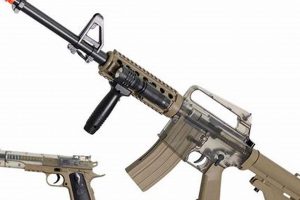
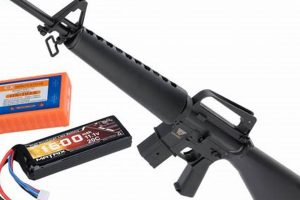
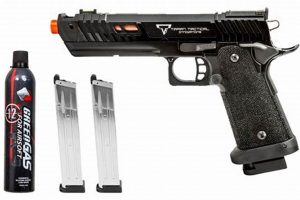
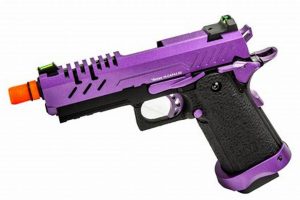
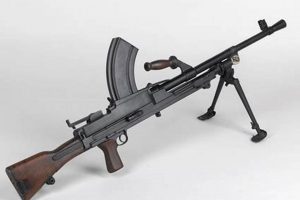
The ability to purchase realistic imitation firearms used in simulated combat sports within the United Kingdom is governed by specific legislation. Ownership and acquisition are subject to legal restrictions designed to ensure responsible use and prevent misuse. Compliance with these regulations is mandatory for both retailers and prospective owners.
These regulations serve to maintain public safety and reduce the risk of these items being mistaken for genuine firearms. They also help to prevent their involvement in criminal activities. The existing laws have evolved over time in response to changing societal concerns and technological advancements in replica firearm manufacturing.
The following sections will elaborate on the specific legal requirements, detailing the purchase process, restrictions based on age and permitted usage, and the consequences of non-compliance with the relevant legislation.
Guidance on Acquisition within the UK
The process of acquiring these items requires adherence to several key points, ensuring compliance with UK law.
Tip 1: Verify Retailer Credentials: Prior to purchase, confirm that the seller is a registered retailer and possesses the necessary licenses to sell Realistic Imitation Firearms (RIFs). Request proof of registration if needed.
Tip 2: Understand the VCRA: Familiarize yourself with the terms of the Violent Crime Reduction Act 2006 (VCRA). This legislation governs the sale, manufacture, and importation of airsoft devices.
Tip 3: Check for UKARA Membership: If intending to purchase a Realistic Imitation Firearm (RIF) without a valid defense, UKARA (United Kingdom Airsoft Retailers Association) membership demonstrates participation in skirmishing activities. Ensure the retailer checks your UKARA status.
Tip 4: Know the “Defense” Requirements: Understanding the legal defenses available under the VCRA is crucial. A valid defense includes being a registered airsoft skirmisher, a re-enactor, or a film/television production company.
Tip 5: Confirm Age Restrictions: The minimum age for purchasing airsoft devices varies. Generally, individuals under 18 are restricted from purchasing RIFs. Verify the age restrictions with the retailer.
Tip 6: Inspect the Device: Examine the device for markings indicating compliance with legal standards. Two-tone or brightly colored airsoft guns are exempt from certain restrictions, but RIFs must be properly acquired.
Tip 7: Obtain Proof of Purchase: Keep receipts and any other documentation that proves lawful acquisition. This documentation may be required to demonstrate compliance during police checks.
Adherence to these guidelines ensures that the acquisition of airsoft devices in the UK occurs within the bounds of the law, promoting responsible ownership and use.
The final sections will cover potential penalties for non-compliance and ethical considerations surrounding the use of these devices.
1. Legality

The legality surrounding the acquisition of airsoft guns in the UK is paramount. It dictates the conditions under which such purchases are permissible and imposes obligations on both vendors and prospective buyers. Ignoring these legal frameworks can result in severe consequences.
- The Violent Crime Reduction Act 2006 (VCRA)
The VCRA forms the cornerstone of regulations concerning airsoft devices. It stipulates that the sale, manufacture, and importation of Realistic Imitation Firearms (RIFs) are restricted. A “defense” is required to legally purchase a RIF, demonstrating participation in airsoft skirmishing, historical re-enactment, or film/television production. Without a valid defense, purchasing a RIF is unlawful.
- Realistic Imitation Firearms (RIFs) vs. Two-Tone Airsoft Guns
The VCRA distinguishes between RIFs and airsoft guns that are painted in bright, non-realistic colors (often referred to as “two-tone” airsoft guns). Two-tone guns are generally exempt from the defense requirement, meaning they can be purchased without proof of participation in airsoft activities. However, once an individual possesses a valid defense, they are legally permitted to purchase RIFs. This distinction highlights a critical legal boundary affecting purchasing choices.
- Age Restrictions and Purchase Requirements
Age is a significant factor affecting legality. Although there is no specific age at which one can own an airsoft gun, those under 18 face stricter limitations when purchasing. Retailers are obligated to verify the age of potential buyers and ensure they meet the defense requirements if seeking to purchase a RIF. Failure to verify age or defense constitutes a violation of the VCRA.
- Consequences of Non-Compliance
Breaching the legal requirements regarding airsoft gun purchases can lead to prosecution. Retailers who sell RIFs without verifying a valid defense, or individuals who purchase RIFs without meeting the legal criteria, face potential fines and even imprisonment. Furthermore, possessing a RIF illegally can result in its confiscation by law enforcement. These penalties underscore the importance of adhering to the VCRA.
In conclusion, the ability to purchase airsoft guns in the UK is directly contingent upon adherence to the legal framework established by the VCRA. The regulations regarding defenses, age, and types of airsoft guns define the boundaries of permissible transactions, highlighting the vital role of legality in this area.
2. Restrictions

Restrictions significantly impact the ability to acquire airsoft guns within the UK. The Violent Crime Reduction Act 2006 (VCRA) imposes specific limitations on the sale, manufacture, and importation of Realistic Imitation Firearms (RIFs). These restrictions dictate who can legally purchase a RIF and under what circumstances. For instance, individuals who are not registered airsoft skirmishers, historical re-enactors, or involved in film/television production are generally prohibited from purchasing RIFs that are not brightly colored. This direct restriction significantly reduces the pool of potential purchasers, demonstrating a clear cause-and-effect relationship: the VCRA’s restrictions directly limit the availability of realistic-looking airsoft guns to the general public.
Furthermore, the VCRA necessitates verification processes, impacting retailers directly. Retailers must confirm a buyer’s eligibility by checking for UKARA (United Kingdom Airsoft Retailers Association) membership or another valid defense. This process creates practical difficulties, as retailers must invest in verification systems and training to ensure compliance. An example of this practical impact can be seen in the increase in smaller retailers opting to only sell two-tone airsoft guns to avoid the complexities of verifying defenses for RIFs. The potential legal repercussions for non-compliance further reinforce the importance of these restrictions for retailers.
In summary, the restrictions imposed by the VCRA are a crucial component of the regulatory landscape governing airsoft gun purchases in the UK. These limitations affect both the consumer’s ability to buy realistic-looking airsoft guns and the retailer’s responsibility to adhere to stringent verification processes. Understanding these restrictions is essential for anyone involved in the airsoft community or retail sector, as failure to comply can lead to significant legal consequences. The VCRA aims to balance the interests of enthusiasts with public safety concerns, illustrating the complex relationship between recreation and regulation.
3. Age Verification

Age verification constitutes a critical component of the regulatory framework governing the purchase of airsoft guns within the UK. The legal structure dictates that individuals below a certain age are either prohibited from purchasing certain types of airsoft guns or are subject to heightened restrictions. Specifically, the sale of Realistic Imitation Firearms (RIFs) to minors carries significant penalties for retailers, thus necessitating rigorous age verification processes. The implementation of effective age verification procedures serves as a direct safeguard against the unlawful acquisition of potentially dangerous items by underage individuals. For instance, a retailer failing to adequately verify the age of a purchaser who then uses the RIF in a criminal act would face severe legal repercussions, highlighting the tangible consequences of inadequate age verification.
The practical application of age verification involves several methods, including the presentation of government-issued identification, such as passports or driving licenses. Online retailers are required to employ digital age verification services that cross-reference personal information against databases to confirm the buyer’s age. The efficacy of these methods varies, and challenges arise in preventing fraudulent attempts to circumvent age verification protocols. The need for robust and reliable verification methods has driven innovation in this sector, leading to the development of biometric identification and enhanced database validation systems. The costs associated with implementing these technologies are often borne by retailers, demonstrating the financial commitment required to ensure legal compliance.
In conclusion, age verification is not merely a procedural formality but a fundamental safeguard integral to responsible airsoft gun sales in the UK. Its effectiveness directly impacts public safety by preventing access to these items by individuals who may misuse them. Challenges remain in maintaining foolproof verification systems, but ongoing efforts to improve and refine these processes reflect the importance placed on upholding legal standards and promoting responsible ownership. The consequences of failing to adequately verify age extend beyond legal penalties, potentially contributing to incidents that undermine public trust and safety within the broader community.
4. UKARA Membership

United Kingdom Airsoft Retailers Association (UKARA) membership holds significant relevance to the ability to purchase Realistic Imitation Firearms (RIFs) within the UK. It establishes a framework for legitimate participation in the sport, thereby influencing the legality of acquiring such items. The following points outline the key facets of UKARA membership in relation to purchasing RIFs.
- Verification of Skirmisher Status
UKARA serves as a central database verifying active airsoft skirmishers. Retailers use this database to confirm that a prospective purchaser is a genuine participant in the sport and thus has a legitimate reason to own a RIF. This verification process ensures compliance with the Violent Crime Reduction Act 2006, which requires a valid defense for purchasing a RIF.
- Legitimate Defense under the VCRA
Possessing UKARA membership provides a recognized legal defense under the VCRA. This defense allows individuals actively engaged in airsoft skirmishing to purchase RIFs without restriction, unlike the general public who may only purchase brightly colored or “two-tone” airsoft guns. The membership acts as tangible proof of participation.
- Retailer Compliance and Reduced Liability
Retailers who sell RIFs to UKARA members are afforded a degree of protection against potential legal repercussions. By verifying membership status, retailers demonstrate due diligence in ensuring that the purchaser meets the legal requirements for owning a RIF. This reduces their liability in the event of misuse of the purchased item.
- Promotion of Responsible Airsoft Participation
UKARA membership promotes responsible airsoft participation by encouraging skirmish sites to adhere to safety standards and ethical practices. This fosters a culture of responsible gun ownership and use within the airsoft community, contributing to the overall safety and legitimacy of the sport.
In summary, UKARA membership functions as a key enabler for purchasing RIFs in the UK, providing a recognized means of verifying skirmisher status, establishing a legal defense under the VCRA, and promoting responsible airsoft participation. Its role is pivotal in balancing the interests of airsoft enthusiasts with the need to regulate realistic imitation firearms for public safety.
5. Permitted Use
The concept of “permitted use” directly dictates the legal boundaries within which airsoft guns, particularly Realistic Imitation Firearms (RIFs), can be operated in the UK. This framework is critical in understanding the practical implications of purchasing these devices, as ownership does not automatically grant unrestricted usage.
- Designated Skirmish Sites
The primary area of permitted use is within designated airsoft skirmish sites. These locations are specifically designed and insured for airsoft activities, providing a controlled environment where participants can engage in simulated combat. Purchase of a RIF is often contingent upon demonstrated membership with an airsoft skirmish organization (e.g., UKARA), linking the purchase directly to the intent of use at such sites. Example: An individual buying a RIF may be required to provide proof of skirmish site registration, thereby tying the acquisition to its permitted use.
- Historical Re-enactments
Another area of permitted use extends to historical re-enactments. Participants in such events may legally utilize RIFs as part of their portrayal, provided the event organizers have obtained necessary permissions and adhered to safety regulations. The purchase of a RIF for re-enactment purposes requires evidence of participation in a recognized historical society or organization, further emphasizing the link between purchase and intended, permitted use. Example: Proof of membership in a historical re-enactment society can serve as a valid defense for purchasing a RIF.
- Film and Television Productions
The use of RIFs in film and television productions constitutes another category of permitted use. Film and television companies may acquire and utilize RIFs for on-screen purposes, subject to strict licensing and safety protocols. Purchase in this context necessitates documentation verifying the production company’s credentials and demonstrating adherence to industry standards for handling imitation firearms. Example: A production company must demonstrate its adherence to industry safety guidelines when purchasing RIFs for a film shoot.
- Private Land with Permission
Limited instances of permitted use may occur on private land, contingent upon obtaining explicit permission from the landowner and ensuring that all safety precautions are observed. This scenario typically necessitates that the land is isolated and that the use of the airsoft gun does not pose a risk to public safety or cause alarm. Purchase for use on private land, while possible, is scrutinized more closely and requires diligent adherence to local regulations. Example: Landowners must grant explicit written permission for airsoft activities on their property, demonstrating a clear understanding of the activity and associated risks.
The overarching theme connecting these facets underscores that purchasing an airsoft gun in the UK is inextricably linked to its intended and permitted use. Legal frameworks necessitate that the acquisition of RIFs align with specific, regulated activities, ensuring that these devices are employed responsibly and in a manner that minimizes risk to public safety. Without a clear and demonstrable connection to a permitted use, the purchase of a RIF may be deemed unlawful, highlighting the critical interplay between acquisition and intended operation.
Frequently Asked Questions Regarding Airsoft Gun Purchases in the UK
This section addresses common inquiries concerning the purchase of airsoft guns within the United Kingdom, providing clarity on legal requirements and restrictions.
Question 1: What legal requirements govern the purchase of airsoft guns in the UK?
The Violent Crime Reduction Act 2006 (VCRA) is the primary legislation. It mandates that Realistic Imitation Firearms (RIFs) can only be purchased by individuals possessing a valid defense, such as registered airsoft skirmishers, historical re-enactors, or film/television production companies. Without a valid defense, only brightly colored or “two-tone” airsoft guns can be purchased.
Question 2: How does one demonstrate a “valid defense” for purchasing a RIF?
Valid defenses include membership in a registered airsoft skirmish site (often verified through UKARA), participation in historical re-enactment events (with verifiable documentation), or involvement in film/television production (with appropriate credentials). Documentation proving participation or membership is typically required.
Question 3: What is UKARA, and how does it relate to purchasing airsoft guns?
UKARA (United Kingdom Airsoft Retailers Association) is a database used by retailers to verify the legitimacy of airsoft skirmishers. Membership in a UKARA-registered skirmish site serves as a valid defense for purchasing RIFs. Retailers often check UKARA membership to ensure compliance with the VCRA.
Question 4: Are there age restrictions on purchasing airsoft guns in the UK?
While there is no specific legal age for owning an airsoft gun, retailers are obligated to verify the age of potential buyers and ensure they meet the defense requirements if seeking to purchase a RIF. Individuals under 18 face stricter limitations, and retailers face penalties for selling RIFs to minors without proper verification.
Question 5: What are the consequences of purchasing or selling airsoft guns illegally?
Purchasing or selling airsoft guns in violation of the VCRA can result in prosecution. Retailers may face fines or imprisonment for selling RIFs without verifying a valid defense. Individuals who purchase RIFs without meeting the legal criteria may also face fines, confiscation of the item, and potential criminal charges.
Question 6: Can airsoft guns be modified to fire lethal projectiles?
Modifying airsoft guns to fire lethal projectiles is illegal and extremely dangerous. Any such modification would constitute a serious offense and could result in severe penalties, including imprisonment. Airsoft guns are designed for recreational use with plastic BBs and should never be altered to cause harm.
Adherence to these legal requirements is essential for responsible participation in the airsoft community and ensures compliance with UK law. Ignoring these regulations can lead to serious legal repercussions.
The next section will explore ethical considerations surrounding the use of airsoft guns and responsible gun ownership.
Conclusion
The preceding discussion has thoroughly examined the multifaceted aspects of whether “can you buy airsoft guns in the UK.” It has elucidated the regulatory landscape shaped by the Violent Crime Reduction Act 2006, emphasizing the importance of valid defenses like UKARA membership, age verification protocols, and restrictions on Realistic Imitation Firearms (RIFs). The permitted use of these devices within designated skirmish sites, historical re-enactments, and film/television productions has been clarified, as have the consequences of non-compliance with the relevant legal frameworks.
Compliance with these regulations is not merely a legal obligation but a fundamental responsibility for all participants, from retailers to individual enthusiasts. Upholding these standards safeguards public safety, promotes ethical engagement in the sport, and ensures the continued viability of the airsoft community within the UK. The responsible acquisition and use of airsoft guns is paramount.