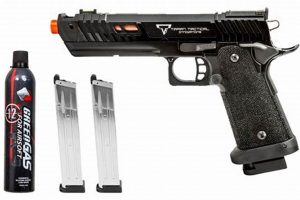
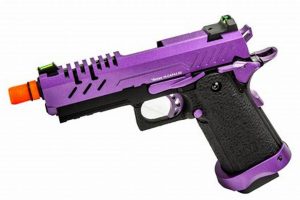
The functionality of an automatic electric gun in airsoft relies on a complex interplay of mechanical and electrical components. A battery powers an electric motor, which, in turn, drives a series of gears. These gears compress a spring, which, when released, propels a piston forward within a cylinder. This action creates a burst of air that forces a plastic projectile (BB) from the barrel.
Understanding the mechanics of these devices allows for informed decisions regarding upgrades and maintenance. Enhanced performance, improved accuracy, and increased reliability are potential benefits derived from a thorough understanding of the underlying operational principles. Historically, these systems have evolved significantly, moving from simple, low-powered mechanisms to sophisticated, high-performance platforms.
This article will delve into the specific components, exploring the roles of the motor, gearbox, hop-up unit, and internal circuitry. Furthermore, it will detail the maintenance procedures necessary for preserving operational efficiency and extending the lifespan of the mechanism.
Maintenance and Operational Tips
The following tips provide insights into maintaining and optimizing the performance of the equipment. Adherence to these guidelines will enhance longevity and ensure consistent operation.
Tip 1: Battery Selection and Charging: Use only batteries with the voltage and discharge rate recommended by the manufacturer. Overcharging or using incompatible batteries can damage internal components and reduce overall performance.
Tip 2: Gearbox Lubrication: Regularly lubricate the gears within the gearbox using a high-quality silicone grease. Insufficient lubrication leads to increased friction, wear, and potential motor burnout.
Tip 3: Hop-Up Adjustment: Properly adjust the hop-up unit to achieve optimal range and accuracy. Incorrect settings result in either under-hopping (BB drops quickly) or over-hopping (BB curves upwards excessively).
Tip 4: Motor Maintenance: Periodically inspect the motor brushes for wear and replace them as needed. Worn brushes reduce motor efficiency and contribute to poor performance.
Tip 5: Cleaning the Barrel: Regularly clean the inner barrel using a cleaning rod and silicone oil. A dirty barrel reduces accuracy and can lead to BB jams.
Tip 6: Spring Maintenance: Periodically replace the main spring, particularly in high-usage scenarios, to maintain consistent power output. Spring fatigue reduces the velocity of the projectile.
Tip 7: Wiring Inspection: Regularly inspect the internal wiring for damage, fraying, or loose connections. Damaged wiring can lead to short circuits and malfunctions.
Following these maintenance and operational guidelines will significantly improve performance, reliability, and lifespan. Consistent adherence to these practices ensures optimum functionality.
The subsequent sections of this document will explore advanced modification techniques and troubleshooting strategies.
1. Battery Power

Battery power serves as the foundational energy source for the functionality of the automatic electric gun. The battery’s capacity, measured in milliampere-hours (mAh), determines the gun’s operational duration, while its voltage dictates the motor’s speed and, consequently, the rate of fire. Without adequate battery power, the electrical motor cannot effectively drive the gearbox mechanism, thus preventing the compression of the piston and the subsequent propulsion of the BB. As an illustrative example, a low-voltage battery may lack the amperage required to cycle the gearbox completely, resulting in sluggish performance or complete operational failure. Therefore, the correlation between optimal battery power and the automatic electric gun’s intended operation is direct and essential.
Different battery chemistries, such as Nickel-Metal Hydride (NiMH) and Lithium Polymer (LiPo), offer varying performance characteristics. LiPo batteries generally provide a higher energy density and discharge rate than NiMH batteries of similar size and weight. This difference translates into potentially higher rates of fire and trigger response. However, LiPo batteries also require more careful handling and charging to prevent damage or thermal runaway. The proper selection and maintenance of batteries, including correct charging procedures and storage conditions, directly impact the longevity and performance of the automatic electric gun.
In summary, battery power is not merely an accessory but an integral component of how an electric airsoft gun functions. Its proper selection, maintenance, and application are pivotal to reliable operation. Deficiencies in battery performance will invariably lead to diminished firing rates, reduced range, or complete operational failure. A thorough understanding of the specific battery requirements for the chosen equipment, coupled with adherence to recommended charging and maintenance protocols, is thus essential for optimal performance and extending the lifespan of the airsoft mechanism.
2. Motor Rotation
Motor rotation constitutes a fundamental element in the operational sequence. Upon receiving electrical energy from the battery, the motor’s armature begins to rotate. This rotational motion is directly responsible for initiating the subsequent mechanical actions required to propel a projectile. The speed and torque of the motor directly impact the rate of fire and the spring compression rate within the gearbox. For instance, a high-torque motor allows for the rapid compression of a stronger spring, resulting in a higher velocity BB, but potentially at the cost of a slower rate of fire. Conversely, a high-speed motor prioritizes a faster firing rate, potentially sacrificing some velocity.
The motor’s construction and internal components significantly influence its rotational capabilities. Brushless motors, for example, offer higher efficiency and longevity compared to brushed motors. This increased efficiency translates into greater power output for a given electrical input, potentially improving both rate of fire and trigger response. Additionally, the gear ratio within the motor itself impacts the final rotational speed delivered to the gearbox. Lower gear ratios result in higher rotational speed, while higher gear ratios provide increased torque. The selection of an appropriate motor type and gear ratio is crucial for achieving the desired performance characteristics. Maintenance practices, such as regular brush inspection and lubrication, are essential for maintaining optimal motor function and preventing premature failure.
In conclusion, motor rotation serves as the catalyst for the entire firing cycle. Variations in motor type, gear ratio, and maintenance practices have a direct and measurable impact on the overall performance. Understanding the relationship between motor rotation and the mechanism’s function is paramount for achieving optimal performance, implementing effective upgrades, and addressing potential malfunctions. A deficiency in motor function will invariably lead to decreased performance or complete operational failure, highlighting the importance of this element.
3. Gearbox Reduction

The gearbox reduction mechanism is integral to the operational sequence, transforming the motor’s high-speed, low-torque output into a more manageable force capable of compressing the mainspring. The motor’s rapid rotation alone is insufficient to generate the force required to cycle the piston effectively. Gears of varying sizes within the gearbox interlock to reduce the rotational speed while proportionally increasing the torque. This conversion is essential for proper functionality. Without gearbox reduction, the motor would be unable to compress the spring, rendering the mechanism inoperative. A practical example involves a motor spinning at 20,000 RPM; the gearbox might reduce this to a rate appropriate for cycling the piston 15-20 times per second, a speed achievable only with the increased torque provided.
The specific gear ratio within the gearbox significantly impacts the performance characteristics. Higher gear ratios offer increased torque, facilitating the use of stronger springs, which translates into higher projectile velocities. However, this also results in a lower rate of fire. Conversely, lower gear ratios prioritize rate of fire but may necessitate the use of weaker springs, thereby limiting maximum velocity. The design and material composition of the gears contribute to the gearbox’s overall durability and efficiency. Gears constructed from reinforced steel exhibit greater resistance to wear and tear compared to those made from softer metals or plastics. Proper lubrication is vital to minimize friction between the gears, extending the lifespan and maintaining optimal performance. Failure to lubricate can lead to increased wear, potential gear stripping, and eventual gearbox failure.
In summary, gearbox reduction is a critical link between the motor’s output and the mechanism’s firing cycle. The selection of appropriate gear ratios, materials, and maintenance practices is essential for achieving the desired performance characteristics. Any deficiency in the gearbox’s function can lead to decreased firing rates, reduced power, or complete operational failure, emphasizing the significance of this component. The interplay between gear ratio selection and spring strength is a key factor to be considered in system modification.
4. Piston Compression
Piston compression represents a pivotal stage in the operational cycle. The reciprocating motion within a cylinder generates the pressurized airflow necessary to propel the projectile. This process transforms the mechanical energy derived from the gearbox into pneumatic force. Understanding the nuances of piston compression is essential for comprehending the overall system mechanics.
- Cylinder Volume and Airflow
The volume of the cylinder directly influences the amount of air displaced during compression. A larger cylinder volume results in a greater volume of pressurized air, potentially increasing the projectile’s velocity. However, a cylinder volume disproportionate to the barrel length can lead to inefficiencies and wasted energy. Optimizing the cylinder volume to match the barrel length is a critical consideration for maximizing performance.
- Piston Head and Air Seal
The piston head’s design and the integrity of the air seal are paramount for efficient compression. The piston head must create a tight seal against the cylinder walls to prevent air leakage during the compression stroke. Air leaks reduce the amount of pressurized air available to propel the projectile, resulting in decreased velocity and inconsistent performance. O-rings and specialized piston head designs are employed to enhance the air seal.
- Spring Strength and Compression Force
The strength of the mainspring dictates the force applied to the piston during compression. A stronger spring requires greater force to compress, resulting in a higher pressure behind the projectile. However, a spring that is too strong can strain the gearbox and motor, reducing reliability and potentially causing damage. Matching the spring strength to the desired performance characteristics is essential for balancing power and durability.
- Piston Weight and Reciprocating Mass
The weight of the piston affects the speed at which it can reciprocate. A heavier piston requires more energy to accelerate and decelerate, potentially reducing the rate of fire. Conversely, a lighter piston can cycle more quickly, but may lack the mass to efficiently compress the air. Balancing piston weight with the other components is a key consideration. Lightened pistons are often used to increase responsiveness.
The elements of piston compressioncylinder volume, air seal, spring strength, and piston weightcollectively dictate the efficiency and power output. Optimizing these factors, and knowing “how an electric airsoft gun works,” allows the propulsion characteristics to be efficiently delivered. A deficiency in any of these area can lead to decreased performance or mechanical failures.
5. Airflow Generation

Within the framework of automatic electric gun operation, airflow generation serves as the direct link between mechanical action and projectile launch. The piston’s forward movement within the cylinder creates a rapid displacement of air, forcing it through the nozzle and into the barrel. The efficiency and consistency of this airflow generation are critical determinants of the projectile’s velocity, range, and overall accuracy. Any compromise in the airflow, such as leaks or inadequate cylinder volume, directly impacts performance.
A practical example underscores the significance of optimized airflow generation. Consider two otherwise identical mechanisms, one with a perfectly sealed piston head and another with a minor air leak. The mechanism with the sealed piston head will consistently achieve higher projectile velocities and greater accuracy due to the more efficient transfer of energy. In contrast, the mechanism with the leak will exhibit reduced power and inconsistent shots. Furthermore, modifying the cylinder head and nozzle to optimize airflow pathways can result in a noticeable improvement in performance, even without altering other components. This highlights the importance of careful design and maintenance of the airflow generation components.
In conclusion, the process of airflow generation is not merely a consequence of piston movement but a vital component ensuring functionality. Efficient and consistent airflow directly translates to enhanced projectile performance. Understanding, optimizing, and maintaining the components responsible for airflow generation present direct performance and functional benefits. The airflow process is crucial for the end result of the airsoft gun in operation.
6. BB Propulsion

Projectile (BB) propulsion is the concluding mechanical event that manifests the culmination of every mechanical process. The compressed air, previously generated by the piston, is now channeled to exert force upon the BB, accelerating it down the barrel. The effectiveness of this stage is directly correlated with the efficiency of previous stages. Therefore, BB propulsion depends on efficient air flow, seal quality, and proper BB-barrel interaction.
- Nozzle Design and BB Seating
The nozzle plays a crucial role in aligning and sealing the BB within the hop-up chamber before releasing the compressed air. A well-designed nozzle ensures consistent BB placement, minimizing variations in velocity and trajectory. If the nozzle design is inadequate, air leakage may occur or BBs may not seat properly, resulting in lower power and accuracy. A consistent and air-tight connection is critical to efficiently propel the BB.
- Barrel Length and Bore Diameter
The barrel’s length and bore diameter affect the duration and efficiency of the force applied to the BB. A longer barrel allows for a more prolonged acceleration period, potentially increasing velocity. The internal bore diameter must be closely matched to the BB size to ensure a tight fit, which prevents air from escaping around the BB and decreases power. For example, oversized barrels can lead to significant air loss and inconsistent BB speeds. Barrel quality and inner surface polish also affect the propulsion.
- Air Volume and Pressure Release
The volume of compressed air released behind the BB must be sufficient to maintain acceleration throughout the barrel’s length. Too little air results in a reduced muzzle velocity and shorter effective range. Too much air can cause turbulence and decrease accuracy. Also, the rate at which this compressed air is released behind the BB is a key factor in maximum muzzle velocity. A pressure curve is generated within the barrel behind the BB. Fine tuning the air volume, barrel bore, and BB weight can maximize results.
- Hop-Up Integration
The hop-up system, while primarily intended to induce backspin, interacts directly with the BB’s propulsion. The rubber bucking within the hop-up unit applies a slight backspin that affects the BB’s trajectory. A hop up also creates a better air seal to propel the BB effectively. Optimizing the hop-up setting allows players to adjust to the distance the BB travels and counteract the effects of gravity. Incorrect hop-up settings can cause significant deviations in trajectory and a decrease in effective range.
These components work together to successfully propel the BB. Optimizing their individual performance and interaction is paramount for maximizing velocity, accuracy, and effective range. Compromises in any of these areas will adversely impact the BB trajectory and performance during firing. The integration of hop-up, nozzle, barrel, and other internal components directly affects the effectiveness of the BB propulsion stage, and therefore, directly impacts an airsoft systems performance.
7. Hop-Up Effect
The hop-up effect is an indispensable aspect of “how an electric airsoft gun works,” significantly influencing projectile range and trajectory. This effect is achieved by imparting backspin to the BB as it exits the barrel, creating an aerodynamic force that counteracts gravity. Without hop-up, BBs would exhibit a significantly shorter range and a pronounced downward trajectory. The hop-up unit, typically consisting of a rubber bucking and an adjustment mechanism, applies this backspin by creating a slight protrusion into the barrel, contacting the top of the BB as it passes. The degree of backspin can be adjusted to optimize performance based on BB weight and environmental conditions. The correlation between hop-up effectiveness and overall range is demonstrable: a correctly adjusted hop-up can extend the effective range by 50% or more compared to a system without hop-up.
The practical application of understanding the hop-up effect extends to gameplay and equipment maintenance. In gameplay scenarios, an awareness of hop-up settings allows players to accurately engage targets at varying distances. Adjusting the hop-up to compensate for wind or using heavier BBs for increased stability are common tactical adaptations. Concerning maintenance, inspecting the hop-up bucking for wear and tear is crucial. A damaged bucking can result in inconsistent backspin and erratic trajectories. Replacing a worn bucking is a straightforward maintenance task that directly improves performance. Advanced airsoft technicians frequently experiment with different bucking materials and designs to fine-tune the hop-up effect and optimize projectile flight characteristics.
In conclusion, the hop-up effect is inextricably linked to “how an electric airsoft gun works,” as it provides the crucial mechanism for extending projectile range and improving accuracy. A functional hop-up unit is not merely an accessory but a fundamental component affecting effective engagement. Its understanding and application are of great practical value to any individual involved with an automatic electric airsoft system. While the hop-up system significantly enhances projectile performance, achieving optimal backspin and trajectory requires careful adjustment and consistent maintenance of system components to minimize inconsistencies and ensure consistent operation.
Frequently Asked Questions
This section addresses common inquiries regarding the operational principles of electric airsoft devices, providing clear and concise answers to enhance understanding and promote informed decision-making.
Question 1: What is the source of power in an automatic electric system?
An automatic electric system derives its power from a rechargeable battery, typically of Nickel-Metal Hydride (NiMH) or Lithium Polymer (LiPo) chemistry. The battery provides the electrical energy necessary to drive the motor and initiate the firing cycle. Battery selection is critical for performance and longevity.
Question 2: How does the gearbox contribute to the functioning of the device?
The gearbox serves as a crucial mechanical intermediary, converting the motor’s high-speed, low-torque output into a more manageable force capable of compressing the mainspring. Gears of varying sizes within the gearbox achieve this reduction, providing the necessary mechanical advantage for projectile propulsion.
Question 3: What role does the piston play in the process?
The piston, located within the cylinder, compresses air when driven forward by the gearbox. This compression generates the pressurized airflow necessary to propel the projectile down the barrel. An effective piston seal is vital for maximizing the air volume and pressure.
Question 4: What is the purpose of the hop-up unit?
The hop-up unit imparts backspin to the projectile as it exits the barrel, counteracting the effects of gravity and extending its range. The degree of backspin is adjustable, allowing users to fine-tune the trajectory for optimal accuracy and distance.
Question 5: How frequently should maintenance be performed on an automatic electric system?
Maintenance frequency depends on usage. Regular lubrication of the gearbox, inspection of the piston seal, and cleaning of the barrel are recommended to ensure optimal performance and longevity. High-usage devices require more frequent attention.
Question 6: What factors influence the projectile’s velocity?
Projectile velocity is influenced by multiple factors, including spring strength, cylinder volume, air seal efficiency, barrel length, and projectile weight. Optimizing these factors can maximize velocity within safe and legal limits.
This FAQ section provides a foundational understanding of automatic electric mechanisms. A comprehensive grasp of these principles allows for informed decisions regarding maintenance, upgrades, and operational practices.
The subsequent sections will address advanced topics such as modification techniques and troubleshooting procedures.
In Summary
This article has explored the multifaceted operation “how an electric airsoft gun works,” elucidating the interplay between electrical and mechanical components. From the battery’s power delivery to the projectile’s ultimate trajectory, each stagemotor rotation, gearbox reduction, piston compression, airflow generation, BB propulsion, and hop-up effectcontributes to the overall functionality. A thorough comprehension of these principles is essential for effective maintenance, performance optimization, and informed modification. Deviations from the established operational parameters at any stage may result in decreased efficiency or system failure.
Continued exploration and application of these concepts will foster greater competency in maintaining and enhancing system operation. Consistent adherence to recommended maintenance practices and informed adjustments based on a solid understanding of “how an electric airsoft gun works” will not only improve system longevity but also elevate operational effectiveness. The principles outlined within this article provide a foundation for informed decision-making, fostering a deeper understanding of airsoft mechanisms and enabling responsible and effective utilization.