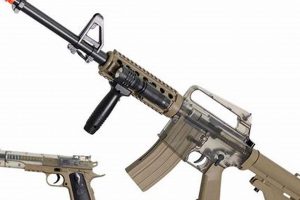
The construction of a projectile-launching replica weapon, primarily for recreational simulation, necessitates careful consideration of mechanical principles and material properties. Such a device typically utilizes compressed air or gas to propel plastic pellets, simulating the operation of a firearm for sporting or training purposes. A simplified example involves the adaptation of a pressurized container connected to a barrel, with a valve mechanism to regulate the release of air and propel the projectile.
Engaging in this activity can foster an understanding of pneumatic systems and basic engineering principles. Furthermore, it may offer a controlled environment for developing skills related to firearm safety and handling, although it is crucial to emphasize that simulated weaponry should never be mistaken for, or treated as, real firearms. Historically, similar projects have served as educational tools, providing hands-on experience in mechanics and physics.
The subsequent sections will address considerations of legality, safety protocols, and the fundamental engineering aspects involved. This information is for educational purposes and does not endorse or encourage the creation of any item that may violate local laws or compromise safety.
Tips for Constructing a Replica Projectile Weapon
Successful development of a functional, safe, and compliant replica projectile weapon requires meticulous planning, precise execution, and adherence to established safety guidelines. The following tips outline key considerations for individuals engaging in such a project.
Tip 1: Prioritize Safety Protocols: The foremost consideration is adherence to rigorous safety protocols. Eye protection is mandatory during all stages of construction and testing. A safe testing environment, free from bystanders and potential hazards, must be established.
Tip 2: Research and Understand Local Laws: Before commencing construction, thoroughly research and comprehend all applicable local, regional, and national laws pertaining to replica projectile weapons. Ensure the planned device complies with regulations regarding velocity, marking requirements, and permitted locations of use.
Tip 3: Select Appropriate Materials: Material selection is critical for both performance and durability. Opt for robust, pressure-resistant materials for pressure vessels and barrels. Consider the weight and impact resistance of materials used for external components.
Tip 4: Design for Controlled Airflow: Effective projectile propulsion hinges on precisely controlled airflow. Design the air delivery system to optimize the volume and pressure of air released behind the projectile. Experiment with different valve mechanisms to achieve desired performance.
Tip 5: Implement a Reliable Trigger Mechanism: The trigger mechanism must be reliable, predictable, and safe. It should allow for precise control over projectile discharge and incorporate safety features to prevent accidental firing.
Tip 6: Conduct Thorough Testing: Following assembly, conduct extensive testing in a controlled environment. Monitor projectile velocity, accuracy, and overall system reliability. Document all test results for future reference and potential modifications.
Tip 7: Implement Fail-Safes: Incorporate fail-safes into the design to mitigate potential hazards. Pressure relief valves can prevent over-pressurization, while safety locks can disable the firing mechanism when not in use.
These tips underscore the importance of safety, legal compliance, and sound engineering practices. By adhering to these guidelines, individuals can approach the activity responsibly and minimize potential risks.
The subsequent sections will address the legal considerations and explore ethical implications associated with this type of construction.
1. Mechanical Principles

The operation of a replica projectile weapon is fundamentally governed by mechanical principles. These principles dictate how energy is transferred and utilized to propel a projectile. Cause and effect are demonstrably linked: design choices rooted in sound mechanics directly influence the weapon’s performance characteristics, such as projectile velocity, range, and accuracy. Without a thorough understanding of these principles, the device risks failing to function as intended, or worse, becoming a safety hazard. For example, the leverage ratio of the trigger mechanism directly affects the force required to actuate the firing valve. Improper design may result in a trigger that is either too stiff to operate or prone to accidental discharge.
Consider the design of the air compression chamber. The volume and shape of this chamber, along with the efficiency of the piston or gas delivery system, determine the amount of potential energy available for projectile propulsion. Applying Boyle’s Law (PV = PV) demonstrates how compressing air into a smaller volume increases its pressure, thus providing the force to expel the projectile. Similarly, the barrel length and internal diameter influence the projectile’s acceleration and stability during its flight. Understanding projectile dynamics allows optimization for the weapon’s performance.
In conclusion, a solid grasp of mechanical principles is not merely beneficial but essential for the successful design and construction of a safe and functional replica projectile weapon. It guides material selection, component geometry, and overall system architecture. This knowledge mitigates potential risks and enables the creation of a device that operates predictably and reliably. Neglecting these principles can lead to inefficient performance, compromised safety, and potential legal issues, highlighting the critical role of mechanics in the entire process.
2. Pneumatic Systems

Pneumatic systems form the core functional component in many replica projectile weapons. The fundamental principle involves the utilization of compressed gas, typically air, to exert force on a projectile, thereby propelling it towards a designated target. The efficiency and effectiveness of this propulsion are directly dependent on the design and implementation of the pneumatic system, including its various sub-components. For instance, the size of the air reservoir determines the amount of stored potential energy, while the valve mechanism controls the release rate and volume of air delivered to the projectile.
Practical application of pneumatic principles is evident in various designs. A simple spring-piston system compresses air with each pull of a spring, which is then rapidly released to propel the projectile. More advanced systems incorporate regulated gas canisters (such as CO2 or green gas) and complex valve assemblies for consistent power output and adjustable velocity. The design choices influence not only performance but also reliability and maintenance requirements. Leakage, a common issue in poorly designed systems, drastically reduces power and necessitates frequent repair. Likewise, valve failures can lead to erratic performance or complete system malfunction.
In summary, a comprehensive understanding of pneumatic systems is crucial for anyone involved in the design, construction, or modification of replica projectile weapons. Success hinges on efficient compression, regulated airflow, and robust component integration. Challenges often arise from balancing performance with reliability and adhering to relevant safety standards. Consequently, the efficacy of the pneumatic system directly correlates to the overall functionality and responsible utilization of the device.
3. Material Selection
Material selection constitutes a critical determinant in the performance, safety, and longevity of a replica projectile weapon. The physical properties of chosen materials directly influence the weapon’s structural integrity, resistance to wear and tear, and ability to withstand operational stresses. For instance, the barrel material affects projectile trajectory and velocity, while the material used for the pressure vessel impacts its ability to safely contain compressed gas.
The interplay between material properties and design is paramount. A pressure vessel constructed from brittle plastic is demonstrably more prone to catastrophic failure under pressure compared to one fabricated from reinforced metal alloy. Similarly, a barrel made of soft metal may deform or wear down quickly, compromising accuracy and projectile velocity. The selection process demands a balance between cost, availability, and performance characteristics. High-strength polymers such as ABS or nylon provide a compromise between weight, durability, and cost for external components. Internal mechanisms often require stronger materials such as steel or aluminum to withstand repeated stress.
In conclusion, a comprehensive understanding of material properties and their relation to operational demands is essential for constructing a safe and reliable replica projectile weapon. The choice of materials is not arbitrary but rather a deliberate engineering decision that directly impacts performance, longevity, and, most importantly, user safety. Incorrect material selection poses significant risks, potentially leading to component failure and user injury, underscoring the importance of informed material choices in this context.
4. Valve mechanisms

Valve mechanisms represent a critical component within the operational architecture of most replica projectile weapons. These mechanisms are responsible for regulating the release of compressed gas, a fundamental aspect of projectile propulsion. The type, design, and precision of the valve directly impact the weapon’s power, accuracy, and consistency. For example, a simple poppet valve can provide a basic on/off control, while more complex designs, such as those incorporating adjustable flow rates, allow for finer-tuned performance.
The selection of a specific valve mechanism is influenced by several factors, including the intended operating pressure, the desired rate of fire, and the overall design constraints. A blowback system, commonly employed in gas-powered replicas, utilizes a portion of the released gas to cycle the bolt, simulating the action of a real firearm. The efficiency of the gas usage in such a system is directly correlated to the valve’s sealing capabilities and its responsiveness. In contrast, spring-piston designs rely on a different valve configuration to release the compressed air generated by the piston’s movement. Therefore, valve mechanisms are instrumental in managing gas release and controlling how the energy is transferred to propel the projectile.
In summary, the valve mechanism is an indispensable component in most replica projectile weapons, serving as the gatekeeper for the compressed gas that powers the device. The performance characteristics of the valve, including its precision, responsiveness, and sealing capabilities, have a direct and significant impact on the overall functionality and reliability of the replica. The valve mechanism plays a significant role in safe projectile weapon build and design.
5. Safety protocols

Safety protocols are paramount when constructing replica projectile weapons. The potential for injury necessitates the implementation of rigorous safety measures throughout the design, build, and testing phases. Ignoring these protocols creates unacceptable risks.
- Eye Protection Mandate
Eye protection is non-negotiable. Projectiles, even those made of plastic, can cause serious eye injury. ANSI Z87.1 rated safety glasses or goggles must be worn at all times by anyone in the vicinity during operation, testing, or maintenance. Failure to consistently use appropriate eye protection can result in permanent vision impairment.
- Safe Testing Environment
Testing must occur in a controlled environment, free from bystanders and potential hazards. A designated backstop is required to contain projectiles and prevent ricochets. The testing area must be clearly marked to indicate an active testing zone. Uncontrolled testing poses a risk of accidental injury to individuals and damage to property.
- Velocity Limitations and Chronograph Use
Adherence to velocity limitations is critical for responsible operation. A chronograph must be used to verify that projectile velocity remains within legal and safe limits. Exceeding these limits increases the risk of injury and may violate applicable laws. Accurate velocity measurement is essential for ensuring compliance and responsible usage.
- Secure Storage and Handling
Replica projectile weapons must be stored securely, inaccessible to unauthorized individuals, particularly children. Safe handling practices, including treating every weapon as if it were loaded, must be followed at all times. Negligent storage and handling can lead to accidental discharge and potential injury or death.
These safety protocols are fundamental to the responsible pursuit of constructing replica projectile weapons. Strict adherence minimizes risk and promotes a culture of safety. Failure to prioritize safety undermines the activity and increases the likelihood of serious consequences, ultimately reducing the quality, and increasing risk, of the experience.
6. Legal compliance
Constructing a replica projectile weapon necessitates strict adherence to legal mandates, as the act of building one often falls under specific regulatory frameworks. Failure to comply can result in serious legal repercussions, including fines, confiscation of the device, and potential criminal charges. The scope of legal compliance extends beyond the finished product; it encompasses the entire process, from initial design to final testing. For instance, some jurisdictions require specific markings to indicate the device is not a real firearm, while others impose restrictions on projectile velocity or permitted locations for operation. These regulations are often intended to prevent confusion with actual firearms and to minimize the risk of misuse.
The specifics of legal compliance vary significantly depending on geographic location. Within the United States, state and local laws frequently supersede federal guidelines, creating a complex patchwork of regulations. For example, New York City has stringent restrictions on replica firearms, requiring specific colorations, while other jurisdictions have more lenient requirements. In some European countries, the possession of a replica projectile weapon is contingent upon membership in a recognized sporting organization or participation in organized events. The lack of due diligence in researching and adhering to these location-specific regulations constitutes a significant legal risk. Ignorance of the law is not a valid defense, and individuals are held accountable for their actions, regardless of their understanding of applicable laws.
In conclusion, the intersection of legal compliance and replica projectile weapon construction is of paramount importance. The potential for legal ramifications underscores the necessity for thorough research and meticulous adherence to all applicable regulations. This diligence is not merely a suggestion but a legal imperative. Without proper attention to legal compliance, the construction of a replica projectile weapon carries substantial risks and potential consequences that must be carefully considered and mitigated.
Frequently Asked Questions
The following questions address common inquiries and concerns regarding the construction of replica projectile weapons. These answers are intended to provide clarity and promote responsible engagement with this activity.
Question 1: Is constructing a replica projectile weapon legal?
The legality of constructing a replica projectile weapon varies significantly depending on jurisdiction. Local, regional, and national laws may impose restrictions on velocity, marking requirements, permitted usage locations, and even the permissibility of construction itself. Thorough research and compliance with all applicable laws are essential.
Question 2: What safety precautions should be observed?
Eye protection, a safe testing environment, adherence to velocity limitations, and secure storage are non-negotiable safety precautions. ANSI Z87.1 rated eye protection must be worn at all times. Testing should occur in a designated area with a backstop. A chronograph should be used to verify projectile velocity. Storage must be secure, preventing unauthorized access.
Question 3: What materials are suitable for construction?
Material selection depends on the specific component and its operational demands. Pressure vessels require robust, pressure-resistant materials, such as reinforced metal alloys. Barrels benefit from materials that provide a smooth, consistent bore, such as steel or aluminum. External components can be constructed from durable polymers like ABS or nylon.
Question 4: How does the valve mechanism affect performance?
The valve mechanism regulates the release of compressed gas, a critical determinant of projectile velocity and accuracy. Its design influences the rate of gas flow and the consistency of propulsion. A properly designed valve ensures efficient and controlled energy transfer to the projectile.
Question 5: What is the importance of understanding pneumatic systems?
Pneumatic systems are the power source for many replica projectile weapons. A thorough understanding of compression, airflow, and pressure regulation is essential for designing an efficient and reliable propulsion system. Knowledge of these principles enables optimization of the weapon’s performance and minimization of potential malfunctions.
Question 6: What are the ethical considerations involved?
Ethical considerations are paramount. Replica projectile weapons should never be mistaken for, or treated as, real firearms. Responsible use and adherence to all applicable laws and safety guidelines are essential to prevent accidents and misuse. The potential for misrepresentation and the risk of causing alarm or fear necessitate responsible ownership and handling.
These questions and answers highlight the key considerations for individuals contemplating the construction of a replica projectile weapon. Diligence, safety, and legal compliance are paramount.
The next section will provide a conclusion of the key aspects of Replica Projectile Weapon Construction.
Conclusion
This exploration into the realm of replica projectile weapon construction, often termed “make an airsoft gun,” has underscored the complex interplay of mechanical principles, material science, pneumatic systems, safety protocols, and legal considerations. The successful and responsible execution of such a project demands a rigorous adherence to established engineering practices and a thorough understanding of the applicable regulatory landscape. Deviation from these standards introduces unacceptable risks and potential legal ramifications.
The information presented serves to promote responsible engagement with the subject matter. It is imperative that individuals approaching the construction of a replica projectile weapon prioritize safety above all else, comply fully with all applicable laws, and conduct themselves in a manner that reflects the gravity of the undertaking. The knowledge gained should be applied judiciously, recognizing the potential consequences of misuse and the importance of ethical conduct.