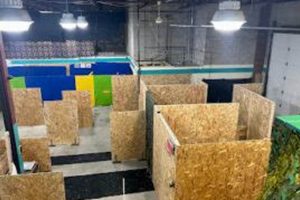
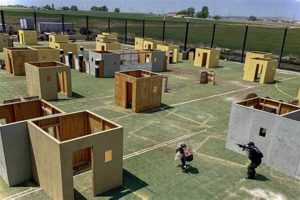
A designated outdoor area, typically on private property, modified for the recreational activity of airsoft. This involves simulated combat scenarios using realistic replica firearms that discharge plastic projectiles. For instance, a homeowner might clear a section of their yard, adding barriers and obstacles to create a miniature battlefield.
These settings offer readily accessible opportunities for practice, skill development, and casual matches. Their establishment can promote responsible firearms handling within a controlled environment and offer a localized alternative to commercial airsoft venues. Historically, creating such spaces allows enthusiasts to engage in their hobby more frequently and conveniently.
The following sections will delve into the considerations for constructing a safe and engaging example, covering topics such as design principles, safety regulations, maintenance best practices, and potential legal ramifications of creating one.
Tips for Establishing a Safe and Engaging Airsoft Environment
Careful planning and execution are paramount when creating an environment for airsoft activities. Safety should be the primary concern, followed by considerations for gameplay quality and adherence to local regulations.
Tip 1: Define Clear Boundaries: Establish the outer limits of the play area with visible markers, such as netting or brightly colored tape. This prevents participants from inadvertently straying into neighboring properties or non-designated zones. Ensure all involved understand and respect these boundaries.
Tip 2: Implement Mandatory Eye Protection: ANSI Z87.1 rated eye protection is non-negotiable. All participants, regardless of their role (player, observer), must wear appropriate safety glasses or goggles throughout the duration of the activity. Regular inspection of eye protection is recommended to ensure integrity.
Tip 3: Establish Rules of Engagement: Clearly define acceptable engagement distances and permissible firing zones. This may include minimum engagement distances to prevent close-range injuries and designated safe zones where weapons are not permitted. These rules should be communicated and enforced consistently.
Tip 4: Utilize Natural and Artificial Cover: Incorporate a mix of natural elements (trees, shrubs) and constructed obstacles (barricades, bunkers) to create a dynamic and strategic environment. The layout should provide adequate cover for maneuvering and reduce the risk of direct impacts.
Tip 5: Conduct Regular Safety Briefings: Prior to each session, conduct a thorough safety briefing covering all relevant rules, boundaries, and emergency procedures. This includes confirming all participants have appropriate safety gear and understand the potential risks involved.
Tip 6: Communicate with Neighbors: Inform adjacent property owners about the airsoft activities, including the planned schedule and safety measures in place. This can help prevent misunderstandings and address any concerns proactively.
Tip 7: Maintain a Safe Zone: Designate a specific area as a “safe zone” where airsoft weapons are unloaded, magazines are removed, and eye protection can be temporarily removed. This provides a neutral space for players to rest and communicate without the risk of accidental discharge.
Implementing these guidelines will contribute to a safer, more enjoyable, and responsible airsoft experience, minimizing potential risks and fostering a positive environment for all participants.
The subsequent section will address legal and liability considerations to ensure compliance with local regulations and protect against potential legal ramifications.
1. Safety Protocols
The operational integrity of a dedicated area for airsoft directly relies on adherence to defined procedures. The existence of a physical arena alone does not ensure a safe recreational environment. Instead, the systematic implementation and consistent enforcement of guidelines are essential. A lack of attention to established procedures inevitably leads to heightened risk, escalating the potential for both minor and serious injuries among participants. For example, consistently failing to mandate eye protection can result in severe ocular trauma, directly attributable to projectiles impacting unprotected eyes.
A structured set of precautions can prevent potential incidents before they escalate. Regular inspections of equipment, including replica firearms and protective gear, contribute to maintaining acceptable standards. Furthermore, briefings that detail regulations and emergency protocols are significant in ensuring that participants are well informed. For example, before each airsoft session in a yard, a group of airsoft player perform safety briefings for beginners for them to comply the regulations.
The inextricable link between safety protocols and designated airsoft zones underscores the critical importance of a proactive approach. Prioritizing the health and well-being of participants through strict compliance with well-defined rules mitigates liability and fosters a sustainable environment for the activity. The neglect of these processes results in increased risk and compromises the integrity of the overall experience. Therefore, safety considerations should be at the very heart of any outdoor airsoft recreational activity.
2. Boundary Definition

Effective boundary definition is a cornerstone of safe and responsible airsoft engagement within any allocated zone. The absence of clearly demarcated limits directly correlates with increased risk of accidental trespass, potential property damage, and heightened likelihood of conflict with neighbors or uninvolved parties. In the context of a dedicated recreational area on private property, unambiguous boundaries are not merely recommended; they are essential. Consider a scenario where an airsoft projectile inadvertently crosses an ill-defined perimeter and strikes a passerby or damages neighboring property. The ramifications of such an incident can range from strained community relations to legal repercussions.
The implementation of physical barriers, such as high-visibility netting or fencing, provides a visual cue that reinforces the designated limits. These barriers serve a dual purpose: preventing projectiles from exiting the play area and deterring unauthorized entry. Additionally, conspicuous signage indicating the nature of the activity and warning against entry can further enhance awareness. For example, a homeowner who designates a section of their yard may elect to use brightly colored construction tape combined with prominently displayed warning signs to prevent accidental incursion.
Ultimately, the relationship between precise limit specification and an zone for airsofting is causal. Clearly defined areas lead directly to reduced risk and enhance the overall safety and responsibility of the activity. It transforms any space into a controlled and regulated environment. Neglecting this fundamental aspect undermines the integrity of the entire operation and significantly increases the probability of adverse outcomes. An explicit limit also help in keeping track the participants of the play.
3. Obstacle Placement
The strategic arrangement of obstacles within a recreational airsoft area directly influences both safety and the quality of gameplay. Obstacle placement is not arbitrary; it is a critical component in creating a balanced and engaging environment. Insufficient or poorly positioned obstacles can lead to predictable and potentially unsafe engagement scenarios. Conversely, thoughtful obstacle design enhances tactical options, promotes player movement, and reduces the risk of static, close-quarters confrontations. A lack of cover necessitates prolonged exposure, increasing the likelihood of participants sustaining multiple projectile impacts. For instance, simply scattering a few wooden pallets haphazardly provides minimal protection and tactical advantage compared to a well-designed bunker system.
The practical application of obstacle placement principles involves considering the size and shape of the airsoft play space, the intended number of participants, and the desired style of gameplay. A smaller area may benefit from fewer, strategically positioned obstacles that force players to maneuver and engage. Larger areas can accommodate more complex layouts with varied terrain and interconnected cover systems. The materials used for obstacle construction also merit consideration. Durable, non-splintering materials are preferable to minimize the risk of injury. For example, using repurposed tires to create bunkers provides a safe and resilient alternative to flimsy wooden structures.
In conclusion, obstacle placement is integral to the functionality and enjoyment of an recreational area, and their arrangement affects how player can get cover from shooting. Proper execution requires careful planning, attention to safety, and a consideration of tactical implications. Obstacles placed in a manner that enhances the game, minimizes injury and risk. Prioritizing these objectives contributes to a more immersive, challenging, and ultimately, safer recreational experience. Without properly placed obstacles, participants of the airsoft game is at risk of being shot.
4. Legal Compliance

The establishment and operation of a recreational airsoft zone on private property are subject to various legal considerations. Understanding and adhering to relevant regulations is essential to mitigate potential legal risks and ensure responsible engagement in the activity.
- Local Ordinances
Municipalities often have ordinances regulating the discharge of projectile weapons, noise levels, and zoning restrictions that may affect the operation of an airsoft arena. Failing to comply with these ordinances can result in fines, legal action, or the forced closure of the activity. For example, some jurisdictions may prohibit the discharge of airsoft guns within certain proximity to residential areas or public spaces.
- Firearms Regulations
Although airsoft guns are not considered firearms under federal law, some states or local jurisdictions may classify them as such for regulatory purposes. This classification can trigger requirements for registration, permits, or restrictions on ownership and use. It is imperative to verify the specific legal status of airsoft guns in the relevant location.
- Nuisance Laws
Repeated or excessive noise generated by airsoft activities can constitute a nuisance under the law, particularly if it disturbs neighbors or violates noise ordinances. Operators must take measures to minimize noise pollution, such as limiting operating hours, using sound barriers, and informing neighbors of planned activities. Failure to do so can lead to complaints and legal action.
- Liability and Insurance
Operating a recreational airsoft area carries inherent risks of injury. Property owners may be held liable for injuries sustained by participants, even if they are participating voluntarily. Obtaining adequate liability insurance can help protect against potential financial losses arising from accidents or injuries. Moreover, waivers and assumption of risk agreements can provide an additional layer of protection, but their enforceability varies depending on jurisdiction.
The diverse aspects of legal compliance underscore the importance of proactive research and consultation with legal professionals to ensure adherence to all applicable laws and regulations. Ignoring these considerations can expose operators to significant legal and financial liabilities, ultimately jeopardizing the sustainability of the recreational activity. Prioritizing legal compliance is a fundamental aspect of responsible airsoft arena operation.
5. Equipment Standards
The safety and fairness of airsoft engagements within a dedicated area are intrinsically linked to adherence to defined equipment standards. The consistent application of these standards mitigates risk, promotes equitable gameplay, and prevents the exploitation of loopholes that could compromise the integrity of the experience.
- Velocity Limits
Maximum velocity limits, typically measured in feet per second (FPS) with 0.20g BBs, are critical to preventing excessive force of impact. Jurisdictions often dictate specific FPS caps to minimize the risk of injury. For example, a limit of 400 FPS with 0.20g BBs is commonly enforced for rifles to maintain a reasonable safety margin. Exceeding these limits could result in serious injury and liability issues.
- Protective Gear Requirements
Mandatory use of ANSI Z87.1 rated eye protection is paramount. Full-seal goggles or glasses designed to withstand high-impact projectiles are essential. Additional protective gear, such as face masks, mouth guards, and ear protection, can further mitigate the risk of injury, particularly in close-quarters engagements. Compliance with these standards is non-negotiable for participation.
- Airsoft Gun Restrictions
Certain types of airsoft guns may be restricted or prohibited based on their power, design, or potential for misuse. For example, fully automatic airsoft guns with excessively high rates of fire may be restricted to prevent unfair advantages or unsafe engagement scenarios. Similarly, modifications that increase the velocity or power of an airsoft gun beyond legal limits are typically prohibited.
- Ammunition Specifications
The use of appropriate ammunition is crucial for both safety and performance. Standard 6mm plastic BBs of a specified weight (typically 0.20g to 0.28g) are generally required. The use of metal BBs or other non-approved projectiles is strictly prohibited due to the increased risk of injury and potential damage to equipment. BB quality also matters; seamless BBs are more accurate and less likely to jam.
The enforcement of these equipment standards directly impacts the safety and enjoyability of the airsoft environment. Consistent inspections, chrono testing (measuring FPS), and adherence to specified equipment regulations are necessary to maintain a fair and safe playing field. The absence of these standards can lead to increased risk, unfair advantages, and ultimately, a compromised experience for all participants within the confines of this space.
6. Neighbour Communication
The establishment of a dedicated airsoft area on private property necessitates proactive communication with neighboring residents. This dialogue is not merely a courtesy; it is a preventative measure that can mitigate potential conflicts and foster positive community relations. The absence of such communication can lead to misunderstandings, complaints, and, in some cases, legal interventions. The sounds of simulated gunfire, even from airsoft weapons, can be alarming to individuals unaware of the activity. Furthermore, the presence of individuals carrying realistic-looking replica firearms, even on private property, can generate anxiety and concern among neighbors unfamiliar with the nature of airsoft.
Effective communication strategies may involve informing neighbors of the planned activity, including the frequency and duration of play sessions. Providing reassurance regarding safety protocols, such as mandatory eye protection and designated play boundaries, can alleviate concerns. Offering a point of contact for addressing any questions or concerns allows for open dialogue and prompt resolution of issues. For example, a homeowner might distribute a letter to neighboring properties outlining the nature of the airsoft activity, the safety measures in place, and contact information for any inquiries. Failure to engage in such communication can result in complaints to local authorities, strained relationships with neighbors, and potential restrictions on the operation of the recreational area.
In conclusion, proactive neighbour interaction is a critical component of responsibly operating an airsoft space. This interaction is a preventative measure to ensure the peace of the community is not disturbed. By prioritizing open communication and addressing potential concerns proactively, operators can foster a positive relationship with their neighbors and avoid potential legal or social repercussions. Such communication is not merely a courtesy, but a necessary component for maintaining the sustainability and acceptance of the activity within the community.
Frequently Asked Questions
The following questions address common inquiries and misconceptions regarding the establishment and operation of an airsoft area on private property. Answers are intended to provide clarity and promote responsible practices.
Question 1: Is a permit required to operate a backyard airsoft field?
The necessity of a permit is dependent on local ordinances and zoning regulations. Contacting the municipal government or local law enforcement agencies is crucial to determine specific requirements for discharging airsoft guns on private property and whether a permit is necessary.
Question 2: What are the minimum safety requirements for participants in a backyard airsoft field?
The minimum requirement is ANSI Z87.1 rated eye protection for all individuals present, including players and observers. Additional protective gear, such as full face masks, mouth guards, and appropriate clothing, is strongly recommended.
Question 3: How can noise complaints from neighbors be mitigated in a backyard airsoft field?
Limiting operating hours, utilizing sound barriers or natural sound dampening features, and informing neighbors of planned activity schedules can reduce noise pollution. Open communication and a willingness to address concerns can help foster positive relations with the community.
Question 4: What liability concerns exist with a backyard airsoft field?
Property owners may be held liable for injuries sustained by participants. Obtaining adequate liability insurance and requiring participants to sign waivers can provide a measure of protection, but these measures do not guarantee immunity from legal action.
Question 5: What velocity limits should be enforced for airsoft guns in a backyard airsoft field?
Velocity limits should be established based on local regulations and best safety practices. A common standard is 400 FPS with 0.20g BBs for rifles. Chronograph testing of all airsoft guns prior to use is essential to ensure compliance.
Question 6: What constitutes acceptable boundaries for a backyard airsoft field?
Boundaries should be clearly defined using physical barriers, such as netting or fencing, combined with visible signage. The boundaries must effectively prevent projectiles from exiting the designated play area and prevent unauthorized entry.
These FAQs serve as a foundational resource for navigating the complexities of creating and maintaining a responsible and compliant area on private land. Further research and consultation with legal professionals may be necessary to address specific circumstances.
The subsequent section will address modification strategies to this space.
Conclusion
The exploration of the airsoft activity within the constraints of a private property reveals a complex interplay of safety, legal, and community considerations. The responsible establishment and operation hinges on strict adherence to safety protocols, comprehensive understanding of local regulations, and consistent maintenance of open communication with neighbours. Obstacle placements, boundary definition, and equipment standards are all integral to a sustainable operational execution.
The information presented is not exhaustive and does not constitute legal advice. It serves as a starting point for diligent research and responsible decision-making for those considering creating one. Prioritizing the safety and well-being of participants and surrounding community is paramount, ensuring this space for airsoft activity remains a legal, ethical, and enjoyable recreational outlet.
![Explore the Biggest Airsoft Field: [Location] Game Zone | Ultimate Airsoft Guide for Beginners, Tactics & Gear Reviews](https://airsoftica.com/wp-content/uploads/2026/05/th-150-300x200.jpg "Explore the Biggest Airsoft Field: [Location] Game Zone Ultimate Airsoft Guide for Beginners, Tactics & Gear Reviews")
![Ultimate Guide: Best Airsoft Fields in the World [Ranked] | Ultimate Airsoft Guide for Beginners, Tactics & Gear Reviews](https://airsoftica.com/wp-content/uploads/2026/05/th-147-300x200.jpg "Ultimate Guide: Best Airsoft Fields in the World [Ranked] Ultimate Airsoft Guide for Beginners, Tactics & Gear Reviews")