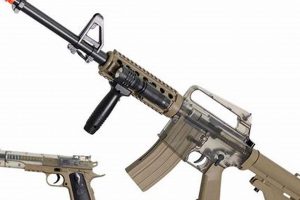
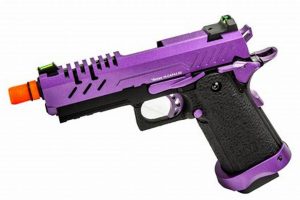
The manufacturing process of these recreational projectile devices involves a series of stages, beginning with design and material selection. Commonly, components are constructed from plastics, metals like aluminum alloys, and composite materials. These are shaped and molded using techniques such as injection molding, die-casting, and machining to create the various parts including the body, gearbox, and internal mechanisms. For example, the receiver might be made from a durable polymer to withstand impacts, while the barrel is often crafted from precision-honed metal for accuracy.
Understanding the construction provides insight into the durability, performance, and overall value of the equipment. A well-engineered product offers enhanced reliability, improved accuracy, and a more realistic simulation experience. Historically, early models were often simple spring-powered mechanisms; however, technological advancements have led to the development of gas-powered and electric-powered (AEG) systems, each with unique performance characteristics. The progression demonstrates a commitment to increased realism and enhanced gameplay.
Further examination will detail the specific processes used to create various types, including spring, gas, and electric-powered models. It will also discuss the assembly procedure, quality control measures, and common materials employed. Detailed insights into internal mechanisms, such as gearboxes, hop-up systems, and gas reservoirs, will also be provided.
Production Insights
The following outlines key considerations in the manufacturing of these recreational projectile devices, emphasizing quality and performance characteristics.
Tip 1: Material Selection is Paramount: The choice of materials directly affects the durability and weight. High-impact polymers for external components and precision-machined metals for internal mechanisms are common choices.
Tip 2: Precision in Manufacturing: Accurate dimensions and tight tolerances are crucial for proper function and air seal. Employing CNC machining ensures consistent component dimensions.
Tip 3: Gearbox Design Optimization: The gearbox is the heart of an AEG. Its design should prioritize efficient power transfer, durability, and ease of maintenance.
Tip 4: Hop-Up System Calibration: The hop-up unit influences range and accuracy. Precise adjustment mechanisms and quality bucking materials are vital for optimal performance.
Tip 5: Quality Control Implementation: Rigorous testing throughout the manufacturing process identifies potential defects early on. This includes pressure testing for gas-powered models and cycle testing for AEGs.
Tip 6: Battery and Power System Integration: For AEGs, the battery and wiring should be robust and properly insulated to prevent shorts or overheating. Battery capacity and voltage impact performance and runtime.
Tip 7: Realistic Aesthetics and Ergonomics: While functionality is key, the external design should closely resemble real firearms. Comfortable grips and intuitive controls enhance the user experience.
These insights emphasize the importance of meticulous design, precise manufacturing, and rigorous quality control in producing high-performance, reliable recreational projectile devices.
The concluding section will summarize the critical aspects and offer a perspective on future development trends within the manufacturing sphere.
1. Design blueprints

Design blueprints are foundational to the manufacturing process, serving as the comprehensive visual and technical guide for producing airsoft guns. These blueprints dictate the precise dimensions, materials, and operational mechanisms of each component and the final assembled product, thereby directly influencing the functionality and performance of the completed airsoft gun.
- Dimensional Accuracy and Tolerances
Design blueprints specify the precise dimensions and acceptable tolerances for each part. Adherence to these specifications ensures that components fit together correctly and function as intended. For example, the dimensions of the cylinder in a gas blowback system must be precise to maintain proper air seal and gas pressure for consistent performance. Failure to adhere to these tolerances can result in malfunctions or reduced efficiency.
- Material Specifications
Blueprints detail the materials to be used for each component, taking into consideration factors such as durability, weight, and cost. The gearbox casing, for instance, may require a high-strength metal alloy to withstand repeated stress from the gears, while the external body could be molded from a durable polymer for impact resistance and reduced weight. These material choices directly impact the longevity and user experience.
- Internal Mechanism Schematics
The blueprints provide detailed schematics of the internal mechanisms, including the gear ratios in AEGs, the gas flow pathways in gas-powered models, and the spring compression systems in spring-powered devices. These schematics dictate how the airsoft gun operates, including its firing rate, power output, and overall efficiency. A well-designed internal mechanism, accurately depicted in the blueprints, is crucial for optimal performance.
- Assembly Instructions and Component Integration
The design blueprints also outline the assembly process, indicating the correct order of operations and the methods for connecting components. This includes details such as the torque specifications for screws, the alignment of gears within the gearbox, and the proper installation of the hop-up unit. Correct adherence to these instructions is vital for ensuring that the airsoft gun functions reliably and safely.
In summary, design blueprints serve as the central document guiding the creation of airsoft guns. Their precision in defining dimensions, materials, internal mechanisms, and assembly processes directly affects the final product’s quality and functionality. Any deviation from these blueprints can lead to performance issues or compromised durability, underscoring the significance of accurate and comprehensive design documentation in manufacturing.
2. Material Selection

The selection of materials is a pivotal decision in the manufacturing process. It directly dictates the durability, performance characteristics, weight, and overall cost. The interplay between these factors necessitates a careful balance to achieve a desirable final product.
- Impact Resistance and Durability
The external components, such as the body and stock, frequently encounter impacts. Therefore, high-impact polymers like ABS or nylon-reinforced plastics are often chosen. These materials provide significant resistance to cracking and breaking, ensuring longevity. Conversely, internal components exposed to stress, such as gears and pistons, might utilize hardened steel or aluminum alloys to withstand wear and tear. The selection must align with the operational demands of the component.
- Precision and Accuracy
Components directly influencing projectile trajectory require dimensionally stable materials. Barrels are commonly constructed from brass or aluminum. These metals maintain precise internal diameters and resist deformation, contributing to consistent accuracy. The hop-up bucking, responsible for imparting backspin, often utilizes specialized rubber compounds or silicone. These materials offer the necessary grip and elasticity to effectively engage the BB.
- Weight Considerations
The weight of the final product significantly affects user comfort and maneuverability. Balancing durability with weight requires judicious material selection. Aluminum alloys are frequently used in receivers and other structural components to provide strength without excessive weight. Polymer components further contribute to weight reduction. The distribution of weight also plays a role; heavier components might be concentrated in areas that enhance stability, while lighter materials are employed elsewhere to minimize fatigue.
- Cost and Manufacturing Feasibility
Material cost is a significant factor in determining the overall price point. While high-performance materials may offer superior characteristics, they can substantially increase manufacturing expenses. Polymers are generally more cost-effective than metals, making them attractive for mass production. Furthermore, the ease of manufacturing influences material selection. Materials that readily lend themselves to injection molding or die-casting processes can reduce production time and complexity.
These considerations collectively illustrate the importance of material selection within the manufacturing process. A compromise, balancing performance, durability, weight, and cost is required to create an airsoft device that meets market demands. These choices inform not only the product’s lifespan and reliability but also its competitiveness within the broader market.
3. Precision machining

Precision machining plays a critical role in the creation of airsoft guns. Its direct effect lies in enabling the manufacturing of components with the tight tolerances necessary for proper function and performance. Without precision machining, achieving the required level of accuracy and consistency in critical parts would be impossible, consequently impacting the overall reliability and realism of the recreational device. For instance, the internal bore of the barrel, responsible for guiding the projectile, necessitates exacting dimensions to ensure consistent air seal and projectile velocity. Any deviation in the barrel’s internal diameter can lead to erratic shots and diminished range. Similarly, the intricate gears within an automatic electric gun (AEG) gearbox demand precise tooth profiles to ensure smooth power transmission and minimize wear. These gears must mesh perfectly to prevent jamming and optimize firing rate.
Further illustrating this connection, the manufacturing of gas blowback (GBB) pistol components relies heavily on precision machining. The gas nozzle, responsible for delivering propellant to the BB, requires intricate channels and precisely machined sealing surfaces to prevent gas leaks and maintain consistent blowback action. Likewise, the hop-up unit, which imparts backspin on the BB to increase range, relies on precisely machined adjustment mechanisms to allow users to fine-tune the amount of backspin applied. The accuracy of these adjustments directly affects the effective range and accuracy of the airsoft gun. These examples highlight that precision machining is not merely a manufacturing step but an integral element directly influencing the practical application of airsoft technology.
In summary, precision machining is indispensable for the production of airsoft guns. It ensures that critical components meet the exacting specifications required for optimal performance and reliability. Challenges remain in maintaining cost-effectiveness while achieving increasingly tight tolerances. Understanding the significance of precision machining is fundamental to appreciating the engineering and manufacturing expertise that goes into producing high-quality recreational projectile devices. This understanding also extends to appreciating the need for quality control and maintenance in sustaining the device’s functionality over its lifespan.
4. Gearbox assembly

Gearbox assembly is a critical stage in the overall process, especially for Automatic Electric Guns (AEGs). It directly influences the performance, reliability, and longevity of the airsoft gun. The precision and correctness of this process are essential for achieving optimal functionality.
- Component Integration and Alignment
The gearbox contains various components, including gears, pistons, springs, and tappet plates. Proper integration and precise alignment of these components are crucial for efficient power transmission and smooth operation. For example, misaligned gears can cause increased friction, leading to premature wear and reduced firing rate. Conversely, a correctly assembled gearbox ensures optimal energy transfer from the motor to the piston, resulting in consistent and reliable performance. Proper alignment also reduces the risk of mechanical failures during operation.
- Lubrication and Friction Reduction
Lubrication is an integral aspect of the gearbox assembly process. Applying the correct type and amount of lubricant to the gears and other moving parts minimizes friction and reduces wear. Insufficient lubrication can lead to overheating and component failure, while excessive lubrication can attract dirt and debris, hindering performance. Therefore, careful application of high-quality grease is necessary to ensure smooth and efficient operation over an extended period.
- Motor Compatibility and Installation
The motor provides the power source for the gearbox. Ensuring compatibility between the motor and the gearbox is essential for optimal performance. Correct installation, including proper shimming and alignment, prevents undue stress on the motor and gears. An improperly installed motor can lead to increased power consumption, reduced firing rate, and potential motor failure. Therefore, careful attention to motor compatibility and installation is paramount during the assembly process.
- Sealing and Air Compression
Within the gearbox, efficient air compression is vital for propelling the BB with sufficient force. Achieving proper sealing between the piston head, cylinder, and nozzle is crucial for maximizing air volume and pressure. Any air leaks can result in reduced muzzle velocity and inconsistent performance. Careful selection of O-rings and proper installation techniques are essential to ensure a tight seal and optimize air compression.
The successful assembly of the gearbox is a lynchpin to the entire manufacturing process. Each step, from component alignment to lubrication, directly impacts the functionality and long-term reliability of the equipment. Without a properly assembled gearbox, the recreational device cannot perform as intended, highlighting the importance of skilled technicians and meticulous procedures in this phase of production.
5. Hop-up system

The hop-up system is an integral component in the manufacturing of airsoft guns, significantly affecting projectile range and accuracy. This system imparts backspin to the BB as it exits the barrel. The backspin creates a Magnus force, counteracting gravity and extending the projectile’s flight path. Without a functional hop-up, BB trajectories would be severely limited, rendering the devices far less effective in simulating realistic combat scenarios. Therefore, the design, materials, and precise assembly of the hop-up unit are critical considerations during the entire production process.
The manufacturing process involves several key steps that directly influence the effectiveness of the hop-up system. These include the creation of a precise contact surface often a rubber bucking that applies the backspin. The consistency of this surface is vital; imperfections can lead to inconsistent shot trajectories. Additionally, the design of the adjustment mechanism, allowing users to modify the amount of backspin, requires precision engineering. Materials must withstand repeated use and maintain dimensional stability. For instance, a poorly designed adjustment mechanism can lead to slippage, rendering the hop-up ineffective. Furthermore, the integration of the hop-up unit within the overall airsoft gun design necessitates careful consideration of barrel alignment and air seal. An imperfect seal can reduce the efficiency of the hop-up and diminish performance. Examples can be seen in high-end models using adjustable rotary hop-up units with numerical markings for repeatable tuning, contrasting with simpler, less precise designs that rely on friction screws.
In conclusion, the hop-up system’s design and construction are fundamentally linked to the broader manufacturing processes. Achieving optimal range and accuracy is contingent upon meticulous attention to detail during each stage, from material selection to final assembly and quality control. Challenges remain in balancing cost-effectiveness with performance, leading to variations in hop-up designs across different models and price points. However, the understanding of the hop-up’s role and its impact on overall performance remains a cornerstone of modern production techniques, contributing significantly to the realism and enjoyment provided by airsoft activities.
6. Quality control

Quality control is an indispensable component of the manufacturing process, directly impacting the reliability, performance, and safety of the finished product. Rigorous implementation of quality control measures throughout production minimizes defects, ensures adherence to design specifications, and ultimately contributes to customer satisfaction.
- Material Inspection and Verification
The initial stage of quality control involves verifying the conformity of raw materials to established standards. This includes assessing the physical properties, chemical composition, and dimensional accuracy of plastics, metals, and other components. For example, tensile strength testing on polymer receivers ensures resistance to fracture under stress, while spectrographic analysis of metal alloys confirms adherence to specified compositions. Non-conforming materials are rejected, preventing potential defects from entering the production stream.
- Dimensional Accuracy Checks
Throughout the machining and assembly phases, dimensional accuracy checks are performed to ensure that components meet design tolerances. This often involves the use of calibrated measuring instruments, such as calipers, micrometers, and coordinate measuring machines (CMMs). For instance, the bore diameter of a barrel is meticulously measured to ensure consistent projectile velocity and accuracy. Similarly, the dimensions of gearbox components are checked to prevent binding and ensure smooth operation. Components failing to meet specified tolerances are either reworked or discarded.
- Functional Testing and Performance Evaluation
Functional testing is conducted on sub-assemblies and finished products to assess their operational characteristics. This may involve pressure testing gas-powered models to detect leaks, cycle testing automatic electric guns (AEGs) to evaluate motor and gearbox durability, and velocity testing to ensure adherence to regulatory limits. Performance evaluation assesses parameters such as firing rate, accuracy, and range. Deviations from expected performance trigger diagnostic procedures to identify and correct underlying issues.
- Safety Compliance and Regulatory Adherence
A critical aspect involves ensuring compliance with relevant safety standards and regulations. This may include testing for lead content in materials, verifying compliance with marking requirements, and assessing the safety of battery charging systems in AEGs. Products failing to meet safety standards are redesigned or modified to ensure compliance before being released to market. Documentation of testing procedures and results is essential for demonstrating adherence to regulatory requirements.
These quality control facets collectively contribute to the creation of recreational projectile devices that meet established performance, reliability, and safety standards. By rigorously monitoring and verifying each stage of production, manufacturers can minimize defects, enhance product quality, and ensure customer satisfaction, ultimately influencing the reputation and market competitiveness of the brand. The effectiveness of the quality control system directly correlates with the overall quality and performance.
7. Final assembly
Final assembly represents the culmination of all prior manufacturing stages, solidifying the transformation of individual components into a functional airsoft gun. This phase is paramount, as any errors or inconsistencies introduced during assembly can negate the quality achieved in earlier processes, directly affecting the device’s performance and reliability.
- Component Integration and Alignment
The correct integration and alignment of all internal and external parts is crucial. The gearbox, hop-up unit, barrel, and external body must be precisely fitted to ensure proper functionality. Misalignment can lead to reduced performance, increased wear, or even complete failure. For example, a misaligned hop-up unit will result in inconsistent backspin, negatively impacting accuracy and range. Correct assembly ensures that each component functions harmoniously within the complete system.
- Electrical Wiring and Connections
For automatic electric guns (AEGs), the final assembly involves connecting the motor, battery, and trigger switch via a network of electrical wiring. Correct polarity, secure connections, and proper insulation are essential to prevent short circuits or malfunctions. Inadequate wiring can lead to reduced firing rate, overheating, or complete failure of the electrical system. Quality control checks at this stage ensure that all connections are robust and reliable.
- Lubrication and Sealing
Final assembly often involves applying lubricant to specific moving parts to reduce friction and ensure smooth operation. This is particularly important for components within the gearbox and the gas delivery system of gas-powered models. Additionally, proper sealing of air pathways is crucial to maintain consistent pressure and maximize performance. Inadequate lubrication or sealing can result in reduced power, inconsistent velocity, and premature wear.
- External Finishing and Aesthetics
The final assembly also encompasses the application of external finishes and aesthetic details. This may include attaching sights, grips, stocks, and other accessories. The quality of the finish, the fit and finish of external components, and the overall aesthetic appeal contribute to the user’s perception of quality and realism. Scratches, imperfections, or misaligned parts can detract from the overall value and user experience.
These elements demonstrate how final assembly serves as the critical integration point, influencing the overall quality and functionality. It is the stage where the design blueprint becomes a tangible and operational product. The success of this stage determines whether the airsoft gun performs as intended and meets the expectations of the end-user, thereby linking directly back to the entire concept of creating the device from initial design to completed recreational product.
Frequently Asked Questions
This section addresses common inquiries regarding the construction of these recreational projectile devices, providing factual and concise information.
Question 1: What are the primary materials utilized in construction?
Construction typically involves a combination of high-impact polymers for external components and metal alloys, such as aluminum, for internal mechanisms. The specific materials depend on the device’s intended performance and price point.
Question 2: Is precision machining necessary, and why?
Precision machining is essential for critical components, such as barrels and gearbox internals. It ensures tight tolerances, which are necessary for consistent performance, air seal, and overall reliability.
Question 3: How does the gearbox assembly process impact AEG performance?
The gearbox assembly directly influences the AEG’s firing rate, power, and reliability. Proper component alignment, lubrication, and motor compatibility are vital for optimal functionality.
Question 4: What role does the hop-up system play, and how is it manufactured?
The hop-up system imparts backspin to the projectile, increasing range and accuracy. Its manufacturing involves precise molding of the bucking and careful design of the adjustment mechanism.
Question 5: What quality control measures are implemented during manufacturing?
Quality control encompasses material inspection, dimensional accuracy checks, functional testing, and safety compliance assessments. These measures aim to minimize defects and ensure adherence to specifications.
Question 6: Can variations in the manufacturing process affect device performance?
Yes. Deviations from established manufacturing protocols, particularly in material selection, machining precision, and assembly procedures, can significantly impact performance, durability, and overall reliability.
Understanding the manufacturing processes provides insights into the design, construction, and functional capabilities of these recreational devices.
The next section will explore emerging trends and future developments in airsoft device manufacturing technologies.
Conclusion
The investigation into the construction of these recreational projectile devices has revealed a multifaceted process that demands precision, adherence to specifications, and rigorous quality control. From initial design blueprints and material selection to precision machining, gearbox assembly, and hop-up system integration, each stage contributes critically to the functionality and reliability of the final product. Effective quality control protocols ensure that safety standards are met and performance expectations are achieved, while skillful final assembly guarantees the seamless integration of all components.
Continued advancements in material science, manufacturing techniques, and design methodologies will likely shape the future of how these devices are made. Further research and adherence to stringent production standards are crucial for maintaining product quality and enhancing the user experience. As technology evolves, a commitment to innovation and responsible manufacturing practices is essential for this industry.