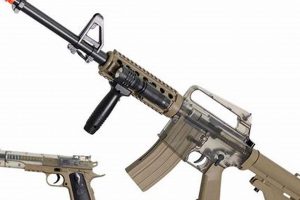
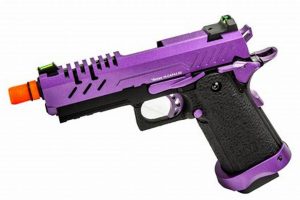
These devices represent a foundational technology in the realm of airsoft weaponry. They operate on a simple mechanical principle: a spring is compressed, and upon release, it propels a piston that forces air through a barrel, discharging a projectile. A common example is the single-shot rifle, which requires manual cocking before each firing sequence.
Their significance lies in their affordability and simplicity. Requiring no batteries or gas, they offer a readily accessible entry point into the sport, often appealing to novice players. Historically, such mechanisms have provided a cost-effective means for target practice and recreational shooting, allowing wider participation without the expenses associated with more complex propulsion systems.
The following sections will delve into the mechanisms, performance characteristics, and maintenance aspects of these airsoft devices, offering a detailed examination of their operation and suitability for various airsoft scenarios.
Optimizing Performance and Longevity
The following tips provide guidance on maximizing the operational effectiveness and extending the lifespan of these devices. Adherence to these practices ensures consistent performance and minimizes potential issues.
Tip 1: Use High-Quality Ammunition: Employing standard-grade plastic projectiles can lead to inconsistencies in trajectory and potential damage to the internal barrel. Opt for precision-grade BBs to ensure optimal accuracy and minimize wear.
Tip 2: Maintain Consistent Cocking Technique: A smooth, deliberate cocking motion prevents premature wear on the spring and piston. Avoid forceful or jerky movements, as these can compromise the internal mechanism’s integrity.
Tip 3: Store Uncocked When Not in Use: Leaving the spring compressed for extended periods can reduce its power over time. Always decock the device after use to prolong the spring’s lifespan and maintain consistent performance.
Tip 4: Regularly Clean the Barrel: Debris and residue accumulation within the barrel can impede projectile velocity and accuracy. Utilize a cleaning rod and appropriate solvent to maintain a clean, unobstructed bore.
Tip 5: Lubricate Internal Components Sparingly: Applying a small amount of silicone-based lubricant to the piston and cylinder helps reduce friction and improve performance. Over-lubrication should be avoided, as it can attract dust and debris.
Tip 6: Inspect for Wear and Tear: Periodically examine the piston head, spring guide, and trigger mechanism for signs of wear or damage. Addressing minor issues promptly prevents more significant problems from developing.
Consistent application of these techniques will ensure reliable and enduring operation. Proper care and maintenance are crucial for maximizing the value and enjoyment derived from these airsoft devices.
The subsequent sections will address troubleshooting common issues, offering practical solutions for maintaining peak operational status.
1. Simple Mechanical Action
The operation hinges on a direct cause-and-effect relationship. Manual force compresses a spring, storing potential energy. Releasing the spring causes a piston to move forward, creating an air pressure that propels a projectile. This uncomplicated design contributes to the affordability and reliability.
The “Simple Mechanical Action” is essential. The lack of intricate electrical components or gas systems reduces the likelihood of malfunction and simplifies maintenance. A notable example is its frequent use in introductory airsoft packages, where the emphasis is on ease of use and affordability rather than advanced features.
Understanding the underlying mechanism directly translates to practical benefits. Users can readily diagnose and address basic issues, such as a worn spring or a misaligned piston, without requiring specialized tools or expertise. The simplicity facilitates widespread accessibility and provides a foundational understanding of airsoft weaponry.
2. Low Initial Cost

The affordable price point of spring-powered airsoft devices stems from their simplified mechanical design and manufacturing processes. A reduced number of components and the absence of complex systems like gas reservoirs or electronic triggers significantly lowers production costs. This translates directly to a lower retail price, making these devices accessible to a wider audience, particularly newcomers to the sport or those on a limited budget. For example, a fully functional spring-powered rifle can often be purchased for a fraction of the cost of a comparable gas-powered or electric model.
The low initial cost has several practical implications. It facilitates entry into the airsoft hobby, allowing individuals to try the sport without a significant financial investment. Furthermore, the affordability makes these devices suitable for recreational use, target practice, or as introductory tools for teaching gun safety. For instance, youth groups or scout troops might utilize spring-powered airsoft guns for supervised marksmanship activities due to their low cost and reduced risk compared to other types of airguns.
In summary, the low initial cost is a defining characteristic that shapes the accessibility and application of spring-powered airsoft devices. While limitations exist in terms of performance and customization compared to more advanced systems, the affordability ensures a wide availability and positions these devices as a foundational element within the broader airsoft ecosystem. This attribute makes them a viable option for beginners, casual users, and organizations seeking cost-effective training tools.
3. Single-Shot Operation

Single-shot operation is a defining characteristic that significantly influences the usage and perceived value of spring-powered airsoft guns. This operational mode directly impacts rate of fire, tactical application, and user experience, shaping the overall suitability of these devices for various airsoft scenarios.
- Manual Recocking Requirement
Each firing sequence necessitates manual recocking of the spring mechanism. This action directly impacts the rate of fire, significantly reducing it compared to automatic or semi-automatic airsoft guns. The manual cocking motion introduces a delay between shots, affecting tactical engagement strategies. An example is the need for careful aiming and deliberate shot placement, as follow-up shots are not immediately available.
- Emphasis on Accuracy
The inherent limitation of single-shot operation often encourages a focus on accuracy. With each shot requiring individual effort, users tend to prioritize precision aiming and controlled firing techniques. For instance, a sniper role, where calculated shots are more valuable than rapid fire, aligns well with this operational constraint.
- Simplified Internal Mechanisms
Single-shot operation contributes to the simplicity of the internal mechanisms. The absence of complex automatic firing systems reduces the number of moving parts, enhancing reliability and easing maintenance procedures. This simplicity also contributes to the lower cost associated with spring-powered airsoft guns.
- Training and Skill Development
The need for manual recocking can be beneficial for training purposes, particularly for novice airsoft players. It promotes a greater understanding of firearm mechanics and fosters discipline in shot placement. For example, practicing with a single-shot spring-powered airsoft gun can improve trigger control and aiming skills, which can then be transferred to more advanced airsoft platforms.
In conclusion, the single-shot operational mode is an integral aspect that defines the performance characteristics of spring-powered airsoft guns. While it restricts the rate of fire, it simultaneously encourages accuracy, simplifies internal mechanisms, and provides a valuable tool for skill development. The suitability of this operational mode is largely dependent on the intended use case, with single-shot spring-powered airsoft guns often finding their niche in training exercises, target practice, or scenarios where precision is paramount.
4. Manual Cocking Required
The necessity of manual cocking is an intrinsic element of spring-powered airsoft guns, representing a direct consequence of their operating mechanism. The manual action serves as the sole method of compressing the internal spring, which, upon release, generates the propulsive force for discharging the projectile. The absence of automated or gas-assisted mechanisms mandates this physical intervention for each shot, thereby establishing a fundamental operational characteristic.
The significance of manual cocking extends beyond simple operation. It dictates the rate of fire, limiting it to the speed at which the user can manually compress the spring. This limitation influences tactical considerations during airsoft gameplay, emphasizing precision and deliberate shot placement over rapid-fire engagements. A practical example is the sniper role, where the deliberate pace imposed by manual cocking aligns with the need for accuracy and concealment. Furthermore, the manual action promotes a deeper understanding of the firearm’s mechanics, offering a tangible connection to the firing process absent in more automated systems. This is often beneficial in training scenarios, where the emphasis is on developing fundamental marksmanship skills.
In summary, manual cocking is not merely a required action but a defining characteristic of spring-powered airsoft guns. It shapes the operational parameters, influences tactical applications, and fosters a direct engagement with the mechanical process of firing. While the limitation on rate of fire presents a challenge in certain scenarios, the simplicity and control offered by manual cocking contribute to the unique appeal and practical utility of these airsoft devices, particularly for beginners and those prioritizing accuracy over speed.
5. Limited Upgrade Potential
The inherent design of spring-powered airsoft guns imposes constraints on their ability to be extensively modified or enhanced. This characteristic arises from the simplicity of their internal mechanisms and the limitations of the materials typically used in their construction. As such, the degree to which performance can be improved through aftermarket parts or modifications is significantly restricted compared to gas-powered or electric airsoft guns.
- Basic Component Design
Spring-powered airsoft guns typically employ a straightforward piston and spring system. While aftermarket springs with varying strengths are available, the gains in power are often marginal and can strain the other components, leading to premature wear or failure. For example, installing a stronger spring may increase projectile velocity, but it can also damage the piston head or trigger sear, negating any performance benefits.
- Material Limitations
The materials used in the construction of spring-powered airsoft guns, often lower-grade plastics and metals, are not designed to withstand the stresses of significant performance enhancements. Attempting to increase the power output beyond a certain point can lead to component breakage or deformation. This is particularly relevant in the context of piston heads and cylinders, where increased stress can result in cracks or complete failure.
- Compatibility Issues
Aftermarket parts designed for gas-powered or electric airsoft guns are generally incompatible with spring-powered models due to differences in internal dimensions and mounting configurations. This lack of cross-compatibility limits the availability of upgrade options specifically tailored to spring-powered airsoft guns. For instance, a high-performance hop-up unit designed for an electric airsoft rifle will not typically fit or function correctly in a spring-powered counterpart.
- Diminishing Returns
Even with the available upgrade options, the performance gains achieved are often incremental and may not justify the cost or effort involved. The overall design limitations of spring-powered airsoft guns inherently restrict the extent to which their performance can be improved. As an illustration, upgrading the spring and piston head may result in a modest increase in projectile velocity, but it will likely not transform the gun into a competitive airsoft platform suitable for high-intensity games.
The limited upgrade potential of spring-powered airsoft guns is a crucial consideration for potential buyers. While these devices offer affordability and simplicity, those seeking extensive customization and performance enhancement are generally better served by exploring gas-powered or electric alternatives. The inherent design constraints and material limitations dictate that spring-powered airsoft guns are best suited for entry-level use, target practice, or scenarios where simplicity and reliability are prioritized over maximum performance.
Frequently Asked Questions About Spring Powered Airsoft Guns
The following addresses common inquiries regarding spring powered airsoft guns. The information provided aims to clarify operational characteristics, performance expectations, and maintenance requirements.
Question 1: What is the effective range of a spring powered airsoft gun?
The effective range is typically limited to 50-80 feet. Factors such as spring strength, projectile weight, and wind conditions significantly influence the achievable distance. Precision aiming becomes increasingly challenging beyond this range.
Question 2: How does the power of a spring powered airsoft gun compare to other types?
The power, measured in feet per second (FPS), is generally lower than that of gas or electric airsoft guns. Most spring-powered models fire projectiles at velocities ranging from 200 to 350 FPS, making them suitable for close-range target practice but less competitive in long-range engagements.
Question 3: What type of maintenance is required for a spring powered airsoft gun?
Regular cleaning of the barrel and occasional lubrication of the piston are essential. Disassembling the gun for thorough cleaning and inspection is recommended periodically. The spring should be replaced if a noticeable decrease in power is observed.
Question 4: Can a spring powered airsoft gun be upgraded for increased performance?
Upgrade options are limited compared to gas or electric models. While stronger springs and improved pistons are available, the gains are often marginal. The basic design and construction materials restrict the extent to which performance can be enhanced.
Question 5: Are spring powered airsoft guns suitable for competitive airsoft games?
They are generally not recommended for competitive games due to their single-shot operation and limited range. The manual cocking requirement significantly reduces the rate of fire, placing users at a disadvantage against opponents with automatic or semi-automatic weapons.
Question 6: What are the safety precautions when using a spring powered airsoft gun?
Eye protection is mandatory at all times. The gun should always be treated as if it is loaded, and the muzzle should never be pointed at a person or animal. Safe handling practices and adherence to local regulations are paramount.
The information provided underscores the defining characteristics and operational considerations associated with these devices. A comprehensive understanding of these aspects is crucial for safe and effective utilization.
The following section will explore the regulatory landscape surrounding airsoft activities, providing insights into legal considerations and responsible participation.
Spring Powered Airsoft Guns
This exploration has elucidated the defining characteristics of spring powered airsoft guns, encompassing their operational simplicity, limitations in upgrade potential, and suitability for specific applications. Their accessibility and foundational nature within the broader airsoft landscape have been established. The inherent restrictions regarding range, rate of fire, and customization necessitate a realistic understanding of their capabilities and intended use cases. Acknowledging these factors allows for informed decision-making regarding their appropriateness for individual needs and scenarios.
Ultimately, the responsible and informed use of spring powered airsoft guns is paramount. Prioritizing safety, adhering to legal regulations, and recognizing their performance limitations are essential for both individual users and the broader airsoft community. Continued awareness and diligent application of the knowledge presented herein will contribute to the safe and ethical enjoyment of this particular category of airsoft device.