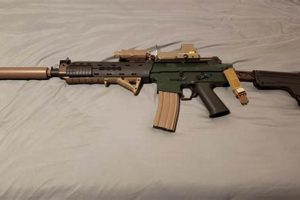
The core function relies on specialized projectiles and an illuminating device. Specifically, these devices operate by exposing tracer BBs to a burst of intense light as they pass through the unit. The BBs are manufactured with a phosphorescent coating that absorbs this light energy, causing them to glow brightly in the dark as they travel downrange. This phenomenon creates a visible trajectory, allowing players to track their shots in low-light conditions. A typical tracer BB, when activated, emits a noticeable green or red light, depending on the coating.
The primary advantage of using such systems is enhanced accuracy and target acquisition during nighttime or indoor scenarios. The illuminated path allows users to adjust their aim in real-time, improving hit probability and providing a more immersive experience. Historically, similar technologies have been employed in military applications for targeting purposes, demonstrating their practical value in low-visibility environments. The use of these units adds a tactical dimension to airsoft, improving strategic decision-making.
The following sections will delve into the specific components, operational principles, and maintenance considerations related to these illuminating airsoft accessories. The illumination technology, power sources, and installation procedures are examined in detail. Furthermore, different types and their specific usages are considered.
Enhancing Airsoft Performance
The following recommendations are intended to optimize the employment of tracer units in airsoft applications, maximizing their effectiveness and longevity.
Tip 1: Select the Appropriate BB Weight: Ensure the BB weight is suitable for both the airsoft replica and the tracer unit. Lighter BBs may not reliably activate the unit’s illumination mechanism, while heavier BBs could affect trajectory. Conduct testing to determine optimal BB weight for consistent performance.
Tip 2: Maintain Battery Charge: Regular charging of the tracer unit’s battery is crucial. A depleted battery results in diminished illumination and reduced visibility. Adhere to the manufacturer’s guidelines regarding charging cycles and storage practices.
Tip 3: Clean the Lens Regularly: Dust, debris, and residue can accumulate on the unit’s lens, hindering light transmission and affecting the brightness of the tracer BBs. Use a soft, lint-free cloth to clean the lens regularly, ensuring optimal clarity.
Tip 4: Secure Proper Mounting: Verify the tracer unit is securely mounted to the airsoft replica. A loose connection can lead to misalignment and inconsistent illumination. Use appropriate mounting hardware and ensure a stable attachment.
Tip 5: Employ Quality Tracer BBs: The performance relies on the quality of the tracer BBs. Use BBs specifically designed for use with these units, as they are manufactured with the correct phosphorescent compounds. Avoid using standard BBs, as they will not illuminate.
Tip 6: Adapt to Environmental Conditions: The effectiveness is dependent on ambient light levels. In very dark environments, the illumination will be more pronounced. Adjust tactics accordingly to leverage the enhanced visibility.
Tip 7: Understand Unit Compatibility: Not all airsoft replicas are compatible with every tracer unit. Research and confirm compatibility before purchase to avoid potential issues with fitment or operation.
Implementing these suggestions enhances the functionality and reliability of the illumination accessory, providing improved target tracking and accuracy during low-light engagements.
The subsequent segments will offer a comprehensive analysis on troubleshooting common problems and ensure its optimal functionality.
1. Illumination Source

The illumination source is a fundamental component, directly affecting its functionality. It serves as the engine that enables specialized BBs to glow in dark conditions, making their trajectory visible to the user. Typically, this source consists of one or more high-intensity light-emitting diodes (LEDs) positioned within the unit’s housing. The wavelength of light emitted is carefully selected to match the excitation spectrum of the phosphorescent material embedded in the tracer BBs. Without a properly functioning light source, the BBs would not illuminate, rendering the unit ineffective. For instance, if the LEDs fail, the unit cannot charge the BBs, negating the advantage of tracing shots in low-light environments. This reliance highlights the illumination source’s indispensable role in the overall operation.
Different types of illumination sources impact overall performance. High-powered LEDs generally provide brighter and more consistent illumination, leading to increased visibility. Certain units incorporate ultraviolet (UV) LEDs, which are particularly effective at exciting specific phosphorescent compounds. Furthermore, the design of the illumination chamber influences the uniformity of light distribution across the BB as it passes through. An optimized chamber ensures that the BB is evenly illuminated, maximizing its glow and visibility. An example is a system with multiple LEDs strategically positioned to bathe the BB in light from all angles, preventing dark spots and ensuring a brighter, more consistent trace.
In conclusion, the illumination source is not merely an accessory but a critical element that dictates its performance and effectiveness. Proper selection, maintenance, and understanding of the illumination source’s characteristics are paramount to maximizing the benefits of using such a system. Addressing any issues related to the illumination source is crucial for its continued operation and utility in providing enhanced visibility during low-light airsoft engagements.
2. Phosphorescent BBs
The functionality is intrinsically linked to the specialized projectiles utilized: phosphorescent BBs. These are not standard airsoft BBs; rather, they are manufactured with a coating of phosphorescent material. This coating exhibits the property of absorbing photons of a specific wavelength and then re-emitting light over a period, resulting in a visible glow. Consequently, the tracer unit itself serves as the energizing component, providing the necessary light source to activate the phosphorescent properties of these specialized BBs. Without phosphorescent BBs, the unit would be unable to produce the desired tracing effect; it would merely be a flashlight attachment.
The practical application underscores their significance. Consider a scenario within a dark, indoor arena. Standard BBs are nearly impossible to track, rendering aimed fire largely guesswork. However, when paired with a tracer unit, the phosphorescent BBs emit a visible trail, enabling users to observe the trajectory of their shots and adjust their aim in real-time. Furthermore, the quality and composition of the phosphorescent material directly affect the brightness and duration of the glow. Premium BBs utilize advanced compounds that offer superior luminescence compared to lower-quality alternatives. For example, BBs designed for use with UV tracer units contain specific phosphors optimized for excitation by ultraviolet light, producing a more intense and persistent glow.
In summary, phosphorescent BBs are an indispensable element, enabling the functionality. The tracer unit functions as an activator, while the BBs are the medium through which the tracing effect is realized. Understanding this relationship is crucial for optimizing performance and ensuring the system operates as intended. The type of phosphor used dictates performance and therefore the understanding of the technology behind the BBs are important. Ultimately, this symbiotic relationship enables enhanced target acquisition and improved accuracy during low-light airsoft engagements.
3. Activation Mechanism

The activation mechanism is an integral component, bridging the gap between projectile movement and illumination. Its design and function directly impact the efficiency and reliability of the system.
- Optical Sensors
Optical sensors, typically infrared or photoelectric, detect the passage of a BB through the unit. When a BB interrupts the sensor’s beam, the system triggers the illumination source. For instance, a sensor might detect the BB entering the chamber and initiate a burst of UV light, causing the BB’s coating to phosphoresce. Failure of the optical sensor results in a non-illuminated projectile, negating the benefits of the system.
- Mechanical Triggers
Some designs employ mechanical triggers, where a physical switch is activated by the BB’s movement. This trigger completes an electrical circuit, activating the illumination. An example includes a small lever that is depressed by the BB as it passes through, completing the circuit and activating the LEDs. While potentially more robust than optical sensors, mechanical triggers can introduce friction and potentially affect BB trajectory.
- Delay Circuits
Regardless of the trigger type, a delay circuit is often incorporated to synchronize the illumination with the BB’s position. This circuit controls the duration and timing of the light burst, ensuring that the BB is adequately illuminated as it exits the barrel. A poorly calibrated delay circuit can result in premature or delayed illumination, reducing the effectiveness of the tracer effect.
- Power Management
The activation mechanism also manages power consumption. It ensures that the illumination source is only active when a BB is present, conserving battery life. In some units, sophisticated power management systems can detect inactivity and enter a sleep mode, further extending battery duration. Inefficient power management leads to frequent battery replacements and diminishes the practicality in extended operations.
In summation, the activation mechanism is central to its operation. It is responsible for accurately detecting projectile movement and initiating the illumination sequence. The efficiency and reliability of this mechanism directly translate to the overall performance and usability of the unit, making it a crucial element for users seeking enhanced target visibility in low-light airsoft scenarios.
4. Power Supply
The power supply is a critical and enabling element, directly dictating operational capability. It provides the electrical energy required to activate the illumination source, which in turn causes tracer BBs to glow. Without a functional power supply, the system remains inert, rendering its intended purpose unattainable. The relationship between the power supply and its function is direct: the electrical energy it provides is the prime mover, fueling the entire process. For example, depleted batteries or a faulty wiring connection within the power supply circuit immediately disable the light emission, resulting in an inability to trace BBs during nighttime or low-light engagements. The choice of power supply, whether it be disposable batteries, rechargeable battery packs, or even external power sources, significantly affects its usability, longevity, and overall practicality.
Different types of power supplies offer varying advantages and disadvantages, affecting the operational characteristics. Disposable batteries, such as AA or AAA cells, offer convenience and widespread availability, but incur recurring costs and contribute to environmental waste. Rechargeable battery packs, often lithium-polymer (LiPo) or nickel-metal hydride (NiMH) types, present a more sustainable and cost-effective solution over time, but require initial investment in a charger and necessitate careful management to prevent overcharging or deep discharging, which can shorten their lifespan. The integration of sophisticated power management circuits further enhances operational efficiency, regulating voltage, preventing overloads, and optimizing energy consumption. An example is the incorporation of automatic shut-off features, which power down the unit after a period of inactivity, preventing unnecessary battery drain.
In summary, the power supply forms the bedrock of its functionality. Selecting the appropriate power source, adhering to proper maintenance practices, and understanding power management principles are essential for ensuring reliable and sustained operation. The absence of a functional power supply renders the illumination source inactive, the activation mechanism dormant, and the overall system inoperable. The operational readiness is thus inextricably linked to the integrity and capacity of its power source. Failure to recognize this can lead to frustration and tactical disadvantage.
5. Unit Housing
The unit housing serves as a protective and structural foundation, influencing its durability, performance, and overall usability. Its design directly affects the integration and functionality of internal components, ultimately impacting the effectiveness of how it functions.
- Component Protection
The primary function of the housing is to safeguard sensitive internal components such as LEDs, sensors, and electronic circuitry from environmental hazards. Impact resistance is crucial, especially in the context of airsoft, where exposure to BB impacts and rough handling is common. A robust housing material, such as reinforced polymer or aluminum alloy, provides essential protection against physical damage that could compromise operation. For example, a fractured housing can expose internal circuitry to moisture, leading to corrosion and malfunction. The integrity of the housing is thus paramount to ensuring reliable long-term operation.
- Light Containment and Direction
The housing design plays a vital role in containing and directing the light emitted by the LEDs. Internal surfaces may be coated with reflective materials to maximize light output and ensure efficient illumination of tracer BBs. Proper light containment prevents light leakage, which can reduce the visibility of the tracer effect and potentially give away a player’s position. The housing may also incorporate lenses or focusing elements to concentrate the light onto the BBs as they pass through the unit, optimizing their phosphorescent activation.
- Mounting Interface
The housing provides the necessary interface for attaching the unit to an airsoft replica. This interface must be robust and secure to maintain alignment and prevent detachment during use. Common mounting systems include threaded adapters, clamp mechanisms, and Picatinny rail mounts. The precision and stability of the mounting interface directly affect the accuracy and consistency of the tracer effect. A loose or misaligned housing can result in inconsistent BB illumination and reduced effectiveness.
- Ergonomics and Aesthetics
While primarily functional, the housing design also influences ergonomics and aesthetics. A well-designed housing is compact, lightweight, and integrates seamlessly with the airsoft replica. The external shape and finish contribute to the overall appearance and user experience. Some housings incorporate features such as textured surfaces or recessed buttons to improve grip and usability. Although aesthetic considerations are secondary, they contribute to the overall appeal and user satisfaction with the accessory.
In summary, the unit housing is not merely a cosmetic enclosure but a critical element that impacts its durability, performance, and usability. Its design dictates component protection, light management, mounting stability, and ergonomic considerations, all of which contribute to the effectiveness of enhancing visibility in low-light airsoft scenarios. The quality of the housing directly correlates to long lasting performance and optimal utilization of how it functions.
6. Mounting System
The mounting system provides the physical connection between the tracer unit and the airsoft replica, playing a crucial role in how efficiently it functions. A secure and stable mounting ensures proper alignment, consistent performance, and overall reliability. Without a suitable mounting system, achieving the intended illumination effect becomes compromised.
- Threaded Adapters
Threaded adapters, commonly utilizing standard airsoft barrel threads (e.g., 14mm clockwise or counter-clockwise), provide a direct and secure connection. They ensure coaxial alignment with the barrel, allowing BBs to pass through the unit without obstruction. An improperly threaded adapter, or one that is cross-threaded, can cause misalignment, leading to inconsistent illumination and potential damage to the unit or replica. Examples include aluminum adapters for durability and ease of installation. A secure adapter is paramount to function.
- Clamp Mechanisms
Clamp mechanisms offer a versatile mounting option, accommodating various barrel diameters and accessory rails. These clamps typically employ screws or levers to tighten the unit onto the barrel or rail, providing a firm grip. However, over-tightening can damage the barrel or housing, while insufficient tightening can lead to slippage and misalignment. Examples include adjustable clamps with rubber padding to protect the barrel surface. Securing properly is important for how it functions.
- Picatinny Rail Mounts
Picatinny rail mounts offer a standardized interface for attaching the unit to airsoft replicas equipped with Picatinny rails. These mounts utilize screws or levers to secure the unit to the rail, providing a stable and repeatable connection. An advantage of Picatinny rail mounts is their ability to position the unit away from the barrel, which can improve airflow and reduce interference with the replica’s performance. Examples include quick-detach Picatinny mounts for rapid installation and removal. Stability is important for consistent performance. If its not stable, function will be inhibited.
- Quick Detach Systems
Quick detach (QD) systems allow for rapid attachment and detachment of the tracer unit without the need for tools. These systems typically employ levers or buttons to release the unit from the mounting interface, enabling swift transitions between different airsoft replicas or scenarios. A QD system can be advantageous in situations where flexibility and adaptability are paramount. However, the security and stability of the QD mechanism must be reliable to prevent accidental detachment during use. QD systems allow for swift changes during intense situations.
In conclusion, the mounting system directly contributes to the functionality of the system. Whether employing threaded adapters, clamp mechanisms, Picatinny rail mounts, or quick detach systems, a secure and aligned connection is essential for achieving consistent performance and reliable operation. A stable mounting ensures that BBs pass through the unit unimpeded and that the illumination effect is accurately projected, enhancing visibility and target acquisition during low-light airsoft engagements. Proper mounting enhances the ability of how it functions.
Frequently Asked Questions
The following questions address common inquiries and misconceptions regarding operational mechanisms. The information provided aims to enhance understanding and promote effective utilization.
Question 1: What specific type of light source is typically employed?
Light-Emitting Diodes (LEDs) are commonly utilized as the illumination source. These are selected based on wavelength output matched to the excitation spectrum of the phosphorescent BBs.
Question 2: Are standard BBs compatible with a tracer unit?
Standard BBs are not compatible. Specialized BBs coated with a phosphorescent material are required to produce the desired tracing effect.
Question 3: What factors influence the visibility?
Several factors impact the visibility, including the intensity of the light source, the quality of the phosphorescent BBs, and the ambient light level. Lower ambient light and higher-quality BBs enhance visibility.
Question 4: What maintenance procedures are essential for optimal performance?
Essential maintenance includes regular cleaning of the lens, ensuring a secure mounting, and maintaining an adequate battery charge. Proper storage when not in use is also important.
Question 5: How does the activation mechanism conserve battery power?
The activation mechanism, typically a sensor, only triggers the illumination source when a BB passes through the unit. This prevents continuous operation and conserves battery power.
Question 6: What safety precautions are necessary during operation?
Safety precautions include avoiding direct eye exposure to the illumination source and ensuring compatibility with the airsoft replica. Adherence to the manufacturers guidelines is crucial.
The operational principles and components are key to maximizing its effectiveness. Proper understanding and maintenance are vital for achieving optimal performance.
The subsequent segments will cover topics related to potential issues, their diagnosis, and rectification strategies.
Operational Synthesis
This exposition has detailed how airsoft tracer units work, emphasizing the interplay of essential components such as the illumination source, specialized projectiles, activation mechanism, power supply, and unit housing. The efficacy is directly proportional to the quality and integration of these elements. The intended outcome is consistently enhanced visibility during low-light engagements.
A thorough understanding of these operational principles facilitates informed decision-making regarding equipment selection, maintenance protocols, and tactical implementation. Continued advancements in illumination technology and phosphorescent materials promise further refinements in functionality. This technological evolution emphasizes the importance of ongoing knowledge acquisition within the airsoft community.