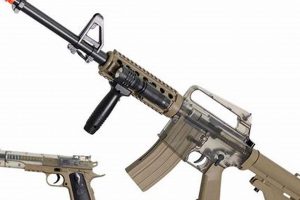
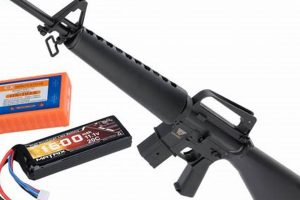
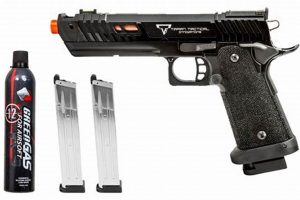
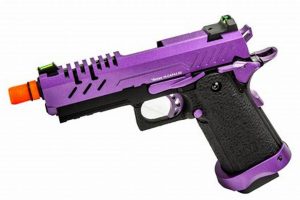
Determining superiority within airsoft weaponry is a multifaceted endeavor, influenced by individual needs, playing style, and budget. The notion of a universally superior airsoft gun is inaccurate; instead, performance is relative to specific criteria such as range, accuracy, durability, and intended application (e.g., CQB, field play, sniper role). A high-end, gas blowback rifle excelling in realism might be considered advantageous by some, while others prioritize the consistent performance of an electric gun for sustained gameplay. Therefore, “the best” is subjective and context-dependent.
The quest for optimal airsoft equipment is central to competitive and recreational play. Enhanced performance translates to a tangible advantage on the field, allowing for improved target acquisition, greater tactical flexibility, and increased overall effectiveness. Historically, the evolution of airsoft technology has driven innovation in materials, mechanisms, and designs, constantly raising the bar for performance expectations and blurring the lines between realistic simulation and competitive sport.
The following sections will delve into the critical factors influencing airsoft gun performance, examine prominent models across different categories, and explore the nuances of selecting an appropriate airsoft gun based on individual requirements and intended use cases. These will provide a more comprehensive understanding of what constitutes effective airsoft weaponry.
Essential Considerations for Selecting Airsoft Equipment
This section outlines key factors to consider when evaluating airsoft guns to determine the most suitable option for individual needs. Understanding these elements is crucial for making an informed decision.
Tip 1: Define Intended Use: Determine the primary environment of use (CQB, field, or sniper role). Short-barreled rifles are typically better suited for CQB environments due to their maneuverability, while longer-barreled rifles offer improved accuracy at longer ranges, ideal for field play.
Tip 2: Evaluate Power Source: Airsoft guns utilize various power sources, including electric (AEG), gas (GBB, CO2), and spring. AEGs offer consistent performance and ease of use. Gas-powered guns provide realistic recoil but may be susceptible to temperature fluctuations. Spring-powered guns are typically used for sniper rifles and require manual cocking before each shot.
Tip 3: Assess Build Quality and Materials: The materials used in construction directly impact durability and lifespan. Metal receivers and gearboxes generally offer greater resilience compared to polymer alternatives. Inspect critical components for robustness and resistance to wear.
Tip 4: Analyze Internal Components: Internal components, such as the hop-up unit, inner barrel, and motor (in AEGs), significantly influence accuracy and range. Upgrading these components can enhance performance. Research compatibility and quality before making modifications.
Tip 5: Consider Ergonomics and Handling: The overall feel and handling of the airsoft gun are important for comfort and ease of use. Ensure the grip is comfortable, the weight is manageable, and the controls are accessible. Consider adjustable stocks and rail systems for customization.
Tip 6: Research Reputable Brands: Established manufacturers often offer higher quality products and better customer support. Research reviews and compare specifications from different brands before making a purchase. Brands like Tokyo Marui, Krytac, and VFC are often regarded as high-quality brands.
Tip 7: Establish a Budget: Airsoft guns range in price from entry-level models to high-end professional-grade equipment. Determine a realistic budget and prioritize features based on available funds. Remember to factor in the cost of accessories, such as magazines, batteries, and optics.
Careful consideration of these factors will enable one to make a more informed decision, leading to a better experience. The selection process should prioritize individual needs and playing style over a generalized concept.
The concluding section will provide a summary of critical points and offer additional resources for further research, aiding the user in finding the ideal airsoft gun for specific requirements.
1. Accuracy

Accuracy is a paramount consideration when evaluating airsoft gun performance. Its significance in determining the optimal airsoft gun cannot be overstated, as it directly affects the ability to effectively engage targets and achieve strategic objectives.
- Hop-Up System Efficiency
The hop-up system imparts backspin to the BB, extending its range and stabilizing its trajectory. The effectiveness of this system is crucial for achieving consistent accuracy. A well-designed and properly adjusted hop-up unit ensures a flat trajectory, minimizing deviation caused by gravity and air resistance. High-quality buckings and precise adjustment mechanisms contribute to superior accuracy. For example, a poorly adjusted hop-up might cause BBs to curve sharply left or right, rendering even a powerful gun ineffective.
- Inner Barrel Quality and Length
The inner barrel’s bore diameter, material, and surface finish affect BB consistency and trajectory. Precision inner barrels with tight tolerances minimize air leakage and ensure a consistent seal around the BB as it travels down the barrel. Barrel length can also influence accuracy, with longer barrels generally providing a more stable platform for the BB to accelerate. Irregularities in the inner barrel, such as scratches or imperfections, can disrupt airflow and reduce accuracy.
- Gas Consistency (for Gas Blowback Guns)
For gas blowback (GBB) rifles and pistols, consistent gas pressure is vital for shot-to-shot accuracy. Fluctuations in gas pressure can lead to variations in BB velocity and trajectory. A reliable gas system, coupled with stable temperature conditions, is essential for maintaining accuracy. Lower quality gas systems or fluctuating temperatures can cause significant drop off in accuracy.
- BB Quality and Weight
The quality and weight of the BBs used directly impact accuracy. High-quality BBs are consistently round and free of imperfections, ensuring a stable flight path. Using heavier BBs can improve accuracy in windy conditions, as they are less susceptible to wind drift. Inconsistent BB size or weight will affect trajectory and diminish accuracy.
These facets of accuracy contribute to the assessment of superiority in the spectrum of airsoft guns. While a particular model might excel in power or rate of fire, subpar accuracy negates these advantages. Consequently, a gun exhibiting consistent, reliable accuracy, achieved through a combination of efficient hop-up, quality barrel, stable gas system (if applicable), and appropriate BB selection, holds a prominent position when considering “what is the best airsoft gun in the world”.
2. Range
Effective range is a critical determinant in the assessment of any airsoft gun, directly impacting its utility in various gameplay scenarios. The ability to engage targets at a distance provides a tactical advantage, dictating potential engagement zones and influencing overall field dominance. A gun with limited range restricts the user to close-quarters engagements, while one with extended range offers versatility across diverse field layouts. Therefore, range is a key component in the equation of what the best airsoft gun in the world is. The interplay between range and accuracy is vital; a gun with long range but poor accuracy is less effective than one with moderate range and high accuracy. The significance of range is exemplified in outdoor field play, where engagements often occur at distances exceeding 100 feet. Guns lacking sufficient range are at a considerable disadvantage, rendering them unable to effectively suppress or eliminate opposing players.
Several factors contribute to an airsoft gun’s range, including the power source, barrel length, hop-up system, and projectile weight. Higher-powered guns, such as those utilizing high-pressure gas or upgraded electric motors, typically achieve greater range. Longer inner barrels facilitate more complete acceleration of the BB, contributing to increased velocity and range. The hop-up system, which imparts backspin to the BB, extends its range by counteracting gravity. Heavier BBs, while reducing initial velocity, often maintain their momentum better, resulting in improved range and accuracy at longer distances. Examples of airsoft guns lauded for their range capabilities include upgraded sniper rifles with enhanced hop-up systems and high-powered AEGs with long inner barrels and precision gearboxes. However, modifications to increase range must be balanced with considerations for safety regulations and field restrictions.
In conclusion, range is an indispensable attribute contributing to the overall effectiveness and tactical value of an airsoft gun. While not the sole determining factor, its significance in engaging targets at varying distances and maintaining a competitive edge on the field is undeniable. However, understanding the interplay between range, accuracy, and legality is necessary to have a comprehensive view. Therefore, any assessment of “what is the best airsoft gun in the world” must prioritize range alongside other critical factors to achieve the delicate balance between power and strategic practicality.
3. Durability
Durability, in the context of airsoft weaponry, directly correlates with the long-term performance and operational lifespan. A gun’s construction and material composition significantly determine its ability to withstand the stresses of regular use, environmental factors, and potential impacts. The pursuit of “the best airsoft gun in the world” invariably involves prioritizing models exhibiting robust construction and resistance to wear and tear. A failure in a critical component during a game can render the weapon useless, negating any advantages in accuracy or range. Thus, durability is not merely a desirable trait but a fundamental requirement for consistent field performance.
The selection of materials plays a pivotal role in determining durability. For example, airsoft guns constructed with full metal bodies, reinforced gearboxes, and high-quality internal components demonstrate superior resistance to damage compared to those made primarily of plastic. Stress points, such as the receiver, barrel assembly, and trigger mechanism, are particularly vulnerable and require robust materials and construction techniques. The Tokyo Marui Recoil Shock series, known for its realistic recoil mechanism, often incorporates reinforced components to mitigate the stress placed on the gearbox during operation. Another instance involves the Krytac Trident series, which utilizes a reinforced gearbox shell designed to withstand the increased stress associated with high-performance upgrades. These examples underscore the direct relationship between material selection, construction quality, and the overall durability of the airsoft gun.
In summary, durability is a non-negotiable attribute when considering “what is the best airsoft gun in the world”. Its impact on long-term performance, reliability, and resistance to damage is undeniable. While factors such as accuracy, range, and ergonomics are important, they are rendered moot if the gun is prone to failure under typical operating conditions. Therefore, a thorough evaluation of material composition, construction techniques, and potential stress points is essential in determining the durability of an airsoft gun and its suitability for prolonged use. Airsoft enthusiasts, retailers, and manufacturers should prioritize material quality in the continuous evolution for the best airsoft gun.
4. Reliability
Reliability is a cornerstone attribute in evaluating airsoft gun performance, particularly when assessing “what is the best airsoft gun in the world.” Its significance stems from the imperative need for consistent functionality throughout gameplay, as malfunctions can negate other beneficial characteristics such as accuracy and range. A weapon prone to failure undermines tactical effectiveness and reduces user satisfaction.
- Consistent Cycling
Consistent cycling, especially in automatic electric guns (AEGs) and gas blowback (GBB) models, is essential for sustained fire. Irregular cycling leads to decreased rate of fire, inconsistent shot power, and potential jams. High-quality motors, gearboxes, and gas systems contribute to reliable cycling. For instance, AEGs with reinforced gearboxes and high-torque motors are less susceptible to cycling failures compared to models with weaker components. Similarly, GBBs with well-designed gas magazines and valves offer more consistent gas pressure, ensuring reliable cycling even during rapid firing sequences.
- Magazine Feeding
Reliable magazine feeding is crucial for uninterrupted gameplay. Misfeeds, where BBs fail to properly load into the hop-up chamber, can disrupt firing sequences and necessitate manual intervention. High-quality magazines with strong springs and consistent BB alignment minimize feeding issues. Mid-cap magazines, which lack winding mechanisms, are generally considered more reliable than high-cap magazines due to their simpler design and reduced reliance on mechanical components. Consistent magazine maintenance, including cleaning and lubrication, also contributes to reliable feeding.
- Electrical System Integrity
The integrity of the electrical system in AEGs is vital for consistent operation. Wiring failures, switch malfunctions, and battery connection issues can result in intermittent firing or complete system shutdowns. Upgraded wiring with lower resistance, reinforced switches, and reliable battery connectors improve the overall reliability of the electrical system. The use of MOSFETs (Metal-Oxide-Semiconductor Field-Effect Transistors) can further enhance reliability by reducing stress on the trigger contacts and improving trigger response.
- Hop-Up Consistency
While primarily associated with accuracy and range, the hop-up system’s reliability is also crucial for consistent performance. A malfunctioning or poorly maintained hop-up unit can lead to inconsistent BB trajectory and reduced effective range. High-quality hop-up buckings, durable adjustment mechanisms, and proper lubrication contribute to hop-up reliability. Regular inspection and cleaning of the hop-up unit are essential for preventing jams and maintaining consistent performance. A damaged or improperly installed hop-up bucking will cause inconsistent backspin on the BB, therefore reducing its accuracy and range.
These facets of reliability, encompassing cycling consistency, magazine feeding, electrical system integrity, and hop-up performance, collectively determine an airsoft gun’s dependability on the field. Models exhibiting consistent performance across these areas are more likely to be considered superior, contributing significantly to the assessment of “what is the best airsoft gun in the world.” Conversely, even a gun with exceptional accuracy or power will be deemed less desirable if it is prone to frequent malfunctions or inconsistent operation, underlining the cardinal nature of dependability. This emphasizes the interplay of all attributes in a gun. An otherwise great gun will not meet the mark if reliability is subpar.
5. Ergonomics

Ergonomics, referring to the design characteristics that optimize human well-being and overall system performance, plays a crucial role in determining the perceived value of any airsoft gun. The relationship between ergonomics and identifying the “best airsoft gun in the world” is directly proportional. A weapon may possess superior accuracy, range, and durability, but if its design hinders comfortable or efficient operation, its overall utility diminishes significantly. Ergonomic considerations encompass weight distribution, grip texture and shape, stock adjustability, and the placement of controls such as the magazine release and selector switch. A poorly designed grip can lead to hand fatigue, reducing the operator’s ability to maintain a stable firing platform. Similarly, an improperly weighted gun can cause muscle strain, impacting maneuverability and reaction time.
Real-world examples illustrate the importance of ergonomics. The H&K 416, widely favored by military and law enforcement personnel, incorporates ergonomic features such as an ambidextrous selector switch and a modular rail system that allows for customization to suit individual preferences. The Krytac Trident MKII series also exemplifies ergonomic design principles, featuring adjustable stocks and comfortable grips that enhance user experience. Conversely, older airsoft gun designs often lack ergonomic considerations, resulting in discomfort and reduced efficiency during prolonged use. An understanding of these ergonomic factors allows users to select airsoft guns that optimize their performance and reduce the risk of fatigue or injury. In scenarios requiring rapid target acquisition and engagement, a well-designed ergonomic interface provides a tangible advantage.
In summary, ergonomics is an integral component of the assessment criteria for determining “the best airsoft gun in the world.” A weapon’s performance is not solely defined by its technical specifications but is also contingent on its suitability for human interaction. While objective measurements of accuracy and range are valuable, the subjective experience of comfort and ease of use significantly impacts overall effectiveness. The challenge lies in balancing technical prowess with human-centered design principles to create airsoft guns that are both high-performing and ergonomically sound. This synthesis ultimately contributes to improved user satisfaction and enhanced operational capabilities on the airsoft field.
6. Modularity
Modularity, the capacity of an airsoft gun to be adapted and customized via interchangeable parts and accessories, holds a significant position in determining its overall value and suitability for diverse applications. The connection between modularity and identifying “what is the best airsoft gun in the world” lies in the ability of a firearm to evolve and adapt to meet specific user needs and playing styles. A highly modular airsoft gun allows for the integration of different optics, stocks, handguards, and internal components, thereby enhancing its performance and versatility. This adaptability enables players to tailor their weapon to specific scenarios, ranging from close-quarters combat (CQB) to long-range engagements. A rigid, non-modular design inherently limits the user’s ability to optimize the weapon for varying conditions, potentially hindering its effectiveness.
For example, a player engaging primarily in CQB might opt for a short-barreled rifle with a red dot sight and a vertical foregrip, emphasizing maneuverability and rapid target acquisition. Conversely, a player assuming a sniper role would prioritize a longer barrel, a high-powered scope, and a bipod, optimizing for accuracy and range. A modular platform allows for seamless transitions between these configurations, providing a distinct advantage over fixed-configuration weapons. The AR-15 platform, widely adopted in the airsoft community, exemplifies the benefits of modularity, offering a vast ecosystem of aftermarket parts and accessories. This modularity allows users to extensively customize their weapons, exceeding the capabilities of less adaptable designs. A less adaptable design means a player would need multiple guns to meet different scenario requirements, adding expense and inconvenience to the playing experience.
In conclusion, modularity enhances the longevity and adaptability of an airsoft gun, making it a crucial factor in determining its overall value and fitness for a broad range of applications. While raw performance metrics such as accuracy and power are important, the ability to adapt and evolve a weapon to meet changing needs solidifies its position as a top contender. It is important to assess a user’s tolerance for tinkering versus the increased versatility offered by highly modular platforms. The challenges associated with modularity involve ensuring compatibility between different components and maintaining a balance between customization and structural integrity. Nonetheless, the inherent advantages of adaptability and user-defined customization confirm the positive correlation between modularity and the overall assessment of “what is the best airsoft gun in the world”.
7. Cost
The economic aspect is intrinsically linked to discerning superiority in airsoft weaponry. The designation of “what is the best airsoft gun in the world” cannot be divorced from its price point, as value is a relative assessment that incorporates both performance and affordability. Cost considerations influence accessibility and define the realistic options for a broad spectrum of players.
- Initial Purchase Price
The initial outlay required to acquire an airsoft gun represents a primary barrier to entry and a significant determinant in purchase decisions. High-end models often boast superior performance characteristics, but their elevated price tags may preclude them from consideration for budget-conscious players. Conversely, more affordable options may sacrifice performance or durability to achieve a lower price point. The Tokyo Marui Recoil Shock series, renowned for its realism and performance, commands a higher initial purchase price compared to entry-level AEGs from lesser-known manufacturers. The discrepancy in cost reflects differences in materials, manufacturing processes, and design complexity. A higher price tag does not always equate to superiority; value depends on the user’s budget and priorities.
- Maintenance and Repair Costs
The long-term economic implications of airsoft gun ownership extend beyond the initial purchase price to encompass maintenance and repair costs. Models with complex internal mechanisms or proprietary parts may incur higher repair expenses compared to simpler designs with readily available components. Gas blowback rifles, while offering enhanced realism, often require more frequent maintenance and are susceptible to gas leaks, necessitating periodic repairs. Electric guns, particularly those with easily accessible gearboxes, tend to be more straightforward to maintain. An assessment of long-term costs is essential when evaluating the overall value proposition of an airsoft gun. Durable guns with easy-to-access and common replacement parts are cheaper to maintain in the long run.
- Upgrade and Accessory Costs
The modularity and potential for upgrades also influence the overall cost of airsoft gun ownership. A model with extensive aftermarket support allows for incremental performance enhancements, but these upgrades can accumulate significant expenses over time. The cost of accessories, such as optics, magazines, and tactical gear, should also be factored into the total investment. A basic AEG may seem affordable initially, but the addition of essential accessories and performance upgrades can quickly escalate its overall cost. Many high-end guns are typically purchased as is and used for that purpose.
- Cost-Benefit Analysis
Ultimately, determining “what is the best airsoft gun in the world” requires a comprehensive cost-benefit analysis that balances performance, durability, features, and affordability. The optimal choice is contingent on the individual user’s budget, playing style, and priorities. A high-end airsoft gun with exceptional performance may represent a worthwhile investment for a serious competitive player, while a more affordable option may suffice for casual recreational use. The perceived value of an airsoft gun is subjective and contingent on aligning its capabilities with individual needs and financial constraints. A gun that performs 80% as well as the very expensive option and saves the player 50% of the cost may actually be “the best gun” for that player.
In conclusion, cost is an inextricable factor in evaluating superiority in airsoft guns. The initial price point, ongoing maintenance expenses, upgrade costs, and overall value proposition collectively influence the assessment of “what is the best airsoft gun in the world.” A responsible evaluation necessitates a thorough consideration of these economic factors in conjunction with performance characteristics to determine the most suitable option for individual circumstances. A highly ranked airsoft gun will incorporate reasonable pricing to be considered “the best”.
Frequently Asked Questions
This section addresses common inquiries regarding the selection and evaluation of airsoft guns, providing objective and factual information to aid in informed decision-making.
Question 1: Is there truly a single “best” airsoft gun?
No. The designation of “best” is subjective and contingent on individual needs, playing style, and budget. A specific model may excel in one area (e.g., accuracy) but fall short in others (e.g., durability or cost). A comprehensive assessment requires a holistic evaluation of multiple factors.
Question 2: What factors should be considered when selecting an airsoft gun?
Key considerations include intended use (CQB, field, sniper), power source (AEG, gas, spring), build quality, internal components, ergonomics, modularity, and cost. Each of these factors should be carefully weighed against individual requirements and priorities.
Question 3: Are expensive airsoft guns always better?
Not necessarily. While high-end models often offer superior performance and features, they may not always represent the best value for all users. A more affordable option may suffice for casual recreational use, while a high-end model may be justified for competitive play.
Question 4: How important is accuracy in an airsoft gun?
Accuracy is a paramount consideration, directly impacting the ability to effectively engage targets. The hop-up system, inner barrel quality, and BB selection all contribute to accuracy. A gun with high power but poor accuracy is less effective than one with moderate power and superior precision.
Question 5: What is the significance of range in airsoft gameplay?
Range determines the effective engagement distance and influences tactical flexibility. A gun with limited range restricts the user to close-quarters engagements, while one with extended range provides a competitive advantage in open field scenarios. Safety regulations and field restrictions should also be considered when assessing maximum range.
Question 6: How does durability affect the overall value of an airsoft gun?
Durability directly impacts the lifespan and long-term reliability of the airsoft gun. A robust construction and high-quality materials are essential for withstanding the stresses of regular use. A failure in a critical component can render the weapon useless, negating any advantages in other areas.
In conclusion, determining the optimal airsoft gun necessitates a careful balancing act, prioritizing individual needs and play styles over the pursuit of a singular “best” option. Thorough research and consideration of multiple factors are essential for making an informed decision.
The subsequent section will provide a summary of critical points and offer additional resources for further research, aiding the user in finding the ideal airsoft gun for specific requirements.
Conclusion
The preceding exploration has illuminated the multifaceted nature of determining the superior airsoft gun. The article has methodically examined key performance indicators, including accuracy, range, durability, reliability, ergonomics, modularity, and cost. It has been established that the perception of “what is the best airsoft gun in the world” is not a static assessment but rather a dynamic evaluation contingent on individual needs, playing environments, and budgetary constraints.
Ultimately, the pursuit of the ideal airsoft gun demands a critical and informed approach. Rather than seeking a singular, universally superior model, individuals should prioritize a holistic evaluation of their specific requirements and weigh the diverse characteristics accordingly. The ongoing evolution of airsoft technology will undoubtedly continue to refine performance metrics and expand customization options. Players should stay informed about the latest developments and exercise discernment in selecting the tools that best align with their operational goals.