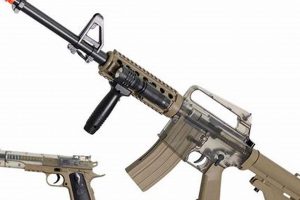
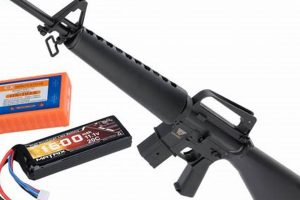
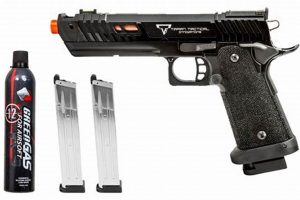
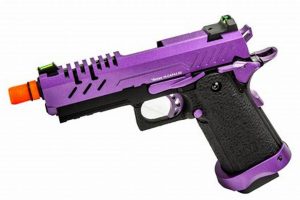
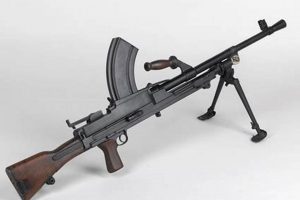
These are replica firearms designed to closely resemble their real-world counterparts, specifically those classified as submachine guns. These replicas are employed in simulated combat scenarios, using small, non-lethal projectiles propelled by compressed gas or electricity. For instance, a model emulating the iconic MP5 is frequently utilized in close-quarters battle simulations.
The appeal of these devices lies in their ability to provide a realistic tactical training experience without the dangers associated with live firearms. Their use promotes teamwork, strategic thinking, and physical activity in a controlled environment. Historically, the development of realistic training tools has been crucial for military and law enforcement, and this category of recreational equipment offers a similar, albeit less intense, experience to a broader audience.
The following sections will delve into the various types available, their performance characteristics, safety considerations for their use, and the specific environments in which they are commonly deployed. Understanding these aspects is essential for both enthusiasts and individuals new to the field of simulated combat.
Guidance on Selection and Utilization
Optimizing performance with these devices requires careful consideration of several key factors. Understanding these elements can enhance both the user’s experience and the longevity of the equipment.
Tip 1: Ammunition Weight and Quality: Employing appropriate projectile weight is critical. Using excessively heavy projectiles can strain internal mechanisms, while overly light ones may lack accuracy and range. High-quality, seamless projectiles are essential to prevent jamming and maintain consistent performance.
Tip 2: Gas System Maintenance: For gas-powered models, regular lubrication of the gas system is vital. Silicone-based lubricants are generally recommended to prevent degradation of rubber seals. Consistent maintenance prevents leaks and ensures consistent pressure output.
Tip 3: Battery Selection and Care: Electric-powered models require appropriately rated batteries. Overcharging or deep discharging lithium polymer (LiPo) batteries can reduce their lifespan and potentially cause damage. Utilize a smart charger designed for LiPo batteries to optimize charging and storage.
Tip 4: Barrel Cleaning: Regularly cleaning the inner barrel removes accumulated residue and improves accuracy. Use a specialized cleaning rod and microfiber cloths to avoid scratching the barrel’s internal surface.
Tip 5: Hop-Up Adjustment: The hop-up unit imparts backspin to the projectile, increasing its range and accuracy. Fine-tune the hop-up adjustment to match the projectile weight and desired range. Incorrect adjustment can result in over-hopping or under-hopping, negatively impacting accuracy.
Tip 6: Internal Component Upgrades: When considering internal upgrades, prioritize quality components from reputable manufacturers. Upgrading the spring, motor, or gears can increase rate of fire and power, but ensure these upgrades are compatible with the overall system to prevent premature wear or failure.
Tip 7: Storage Considerations: Store these devices in a cool, dry environment, away from direct sunlight and extreme temperatures. Proper storage helps prevent damage to internal components and extends the lifespan of the replica.
Adhering to these guidelines will contribute to improved performance, enhanced reliability, and extended longevity of the equipment. Proper maintenance is paramount for both safety and optimal functionality.
The subsequent sections will address common troubleshooting scenarios and advanced customization options.
1. Realism and Replication

Realism and replication are central to the appeal and effectiveness of simulated submachine gun platforms. The degree to which these replicas mirror their real-world counterparts directly impacts the training value and immersion experienced by participants. High fidelity in external appearance, weight, and handling characteristics enhances the sense of tactical authenticity. For instance, a highly accurate replica of an MP7 submachine gun, complete with correct dimensions, polymer construction, and magazine placement, allows users to practice weapon manipulation drills that closely approximate real-world scenarios. This fidelity is crucial for building muscle memory and developing effective tactical responses.
The internal mechanisms also contribute to the realism. The rate of fire, sound signature, and recoil (where simulated) all contribute to a more immersive experience. More advanced models incorporate blowback systems that mimic the recoil of actual firearms, further enhancing the sense of authenticity. This level of detail extends beyond mere aesthetics; it influences user behavior and tactical decision-making. If a replica accurately replicates the weight distribution of a real submachine gun, users are more likely to employ proper stance and handling techniques, improving their overall performance in a simulated combat environment. Consider, by contrast, a low-quality replica with an inaccurate rate of fire or flimsy construction. The lack of realism would detract from the experience and potentially hinder the development of effective tactical skills.
Ultimately, the pursuit of realism and faithful replication is not simply about creating aesthetically pleasing toys; it is about providing tools that can be used for effective training, recreation, and historical reenactment. The more accurately these devices mirror their real-world counterparts, the more valuable they become as training aids and the more engaging they are for enthusiasts. Challenges remain in balancing cost, durability, and safety with the desire for maximum realism. Nevertheless, ongoing advancements in materials and manufacturing techniques continue to push the boundaries of what is achievable in this field, further solidifying the role of these devices in recreation and training scenarios.
2. Rate of Fire (ROF)

The rate of fire (ROF) represents a critical performance characteristic directly impacting the tactical application and simulation fidelity of any submachine gun replica. Measured in rounds per minute (RPM), ROF dictates the volume of projectiles delivered within a given timeframe. A higher ROF translates to a denser stream of projectiles, potentially providing a competitive advantage in close-quarters engagements. Conversely, an excessively high ROF can deplete ammunition rapidly, necessitating frequent reloading and potentially exposing the user to vulnerability. The ROF of a submachine gun directly affects its suitability for specific roles. For instance, models replicating the MP5, known for its controllable ROF in its real-world counterpart, are frequently employed in scenarios requiring precision and sustained fire. In contrast, replicas of the Uzi, characterized by a higher ROF, may be favored in situations demanding suppressive fire and area denial.
The ROF of submachine gun replicas is generally governed by the motor speed and gear ratio in electric-powered models or by the gas flow rate and valve design in gas-powered models. Adjustments to these parameters can modify the ROF, allowing users to tailor the weapon’s performance to their specific needs. However, altering the ROF can also impact other performance characteristics, such as accuracy and energy output. Increasing the ROF, for instance, may lead to decreased accuracy due to increased vibration and muzzle climb. Similarly, exceeding the manufacturer’s recommended ROF limits can place undue stress on internal components, potentially leading to premature wear or failure. Therefore, careful consideration of the trade-offs is essential when modifying ROF.
In summary, ROF represents a fundamental design and operational parameter determining the tactical effectiveness and practical application. Optimization of ROF within the limitations of equipment and scenario parameters is essential to achieve both peak performance and equipment longevity. Therefore, users are encouraged to balance their ROF needs against those requirements to maintain their performance.
3. Effective Range

Effective range, in the context of submachine gun replicas, defines the distance at which a projectile can consistently and accurately strike a target with sufficient energy to achieve the intended effect. This parameter is crucial in determining the suitability of a given replica for specific gameplay scenarios and environments. Understanding the factors influencing effective range is essential for informed decision-making when selecting and utilizing these devices.
- Projectile Weight and Velocity
Projectile weight and velocity directly influence trajectory and energy retention. Heavier projectiles, propelled at sufficient velocity, tend to maintain momentum over greater distances, resisting the effects of air resistance and wind. Conversely, lighter projectiles may exhibit higher initial velocities but lose energy rapidly, resulting in shorter effective ranges. This relationship necessitates a balance between projectile weight and velocity to optimize range and accuracy.
- Hop-Up System
The hop-up system imparts backspin to the projectile, creating lift and extending range. Adjusting the hop-up unit allows users to fine-tune the projectile’s trajectory to counteract gravity, effectively increasing the distance at which a target can be engaged with reasonable accuracy. Improperly adjusted hop-up systems can result in either under-hopping (resulting in a downward trajectory) or over-hopping (resulting in an upward trajectory), both diminishing the effective range.
- Environmental Factors
Environmental conditions, such as wind and temperature, can significantly impact projectile trajectory and effective range. Wind can deflect projectiles laterally, reducing accuracy and effective range, particularly at longer distances. Temperature affects gas pressure in gas-powered models, influencing projectile velocity and range. Compensating for these environmental factors requires skill and experience.
- Barrel Length and Internal Air Seal
Barrel length and the integrity of the internal air seal influence the velocity and consistency of projectile launch. Longer barrels generally allow for greater acceleration of the projectile, resulting in higher velocities and extended range. A poor air seal can lead to inconsistent velocities, reducing accuracy and diminishing the effective range. Maintaining a proper air seal is therefore critical for maximizing performance.
The interplay of projectile characteristics, hop-up settings, environmental conditions, and internal mechanics dictates the effective range. Optimizing these factors is essential for maximizing the utility of these devices in diverse simulated combat scenarios. Variations in these parameters account for the broad spectrum of performance capabilities observed across different submachine gun replicas.
4. Power Source Variety
The diversity of power sources available for submachine gun replicas represents a pivotal consideration for users, directly influencing operational characteristics, maintenance requirements, and overall cost of ownership. The choice of power source dictates aspects such as rate of fire, consistency, and the logistical demands associated with operation in simulated combat scenarios.
- Electric (AEG – Automatic Electric Gun)
Electric-powered replicas utilize rechargeable batteries to drive an internal gearbox, which in turn propels projectiles. These models are characterized by consistent performance, adjustable rate of fire, and relative ease of maintenance. Battery types commonly employed include Nickel-Metal Hydride (NiMH) and Lithium Polymer (LiPo), each offering distinct advantages in terms of energy density and discharge rate. AEGs are suitable for a wide range of gameplay styles, from close-quarters engagements to outdoor skirmishes, and represent a prevalent choice among enthusiasts due to their versatility and reliability.
- Gas (GBB – Gas Blowback / NBB – Non-Blowback)
Gas-powered replicas utilize compressed gas, typically propane or CO2, to propel projectiles. Gas Blowback (GBB) models incorporate a mechanism that simulates recoil, enhancing realism but potentially impacting gas efficiency. Non-Blowback (NBB) models lack this feature, prioritizing gas efficiency and consistent performance. Gas-powered replicas often exhibit higher power output and a more realistic feel, but require regular maintenance to prevent leaks and ensure optimal performance. They are frequently favored by experienced users seeking a more authentic shooting experience.
- Spring-Powered
Spring-powered replicas utilize a spring-loaded piston to generate the force required to propel projectiles. These models are typically single-shot and require manual cocking before each shot. Spring-powered replicas are generally less expensive and simpler to maintain than electric or gas-powered models, but offer a lower rate of fire and limited customization options. They are often employed as entry-level devices or for specialized roles requiring stealth and simplicity.
The selection of a power source is a critical decision that must align with individual preferences, gameplay requirements, and budgetary constraints. Each power source offers a unique set of advantages and disadvantages, influencing the overall user experience and tactical effectiveness of the submachine gun replica. Consideration of these factors is paramount for maximizing enjoyment and achieving optimal performance in simulated combat scenarios.
5. Scenario Suitability
Appropriate matching of submachine gun replicas to specific gameplay environments is crucial for maximizing tactical effectiveness and ensuring participant safety. The physical characteristics of the playing field, the rules of engagement, and the intended style of play dictate the optimal selection and configuration of equipment. Mismatched equipment can lead to diminished performance, tactical disadvantages, and potential safety hazards.
- Close Quarters Battle (CQB) Arenas
CQB environments, characterized by confined spaces and short engagement distances, necessitate compact and maneuverable submachine gun replicas. Models with high rates of fire and minimal barrel length are generally preferred for rapid target acquisition and engagement. Lower power outputs are often mandated by safety regulations to minimize the risk of injury at close range. Examples include replicas of the MP5K or the Scorpion EVO 3 A1, known for their compact dimensions and high maneuverability. Inappropriate choices, such as long-barreled sniper rifles, would be unwieldy and ineffective in this environment.
- Outdoor Skirmish Fields
Outdoor skirmish fields, featuring larger open areas and longer engagement distances, require submachine gun replicas with extended effective ranges and greater accuracy. Models with adjustable hop-up systems and moderate rates of fire are advantageous for engaging targets at medium distances. Power outputs may be higher, allowing for greater projectile range, but must still adhere to established safety regulations. Replicas of the MP5A5 or the P90 are frequently employed in these scenarios. Inappropriate choices, such as low-powered spring pistols, would be unable to effectively engage targets at typical engagement distances.
- MilSim (Military Simulation) Events
MilSim events, designed to simulate realistic military operations, demand submachine gun replicas that closely replicate the appearance, handling, and performance characteristics of their real-world counterparts. Emphasis is placed on tactical realism, requiring adherence to specific equipment loadouts and operational procedures. Models with realistic weight, dimensions, and magazine capacities are favored. Examples include replicas of the M4 platform configured as a close-quarters weapon, or specialized submachine guns like the HK416C. Inappropriate choices, such as brightly colored or overtly futuristic replicas, would detract from the immersive nature of the simulation.
- Historical Reenactments
Historical reenactments necessitate submachine gun replicas that accurately reflect the specific firearms used by historical military units. Attention to detail is paramount, requiring replicas that match the appearance, markings, and operational characteristics of the original weapons. Examples include replicas of the Thompson submachine gun (used in World War II) or the Sten gun (used by British forces). The use of anachronistic or inaccurate replicas would undermine the historical authenticity of the event.
The successful integration of these replicas hinges on a thorough understanding of the operational environment and the intended purpose. Selecting appropriate equipment not only enhances the user experience but also ensures a safe and engaging simulated combat scenario. Careful evaluation of these considerations optimizes the tactical potential of these devices and promotes responsible participation in recreational simulated combat.
Frequently Asked Questions
The following addresses common inquiries and misconceptions surrounding submachine gun replicas, providing clarification on critical aspects of their usage and capabilities.
Question 1: What distinguishes submachine gun replicas from other types of airsoft devices?
Submachine gun replicas are differentiated by their design, mimicking the form and function of real-world submachine guns. This generally translates to a smaller overall size compared to assault rifles, and a focus on close-quarters combat scenarios. They typically fire in fully automatic or burst modes, whereas some other types may be limited to semi-automatic fire.
Question 2: What safety precautions are essential when handling submachine gun replicas?
Eye protection is mandatory at all times. Barrel socks or plugs should be utilized when the replica is not in active use. Respect for the designated safe zones is crucial, and replicas must be treated as if they were loaded at all times. Chronograph testing is essential to ensure that the device operates within established field limits.
Question 3: What is the typical effective range of a submachine gun replica?
The effective range varies depending on the model, power source, and environmental conditions. However, most submachine gun replicas are optimized for engagement distances of approximately 50 to 150 feet. Factors such as hop-up adjustment and projectile weight significantly influence the achievable range.
Question 4: What types of maintenance are required to ensure the longevity of submachine gun replicas?
Regular cleaning of the barrel, lubrication of internal components (particularly in gas-powered models), and proper battery care (for electric models) are essential for maintaining optimal performance and preventing premature wear. Storing the replica in a cool, dry environment when not in use is also recommended.
Question 5: Are there legal restrictions associated with owning or using submachine gun replicas?
Legal regulations vary significantly by jurisdiction. Some regions may require orange tips or markings to distinguish the replica from a real firearm. Others may have age restrictions or limitations on public display. It is the user’s responsibility to be fully aware of, and compliant with, all applicable local, state, and federal laws.
Question 6: What are the common performance upgrades available for submachine gun replicas?
Performance upgrades may include enhanced motors, tighter-bore barrels, improved hop-up units, and reinforced internal components. These upgrades can increase the rate of fire, accuracy, and overall reliability of the replica. However, modifications should be performed by experienced technicians to avoid damaging the device or violating field regulations.
Understanding these aspects is critical for responsible ownership and effective deployment of these replicas. Prioritizing safety and adhering to established guidelines ensures a positive and secure simulated combat experience.
The following section will delve into advanced customization options.
Conclusion
This exploration has elucidated key aspects of submachine gun airsoft, encompassing its functionality, performance characteristics, safety considerations, and tactical applications. A comprehensive understanding of these elements is paramount for responsible participation and informed decision-making within the simulated combat environment. The nuances of power sources, effective ranges, and scenario suitability directly influence the user experience and the overall effectiveness of these devices.
Continued adherence to safety protocols and a commitment to ongoing education are essential for ensuring the safe and responsible enjoyment of submachine gun airsoft. Further research and engagement with the broader community will undoubtedly contribute to the advancement of this engaging recreational pursuit. The evolution of technology and the development of ever-more-realistic replicas will shape the future of this activity, demanding continued vigilance and a dedication to ethical conduct.