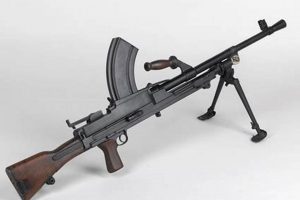
The process of aligning an airsoft gun’s aiming device, such as iron sights or a scope, with its projectile trajectory is essential for achieving accuracy. This adjustment ensures the point of aim coincides with the point of impact at a designated distance. Successfully completing this procedure involves making controlled adjustments to the aiming device until the airsoft gun consistently shoots where it is aimed.
Proper alignment is crucial for maximizing an airsoft gun’s effectiveness in skirmishes and target practice. A well-sighted airsoft gun allows the operator to engage targets with greater precision, leading to improved performance and a more enjoyable experience. Historically, similar methods have been used to calibrate firearms and other projectile weapons, adapting to the specific mechanics and ranges involved in each discipline.
Subsequent sections will provide detailed instructions on the tools and techniques needed for successful airsoft gun alignment. These include understanding various aiming devices, setting up a proper target range, and making precise adjustments for windage and elevation. Furthermore, advanced techniques for fine-tuning accuracy at different distances will be explored.
Tips for Accurate Airsoft Gun Alignment
Achieving precise alignment requires attention to detail and a systematic approach. The following tips provide guidance for maximizing the accuracy of an airsoft gun.
Tip 1: Secure the Airsoft Gun. Use a stable rest, such as sandbags or a gun vise, to eliminate human error from movement. A stable platform ensures consistent shot placement for accurate adjustments.
Tip 2: Establish a Consistent Distance. Select a target distance that represents the typical engagement range. Shorter distances may require less adjustment, while longer distances highlight inaccuracies.
Tip 3: Adjust for Windage First. Correct left-to-right deviations before addressing elevation. Windage adjustments are typically more sensitive and can significantly impact overall accuracy.
Tip 4: Use Small, Incremental Adjustments. Make small clicks or turns on the aiming device. Overcorrection is a common mistake that prolongs the process.
Tip 5: Confirm Adjustments with Multiple Shots. Fire a group of shots after each adjustment to verify the change. A tight grouping indicates accurate alignment.
Tip 6: Account for Hop-Up Settings. Adjust the hop-up system for optimal range and trajectory before beginning the alignment process. Incorrect hop-up settings can skew the results.
Tip 7: Consider BB Weight and Quality. Use consistent BBs of known weight and quality. Variations in BBs can introduce inconsistencies in shot placement.
Tip 8: Regularly Inspect and Maintain the Airsoft Gun. Ensure the airsoft gun is clean and properly maintained. Loose components or debris can affect accuracy.
Implementing these strategies contributes significantly to improved accuracy and consistency in airsoft engagements. Following a methodical approach and paying close attention to detail are essential for achieving optimal results.
The subsequent section will address advanced techniques and troubleshooting for complex alignment challenges.
1. Target Distance

Target distance is a foundational element in the process of airsoft gun alignment. The chosen distance directly influences the adjustments required to synchronize the point of aim with the point of impact, shaping the entire procedure.
- Zeroing Range Selection
Selecting an appropriate zeroing range is crucial. This distance should reflect the typical engagement ranges anticipated during gameplay. Zeroing at too short a distance can lead to significant inaccuracies at longer ranges, while zeroing at too long a distance can complicate close-quarters engagements. For example, an airsoft rifle intended for outdoor skirmishes might be zeroed at 100 feet, while an airsoft pistol used primarily in indoor environments might be zeroed at 30 feet. The choice impacts the trajectory of the BB and subsequent adjustments.
- Trajectory Compensation
BBs, being lightweight projectiles, exhibit significant bullet drop over distance. As a result, the aiming device must be adjusted to compensate for this drop. The amount of compensation required is directly proportional to the target distance. Sighting at longer distances necessitates a greater degree of upward adjustment to counteract the effects of gravity. This principle explains why a consistent zeroing distance is essential; varying distances introduce inconsistencies in the required compensation.
- Parallax Error
Optical sights, such as scopes, can introduce parallax error, which is the apparent shift in the position of the reticle relative to the target when the shooter’s eye moves. This error is more pronounced at shorter distances. Some high-end scopes feature parallax adjustment knobs, allowing the user to minimize parallax error at specific target distances. When using scopes without parallax adjustment, minimizing parallax becomes more important, especially at shorter ranges.
- Impact of Hop-Up
The hop-up system imparts backspin to the BB, creating lift and extending its range. However, the effectiveness of the hop-up system is distance-dependent. As the BB travels further, the backspin dissipates, and gravity exerts a greater influence. Therefore, the hop-up setting must be optimized for the chosen target distance. Sighting at different distances may necessitate adjustments to the hop-up to maintain a flat trajectory and maximize accuracy.
In summary, target distance is not merely a parameter but a defining factor in airsoft gun calibration. It dictates the necessary trajectory compensation, influences parallax error, and interacts directly with the hop-up system. Selecting an appropriate zeroing range and understanding its implications are paramount for achieving consistent and accurate shot placement.
2. Stable Platform

The stability of the platform from which an airsoft gun is fired exerts a significant influence on the accuracy of the sighting process. Any movement or instability during firing introduces variables that compromise the ability to reliably assess and correct the alignment of the aiming device. For example, attempting to zero an airsoft rifle while standing unsupported will likely result in inconsistent shot placement due to natural body sway and muscle fatigue. This inconsistency masks the true point of impact, making accurate adjustments to the sights or scope impossible. Therefore, a stable platform functions as a prerequisite for effective airsoft gun alignment.
The use of devices such as sandbags, bipods, or shooting rests mitigates the effects of instability. These tools minimize the movement of the airsoft gun during the firing sequence, allowing for a more consistent grouping of shots. Consider the practical difference between firing from a prone position supported by a bipod versus firing from a standing, unsupported position. The bipod provides a consistent and stable base, reducing vertical and horizontal deviation in shot placement. This consistency allows for more precise adjustments to the aiming device, leading to a more accurate zero. Similarly, a shooting rest can eliminate human error when sighting an airsoft pistol, particularly at extended ranges.
In conclusion, a stable platform is not merely a suggestion but an essential component of proper airsoft gun alignment. It serves to minimize external variables that obscure the true point of impact, allowing for precise adjustments to the aiming device. The absence of a stable platform will inevitably lead to inaccurate sighting and compromised performance. By prioritizing stability, operators can ensure that adjustments to their airsoft gun’s aiming system are based on reliable data, resulting in improved accuracy and consistency on the field.
3. Aiming Device

The aiming device is the central component in the process of airsoft gun alignment. Its type and condition directly influence the methodology and achievable precision during sighting. An improperly functioning or poorly chosen aiming device renders the entire procedure futile. For instance, attempting to sight an airsoft rifle with damaged iron sights or a scope with internal misalignment will invariably lead to inaccurate results, regardless of the operator’s skill or adherence to proper technique. The aiming device, therefore, dictates the fidelity of the alignment process and the operator’s ability to engage targets accurately. The selection of an appropriate aiming device is the first step in the process.
Various aiming devices, including iron sights, red dot sights, and magnified scopes, offer different levels of precision and suitability for specific scenarios. Iron sights, being the most basic option, are durable and reliable but may be challenging to use effectively at longer ranges or in low-light conditions. Red dot sights offer faster target acquisition and are generally preferred for close-quarters combat. Magnified scopes, on the other hand, provide enhanced accuracy at extended ranges but can be cumbersome in confined spaces. The choice of aiming device must be tailored to the intended application of the airsoft gun and the operator’s individual preferences. Regardless of the type chosen, the device must be securely mounted and properly adjusted to achieve accurate alignment.
In summary, the aiming device is not merely an accessory but an integral element in the process of airsoft gun alignment. Its quality, condition, and suitability for the intended application directly impact the accuracy and effectiveness of the sighting procedure. Selecting a proper aiming device and ensuring it is securely mounted and correctly adjusted are essential prerequisites for achieving consistent and precise shot placement. The subsequent steps in the alignment process are contingent upon the reliability and accuracy of the chosen aiming device, highlighting its central role in the pursuit of accuracy.
4. Windage Adjustment

Windage adjustment constitutes a critical element within the process of achieving proper airsoft gun alignment. This adjustment addresses horizontal deviations in projectile trajectory, correcting for instances where the BB consistently impacts to the left or right of the intended point of aim. Without proper windage correction, an airsoft gun cannot be considered accurately sighted, irrespective of its elevation settings. The relationship is causal; the degree of windage error directly dictates the extent of the adjustment required. The importance of this step stems from its impact on first-shot accuracy and the ability to engage targets effectively in dynamic scenarios. For example, an airsoft gun with a significant windage error might consistently miss targets at moderate ranges, even when the vertical trajectory is correctly calibrated.
The practical application of windage adjustment involves systematically adjusting the aiming device whether iron sights, a red dot sight, or a scope until the BB impacts consistently on the vertical centerline of the target. Most aiming devices incorporate adjustable knobs or screws that allow for precise lateral movement of the reticle or the entire sight housing. The direction of adjustment is typically indicated by markings (L for left, R for right). It is crucial to make incremental adjustments, firing a grouping of shots after each adjustment to assess the impact. External factors such as wind conditions must also be considered, as they can introduce horizontal drift. The use of a stable shooting platform is imperative to minimize the influence of shooter-induced errors during this process.
In conclusion, windage adjustment is not merely a fine-tuning step but a fundamental requirement for accurate airsoft gun calibration. Neglecting this aspect will compromise the effective range and precision of the airsoft gun. The successful application of windage correction demands a methodical approach, a stable platform, and an understanding of external influences such as wind. Mastering this skill is essential for achieving consistent shot placement and maximizing the performance of the airsoft gun in both recreational and competitive scenarios.
5. Elevation Adjustment
Elevation adjustment is an indispensable aspect of properly calibrating an airsoft gun. It directly addresses the vertical displacement of projectiles, ensuring they impact the target at the desired point of aim. Failure to correct elevation leads to consistent overshooting or undershooting, negating the benefits of precise windage alignment and stable shooting platforms.
- Counteracting Projectile Drop
Due to gravity, airsoft BBs experience a downward trajectory as they travel. Elevation adjustment compensates for this drop, raising the barrel or sights to angle the projectile upward. The amount of adjustment required is proportionate to the target distance; longer ranges necessitate greater elevation correction. For example, an airsoft rifle sighted at 50 feet will require significantly less elevation adjustment than the same rifle sighted at 100 feet.
- Interaction with Hop-Up Systems
Airsoft guns utilize hop-up systems to impart backspin to the BB, creating lift and extending its effective range. Elevation adjustment must be coordinated with the hop-up setting. If the hop-up is set too high, the BB may rise excessively, requiring a downward elevation adjustment. Conversely, if the hop-up is too low, the BB will drop prematurely, necessitating an upward adjustment. Balancing elevation and hop-up is critical for achieving a flat trajectory.
- Accounting for Variances in BB Weight
Airsoft BBs are available in a range of weights, typically from 0.20g to 0.30g. Heavier BBs are less susceptible to wind and maintain momentum better but require more significant elevation adjustment due to increased gravitational effects. Lighter BBs require less elevation correction but are more easily affected by external factors. Consistency in BB weight is essential for accurate elevation adjustment.
- Zeroing Procedures and Techniques
Elevation adjustment is often performed iteratively, involving firing a group of shots at a known distance, measuring the vertical deviation from the point of aim, and adjusting the sights or scope accordingly. Common techniques include using a bench rest to minimize shooter-induced error and employing ballistic calculators or charts to estimate the initial elevation adjustment. Consistent shot placement and a methodical approach are paramount for accurate elevation correction.
In summary, elevation adjustment is not a standalone procedure but an integral component of the overall sighting process. It directly addresses projectile drop, interacts closely with hop-up systems and BB weight, and requires consistent technique. A comprehensive understanding of these factors is essential for achieving accurate airsoft gun alignment.
6. Hop-Up Setting

The hop-up setting is a critical determinant of projectile trajectory, directly influencing the point of impact and necessitating careful consideration during the alignment process. An improperly adjusted hop-up system can render precise sight adjustments ineffective, as the BB’s flight path will deviate unpredictably.
- Trajectory Shaping
The hop-up unit imparts backspin to the BB as it exits the barrel, creating lift and extending the range. The degree of backspin dictates the BB’s trajectory, with excessive hop-up causing the BB to rise excessively and insufficient hop-up resulting in a rapid drop. Proper alignment requires balancing the hop-up setting with sight adjustments to achieve a flat, consistent trajectory within the intended engagement range. For instance, a marksman might use a slightly lower hop-up setting when engaging targets at close range, and a higher setting for reaching targets further away. The process involves continuous experimentation to find the right setting for a given set of conditions.
- Range Optimization
The hop-up system significantly extends the effective range of an airsoft gun. Without sufficient hop-up, the BB’s range is limited by gravity. The correct setting maximizes range without sacrificing accuracy. Adjusting the hop-up setting can have a pronounced effect on shot placement, especially at longer distances. This setting plays a critical role for snipers or designated marksmen who require maximum range from their airsoft gun. Failure to appropriately set hop-up will be a great hindrance on long range precision.
- BB Weight Dependency
The optimal hop-up setting varies with BB weight. Heavier BBs require more hop-up to achieve the same trajectory as lighter BBs. This is because heavier BBs are more resistant to the effects of wind and maintain their momentum better. When switching between different BB weights, the hop-up setting must be recalibrated to ensure consistent performance. This is why many experienced airsoft players tend to keep a record of the hop-up setting of each weight of BB they’re using.
- Effect on Sight Adjustment
The hop-up setting and sight adjustments are interdependent. Adjusting one without considering the other can lead to inaccurate results. The ideal approach involves first setting the hop-up to achieve a stable and flat trajectory and then fine-tuning the sights to compensate for any remaining deviation. The process is cyclical, requiring iterative adjustments to both the hop-up and sights until the desired accuracy is achieved. After any significant change to the hop-up settings, the airsoft gun should be re-sighted to ensure consistency.
The hop-up setting’s impact on trajectory, range, and BB weight underscores its essential role in accurate airsoft gun alignment. To perform this operation effectively, operators must fully understand its impact for various distances.
7. BB Consistency
BB consistency is a foundational element impacting the efficacy of any attempt to calibrate an airsoft gun. Variability in BB characteristics introduces unpredictable deviations in trajectory, directly undermining the accuracy and reliability of sight adjustments.
- Weight Variance
BBs, though appearing uniform, exhibit slight variations in weight. These micro-discrepancies translate into noticeable differences in flight characteristics, especially at extended ranges. Lighter BBs decelerate more rapidly and are more susceptible to wind drift, while heavier BBs maintain momentum but require greater elevation adjustments. The implication for sighting is that a mixture of BB weights will yield inconsistent shot groupings, rendering precise sight corrections impossible. For example, a spread of 0.02g in weight among BBs can result in a vertical dispersion of several inches at 100 feet.
- Dimensional Uniformity
Diameter inconsistencies among BBs impact their fit within the airsoft gun’s barrel. Variations in diameter affect the consistency of air seal and the amount of friction experienced by the BB during its passage through the barrel. These inconsistencies translate to variations in muzzle velocity and trajectory. This variation would introduce an additional layer of unreliability and therefore making sighting to achieve a satisfactory outcome becomes more complicated. The more variations are presented, the more unreliability would come up.
- Surface Imperfections
The surface finish of a BB influences its interaction with the air and the hop-up system. Imperfections, such as seams, dimples, or uneven coatings, disrupt airflow and create inconsistent backspin. These irregularities alter the BB’s lift characteristics and trajectory, leading to unpredictable deviations from the intended point of impact. BBs with smooth, polished surfaces promote more consistent airflow and backspin, yielding more predictable flight paths. It’s important to consider the quality of the BBs if one wants to improve the efficiency of aligning the airsoft gun.
- Material Composition
The type and quality of plastic used in BB manufacturing affect their density, hardness, and resistance to deformation. BBs made from inferior materials may shatter upon impact or deform during firing, leading to wildly erratic flight paths. Shattered BBs can also damage the airsoft gun’s internal components. High-quality BBs are manufactured from durable, consistent plastics that maintain their shape and integrity during the firing cycle.
The cumulative effect of these BB inconsistencies directly compromises the ability to accurately sight an airsoft gun. A stable platform, precise aiming device, and meticulous sight adjustments are rendered ineffective when the projectiles themselves exhibit unpredictable behavior. By ensuring BB consistency through the selection of high-quality ammunition, the operator establishes a foundation for reliable and accurate sight calibration.
Frequently Asked Questions
The following questions address common concerns regarding the proper alignment of airsoft guns.
Question 1: What is the optimal distance for sighting an airsoft gun?
The optimal distance depends on the intended application of the airsoft gun. For indoor use, a shorter distance, such as 25-50 feet, may suffice. For outdoor skirmishes, a longer distance, such as 75-100 feet, may be more appropriate. The chosen distance should reflect the typical engagement ranges.
Question 2: How frequently should an airsoft gun be re-sighted?
An airsoft gun should be re-sighted after any significant impacts, after disassembly for maintenance, or if there is a noticeable decline in accuracy. Regular checks are recommended, especially before important events.
Question 3: Can wind affect the trajectory of airsoft BBs?
Yes, wind can significantly affect the trajectory of airsoft BBs, especially at longer ranges. Crosswinds can cause horizontal drift, while headwinds or tailwinds can affect vertical trajectory. Wind conditions should be considered during the sighting process.
Question 4: What is the purpose of the hop-up system, and how does it affect sighting?
The hop-up system imparts backspin to the BB, creating lift and extending its range. The hop-up setting must be properly adjusted for the chosen target distance and BB weight. An improperly adjusted hop-up system can render precise sight adjustments ineffective.
Question 5: Are more expensive aiming devices always better for achieving accurate alignment?
While higher-quality aiming devices often offer greater precision and durability, they are not a guaranteed solution for inaccurate sighting. Proper technique and understanding of the principles of alignment are equally important. A basic, well-adjusted aiming device can be more effective than an expensive, poorly adjusted one.
Question 6: What is the importance of using consistent BBs when sighting?
Consistent BBs are crucial for achieving accurate and repeatable results. Variations in BB weight, diameter, or surface finish can introduce unpredictable deviations in trajectory, undermining the sighting process. High-quality BBs of uniform characteristics are essential.
Mastering these essential processes is vital for any airsoft gun user.
The subsequent section will address advanced techniques and troubleshooting for complex alignment challenges.
Concluding Thoughts on Airsoft Gun Alignment
This exploration of how to sight in an airsoft gun has underscored the multifaceted nature of the process. Achieving accuracy demands a comprehensive understanding of various factors, encompassing target distance, platform stability, aiming device characteristics, windage and elevation adjustments, hop-up settings, and projectile consistency. Mastery of each element contributes to repeatable precision. The successful alignment of an airsoft gun translates directly to enhanced performance, improved target engagement capabilities, and an overall elevation of the operator’s proficiency.
Therefore, continued diligence in applying these principles, coupled with sustained practice and a commitment to quality components, remains paramount. Consistent application will lead to a greater command of airsoft weaponry, allowing operators to confidently engage targets with heightened precision and efficacy. The pursuit of accuracy is a continuous endeavor, one that demands dedication to refining skills and maintaining equipment to exacting standards.