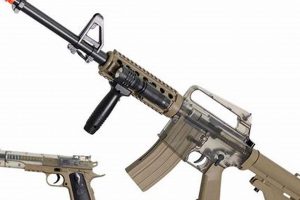
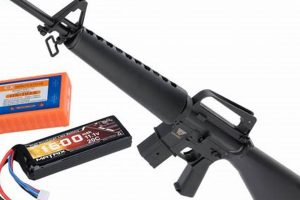
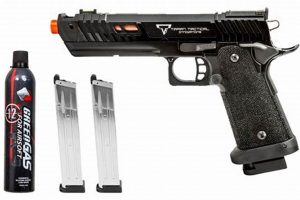
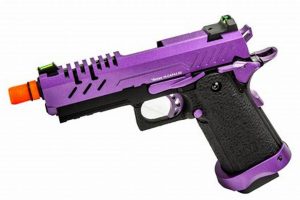
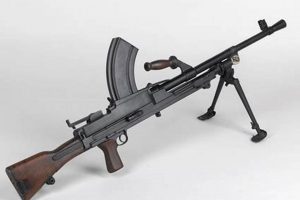
Selecting an appropriate airsoft replica involves carefully considering several factors to match individual needs and playing styles. The decision encompasses evaluating different types, power sources, and construction materials, ensuring a satisfying and effective experience within the sport.
A well-informed decision regarding equipment enhances gameplay, promotes safety, and extends the longevity of the chosen airsoft device. Historically, understanding the nuances of available options has been crucial for both recreational players and those participating in organized skirmishes, fostering a competitive yet secure environment.
The following sections will detail key considerations, including the various categories of airsoft mechanisms, power source selection criteria, and material attributes to facilitate informed purchasing decisions. These factors will provide a framework for aligning equipment choices with intended use and personal preferences.
Essential Guidance for Airsoft Replica Acquisition
The selection of an appropriate airsoft device requires careful evaluation. The following points highlight key considerations to ensure compatibility with individual needs and playing styles.
Tip 1: Define Intended Use: Determine whether the device will be used primarily for indoor close-quarters combat, outdoor field play, or target practice. This dictates optimal range, power level, and maneuverability requirements.
Tip 2: Research Mechanism Types: Airsoft replicas operate using electric, gas, or spring-powered mechanisms. Each has distinct characteristics regarding rate of fire, maintenance, and cost. Electric models offer versatility; gas models simulate realism; spring models provide reliability and affordability.
Tip 3: Assess Power Output (FPS): Field regulations often impose limits on muzzle velocity, measured in feet per second (FPS). Compliance is crucial for safe participation. Verify local rules and choose a device that adheres to these standards.
Tip 4: Evaluate Material Construction: External components may be constructed from polymer, metal, or a combination. Metal provides durability and realism, while polymer reduces weight and cost. Consider the trade-offs based on intended use and budget.
Tip 5: Prioritize Ergonomics and Handling: The device should fit comfortably in the hand and be easily manipulated. Factors such as weight, grip design, and adjustability contribute to overall user experience. Test handling characteristics, if possible, prior to purchase.
Tip 6: Consider Upgrade Potential: Some airsoft devices offer upgrade options for internal components, allowing for increased performance or customization. Evaluate the availability of aftermarket parts and the potential for future modifications.
Tip 7: Establish a Budget: Airsoft replicas range in price from entry-level to high-end models. Determine an acceptable spending limit and prioritize features within that constraint. Remember to factor in the cost of accessories, such as magazines and batteries.
Careful consideration of these aspects allows for a more informed decision, aligning equipment capabilities with individual requirements, promoting safety, and enhancing the overall airsoft experience.
The subsequent sections will explore specific device categories and provide more detailed insights into common performance characteristics and maintenance considerations.
1. Mechanism

The operational mechanism within an airsoft replica constitutes a fundamental factor in the selection process. The chosen mechanism directly influences performance characteristics, maintenance demands, and overall suitability for different playing styles and environments. Understanding the nuances of each mechanism, specifically electric (AEG), gas (GBB/NBB), and spring-powered systems, is crucial for aligning the device with intended use. For instance, an individual prioritizing high rates of fire and consistent performance might favor an AEG, while someone seeking realism in operation might prefer a GBB. Conversely, a player looking for a reliable, low-maintenance option could opt for a spring-powered device.
Each mechanism type presents distinct advantages and disadvantages. AEGs, powered by rechargeable batteries, offer consistent power output and customizable upgrade options. GBB replicas utilize compressed gas (typically green gas or CO2) to simulate realistic recoil and blowback action, enhancing the immersive experience but potentially requiring more frequent maintenance. Spring-powered models, reliant on manual cocking, are generally less expensive and offer inherent reliability, making them suitable for beginners or as backup devices. These attributes dictate the user’s handling and functionality expectation during airsoft engagements.
The selection of an airsoft device should, therefore, begin with a careful evaluation of its underlying mechanism. This decision directly impacts performance, maintenance requirements, and ultimately, the overall satisfaction with the chosen replica. Failure to understand these nuances can result in a device that is ill-suited for the intended purpose, leading to frustration and diminished enjoyment of the sport. Comprehending the mechanics is key to optimal airsoft replica acquisition.
2. Velocity

Velocity, measured in feet per second (FPS), represents a critical performance characteristic directly influencing the suitability of an airsoft device. Its consideration is paramount during the selection process due to safety regulations, gameplay dynamics, and equipment limitations.
- Field Regulations and Safety Compliance
Airsoft fields commonly impose strict limits on maximum FPS to mitigate the risk of injury. Failure to adhere to these regulations may result in exclusion from gameplay. Selecting a device that complies with the FPS limits of the intended playing environment is, therefore, a primary consideration. For instance, indoor arenas typically enforce lower FPS limits compared to outdoor fields.
- Effective Range and Target Engagement
Higher FPS values generally translate to increased effective range, enabling a user to engage targets at greater distances. However, this benefit must be balanced against safety considerations and field restrictions. A device with excessively high FPS may exceed safety limits or provide an unfair advantage, compromising gameplay integrity. The optimal FPS value depends on the typical engagement distances encountered in the chosen playing environment.
- Hop-Up System Compatibility
The hop-up system, which imparts backspin to the BB for increased range and accuracy, must be appropriately adjusted to match the device’s FPS. An improperly adjusted hop-up system can negatively impact accuracy or even damage the BB, reducing overall effectiveness. Matching hop-up adjustments to velocity output is essential for optimal performance.
- Internal Component Stress and Durability
Higher FPS values exert greater stress on internal components, potentially reducing the device’s lifespan or increasing the likelihood of malfunctions. Enhanced springs, reinforced gearboxes, and other upgraded components may be necessary to ensure reliable operation at elevated FPS levels. Assessing the durability and upgrade potential of a device is, therefore, crucial when selecting a high-velocity airsoft replica.
These velocity-related facets emphasize the intricate relationship between performance, safety, and regulatory compliance in the selection of airsoft equipment. An informed choice requires a comprehensive understanding of how FPS interacts with various operational parameters, ensuring both a safe and effective experience on the playing field.
3. Ergonomics
Ergonomics, the science of designing equipment and working environments to fit the user, assumes a significant role in the process of selecting an appropriate airsoft replica. The interaction between the operator and the device directly impacts comfort, maneuverability, and overall effectiveness during gameplay. A replica exhibiting poor ergonomic design may lead to fatigue, reduced accuracy, and an increased risk of strain or injury. Conversely, a well-designed airsoft device enhances performance and promotes a more enjoyable experience. For example, an airsoft rifle with an adjustable stock and comfortable grip allows the user to customize the fit to their body, improving stability and control during aiming and firing. Conversely, a rifle with a fixed stock and poorly shaped grip can cause discomfort and hinder accurate target acquisition.
The importance of ergonomics extends beyond mere comfort. A properly weighted and balanced replica allows for quicker target transitions and improved reaction times. Features such as ambidextrous controls cater to both right- and left-handed users, increasing versatility. The size and positioning of magazine release buttons, selector switches, and charging handles significantly affect the speed and efficiency of weapon manipulations. Consider a scenario where a player needs to quickly reload their weapon during a firefight. A poorly positioned magazine release can slow down the reloading process, potentially placing the player at a disadvantage. Replicas with ergonomically designed controls enable faster and more intuitive operation, improving the player’s overall performance in dynamic situations. Grip texture and angle, trigger pull weight, and cheek rest height further impact a user’s ability to maintain a stable firing position and accurately engage targets.
In conclusion, ergonomic considerations are an essential component of choosing an airsoft device. The design and configuration of the replica should align with the user’s physical characteristics and playing style. Evaluating factors such as weight distribution, adjustability, control placement, and grip design can significantly impact comfort, maneuverability, and overall performance. Understanding these ergonomic principles ensures a more informed purchasing decision, ultimately enhancing the airsoft experience and promoting safe and effective gameplay. Neglecting ergonomics may lead to user discomfort, reduced effectiveness, and increased risk of injury, diminishing the enjoyment and longevity of participation in the sport.
4. Durability
The durability of an airsoft replica is a paramount consideration when making a selection. A device’s resilience directly affects its long-term performance, reliability, and overall value. Choosing a robust model mitigates the risk of malfunctions, reduces the frequency of repairs, and ensures consistent operation under varying conditions. The cause-and-effect relationship is clear: inferior materials and construction methods lead to premature failure, while quality components and meticulous assembly result in extended service life. For instance, a gearbox constructed with reinforced steel gears is less likely to strip under stress compared to one with cast zinc gears. Similarly, a polymer receiver made from high-impact nylon is more resistant to cracking and breakage than one composed of lower-grade plastic.
The importance of durability as a factor in the decision-making process cannot be overstated. A replica subjected to regular skirmishes and diverse environmental conditions will experience significant wear and tear. Models employing metal receivers, full metal gearboxes, and reinforced internal components are generally better suited for rigorous use than those constructed primarily from plastic. An example would be a player consistently engaging in outdoor woodland scenarios. The airsoft gun is likely to get scratched, hit tree trunks or the ground. Choosing a durable model helps preventing such damage.
In conclusion, durability represents a critical nexus point in the process of selecting an airsoft device. Selecting a model constructed from robust materials and assembled with precision leads to enhanced reliability and long-term cost-effectiveness. Neglecting durability considerations can result in frequent repairs, performance degradation, and ultimately, premature replacement. A careful evaluation of construction materials, internal components, and overall build quality is essential for ensuring that the chosen replica can withstand the demands of regular use and provide a satisfying airsoft experience.
5. Regulations

The interplay between regulations and the selection of an airsoft device is paramount. Regulatory frameworks, encompassing federal, state, and local ordinances, dictate permissible muzzle velocities, acceptable usage locations, and legal ownership requirements. A failure to align equipment choices with these regulations can result in legal penalties, including fines and confiscation of the device. The selection process must, therefore, prioritize compliance with applicable laws to ensure responsible and lawful participation in the sport. For example, some municipalities may prohibit the discharge of airsoft devices within city limits, regardless of muzzle velocity. Selecting a low-power device does not negate the need to adhere to these local ordinances.
Adherence to field-specific regulations also informs equipment selection. Airsoft fields routinely establish rules regarding maximum muzzle velocities, minimum engagement distances, and acceptable types of devices. These regulations are designed to promote player safety and ensure fair gameplay. An individual intending to participate in skirmishes at a particular field must select an airsoft device that complies with the field’s specific requirements. Using a replica exceeding the field’s velocity limits poses a safety risk and violates the terms of participation. For example, an outdoor field may permit higher FPS devices compared to an indoor CQB environment.
In conclusion, understanding and adhering to relevant regulations is a non-negotiable aspect of choosing an airsoft replica. Failure to do so can lead to legal repercussions, jeopardize safety, and prevent participation in organized events. Selecting a device that complies with both legal and field-specific regulations demonstrates responsible ownership and fosters a safe and enjoyable environment for all participants. Therefore, a thorough assessment of applicable rules constitutes an integral step in the decision-making process, ensuring compliance and promoting ethical gameplay.
Frequently Asked Questions
The following section addresses common inquiries regarding the acquisition of airsoft replicas, providing clarity on key considerations and dispelling prevalent misconceptions.
Question 1: What constitutes the primary determinant when acquiring an airsoft device?
Intended use serves as the primary determinant. Device selection should align with the intended playing environment, whether it be close-quarters combat, outdoor skirmishes, or target practice, as these scenarios necessitate different performance characteristics and feature sets.
Question 2: What mechanism is generally appropriate for novice airsoft participants?
Spring-powered replicas are often recommended for beginners due to their inherent simplicity, reliability, and affordability. These devices require manual cocking before each shot, fostering a fundamental understanding of airsoft operation.
Question 3: How does muzzle velocity affect gameplay and safety protocols?
Muzzle velocity, measured in feet per second (FPS), directly impacts the effective range and potential for injury. Airsoft fields impose strict FPS limits to ensure player safety; exceeding these limits can result in expulsion from gameplay.
Question 4: What construction materials are most suitable for demanding airsoft engagements?
Metal receivers and reinforced internal components are generally preferred for demanding engagements due to their enhanced durability and resistance to wear and tear. Polymer materials offer a lighter weight alternative but may be less robust.
Question 5: Is it possible to enhance the performance of an airsoft replica through modifications?
Many airsoft devices offer upgrade options, allowing for modifications to internal components such as springs, gears, and motors. These modifications can increase muzzle velocity, rate of fire, or overall reliability, but should be performed by experienced technicians.
Question 6: Is adherence to safety regulations an essential component of airsoft participation?
Strict adherence to safety regulations is absolutely essential. This includes wearing appropriate eye protection, observing minimum engagement distances, and handling replicas responsibly at all times. Failure to comply with safety protocols can result in serious injury.
The proper selection of an airsoft replica is a multifactorial process requiring careful consideration of intended use, performance characteristics, construction materials, and regulatory compliance. A well-informed decision ensures a safe and enjoyable airsoft experience.
The next section will delve into specific categories of airsoft devices, providing detailed insights into their respective strengths, weaknesses, and suitability for different playing styles.
Concluding Remarks
This article has explored the pivotal considerations involved in acquiring an appropriate airsoft replica. The informed selection process encompasses evaluating mechanism types, assessing velocity parameters, prioritizing ergonomic designs, ensuring structural durability, and adhering to relevant regulatory frameworks. Each of these factors contributes to the overall performance, safety, and longevity of the chosen device.
Diligent application of these principles facilitates the acquisition of a replica that aligns with individual needs and playing styles. Continued awareness of evolving technologies and regulatory changes will ensure a commitment to responsible and informed participation in the airsoft community. The ongoing application of due diligence is paramount for a fulfilling and safe experience.