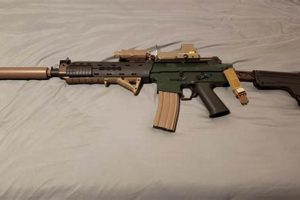
The utilization of additive manufacturing techniques to create components and accessories for airsoft guns has become increasingly prevalent. This involves designing, and then producing, physical parts from digital models, often using materials like polymers and composites. A common example is the creation of custom magazines tailored to specific loadouts or unique aesthetic modifications for existing airsoft replicas.
This approach offers several advantages, including design flexibility, rapid prototyping, and the ability to produce low-volume or personalized items efficiently. Historically, airsoft enthusiasts relied on commercially available parts or complex machining processes for customization. The advent of accessible technologies has significantly lowered the barrier to entry for creating bespoke equipment, fostering a vibrant community of designers and manufacturers.
This article will further explore the specific materials used, the design considerations relevant to airsoft applications, legal and ethical aspects, and practical considerations for successful implementation of this fabrication method.
Airsoft 3D Print
Achieving optimal results with additive manufacturing for airsoft components requires careful consideration of various factors, from material selection to design constraints. The following tips offer guidance for maximizing the potential of this technology.
Tip 1: Prioritize Material Selection. The chosen filament or resin should exhibit suitable strength, impact resistance, and temperature tolerance for the intended application. PLA is often used for prototyping, while ABS, PETG, or Nylon-based materials offer greater durability for functional parts that endure stress during gameplay. Consider the specific stress a component will experience to choose the correct material.
Tip 2: Design for Printability. Overhangs exceeding 45 degrees typically require supports, which can impact surface finish and increase post-processing time. Orient parts strategically to minimize support material and optimize layer adhesion in critical stress areas. Bridging, where the printer extrudes horizontally between two supports, can be difficult. Design with these constraints in mind from the beginning.
Tip 3: Calibrate and Maintain Equipment. Regular calibration of the 3D printer ensures dimensional accuracy and consistent results. Cleanliness is vital; debris and accumulated filament can lead to printing errors. Regularly check the nozzle for clogs and replace it as needed. A well-maintained machine provides more reliable output.
Tip 4: Account for Tolerances. Additive manufacturing processes inherently involve dimensional variations. Design parts with sufficient clearance for moving components and ensure tight fits by incorporating appropriate tolerances. Test prints and iterative design refinement are essential for achieving desired fitment. Leave room for post-processing (sanding, filing) and factor that into the design.
Tip 5: Consider Post-Processing Techniques. 3D-printed parts often require finishing to improve surface quality, strength, or aesthetics. Sanding, painting, vapor smoothing, and epoxy coating can enhance the final product. Research and implement appropriate post-processing methods to achieve the desired functionality and appearance.
Tip 6: Validate Designs Through Testing. Before committing to large-scale production, thoroughly test prototypes to identify potential weaknesses or areas for improvement. Subject components to realistic stress tests to ensure they can withstand the demands of airsoft gameplay. This iterative process is crucial for developing robust and reliable parts.
By adhering to these guidelines, individuals can effectively leverage additive manufacturing technologies to create high-quality airsoft components that enhance performance, customization, and overall gameplay experience. Diligence throughout the process results in parts that meet requirements and deliver tangible benefits.
The subsequent sections will delve deeper into specific design strategies and legal considerations relevant to this application of additive manufacturing.
1. Material Strength
Material strength is a critical factor in the design and production of components using additive manufacturing techniques. Airsoft guns operate under mechanical stress, and the components fabricated using technologies must possess the necessary tensile strength, impact resistance, and durability to withstand repeated use. Failure to consider strength can result in component breakage, malfunction of the airsoft gun, and potential safety hazards. A common scenario involves the creation of pistol slides; a weak material will fracture under the repeated stress of cycling, rendering the replica inoperable.
The selection of appropriate materials directly influences the lifespan and reliability of customized parts. Polymers like ABS, PETG, and Nylon are commonly employed due to their balance of strength, flexibility, and cost-effectiveness. However, the specific material choice must align with the intended application. For instance, a 3D-printed receiver that houses the gearbox requires a more robust material compared to purely aesthetic accessories. Furthermore, post-processing techniques, such as annealing, can improve the mechanical properties of printed parts. An example of this is reinforcing a 3D-printed gear with epoxy resin, significantly increasing its resistance to shear forces.
Ultimately, the relationship between material strength and additive manufacturing in airsoft applications determines the overall performance and longevity of customized components. Prioritizing proper material selection, understanding the limitations of specific printing technologies, and employing appropriate post-processing methods are essential for creating durable and reliable airsoft gun modifications. Ignoring these considerations risks compromising the functionality and safety of the replica and potentially causing injury to the user. Thus material selection is paramount in the success of a fabricated component.
2. Design Accuracy
In the context of airsoft, achieving precise dimensional accuracy in the design phase is critical to the successful integration of additively manufactured components. Discrepancies between the design and the original airsoft replica can lead to incompatibility, functional impairment, and potential safety concerns. Rigorous adherence to accurate measurements and precise modeling techniques is therefore paramount.
- Accurate Measurements
The foundation of design accuracy lies in obtaining precise measurements of the airsoft replica being modified. This involves using calibrated tools such as calipers and micrometers to capture the exact dimensions of existing parts. Deviations, even minor ones, can result in misalignment, binding, or complete failure of the printed component to fit. For example, a poorly measured magazine well may prevent a fabricated magazine from seating correctly, rendering it unusable. These measurements should then translate directly into the CAD model.
- CAD Modeling Precision
Computer-aided design (CAD) software facilitates the creation of three-dimensional models that define the geometry of the component. The level of detail and precision within the CAD model directly influences the accuracy of the printed part. Features such as threads, grooves, and mating surfaces must be modeled with meticulous attention to detail to ensure proper functionality. An example is a 3D-printed hop-up unit; the internal bore and bucking interface must be modeled with exceptional precision to achieve consistent BB trajectory.
- Tolerance Management
Additive manufacturing processes inherently involve dimensional variations. Designers must account for these tolerances by incorporating appropriate clearances and allowances within the CAD model. For example, a printed bushing intended to fit within a bearing housing must be designed with a slight clearance to accommodate variations in the printing process. Failure to account for tolerances can result in parts that are either too tight to assemble or too loose to function effectively.
- Iterative Prototyping
Achieving optimal design accuracy often necessitates an iterative prototyping process. This involves printing preliminary versions of the component, testing its fit and function, and then refining the CAD model based on the results. This cycle of testing and refinement helps to identify and correct any discrepancies between the design and the intended application. The iterative prototyping process minimizes the risk of producing large quantities of inaccurate or non-functional parts.
The facets described underscore the significance of design accuracy for the successful application of this technology to airsoft replicas. Precise measurements, meticulous CAD modeling, careful tolerance management, and iterative prototyping are each crucial to the creation of components that meet the required standards of performance, compatibility, and safety. Failing to address these critical considerations can lead to suboptimal results and increased project costs.
3. Replica Compatibility

The integration of additively manufactured components into existing airsoft replicas hinges critically on the concept of replica compatibility. It dictates the seamless integration of custom or replacement parts with the original airsoft gun, ensuring proper function, safety, and aesthetic cohesion. Neglecting this fundamental principle can result in performance degradation, mechanical failures, and potential damage to the host airsoft gun.
- Dimensional Accuracy and Fitment
Achieving replica compatibility commences with precise dimensional accuracy. Additively manufactured components must adhere to the exact dimensions and tolerances of the corresponding parts they are intended to replace or augment. A failure to replicate these critical measurements can lead to binding, misalignment, or complete inability to assemble the part. An instance of this involves creating a custom trigger; if the dimensions are slightly off, it may fail to engage the sear properly, rendering the weapon inoperable or creating a potential safety hazard.
- Material Compatibility
Beyond physical fitment, material compatibility plays a vital role in long-term reliability. Combining dissimilar materials with vastly different thermal expansion coefficients or chemical reactivity can lead to stress concentrations, corrosion, or premature failure. For example, mating a 3D-printed nylon component with a metal gearbox shell without considering differential expansion could result in cracking or deformation over time. Choosing materials with comparable properties, or employing appropriate interface treatments, mitigates these risks.
- Functional Integration
Ensuring functional integration involves more than simply replicating the physical shape of a component. The additively manufactured part must also fulfill the intended function within the overall system. This may involve designing appropriate interfaces for electrical connections, pneumatic seals, or mechanical linkages. A poorly designed hop-up unit, despite having the correct dimensions, may fail to impart the necessary backspin on the BB, resulting in inaccurate shots and reduced range.
- Aesthetic Cohesion
While primarily a cosmetic consideration, aesthetic cohesion contributes to the overall satisfaction of the end-user. The additively manufactured component should seamlessly blend with the existing aesthetics of the airsoft replica, both in terms of color, texture, and surface finish. A mismatched accessory can detract from the overall realism and visual appeal of the replica. Post-processing techniques, such as painting or surface texturing, can help achieve a more harmonious integration.
These combined attributes highlight the multifaceted nature of replica compatibility within the context of airsoft. By carefully considering the dimensional, material, functional, and aesthetic aspects, designers can leverage additive manufacturing to create components that seamlessly integrate with existing airsoft replicas, enhancing performance, reliability, and overall user experience. Compromising any of these facets can lead to suboptimal results and potential dissatisfaction.
4. Regulation Compliance

The integration of additive manufacturing into the airsoft arena introduces critical considerations regarding regulation compliance. Airsoft guns, and their components, are subject to various legal restrictions depending on jurisdiction. Understanding and adhering to these regulations is paramount for individuals and businesses involved in creating or distributing additively manufactured airsoft parts.
- Material Restrictions
Certain jurisdictions may impose restrictions on the materials used in the construction of airsoft guns. These restrictions often target materials that could potentially be modified to create functional firearms. For example, regulations may prohibit the use of high-strength metals or specific polymers. Those involved in additively manufacturing components must ensure their material choices comply with the applicable laws to avoid legal repercussions. For instance, some areas may permit only specific colors for the replicas external shell to quickly differentiate it from a real firearm.
- Design Restrictions
Regulations may also dictate specific design characteristics of airsoft guns to prevent their easy conversion into real firearms. This could include restrictions on dimensions, internal mechanisms, or the overall appearance of the replica. Additively manufactured components must conform to these design constraints. Consider the legality of producing a receiver that could be readily modified to accept firearm components; such a design would likely violate relevant regulations.
- Marking and Identification Requirements
Many jurisdictions mandate that airsoft guns be clearly marked with specific information, such as the manufacturer’s name, a unique serial number, and a statement indicating that the item is an airsoft replica. Additively manufactured components may need to incorporate these markings to ensure compliance. A 3D-printed receiver lacking the required markings could be deemed illegal, potentially resulting in fines or confiscation of the replica.
- Import and Export Regulations
Cross-border transactions involving airsoft guns and their components are subject to import and export regulations. These regulations may require permits, licenses, or specific documentation. Individuals and businesses involved in additively manufacturing and distributing parts across international borders must comply with these requirements. The unapproved export of an airsoft component that could be used in a real firearm could result in significant legal penalties.
The aforementioned examples highlight the crucial link between regulation compliance and the utilization of additive manufacturing in the airsoft community. Strict adherence to legal standards is essential to prevent legal issues and ensure responsible and ethical engagement with this technology. Ignorance of these factors can have serious implications. Compliance is not merely a suggestion but a legal requirement.
5. Functional Durability
Functional durability, the capacity of an additively manufactured component to withstand operational stresses and maintain its intended function over an extended period, is paramount in the context of airsoft. Given the demanding nature of airsoft gameplay, parts are subjected to repetitive impact, stress, and environmental factors. The ability of a component to resist degradation under these conditions directly impacts its lifespan and the overall reliability of the airsoft replica.
- Material Selection and Performance
The selection of appropriate materials is fundamental to achieving functional durability. Materials such as PLA, while suitable for prototyping, generally lack the impact resistance necessary for sustained use in airsoft applications. Higher-performance polymers, including ABS, PETG, Nylon, and carbon fiber composites, offer improved strength, temperature resistance, and wear characteristics. For example, a magazine well fabricated from PLA is prone to cracking under stress, whereas a nylon alternative offers significantly enhanced resistance to impact and abrasion. This choice directly influences the part’s operational lifespan.
- Design for Stress Mitigation
The design of additively manufactured components must consider stress distribution and potential failure points. Sharp corners and abrupt transitions can concentrate stress, leading to premature cracking or breakage. Incorporating fillets, radii, and gradual transitions can mitigate these stress concentrations and enhance overall durability. Consider a 3D-printed pistol grip; if the design incorporates sharp angles where it attaches to the frame, it is likely to fail under repeated recoil stress. A design incorporating smooth, radiused transitions would significantly improve its longevity.
- Layer Adhesion and Printing Parameters
Layer adhesion, the strength of the bond between successive layers of deposited material, is critical to the structural integrity of additively manufactured parts. Weak layer adhesion can lead to delamination, compromising the component’s ability to withstand stress. Optimizing printing parameters, such as nozzle temperature, bed temperature, and print speed, is essential for promoting strong layer adhesion. A gearbox shell with poor layer adhesion may split apart under the stress of the internal gears, rendering it useless. Correcting printing parameters would improve the layer fusion and overall strength.
- Post-Processing Techniques for Enhanced Durability
Post-processing techniques can further enhance the functional durability of additively manufactured components. Annealing, a heat treatment process, can improve the strength and temperature resistance of certain polymers. Applying protective coatings, such as epoxy resin, can enhance resistance to abrasion, chemicals, and environmental factors. Reinforcing a 3D-printed nozzle with a thin layer of epoxy can protect it from wear caused by friction against the cylinder head, extending its operational lifespan.
These factors collectively illustrate the intricate relationship between functional durability and the successful application of this technology in airsoft. Proper material selection, thoughtful design, optimized printing parameters, and appropriate post-processing techniques are crucial for creating additively manufactured airsoft components that withstand the rigors of gameplay and provide reliable performance over time. Careful consideration of these aspects ensures that the benefits are realized without compromising the longevity or safety of the replica.
Frequently Asked Questions
This section addresses common inquiries surrounding the application of additive manufacturing within the airsoft domain, providing clear and concise answers to relevant questions.
Question 1: What materials are best suited for parts designed for use in Airsoft replicas?
The suitability of a material depends on the intended application. PLA is acceptable for prototyping and purely aesthetic parts. Functional components requiring durability necessitate the use of ABS, PETG, Nylon, or composites. Material selection must consider impact resistance, temperature tolerance, and wear characteristics.
Question 2: Is there a noticeable decrease in reliability when using 3D-printed airsoft components versus traditionally manufactured parts?
Reliability depends heavily on design, material selection, and printing parameters. A poorly designed or inadequately printed component will likely exhibit reduced reliability compared to a professionally manufactured part. However, a well-designed and meticulously printed component, utilizing appropriate materials, can achieve comparable or, in some cases, superior performance.
Question 3: What level of technical expertise is required to successfully design and produce functional components using 3D printing?
A moderate level of technical proficiency is required. Familiarity with CAD software, an understanding of material properties, and knowledge of printing processes are essential. Successful design and production also necessitates an understanding of airsoft gun mechanics and potential failure modes.
Question 4: Are there legal limitations to consider when fabricating airsoft components using additive manufacturing?
Yes. Legal restrictions vary by jurisdiction. These may include restrictions on materials, design features, and marking requirements. Adherence to applicable laws is crucial to avoid legal repercussions.
Question 5: How does the cost of additively manufactured components compare to commercially available airsoft parts?
The cost varies depending on the complexity of the design, the material used, and the production volume. For low-volume or custom components, additive manufacturing can be more cost-effective than traditional manufacturing methods. However, for mass-produced parts, injection molding typically offers a lower per-unit cost.
Question 6: What are the most common failure points in additively manufactured airsoft components, and how can they be prevented?
Common failure points include areas of stress concentration, weak layer adhesion, and inadequate material strength. These can be mitigated through careful design, optimized printing parameters, appropriate material selection, and the use of post-processing techniques.
In summary, successfully integrating additive manufacturing into airsoft requires a comprehensive understanding of materials, design principles, legal considerations, and the printing process itself. Diligence and attention to detail are paramount for achieving reliable and safe results.
The subsequent section will delve into case studies demonstrating the practical application of this technology within the airsoft community.
Conclusion
This exploration of airsoft 3D print has illuminated its transformative potential within the airsoft community. The technology empowers enthusiasts and manufacturers to create custom components, enhancing replica performance and aesthetic personalization. Material selection, design accuracy, regulation compliance, and functional durability have been identified as paramount considerations for successful implementation.
Continued innovation in materials and printing technologies will undoubtedly expand the capabilities and applications of airsoft 3D print. Adherence to ethical and legal guidelines remains crucial. Further research into optimized designs and advanced materials will yield even greater benefits for the airsoft community. Responsible engagement with this technology will ensure its continued positive impact on the sport.