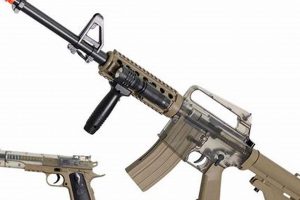
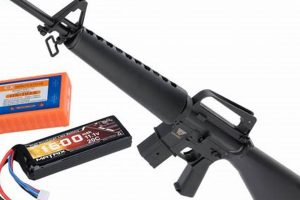
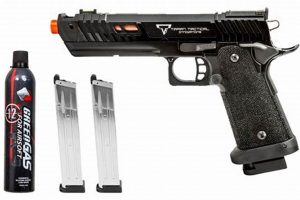
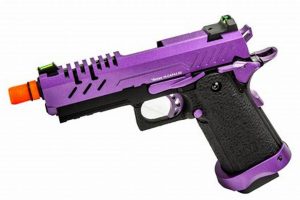
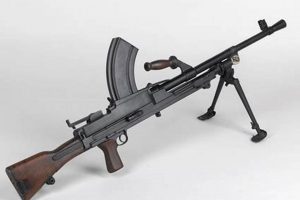
The maximum projectile range of an airsoft replica firearm is a critical performance characteristic. This distance varies considerably based on factors such as the specific type of airsoft gun (e.g., spring-powered, gas-powered, electric), the power source used, and modifications made to the internal components. For example, a stock electric airsoft rifle might achieve a significantly different range than a heavily upgraded sniper rifle.
Understanding the projectile range is essential for strategic gameplay and safety considerations in airsoft. Historically, range limitations have dictated engagement tactics, influencing the evolution of airsoft scenarios and field designs. A longer effective range allows for more flexible maneuvering and a greater ability to engage opponents from a distance, while a shorter range necessitates a more aggressive, close-quarters approach. Safety protocols are built around understanding the limitations of different airsoft guns.
The following discussion will elaborate on the key determinants of projectile range, including the type of airsoft gun, the influence of internal upgrades, and the critical role of ammunition selection. These elements combine to define the effective distance an airsoft projectile can travel and maintain accuracy.
Maximizing Airsoft Projectile Range
Optimizing the distance an airsoft projectile travels involves careful consideration of various factors. Implementing these strategies can enhance performance and improve accuracy at extended ranges.
Tip 1: Airsoft Gun Type Selection: Electric airsoft rifles (AEGs) generally offer a balance of range and rate of fire, suitable for diverse combat scenarios. Spring-powered rifles, often used as sniper rifles, can achieve greater ranges but require manual cocking between shots. Gas blowback rifles (GBBRs) provide realism but may have reduced range compared to AEGs.
Tip 2: Inner Barrel Quality: Upgrading to a tighter bore inner barrel can improve consistency and accuracy, contributing to increased projectile range. Stainless steel barrels are often preferred for their durability and consistent internal diameter.
Tip 3: Hop-Up Adjustment: Precisely adjust the hop-up unit to impart backspin on the BB, extending its range by counteracting gravity. Fine-tuning the hop-up is crucial for achieving optimal projectile trajectory.
Tip 4: Ammunition Weight Selection: Employ heavier BBs (e.g., 0.25g, 0.28g, or higher) for enhanced stability in flight, especially in windy conditions or for longer-range engagements. Lighter BBs are more susceptible to wind drift and may lose velocity quickly.
Tip 5: Air Seal Optimization: Ensure a proper air seal within the airsoft gun’s compression components. Leaks in the piston head, cylinder head, or nozzle can significantly reduce power and, consequently, projectile range. Consider O-ring upgrades.
Tip 6: Power Source Consistency: Maintain a consistent power source. For AEGs, this means using a fully charged battery with adequate voltage. For gas-powered guns, ensure the gas reservoir is adequately filled, and ambient temperature is appropriate for optimal gas pressure.
Tip 7: Regular Maintenance: Consistent cleaning and lubrication of internal components reduce friction and wear, maintaining optimal performance and preventing range degradation. Lubricate the gears and piston O-ring with appropriate silicone grease.
Implementing these strategies collectively enhances airsoft projectile range, contributing to improved performance in various gameplay scenarios. The careful execution of these adjustments maximizes the effective distance a projectile can travel with maintained accuracy.
Moving forward, the article will conclude with a comprehensive summary of the key elements determining projectile range and offer final thoughts on optimizing performance in airsoft engagements.
1. Power source consistency

Power source consistency is a critical determinant of projectile range in airsoft replicas. Fluctuations in the power supply directly impact the amount of energy transferred to the projectile, influencing its initial velocity and, consequently, the distance it travels. In electric airsoft guns (AEGs), a battery with inconsistent voltage output results in variable motor performance, leading to inconsistent piston movement and air compression. This directly translates to differences in the velocity of the BB leaving the barrel, affecting the trajectory and ultimate range.
Gas-powered airsoft guns also exhibit a strong dependence on power source consistency. Variations in gas pressure, influenced by factors like ambient temperature or the fill level of the gas reservoir, cause fluctuations in the force propelling the BB. Lower gas pressure results in reduced projectile velocity and a shorter range, while inconsistent pressure leads to erratic shots and decreased accuracy. As an example, a gas blowback pistol using a nearly empty magazine will show a significant decrease in power and range compared to one using a freshly filled magazine. Maintaining a stable and optimal power source is therefore imperative for maximizing and maintaining projectile range.
In summary, power source consistency is fundamentally linked to projectile range in airsoft. Voltage sags in electric airsoft guns and pressure variations in gas-powered replicas directly impact the energy imparted on the BB, subsequently affecting its velocity and range. Adhering to manufacturer recommendations regarding battery voltage and gas type, coupled with ensuring consistent gas pressure, are crucial steps in maintaining projectile range and overall performance. Failure to address power source consistency will inevitably result in decreased range and unpredictable shot patterns, diminishing the effectiveness of the airsoft gun.
2. Hop-up unit adjustment

The relationship between hop-up unit adjustment and projectile range is a foundational element in airsoft performance. A hop-up unit imparts backspin onto the airsoft BB as it exits the inner barrel. This backspin creates an aerodynamic effect known as the Magnus effect, generating lift that counteracts gravity. Without proper hop-up adjustment, the BB will experience a rapid descent, significantly limiting its range. Conversely, excessive hop-up can cause the BB to rise sharply and prematurely, again reducing effective range. The optimal setting achieves a balance, allowing the BB to travel a greater distance on a flatter trajectory. As an example, consider two identical airsoft rifles firing the same ammunition. One rifle has a properly adjusted hop-up, imparting optimal backspin; the other has no hop-up engaged. The rifle with the adjusted hop-up will consistently achieve a significantly greater range.
The practical application of hop-up adjustment extends to various airsoft gameplay scenarios. In outdoor settings, where longer engagement distances are common, precise adjustment is crucial for accurate shots. Skilled players routinely fine-tune their hop-up based on BB weight, wind conditions, and desired target distance. This allows for more effective target engagement and reduces the need for excessive elevation compensation when aiming. Furthermore, an improperly adjusted hop-up can lead to inconsistent shot placement, impacting accuracy and overall effectiveness during gameplay. The adjustment of hop-up varies based on the type of gun. For example, some guns have rotary hop-up systems that allow for very precise adjustments.
In conclusion, hop-up unit adjustment is indispensable for maximizing projectile range in airsoft. Understanding the principle of backspin and its impact on trajectory is essential for effective gameplay. The correct adjustment will give the airsoft BB the most range and accuracy for engagement, regardless of environmental conditions. Effective range, or how far an airsoft gun can shoot, is inextricably linked to the fine-tuning of the hop-up unit to optimize BB flight path.
3. Ammunition weight selection
The selection of ammunition weight directly influences the distance an airsoft projectile can travel. Lighter BBs, typically ranging from 0.12g to 0.20g, achieve higher initial velocities due to requiring less energy for propulsion. This can result in a seemingly longer initial flight path. However, their reduced mass makes them more susceptible to wind resistance and air currents, leading to rapid deceleration and trajectory deviation, ultimately shortening the effective range. Conversely, heavier BBs, ranging from 0.25g to 0.40g or higher, possess greater momentum, allowing them to resist air resistance more effectively. While they might exhibit a slightly lower initial velocity, their ability to maintain velocity and stability over longer distances contributes to an extended range and improved accuracy, especially in outdoor environments.
The optimal ammunition weight varies based on the airsoft gun’s power output and intended use. Lower-powered airsoft pistols or indoor-oriented rifles often perform adequately with lighter BBs, as the shorter engagement distances mitigate the effects of wind resistance. Higher-powered rifles, particularly those used in outdoor scenarios, benefit significantly from heavier BBs. For example, a sniper rifle shooting at targets beyond 50 meters would typically utilize BBs in the 0.30g to 0.40g range to maintain accuracy and minimize the impact of wind. Furthermore, using a weight outside a recommended range can negatively affect the airsoft gun’s components, causing potential wear and tear or even malfunctions due to excessive strain.
In summary, ammunition weight selection is a critical factor determining the projectile range and accuracy of airsoft guns. While lighter BBs offer higher initial velocities, heavier BBs provide superior stability and resistance to environmental factors, leading to increased effective range, particularly at longer distances. Selecting the appropriate BB weight based on the airsoft gun’s power output and the intended engagement distance is crucial for optimal performance and responsible gameplay.
4. Inner barrel quality

The quality of the inner barrel is a significant determinant in the achievable projectile range of an airsoft gun. The inner barrel serves as the final pathway for the BB before exiting the replica, and its characteristics profoundly influence projectile velocity and trajectory stability, thereby affecting how far an airsoft gun shoots. Key attributes, such as bore diameter consistency, surface smoothness, and material composition, collectively contribute to the efficiency of gas or air propulsion behind the BB. Inconsistencies in bore diameter or imperfections in the internal surface can disrupt airflow, leading to turbulence and reduced projectile velocity. The choice of material also impacts barrel rigidity and vibration dampening, factors that further influence projectile trajectory. For example, a high-precision stainless steel barrel with a consistent bore diameter will generally yield greater range and accuracy compared to a lower-quality aluminum barrel with manufacturing imperfections.
The practical implications of inner barrel quality are evident in observed airsoft performance. Upgrading to a tighter bore inner barrel, often referred to as a “tightbore,” can enhance projectile velocity by minimizing air leakage around the BB. However, a tightbore barrel necessitates higher-quality BBs to prevent jamming and further exacerbate any imperfections in the barrel itself. Conversely, a wider bore barrel might be more forgiving of lower-quality BBs but will generally result in a lower projectile velocity. Furthermore, the length of the inner barrel also plays a role. Longer barrels generally allow for greater acceleration of the BB, but this is contingent on the air volume generated by the airsoft gun’s cylinder being appropriately matched to the barrel length. Insufficient air volume can lead to a phenomenon known as “undervoluming,” where the BB begins to decelerate before exiting the barrel, negating any potential range benefits. As such, inner barrel quality is a multifaceted consideration that requires careful integration with other internal components for optimal performance.
In conclusion, inner barrel quality is inextricably linked to the projectile range of an airsoft gun. While not the sole determinant, it is a critical component in maximizing velocity, ensuring trajectory stability, and ultimately, achieving the desired distance. Challenges arise in selecting the appropriate barrel length and bore diameter in relation to other internal components, necessitating a balanced approach to upgrade and modification. A comprehensive understanding of the principles governing airsoft mechanics, coupled with careful selection of high-quality inner barrels, contributes significantly to optimizing projectile range.
5. Air seal optimization
Air seal optimization is paramount in maximizing projectile range in airsoft replicas. An efficient air seal ensures minimal air leakage within the compression components, leading to consistent and maximized energy transfer to the BB. This efficient energy transfer translates directly into higher muzzle velocity and, consequently, a greater effective range for the airsoft gun.
- Piston Head Integrity
The piston head’s seal within the cylinder is crucial. Worn or damaged piston head O-rings allow air to bypass the piston during compression, reducing the force propelling the BB. For example, a cracked O-ring in a high-powered AEG can diminish projectile range by as much as 20%, severely hindering its performance on the field.
- Cylinder Head Nozzle Alignment
Proper alignment and sealing between the cylinder head nozzle and the hop-up bucking are essential for directing the compressed air efficiently. Misalignment or gaps can result in air leakage, diminishing muzzle velocity and reducing the projectile’s effective range. Inconsistent sealing here can also impact shot-to-shot consistency.
- Hop-Up Bucking Seal
The hop-up bucking must create a tight seal around the BB as it enters the barrel. A worn or incorrectly installed bucking can leak air, reducing the amount of force applied to the BB as it is propelled forward. This is especially noticeable in gas blowback rifles, where gas efficiency and projectile range are closely linked to the integrity of the hop-up bucking seal.
- Nozzle O-Ring Effectiveness
The nozzle O-ring, if present, seals the nozzle against the hop-up bucking during the firing cycle. A deteriorated or absent O-ring can cause significant air loss, diminishing the force behind the BB and greatly reducing potential range. Regular maintenance of this component is essential to prevent performance degradation.
These facets demonstrate that air seal optimization is not a single component adjustment, but a series of integrated system checks to eliminate losses. Every point where air can escape reduces the effectiveness of the airsoft gun and negatively impacts how far the airsoft gun can shoot. A focus on maximizing air seal efficiency across all components will deliver a noticeable improvement in power, consistency, and overall range.
6. Gun type variations
The type of airsoft gun significantly influences projectile range. Different propulsion systems, mechanisms, and inherent power levels lead to substantial disparities in how far each gun type can effectively shoot. Understanding these variations is crucial for informed equipment selection and strategic gameplay.
- Spring-Powered Rifles
Spring-powered rifles, particularly sniper rifles, often achieve greater projectile range due to their focus on power and precision. These rifles utilize a manually cocked spring to generate significant force, propelling the BB at high velocities. However, their single-shot nature limits their rate of fire. An example would be a high-end sniper rifle with upgraded internals capable of accurately hitting targets at distances exceeding 70 meters.
- Electric Airsoft Guns (AEGs)
AEGs offer a balance between rate of fire and range. Their electric motors drive a piston that compresses air, propelling the BB. While typically not matching the peak range of spring-powered sniper rifles, AEGs provide consistent performance and a higher volume of fire, making them versatile for diverse combat scenarios. A standard AEG may have an effective range of around 40-50 meters.
- Gas Blowback Rifles (GBBRs)
GBBRs utilize compressed gas (typically green gas or propane) to propel the BB and cycle the bolt, simulating the recoil action of a real firearm. While offering a more realistic shooting experience, GBBRs generally exhibit reduced projectile range compared to AEGs due to efficiency losses associated with the gas blowback mechanism. Performance is also influenced by ambient temperature, which can affect gas pressure. A GBBR might achieve an effective range of 30-45 meters under optimal conditions.
- High-Pressure Air (HPA) Systems
HPA systems utilize an external air tank to provide a consistent and adjustable power source. These systems allow for precise control over projectile velocity and can achieve significant range and accuracy, often surpassing AEGs and GBBRs. HPA systems are popular for their customization options and consistent performance, particularly in long-range engagements. Depending on the setup, an HPA system can easily achieve an effective range similar to a spring-powered sniper rifle, but with the added benefit of adjustable power levels and potentially higher rates of fire.
These gun type variations illustrate the diverse range capabilities within the airsoft sport. Each system has its strengths and weaknesses, influencing tactical applications and playing styles. The ultimate distance an airsoft gun can effectively shoot is inextricably linked to the design and power source inherent to its type.
7. Environmental conditions
Environmental conditions exert a significant influence on the projectile range of airsoft guns. Atmospheric factors directly impact the trajectory and velocity of airsoft BBs, subsequently affecting the achievable distance and accuracy. Wind, temperature, humidity, and precipitation are primary environmental variables that must be considered when assessing effective range. For example, a crosswind can deflect a BB from its intended path, causing it to deviate laterally and reducing its accuracy at longer ranges. Similarly, higher air density due to lower temperatures can increase air resistance, slowing the BB down and diminishing its overall range.
Wind speed and direction are particularly influential. Even a slight breeze can cause a measurable shift in the BB’s trajectory, necessitating adjustments to aiming points. Experienced airsoft players often employ techniques to estimate wind drift and compensate accordingly. Temperature affects gas pressure in gas-powered airsoft guns, where colder temperatures can reduce pressure, leading to lower muzzle velocities and shorter ranges. Humidity can also affect BBs, potentially causing them to absorb moisture and increase in weight, altering their flight characteristics. Rain or other precipitation can introduce significant drag, severely limiting projectile range and accuracy. The interplay of these environmental factors introduces complexity to airsoft gameplay and requires adaptability and an understanding of physics to maintain effectiveness. As such, knowledge of external conditions is a critical component of maximizing both range and accuracy.
In summary, environmental conditions represent a complex yet critical factor in determining projectile range in airsoft. Wind, temperature, humidity, and precipitation each contribute to variations in BB trajectory and velocity, requiring players to adapt their strategies and techniques. Neglecting these environmental influences can lead to inaccurate shots and a reduced effective range, highlighting the importance of understanding and accounting for these variables to optimize airsoft performance. Mastering windage and elevation adjustments based on prevailing environmental conditions is a significant skill for advanced airsoft players.
Frequently Asked Questions
The following addresses common inquiries regarding the distance airsoft projectiles can travel and factors influencing range performance.
Question 1: What is the typical projectile range of a standard electric airsoft rifle (AEG)?
A standard AEG typically achieves an effective range of approximately 40-50 meters. However, this can vary based on internal components, hop-up adjustment, and ammunition weight.
Question 2: Can modifications to an airsoft gun significantly increase its projectile range?
Yes, modifications such as upgrading the inner barrel, optimizing air seal, and adjusting the hop-up unit can demonstrably increase projectile range. However, modifications should be performed by experienced individuals to avoid compromising safety or performance.
Question 3: How does ammunition weight affect the distance an airsoft gun can shoot?
Heavier ammunition generally provides greater stability in flight and resistance to wind, contributing to increased effective range, especially at longer distances. Lighter ammunition may achieve higher initial velocities but is more susceptible to environmental factors.
Question 4: Are there any legal restrictions on the power or range of airsoft guns?
Legal restrictions on the power of airsoft guns vary by jurisdiction. Some regions impose velocity limits, typically measured in feet per second (FPS) with a specific BB weight. It is essential to be aware of and comply with all applicable local laws and regulations.
Question 5: What role does the hop-up unit play in determining projectile range?
The hop-up unit imparts backspin onto the BB, creating lift that counteracts gravity and extends the projectile’s range. Precise adjustment of the hop-up is crucial for achieving optimal trajectory and maximizing distance.
Question 6: How do environmental conditions impact the distance an airsoft gun can shoot?
Environmental conditions, such as wind, temperature, and humidity, significantly affect projectile trajectory and range. Wind can cause lateral deviation, while temperature can affect gas pressure in gas-powered guns. Players should adjust their tactics and equipment based on prevailing conditions.
Understanding the elements influencing projectile range in airsoft is critical for both maximizing performance and adhering to safety guidelines. Careful consideration of these factors contributes to a more enjoyable and responsible airsoft experience.
The subsequent discussion will address safety considerations when handling airsoft guns, focusing on eye protection, responsible gun handling, and awareness of surroundings.
How Far Does An Airsoft Gun Shoot
The distance an airsoft projectile travels is determined by a convergence of factors, encompassing gun type, internal components, ammunition selection, and environmental conditions. Spring-powered rifles often exhibit the greatest potential range due to their inherent power, while electric airsoft guns (AEGs) provide a balance of range and rate of fire. Gas blowback rifles, prioritizing realism, tend to have somewhat reduced range compared to AEGs. Environmental variables, such as wind and temperature, can significantly influence trajectory and overall distance.
Understanding these interdependencies is crucial for optimizing performance and ensuring responsible airsoft practices. Awareness of how far an airsoft gun can shoot allows for informed tactical decisions and promotes adherence to established safety protocols, fostering a safe and engaging environment for all participants. Continued research and development in airsoft technology will further refine range capabilities, making it essential for players to remain informed about advancements in the field.