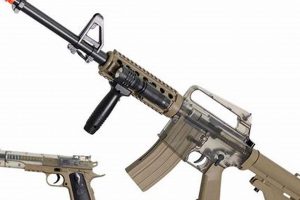
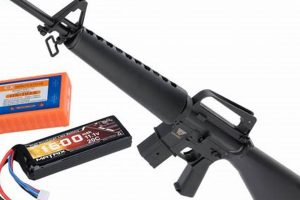
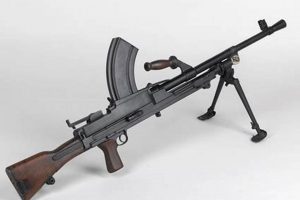
Airsoft is a recreational activity where participants eliminate opponents by hitting them with spherical non-metallic pellets launched from realistic replica firearms. The activity encompasses a variety of organized scenarios, often mimicking military tactics and objectives. These scenarios provide structure and purpose to the engagements.
Organized airsoft scenarios promote teamwork, strategic thinking, and physical activity. The simulations encourage communication and coordination among participants, fostering social interaction and camaraderie. Furthermore, the tactical aspects of the simulations require players to develop problem-solving skills and adapt to changing circumstances. Historically, this type of organized recreational shooting has provided an outlet for individuals interested in military simulations and tactical training in a safe and controlled environment.
The following sections will detail specific scenario types, outlining their objectives, rules, and strategic considerations, thus providing a comprehensive guide to understanding and participating in diverse airsoft experiences.
Enhancing Airsoft Engagement
Effective participation requires strategic planning and adherence to established guidelines. The following considerations are essential for maximizing enjoyment and minimizing potential risks.
Tip 1: Objective Prioritization: Before the engagement commences, clearly define the primary and secondary objectives. Understanding these objectives facilitates focused tactical decision-making and efficient resource allocation.
Tip 2: Communication Protocol: Establish a clear and concise communication system among team members. Utilizing pre-determined codes and signals ensures efficient information dissemination and coordinated movement.
Tip 3: Cover and Concealment Mastery: Emphasize the importance of utilizing available cover and concealment. Understanding angles of fire and minimizing exposure significantly reduces the risk of elimination.
Tip 4: Tactical Maneuvering: Employ flanking maneuvers and coordinated advances to gain a tactical advantage. Avoid predictable movement patterns and anticipate opponent reactions.
Tip 5: Equipment Maintenance: Regularly inspect and maintain all equipment, including airsoft replicas, protective gear, and communication devices. This ensures reliable performance and minimizes the risk of malfunctions during the engagement.
Tip 6: Rules of Engagement Adherence: Strictly adhere to established rules of engagement, including safety protocols, minimum engagement distances, and acceptable behavior. Compliance promotes a safe and enjoyable experience for all participants.
These strategic considerations are fundamental to optimizing effectiveness and ensuring a safe and enjoyable experience. Implementing these principles elevates the level of engagement and contributes to a more rewarding overall experience.
The following sections will explore specific airsoft scenarios in greater detail.
1. Objective-Based Scenarios
The establishment of defined objectives serves as the cornerstone of organized airsoft engagements. Without a clear objective, airsoft devolves into unstructured skirmishes lacking purpose and strategic depth. Objective-Based Scenarios provide the framework upon which tactics are developed, teamwork is emphasized, and the overall experience is enhanced. The cause-and-effect relationship is straightforward: a defined objective prompts strategic planning, which in turn necessitates communication and coordinated action among participants.
A common example is “Capture the Flag,” where two teams vie for possession of the opposing team’s flag while simultaneously defending their own. This specific objective mandates a multifaceted approach involving offensive maneuvers, defensive strategies, and logistical support. Another prevalent scenario involves bomb defusal, requiring one team to plant a simulated explosive device while the opposing team attempts to disarm it within a time limit. The practical significance of understanding the connection between objective-based gameplay and overall participant experience lies in the ability to design and implement engaging simulations that promote teamwork, strategic thinking, and problem-solving skills.
In summary, the inclusion of Objective-Based Scenarios is paramount to structuring and enriching recreational airsoft. Challenges in their design often involve balancing complexity with accessibility to ensure a rewarding experience for participants of varying skill levels. Understanding this critical component contributes directly to the successful planning and execution of organized airsoft activities and links to the broader theme of creating engaging and immersive recreational activities.
2. Team-Oriented Gameplay

Team-oriented gameplay is a fundamental component of organized airsoft scenarios. Its absence transforms engagements into individualistic endeavors, diminishing the strategic complexity and social interaction inherent in the activity. The structure of such games often necessitates collaborative effort to achieve predetermined objectives. The cause-and-effect relationship is evident: the establishment of a team-based objective mandates communication, coordination, and strategic alignment among participants. The importance of team-oriented gameplay lies in its ability to foster camaraderie, enhance strategic thinking, and promote problem-solving skills within a group dynamic. For instance, scenarios such as “Capture the Flag” or “Search and Destroy” require teams to coordinate offensive and defensive strategies, share information about enemy positions, and support one another in achieving their objectives. Without team cohesion, success in these scenarios becomes significantly more challenging.
The practical significance of understanding this connection extends to the design and implementation of airsoft events. Organizers must carefully craft scenarios that incentivize teamwork and discourage individual “lone wolf” tactics. This can be achieved through the implementation of rules that reward coordinated action, penalize uncooperative behavior, or simply design objectives that are inherently difficult to achieve without teamwork. For example, a scenario might require teams to simultaneously control multiple points on a map, making it impossible for individuals to effectively defend all locations alone. Similarly, scenarios requiring the transport of heavy objects or the completion of complex tasks necessitate coordinated effort and division of labor.
In summary, team-oriented gameplay is not merely a desirable element of airsoft engagements but an essential ingredient for creating immersive, engaging, and socially rewarding experiences. The challenge lies in designing scenarios that effectively encourage teamwork and minimize the potential for individualistic play styles. Failing to recognize and address this challenge can result in diminished participant satisfaction and a less engaging overall experience. This reinforces the broader theme of creating structured and interactive recreational activities that promote social interaction and strategic thinking.
3. Strategic Teamwork
Strategic teamwork is a cornerstone of success in airsoft, influencing the outcome of simulated combat scenarios and the overall enjoyment derived from participation. Effective coordination and communication among team members are essential for achieving objectives and overcoming challenges inherent in these activities.
- Coordinated Maneuvers
Coordinated maneuvers involve synchronized movement and tactical positioning to gain an advantage over opposing forces. Teams that effectively utilize flanking tactics, diversionary attacks, and coordinated advances are more likely to achieve their objectives. A real-world example is a squad executing a pincer movement to surround and neutralize an enemy position. In airsoft, this might involve one group providing covering fire while another flanks the opposing team, demonstrating how coordinated action enhances effectiveness.
- Effective Communication
Effective communication facilitates real-time information sharing and coordinated decision-making. Teams that establish clear communication channels and protocols can rapidly adapt to changing battlefield conditions and respond effectively to threats. Military units rely heavily on standardized communication procedures to ensure clarity and minimize misunderstandings. Airsoft teams benefit from similar practices, using radios or pre-arranged hand signals to relay information about enemy positions, movements, and intentions.
- Role Specialization
Role specialization involves assigning specific tasks and responsibilities to individual team members based on their skills and expertise. Teams that effectively utilize role specialization can maximize their collective capabilities and improve their overall performance. In military units, individuals may specialize in areas such as reconnaissance, demolition, or medical support. Airsoft teams can adopt similar roles, with some members focusing on sniping, others on close-quarters combat, and still others on providing support and communication.
- Adaptive Strategy
Adaptive strategy involves the ability to adjust tactics and plans in response to changing circumstances and unexpected challenges. Teams that can quickly assess the situation, identify emerging threats, and adapt their strategy accordingly are more likely to succeed. Military commanders must constantly adapt their plans based on intelligence reports and battlefield developments. Airsoft teams benefit from a similar mindset, adjusting their tactics based on enemy movements, terrain features, and objective requirements.
These facets of strategic teamwork demonstrate its integral role in airsoft engagements. Scenarios that prioritize and reward coordinated action among participants enhance the overall level of engagement and contribute to a more rewarding and immersive experience. Strategic teamwork not only improves a team’s chances of success but also fosters camaraderie and promotes the development of valuable leadership and communication skills, furthering the intrinsic recreational value of organized airsoft.
4. Realistic Tactical Simulation

Realistic Tactical Simulation forms a crucial link within organized airsoft activities. The degree to which a scenario accurately simulates real-world combat tactics and procedures directly influences participant engagement and the development of transferable skills. The cause is clear: accurate simulation promotes immersive gameplay, heightened strategic thinking, and an appreciation for the complexities of tactical decision-making. The importance of this element lies in its capacity to elevate airsoft beyond simple recreational shooting, transforming it into a challenging and intellectually stimulating activity. Military training exercises often incorporate simulated combat environments to prepare soldiers for real-world scenarios. Similarly, airsoft scenarios that accurately replicate tactical formations, communication protocols, and objective-based missions provide participants with a tangible experience of strategic planning and execution. The practical significance of this understanding lies in its ability to inform scenario design and rule implementation, ultimately enhancing the quality and educational value of airsoft engagements.
Further analysis reveals several practical applications of realistic tactical simulation. The use of authentic military terminology, the implementation of realistic movement and communication protocols, and the incorporation of objective-based scenarios mirroring real-world missions contribute to a more immersive and engaging experience. For example, a scenario that requires participants to navigate a simulated urban environment while adhering to specific rules of engagement provides a realistic context for tactical decision-making. Such scenarios can promote critical thinking, problem-solving, and leadership skills, as participants are forced to adapt to changing circumstances and coordinate their actions with team members. These applications are not limited to simulating combat scenarios, they extend to disaster response, search and rescue, and law enforcement training.
In conclusion, the integration of realistic tactical simulation is essential for maximizing the value of organized airsoft. While challenges remain in balancing realism with accessibility, the benefits of this approach are undeniable. By prioritizing realistic tactical simulations, airsoft organizers can create engaging, intellectually stimulating, and potentially educational experiences that foster teamwork, strategic thinking, and an appreciation for the complexities of real-world tactical operations. This contributes to the broader theme of utilizing recreational activities to promote learning, personal growth, and the development of transferable skills.
5. Adherence to Safety Protocols
The integration of safety regulations is paramount within organized airsoft activities. Failure to enforce and comply with established guidelines presents a significant risk of injury and compromises the integrity of the engagement. The direct correlation between strict adherence to safety protocols and the successful execution of scenarios is irrefutable: Safe practices mitigate the potential for harm, creating a secure environment that allows for focused participation and strategic interaction. Prioritizing safety measures transforms recreational shooting from a potentially hazardous activity into a controlled and enjoyable pastime. Enforced safety rules dictate mandatory eye protection, minimum engagement distances, and limitations on projectile velocity, ensuring responsible and controlled interactions. A lack of enforcement invariably increases incidents such as eye injuries, welts, or other physical harm caused by close-range impacts or excessive projectile force.
A further examination reveals several practical implications. The implementation of mandatory pre-engagement safety briefings, equipment inspections, and field marshal oversight significantly reduces the likelihood of accidents. Strict adherence to velocity limits, usually measured in feet per second (FPS), prevents the use of excessively powerful airsoft replicas that could cause serious injury. Furthermore, the designation of safe zones where eye protection is mandatory, even when replicas are not in use, provides an additional layer of security. Regularly reviewing and updating safety protocols to reflect current best practices and address emerging concerns, such as the use of modified replicas, ensures that participants are protected from potential hazards. Failure to address these measures can have dire consequences for participants who failed to follow the safety protocols.
In summary, consistent compliance with safety protocols is non-negotiable in organized airsoft engagements. Although implementing and enforcing these measures presents ongoing challenges, their benefits are clear: reduced injury risk, enhanced participant safety, and the preservation of airsoft as a recreational activity. Ignoring these essential elements fundamentally undermines the sustainability and integrity of airsoft events, linking to the broader theme of promoting responsible and safe recreational activities that prioritize the well-being of participants.
Frequently Asked Questions Regarding Organized Airsoft Engagements
This section addresses common inquiries and misconceptions surrounding organized airsoft scenarios. Information is presented to clarify fundamental aspects and promote a comprehensive understanding of the activity.
Question 1: What distinguishes organized airsoft from casual backyard shooting?
Organized airsoft involves structured scenarios with defined objectives, rules of engagement, and safety protocols. Casual shooting lacks these elements, increasing the risk of injury and diminishing the strategic depth.
Question 2: What are the essential safety requirements for participation?
Mandatory eye protection, adherence to velocity limits, and respect for minimum engagement distances are crucial for participant safety. Failure to comply with these requirements can result in exclusion from the engagement.
Question 3: How are teams typically structured in airsoft engagements?
Teams are generally organized with specific roles assigned to individual members, such as assault, support, and reconnaissance. This structure promotes teamwork and strategic coordination.
Question 4: What types of airsoft replicas are commonly used?
Airsoft replicas vary in design and power, ranging from electric-powered automatic rifles to gas-powered pistols. Compliance with velocity limits is essential regardless of replica type.
Question 5: What strategies are most effective for achieving objectives?
Effective strategies include coordinated maneuvers, clear communication, and adaptive tactics. Individual “lone wolf” approaches are generally less successful than teamwork-based approaches.
Question 6: How can participants ensure a positive experience for all involved?
Adhering to safety protocols, respecting game rules, and maintaining sportsmanlike conduct contribute to a positive and enjoyable experience for all participants.
In summary, understanding the fundamental principles of organized airsoft, prioritizing safety, and promoting teamwork are essential for maximizing the enjoyment and minimizing the risks associated with this recreational activity.
The following sections will explore advanced tactical strategies and equipment considerations in greater detail.
Conclusion
This exploration has elucidated the structured landscape surrounding “games to play with airsoft guns.” It underscores the significance of objective-based scenarios, team-oriented gameplay, strategic teamwork, realistic tactical simulation, and unwavering adherence to safety protocols. The efficacy of airsoft engagements hinges on a delicate balance between immersive realism and responsible conduct.
The information presented serves as a foundation for both participants and organizers. Continued emphasis on safety, ethical play, and innovative scenario design will ensure the longevity and responsible evolution of “games to play with airsoft guns” as a recreational activity. Further developments in replica technology and tactical simulations offer opportunities for enhanced engagement and skill development, contingent upon unwavering commitment to safety and ethical considerations.