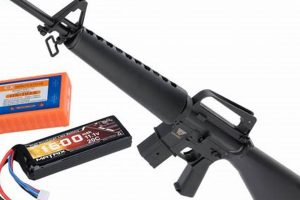
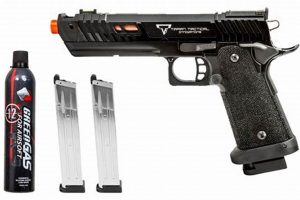
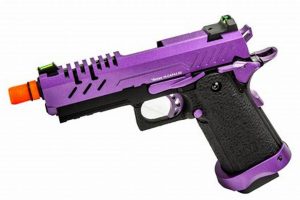
The presence of a brightly colored marking, often orange, at the muzzle of replica firearms, including those used in airsoft, serves as a visual indicator that the item is not a real firearm. This marker is typically a plastic plug permanently affixed to the barrel’s end. An example would be a bright orange piece that covers the last inch or so of an airsoft gun’s barrel.
This identification mark is crucial for preventing confusion and potential misidentification by law enforcement or the general public. Its purpose is to distinguish these recreational devices from actual weapons, thereby minimizing the risk of accidental shootings, escalated confrontations, or unnecessary alarm. Its historical context stems from an attempt to regulate the appearance of imitation firearms to reduce related safety concerns and misuse.
The subsequent sections will elaborate on the legal requirements surrounding these markers, the specific regulations that apply to airsoft devices, and the potential consequences of non-compliance.
Understanding Muzzle Markings on Airsoft Replicas
This section outlines key considerations related to required muzzle markings on airsoft devices, focusing on practical guidance and regulatory awareness.
Tip 1: Federal Law Adherence: U.S. federal law mandates that all imported imitation firearms possess a blaze orange marking covering the barrel’s extreme tip. This marking must extend no more than 6mm from the muzzle end. Failure to comply can result in seizure of the item.
Tip 2: State and Local Regulations: While federal law establishes a baseline, state and local laws can impose stricter requirements or outright bans on imitation firearms. It is imperative to research and understand the specific regulations applicable in your area.
Tip 3: Permanent Affixation: The orange tip should be permanently affixed. Removal or alteration of the marking can be interpreted as an attempt to make the replica resemble a real firearm, potentially leading to legal repercussions.
Tip 4: Transportation Considerations: When transporting an airsoft replica, ensure the orange tip is clearly visible. Carrying it in a case or bag with the orange tip concealed could raise suspicion and lead to unnecessary encounters with law enforcement.
Tip 5: Purchase from Reputable Sources: Acquire airsoft devices only from reputable dealers who are aware of and comply with all applicable laws. This minimizes the risk of purchasing a replica that does not meet legal standards.
Tip 6: Documentation is Helpful: Keep receipts or other documentation proving the device is an airsoft replica. This can be helpful in clarifying the device’s nature if questioned by authorities.
Tip 7: Educate Others: Inform others involved in airsoft activities, especially younger participants, about the importance of orange tips and the potential consequences of their removal or alteration.
Adherence to these guidelines promotes safety and compliance with legal requirements, mitigating potential risks associated with the use and transportation of airsoft devices.
The following sections will provide a comprehensive summary of the information presented and offer concluding remarks on the subject.
1. Federal Import Regulation
Federal Import Regulation directly necessitates a positive response to “do airsoft guns need orange tips”. This regulation stipulates that all imitation firearms, including airsoft guns, imported into the United States must have a blaze orange marking, typically a tip, affixed to the muzzle. This requirement functions as a critical safety measure, ensuring that these replicas are readily distinguishable from real firearms upon arrival within the country’s borders. The absence of this regulatory measure could lead to increased instances of misidentification, potential law enforcement escalations, and compromised public safety. For example, without the orange tip mandate, customs officials would face increased difficulty in differentiating airsoft guns from actual firearms during inspections, potentially delaying shipments and diverting resources.
The enforcement of the Federal Import Regulation is the mechanism through which the need for orange tips is concretely realized. Compliance prevents replicas from entering the market disguised as functional weapons. This, in turn, significantly reduces the likelihood of incidents involving misuse or confusion. The presence of the orange tip provides a clear visual signal, assisting law enforcement in rapid assessment situations and providing a critical margin of safety in interactions with the public. Understanding this cause-and-effect relationship allows individuals to appreciate that the regulation isnt merely a bureaucratic formality but a crucial layer of protection.
In summary, the Federal Import Regulation serves as the primary driver for the requirement that airsoft guns imported into the United States possess an orange tip. Its effective implementation contributes significantly to mitigating the risk of misidentification and promoting responsible handling and use of these devices. The challenge lies in maintaining consistent enforcement and widespread awareness of the regulation to ensure its continued effectiveness in safeguarding public safety and preventing potential incidents.
2. State Law Variance

The existence of “State Law Variance” introduces complexity regarding whether “do airsoft guns need orange tips”. While federal law mandates orange tips for imported airsoft devices, individual states and municipalities can enact their own regulations, potentially creating inconsistencies. This variance means that even if an airsoft gun complies with federal requirements, it might still violate local laws. For example, some states may prohibit the sale of airsoft guns altogether, irrespective of the presence of an orange tip, effectively rendering the federal requirement moot within that jurisdiction. Others may mandate additional markings or safety features beyond the federal standard. Therefore, understanding “State Law Variance” is crucial in determining the legal requirements for airsoft devices.
The practical significance of this understanding lies in avoiding potential legal repercussions. For instance, transporting an airsoft gun with an orange tip that complies with federal law into a state where such devices are banned could still result in confiscation and legal penalties. Similarly, selling an airsoft gun with only an orange tip in a locality requiring additional markings would constitute a violation of local ordinance. The onus, therefore, falls upon the individual to ascertain and adhere to all applicable state and local laws, irrespective of federal compliance. Online forums and legal resources often provide information regarding state and local regulations, though consulting with local law enforcement or legal counsel remains the most reliable method.
In summary, while federal law sets a baseline for orange tips on imported airsoft guns, “State Law Variance” necessitates diligent research and compliance with specific state and local laws. The lack of awareness regarding these varying regulations can result in legal complications, emphasizing the importance of thorough investigation before purchasing, selling, transporting, or using airsoft devices in any given location. This intricate interplay between federal and state laws underscores the ongoing challenge of ensuring consistent and comprehensive regulation of airsoft guns across different jurisdictions.
3. Permanent Affixation Mandate
The “Permanent Affixation Mandate” forms a crucial element regarding “do airsoft guns need orange tips.” This mandate stipulates that the orange tip, or other required marking, must be permanently and irreversibly attached to the airsoft device. Its significance lies in preventing the easy removal of the identifier, thereby reducing the risk of the replica being mistaken for a real firearm. The cause-and-effect relationship is clear: a permanently affixed marking minimizes the potential for deliberate concealment or alteration, thus promoting safer handling and mitigating risks associated with misidentification. The “Permanent Affixation Mandate” directly reinforces the function of “do airsoft guns need orange tips” by ensuring long-term visibility and preventing fraudulent modification.
Practical application of this mandate involves specific manufacturing processes and regulatory oversight. Manufacturers must employ adhesives or mechanical methods that render the orange tip inseparable from the barrel without causing significant damage to the device. Law enforcement agencies may conduct inspections to verify compliance, particularly at points of import or sale. For example, if an airsoft gun arrives at a port of entry with an orange tip easily detached, it fails to meet the “Permanent Affixation Mandate” and may be subject to seizure. Similarly, retailers selling airsoft guns with removable orange tips could face legal penalties and product recalls. The interpretation of “permanent” also plays a role, defining the allowable methods of affixation and the degree of force required to separate the marking.
In summary, the “Permanent Affixation Mandate” is intrinsically linked to the effectiveness of “do airsoft guns need orange tips.” This mandate prevents the simple removal of safety features, preventing misidentification. Enforcement challenges involve ensuring consistent interpretation and rigorous inspection procedures, ultimately safeguarding against the potential misuse of airsoft devices. This requirement highlights the ongoing effort to regulate the use of replica firearms and promote public safety.
4. Visibility During Transport

The connection between “Visibility During Transport” and “do airsoft guns need orange tips” centers on mitigating risks associated with misidentification. The presence of the orange tip, mandated by law in many jurisdictions, serves as a visual indicator that the item is an airsoft replica and not a real firearm. During transportation, especially in public spaces, an airsoft gun lacking a clearly visible orange tip can be misinterpreted as a genuine weapon, potentially triggering alarm and prompting intervention by law enforcement or armed citizens. Therefore, “Visibility During Transport” directly relies on the presence and clarity of “do airsoft guns need orange tips” to prevent misunderstandings. An example includes carrying an airsoft gun in a case with the orange tip obscured, versus openly displaying the replica with the orange tip unhindered, altering the immediate perception of threat.
The practical significance of “Visibility During Transport” extends beyond mere legal compliance; it embodies responsible gun ownership and promotes public safety. Adhering to this principle reduces the likelihood of accidental shootings, escalated confrontations, or unwarranted police involvement. For example, transporting airsoft guns to and from a skirmish event necessitates careful consideration of “Visibility During Transport.” This can involve using transparent cases or ensuring the orange tip remains unobscured even within a bag. Furthermore, it highlights the need for clear communication with law enforcement if stopped while transporting airsoft equipment, further emphasizing responsible gun handling.
In summary, the successful implementation of “do airsoft guns need orange tips” hinges significantly on “Visibility During Transport.” Challenges arise from variations in state and local laws, requiring individuals to be aware of specific regulations in their area. Maintaining vigilance regarding “Visibility During Transport” is a fundamental aspect of safe and responsible airsoft practice, contributing to overall public safety and minimizing potential misinterpretations and their consequences. Further awareness regarding the responsible handling of replicas is necessary to achieve greater social safety.
5. Preventing Misidentification

The core purpose of regulations concerning “do airsoft guns need orange tips” centers on “Preventing Misidentification.” The brightly colored tip serves as an immediate visual cue, distinguishing an airsoft replica from a real firearm. This distinction is paramount, as the consequences of misidentification can range from unwarranted alarm to deadly force. The presence of the orange tip provides a clear signal to law enforcement, civilians, and even other airsoft participants that the object is a non-lethal training or recreational device. Without this readily apparent marker, distinguishing an airsoft gun from its real counterpart becomes significantly more challenging, increasing the risk of misinterpretation and potentially escalating dangerous situations. A direct example can be seen in situations where a citizen mistakes an airsoft gun for a weapon during a robbery and responds. The situation may be deadly.
The practical application of “Preventing Misidentification” through “do airsoft guns need orange tips” extends beyond law enforcement scenarios. It also plays a crucial role in public spaces, transportation, and even within the airsoft community itself. In public, the presence of the orange tip helps alleviate fears and misunderstandings, preventing unnecessary panic. During transportation, especially across state lines with varying regulations, the visual marker provides assurance to authorities that the device is not a concealed weapon. Within the airsoft community, the orange tip reinforces safe handling practices and serves as a constant reminder of the non-lethal nature of the equipment. This has practical application in training scenarios and community education efforts.
In summary, “Preventing Misidentification” is the fundamental principle driving the requirement that “do airsoft guns need orange tips.” The orange tip’s effectiveness depends on consistent application, visibility, and public awareness. Challenges arise from variations in state and local laws, as well as attempts to circumvent regulations through removal or concealment. Addressing these challenges requires ongoing efforts to educate the public, enforce regulations, and promote responsible airsoft practices. The orange tip is a practical requirement and a symbol of commitment to safety and responsible handling in the realm of airsoft activities.
Frequently Asked Questions Regarding Muzzle Markings on Airsoft Replicas
The following questions address common inquiries and misconceptions surrounding the requirement for orange tips on airsoft devices, clarifying regulations and best practices.
Question 1: Is an orange tip absolutely required on all airsoft guns?
Federal law mandates a blaze orange marking on imported imitation firearms, including airsoft guns. However, state and local laws may impose additional requirements or restrictions.
Question 2: What are the consequences of removing the orange tip from an airsoft gun?
Removing the orange tip can be construed as an attempt to make the airsoft gun resemble a real firearm. This may result in legal penalties, including fines and confiscation of the device.
Question 3: Does the orange tip need to be a specific shade of orange?
While federal law specifies “blaze orange,” some local regulations may further define acceptable shades. It is advisable to consult local ordinances for precise requirements.
Question 4: Can the orange tip be painted over or altered?
Altering or painting over the orange tip is generally discouraged, as it diminishes its visibility and intended purpose. This action may be interpreted as an attempt to circumvent the law.
Question 5: Does the requirement for an orange tip apply to antique or collectible airsoft guns?
The requirement generally applies to all airsoft guns, regardless of their age or collectibility. However, specific exemptions may exist for certain historical replicas; legal counsel should be sought for clarification.
Question 6: Are there alternative markings that comply with the law besides an orange tip?
While the orange tip is the most common marking, some jurisdictions may permit alternative markings, such as brightly colored barrels or bands. Compliance with local laws remains paramount.
Understanding and adhering to these regulations is crucial for responsible airsoft participation and legal compliance. Failure to do so can result in severe penalties and contribute to potential misidentification.
The subsequent sections will provide a comprehensive summary of the information presented and offer concluding remarks on the subject.
The Imperative of Muzzle Markings
This exploration of “do airsoft guns need orange tips” has illuminated the legal requirements, safety considerations, and practical implications associated with muzzle markings on airsoft replicas. Federal regulations mandate orange tips on imported devices, but state and local laws introduce variations that demand diligent research. The permanent affixation of the marker and its visibility during transport are crucial for preventing misidentification and minimizing potential risks. Compliance with these regulations is not merely a legal obligation but a fundamental responsibility for all airsoft participants.
The continued effectiveness of orange tip regulations depends on consistent enforcement, ongoing education, and a commitment to responsible airsoft practices. The future may bring technological advancements or legislative changes that refine or replace current standards, but the underlying principle of preventing misidentification will remain paramount. Adherence to these guidelines safeguards individuals, communities, and the integrity of the airsoft hobby itself. Vigilance, understanding, and responsible action are necessary to ensure that airsoft remains a safe and legally compliant activity.