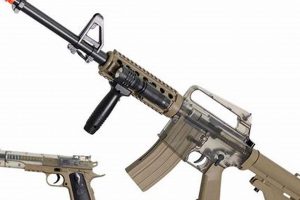
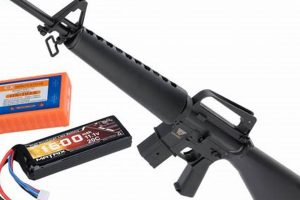
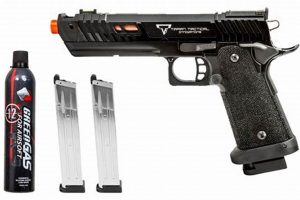
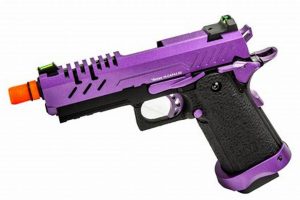
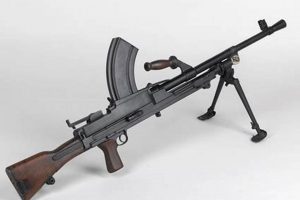
The selection of an appropriate airsoft weapon is a crucial decision for players of all experience levels. The optimal choice depends heavily on individual playing style, field environment, and budget. Factors such as rate of fire, accuracy, effective range, and overall build quality influence performance. Evaluating these attributes helps players determine the suitability of specific models for their intended use.
A well-chosen airsoft platform enhances the overall experience by providing a competitive edge and increasing enjoyment. The evolution of these devices from simple spring-powered models to sophisticated gas blowback and electric systems reflects a constant pursuit of realism and performance. Understanding the historical progression of airsoft technology provides context for current market offerings and helps players appreciate the advancements in design and functionality.
The subsequent discussion will explore the various power source mechanisms, including electric (AEG), gas (GBB/NBB), and spring-powered options. Further analysis will detail the advantages and disadvantages of each type, allowing for a more informed assessment of their practical application within diverse airsoft scenarios.
Considerations for Airsoft Weapon Selection
Selecting the most suitable airsoft weapon requires careful evaluation of several key factors. Matching the device characteristics to intended use is critical for optimal performance.
Tip 1: Assess Playing Style. Determine if aggressive, close-quarters engagements or long-range, tactical maneuvers are preferred. This influences the need for high rate-of-fire versus accuracy and range.
Tip 2: Evaluate Field Environment. The typical playing field dictates the optimal weapon type. Indoor arenas benefit from compact, maneuverable platforms, while outdoor fields require greater range and power.
Tip 3: Determine Power Source Suitability. Electric (AEG), gas (GBB/NBB), and spring-powered options offer distinct advantages. Electric models provide consistent performance, gas models offer increased realism, and spring models provide simplicity and affordability.
Tip 4: Establish Budgetary Constraints. Airsoft devices range widely in price. Setting a realistic budget guides the selection process and prevents overspending on unnecessary features.
Tip 5: Research Reputable Manufacturers. Choose brands known for quality construction, reliable performance, and readily available replacement parts. This ensures long-term usability and minimizes maintenance costs.
Tip 6: Prioritize Internal Component Quality. The quality of internal components directly impacts performance and longevity. Research the materials and construction of gears, pistons, and hop-up units before making a purchase.
Tip 7: Test-Fire Before Purchase (If Possible). Whenever feasible, test-fire the chosen model to assess its ergonomics, trigger response, and overall feel. This provides valuable insight beyond specifications.
Careful consideration of these points ensures the selection of a device that meets individual needs and enhances the airsoft experience. A well-informed decision leads to improved performance and greater satisfaction.
The final section will offer a comprehensive summary and recommendations based on the preceding analysis.
1. Power Source Reliability

Power source reliability directly impacts the consistent functionality of an airsoft weapon, making it a critical determinant in assessing the device’s overall suitability. The selection of an appropriate power source, be it electric (AEG), gas (GBB/NBB), or spring-powered, influences operational dependability across varying conditions. A weapon system that experiences frequent failures or inconsistent performance due to an unreliable power source is inherently less effective than one that maintains consistent output.
For instance, automatic electric guns (AEGs) are often favored for their consistent rate of fire and operational stability, particularly in prolonged engagements. This reliability stems from their battery-powered electric motors, which provide a stable and predictable energy supply. Conversely, gas blowback (GBB) systems can be susceptible to temperature fluctuations, leading to variations in gas pressure and reduced performance in colder environments. The choice between these systems often hinges on the anticipated environmental conditions and the need for sustained, uninterrupted functionality. A user prioritizing consistent performance in diverse climates might favor an AEG over a GBB, despite the latter’s greater realism.
In summary, power source reliability is a cornerstone characteristic in determining the optimal type of airsoft weapon. Weapons with inherently reliable power sources minimize malfunctions and ensure predictable performance, contributing significantly to a player’s effectiveness and enjoyment. Selecting a weapon with a proven and dependable power source is paramount to achieving consistent functionality.
2. Effective range capability

Effective range capability directly correlates with the selection of an airsoft weapon suited for specific playing environments. A platform’s ability to consistently and accurately project projectiles over a given distance significantly impacts its utility in various field scenarios. The determination of optimal device is intrinsically linked to matching its range capabilities with the intended engagement distances.
For example, a player operating in a large, outdoor environment with extended sightlines requires a weapon possessing greater range. Sniper rifles and designated marksman rifles (DMRs), characterized by upgraded internals and longer barrel lengths, are specifically designed to achieve this increased range. Conversely, in confined indoor arenas, shorter-barreled rifles or pistols offer increased maneuverability, negating the necessity for long-range capabilities. An attempt to utilize a close-quarters battle (CQB) weapon in a long-range engagement proves ineffective due to reduced projectile velocity and accuracy over distance. A comparable detriment is using a sniper rifle indoors, with limited room for maneuverability in this limited space.
In summation, effective range capability constitutes a crucial element in the overall assessment of the suitable type of airsoft weapon. The ability to accurately engage targets at varying distances directly influences the platform’s practical application and effectiveness within defined playing environments. The selection of a system with range parameters aligned with the intended operational context is paramount for optimal performance.
3. Rate of fire performance
Rate of fire performance stands as a critical determinant in assessing the suitability of any airsoft weapon. Its influence extends across various engagement scenarios, dictating a weapon’s effectiveness in both offensive and defensive roles. The correlation between rate of fire and overall performance necessitates a thorough understanding of its implications when determining optimal weapon selection.
- Suppressive Fire Capability
High rates of fire enable effective suppressive fire, allowing players to pin down opponents and provide cover for advancing teammates. Automatic electric guns (AEGs) often excel in this area, delivering a sustained barrage of projectiles. The ability to maintain a high volume of fire creates a tactical advantage, forcing opponents to remain in cover and limiting their offensive capabilities. Weapons lacking adequate rate of fire are less effective in suppressive roles.
- Close Quarters Engagement Effectiveness
In confined spaces, a high rate of fire offers a decisive advantage during close-quarters engagements. The rapid discharge of projectiles increases the likelihood of hitting a target, providing a significant edge in fast-paced scenarios. Submachine guns (SMGs) and some AEGs are frequently selected for their high rates of fire in CQB environments. A slower rate of fire reduces the probability of securing a rapid elimination in close proximity to opposing players.
- Ammunition Consumption Considerations
Higher rates of fire correlate with increased ammunition consumption. Players must carefully manage their ammunition reserves to avoid running dry during critical moments. Selecting a weapon with a high rate of fire necessitates carrying a sufficient quantity of magazines or employing support roles to maintain adequate ammunition supply. Failure to address ammunition consumption can negate the advantages conferred by a high rate of fire.
- Mechanical Stress and Reliability
Sustained high rates of fire place increased mechanical stress on internal components, potentially impacting weapon reliability and longevity. Reinforced internal parts and robust construction are essential to withstand the demands of consistent high-speed operation. Weapons with poorly constructed internals may experience accelerated wear and tear, leading to malfunctions and reduced lifespan. The relationship between rate of fire and mechanical stress must be carefully considered when selecting a weapon designed for sustained automatic fire.
In conclusion, the rate of fire performance exerts a significant influence on the utility of an airsoft weapon across various tactical situations. The advantages conferred by a high rate of fire, such as enhanced suppressive capabilities and close-quarters effectiveness, must be balanced against potential drawbacks, including increased ammunition consumption and mechanical stress. A comprehensive understanding of these factors is essential for making informed decisions when selecting the most appropriate platform.
4. Durability of construction
Durability of construction represents a paramount consideration when evaluating the optimal airsoft weapon. The ability of a platform to withstand the rigors of field use, potential impacts, and varying environmental conditions directly influences its longevity and overall value. An inherently fragile device proves unsuitable for sustained operation, regardless of its other attributes.
- Material Selection and Impact Resistance
The materials used in the construction of an airsoft weapon dictate its capacity to absorb impacts and resist structural damage. Polymers, such as reinforced nylon or ABS, offer a balance of weight and impact resistance, commonly found in mid-range AEGs. Metal alloy components, particularly in critical stress areas like the receiver and barrel assembly, enhance overall durability but increase weight and price. A weapon constructed primarily of brittle plastics is inherently more susceptible to damage from drops or collisions compared to one utilizing robust metal alloys.
- Internal Component Reinforcement
Internal components, such as gears, pistons, and bushings, are subject to significant stress during operation. Reinforced internal components, constructed from high-strength steel or hardened alloys, increase the weapon’s ability to withstand sustained use and high rates of fire. A gearbox containing standard, non-reinforced components is more prone to failure under heavy load compared to one with upgraded internals. Such internal fortifications prolong operational life and improve overall reliability.
- Weather Resistance and Environmental Tolerance
Exposure to moisture, dust, and extreme temperatures can negatively impact the functionality and longevity of an airsoft weapon. Models featuring sealed electronics and corrosion-resistant coatings offer enhanced protection against environmental elements. A weapon designed without adequate weather sealing is more likely to experience malfunctions or corrosion in wet or dusty environments compared to one with protective measures. This is especially crucial for outdoor gameplay.
- Assembly Quality and Tolerances
The precision and quality of the assembly process directly influence the overall structural integrity of the airsoft platform. Tight tolerances and secure fasteners minimize play between components, reducing the likelihood of loosening or breakage during operation. A weapon exhibiting loose connections or poorly aligned components is more prone to mechanical failures compared to one assembled with meticulous attention to detail. This underscores the significance of choosing a manufacturer with a reputation for quality control.
The aforementioned facets highlight the critical relationship between durability of construction and the selection of an effective airsoft weapon. Choosing a model constructed from robust materials, featuring reinforced internals, designed for weather resistance, and assembled with precision enhances long-term usability and minimizes the risk of field failures. Therefore, durability of construction is a fundamental element when assessing platform quality and suitability for a specific application. An informed selection prioritizes a well-built platform to ensure sustained performance.
5. Accuracy consistency

Accuracy consistency, defined as the repeatability of a weapon’s projectile placement under identical conditions, represents a crucial factor in determining the suitability of any airsoft gun. Its influence directly impacts a player’s ability to engage targets effectively and predictably. The weapon possessing higher accuracy consistency provides a significant advantage in competitive scenarios. Fluctuations in accuracy render the weapon unreliable, diminishing its practical value. This principle applies across all engagement distances and tactical roles. For example, a sniper rifle, intended for long-range engagements, becomes ineffective if its projectile trajectory varies significantly from shot to shot, even with precise aiming. Similarly, a close-quarters weapon loses its advantage if its spread pattern is unpredictable, reducing the likelihood of a successful hit.
The underlying causes of inconsistent accuracy are multifaceted, stemming from variations in hop-up performance, barrel quality, and projectile quality. The hop-up system, responsible for imparting backspin to the projectile to extend its range, must deliver consistent pressure and alignment. Inconsistencies in the hop-up mechanism lead to variations in projectile trajectory and range. Barrel quality, specifically the inner diameter and smoothness, influences projectile flight path and consistency. Irregularities or imperfections within the barrel contribute to deviation. The projectiles themselves must maintain consistent weight and shape, as variations in these attributes impact flight stability. The utilization of low-quality projectiles exacerbates accuracy problems, regardless of the weapon’s other attributes.
In conclusion, accuracy consistency stands as a fundamental element in the assessment of airsoft weapon performance. The ability to predictably and repeatedly place projectiles on target contributes directly to a weapon’s effectiveness in diverse playing conditions. Addressing the factors that impact accuracy consistency, such as hop-up performance, barrel quality, and projectile selection, represents an essential step in optimizing the weapon’s overall utility. Therefore, the careful consideration of accuracy consistency should guide purchasing decisions, influencing player satisfaction and competitive success. Without it, a highly-powered airsoft weapon is useless.
6. Maintenance requirements

Maintenance requirements represent a significant factor in determining the long-term viability and cost-effectiveness of any airsoft weapon. The level of maintenance demanded by a particular platform directly impacts its operational readiness, lifespan, and overall user experience. Selecting a weapon that aligns with an individual’s capacity for maintenance ensures sustained performance and minimizes potential downtime.
- Frequency of Cleaning and Lubrication
The frequency with which an airsoft weapon requires cleaning and lubrication varies depending on its internal mechanisms and materials. Gas blowback (GBB) systems typically demand more frequent cleaning and lubrication due to the use of propellant gas, which can leave residue within the internal components. Automatic electric guns (AEGs) generally require less frequent attention, though periodic cleaning of the barrel and lubrication of the gears remain essential for optimal performance. Neglecting routine cleaning and lubrication can lead to reduced accuracy, decreased range, and potential malfunctions. Therefore, players should select a type of weapon for which they can commit to regular care.
- Complexity of Disassembly and Reassembly
The complexity involved in disassembling and reassembling an airsoft weapon for maintenance purposes directly influences the level of technical skill required from the user. Some platforms feature modular designs that allow for easy access to internal components, facilitating straightforward cleaning and repairs. Other weapons possess intricate internal arrangements that necessitate specialized tools and extensive knowledge for proper disassembly and reassembly. Individuals with limited technical experience may prefer weapon types that offer simpler disassembly procedures to avoid accidental damage or improper reassembly. A difficult disassembly can lead to frustration and component breakage.
- Availability and Cost of Replacement Parts
The availability and cost of replacement parts for an airsoft weapon significantly impact its long-term maintainability and affordability. Weapons produced by reputable manufacturers generally have a wider range of readily available replacement parts compared to those produced by less-established companies. The cost of these parts also varies considerably, with some components being relatively inexpensive and others requiring a substantial investment. Selecting a weapon type with easily accessible and reasonably priced replacement parts reduces the financial burden associated with repairs and extends the platform’s operational lifespan. A lack of replacement parts renders a weapon unusable once components fail.
- Specialized Tools and Equipment Requirements
Certain airsoft weapons may necessitate specialized tools and equipment for proper maintenance and repair. These tools can range from simple Allen wrenches and screwdrivers to more advanced devices such as multimeters, chronographs, and specialized gearbox tools. The need for specialized tools adds to the overall cost of ownership and requires users to acquire the necessary equipment. Furthermore, the operation of these tools may demand specific skills and knowledge. Selecting a weapon that can be maintained with readily accessible and easily operated tools minimizes the barrier to entry for routine maintenance tasks.
In summary, the maintenance requirements associated with an airsoft weapon constitute a crucial consideration for potential buyers. Balancing the desired performance characteristics with the practicalities of routine maintenance ensures sustained performance, longevity, and overall satisfaction. Selecting a weapon type that aligns with one’s technical capabilities, budget, and commitment to maintenance optimizes the user experience and minimizes the risk of premature failures or costly repairs. It is important to check if there is a skilled technician nearby that can help to fix. The selection of an airsoft is a critical decision that must be thought out beforehand.
7. Ergonomic design
Ergonomic design directly influences the effectiveness and user satisfaction derived from an airsoft weapon. The interface between the user and the platform dictates handling, maneuverability, and overall control during gameplay. A weapon with poor ergonomics hinders performance, leading to reduced accuracy, increased fatigue, and compromised tactical responsiveness. Conversely, a well-designed weapon enhances comfort, allows for intuitive operation, and facilitates efficient target acquisition and engagement. The relationship between ergonomic design and performance is therefore a critical consideration in selecting an appropriate airsoft platform. The physical interaction profoundly affects the efficacy of the weapon’s intended function. The controls must be easy to use and access at the ready.
The significance of ergonomic design manifests in several key areas. Grip angle, stock adjustability, and control placement directly affect a user’s ability to maintain a stable firing stance and manipulate the weapon effectively. A grip angle that does not align naturally with the user’s wrist can lead to discomfort and reduced trigger control. Adjustable stocks accommodate varying body sizes and shooting styles, promoting proper eye relief and shoulder alignment. Well-placed controls, such as magazine release and selector switch, allow for rapid and intuitive manipulation without disrupting the firing grip. For example, a high-quality airsoft rifle with an adjustable stock, ergonomic grip, and ambidextrous controls allows the player to adjust the weapon for maximum comfort and performance when in gameplay. Weapons lacking such features, force the user to adapt to the platform, rather than the platform adapting to the player. It needs to feel like a second skin.
In conclusion, ergonomic design is a cornerstone attribute when determining the suitability of any airsoft weapon. It greatly affects user comfort, control, and overall performance during gameplay. Recognizing the importance of ergonomic features and selecting a platform that aligns with individual preferences enhances the user experience. The choice of this one attribute, can determine a weapon’s competitive capabilities. This should not be ignored at any cost.
Frequently Asked Questions
This section addresses common inquiries regarding airsoft weapon selection, providing detailed and objective answers to assist in making informed decisions.
Question 1: Are electric (AEG) airsoft guns suitable for beginners?
AEGs generally represent a suitable starting point due to their ease of use, consistent performance, and relatively low maintenance requirements compared to gas-powered alternatives. Their operational simplicity allows new players to focus on developing fundamental skills.
Question 2: What role does budget play in determining the selection?
Budget imposes significant constraints on the available options. Higher-priced models often feature superior materials, enhanced performance, and increased durability. However, affordable alternatives can provide adequate functionality for recreational use.
Question 3: How does playing style influence the appropriate weapon selection?
Aggressive, close-quarters battle styles benefit from compact, high rate-of-fire platforms such as submachine guns or short-barreled rifles. Tactical, long-range engagements necessitate the use of sniper rifles or designated marksman rifles (DMRs) with enhanced accuracy and range.
Question 4: Is gas blowback (GBB) realism worth the increased maintenance?
The increased realism offered by GBB platforms comes at the cost of more frequent maintenance and potential performance variations due to temperature fluctuations. The value proposition is dependent on individual priorities.
Question 5: What is the importance of internal component quality?
Internal component quality directly impacts a weapon’s performance, reliability, and longevity. Upgraded gears, pistons, and hop-up units enhance durability and improve accuracy consistency. Lower-quality components are prone to premature failure, leading to reduced performance and increased maintenance costs.
Question 6: How critical is ergonomic design in platform selection?
Ergonomic design significantly influences user comfort, handling, and control. A well-designed weapon enhances maneuverability, reduces fatigue, and promotes efficient target acquisition. Poor ergonomics can hinder performance and diminish overall enjoyment.
Key takeaway is that selecting an airsoft weapon necessitates balancing performance, budget, playing style, and maintenance requirements.
The next segment of the article will provide a comparative summary of the different types of airsoft weapons, highlighting their respective strengths and weaknesses.
Determining the Optimal Airsoft Weapon
The preceding analysis explored the multifaceted considerations inherent in determining “what type of airsoft gun is the best”. Factors such as power source reliability, effective range capability, rate of fire performance, durability of construction, accuracy consistency, maintenance requirements, and ergonomic design were examined. A thorough assessment of these attributes is essential for aligning weapon characteristics with individual playing styles, field environments, and budgetary constraints. No single airsoft platform universally excels; the optimal choice depends on the prioritization of these inter-related factors.
Ultimately, the selection of an airsoft weapon constitutes a strategic decision with lasting implications. Further research and hands-on evaluation are encouraged to refine the decision-making process. Continued advancements in airsoft technology will undoubtedly introduce new options and considerations. The ongoing pursuit of informed decision-making will enhance both the individual player’s experience and the overall advancement of the sport.