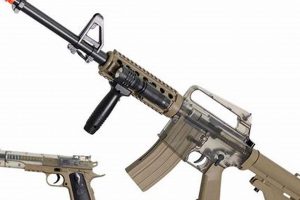
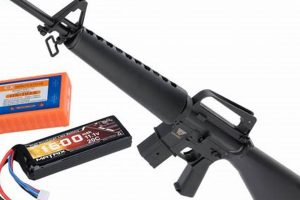
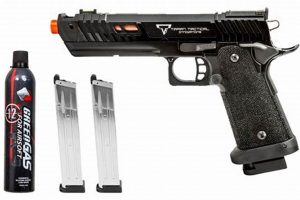
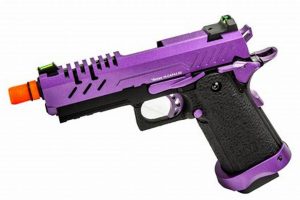
Entry-level airsoft replicas, often available for a limited financial outlay, represent a starting point for individuals interested in the sport. These models typically utilize less expensive materials and simpler internal mechanisms, reflecting their affordability. For example, a spring-powered pistol or a low-powered electric rifle often falls into this price category.
The availability of these more affordable options fosters wider participation in airsoft, enabling individuals to explore the activity without a significant initial investment. Historically, these models have served as gateway products, introducing new players to the tactical aspects and community associated with airsoft. Furthermore, accessible pricing can encourage responsible use and experimentation with the sport’s fundamentals.
The following sections will explore specific types of these entry-level models, covering their advantages, disadvantages, and factors to consider when making a purchase decision.
Tips for Selecting Affordable Airsoft Replicas
Choosing an appropriate airsoft model within a limited budget requires careful consideration. Focusing on core functionalities and durability can optimize the purchase.
Tip 1: Prioritize Spring-Powered or Low-Powered Electric Models: These typically offer the most cost-effective entry point. Spring-powered guns require manual cocking before each shot, while low-powered electric guns (LPEGs) utilize batteries for automatic firing, though their performance is generally less robust than higher-end models.
Tip 2: Evaluate Material Quality: While inexpensive, the construction material’s resilience matters. ABS plastic, though lighter, is less durable than metal. Consider models with reinforced stress points.
Tip 3: Check Magazine Capacity and Availability: Low-capacity magazines require frequent reloading. Ensure spare magazines are readily available and affordable.
Tip 4: Assess Accuracy at Close Range: These models are not designed for long-distance engagements. Evaluate their accuracy at distances of 20-30 feet.
Tip 5: Consider Intended Use: If the primary purpose is target practice, a basic spring-powered pistol might suffice. For skirmishes, a low-powered electric rifle may be more suitable.
Tip 6: Research User Reviews: Prior to purchase, consult online reviews from other users to identify potential issues or weaknesses.
Tip 7: Verify Compliance with Local Regulations: Ensure the selected model adheres to local laws and regulations regarding airsoft guns.
By focusing on fundamental features, evaluating material quality, and understanding the intended use, it is possible to select a suitable model within a restrictive price range.
The subsequent sections will discuss the maintenance and care required to prolong the lifespan of these more affordable airsoft options.
1. Spring-powered simplicity

The operational mechanism of spring-powered airsoft replicas directly influences their affordability. The simplicity of this mechanism requiring manual cocking to compress a spring that subsequently propels the projectile eliminates the need for batteries or gas. This reduction in complexity translates to lower manufacturing costs, a primary factor in making such models accessible at reduced prices. For instance, a basic spring-powered pistol consists of fewer components than a gas blowback pistol, leading to a lower retail price. Consequently, “Spring-powered simplicity” becomes a defining attribute of those available for limited financial resources.
Moreover, the inherent robustness of a simple spring mechanism contributes to the longevity and reduced maintenance requirements of these models. With fewer moving parts, the potential for mechanical failure decreases. This, in turn, minimizes the need for repairs or replacement components, resulting in lower long-term expenditure. The absence of reliance on external power sources, such as batteries or compressed gas, further simplifies operation and reduces associated costs. A practical example is seen in the widespread use of spring-powered shotguns for introductory airsoft games, where their reliability and ease of use outweigh the limitations in rate of fire.
In conclusion, the direct correlation between “Spring-powered simplicity” and reduced production costs makes this operational mechanism a cornerstone of affordability. This simplicity not only lowers the initial purchase price but also minimizes maintenance expenses, enhancing the overall value proposition. While spring-powered models may lack the advanced features of more expensive alternatives, their accessibility and reliability make them a viable entry point for newcomers to the sport, thus solidifying their position within the spectrum of cheaper options.
2. Plastic construction

The utilization of plastic components in airsoft replica manufacturing directly correlates with reduced production costs. Thermoplastics, such as ABS and nylon-reinforced polymers, are significantly less expensive to mold and machine than metals like aluminum or steel. The reduced material cost translates directly into a lower retail price, a crucial factor in creating airsoft models available for a restricted financial outlay. For example, an entry-level electric rifle constructed primarily of ABS plastic can be marketed at a significantly lower price point compared to a similar model featuring a metal receiver and barrel assembly. This difference in price allows manufacturers to target a broader consumer base, specifically individuals new to the sport or those seeking a budget-friendly option.
The use of plastic in airsoft models also impacts their weight and handling characteristics. Plastic components are lighter than their metal counterparts, making plastic-constructed replicas easier to handle, especially for younger or less experienced users. This reduced weight can also contribute to improved maneuverability in skirmishes. However, plastic construction inherently compromises durability. While advancements in polymer technology have improved the strength and impact resistance of certain plastics, they generally lack the resilience of metal. Consequently, plastic-constructed airsoft models are more susceptible to damage from drops, impacts, or prolonged exposure to extreme temperatures. An example is a plastic gearbox casing, which, under stress or high-powered upgrades, is more prone to cracking or failure compared to a metal gearbox.
In conclusion, “Plastic construction,” while facilitating affordability by lowering material and manufacturing costs, simultaneously introduces limitations in durability. This trade-off between cost and resilience is a defining characteristic of airsoft models. Understanding this relationship enables consumers to make informed decisions, weighing the benefits of a lower price point against the potential for reduced longevity and increased susceptibility to damage. Choosing a model with strategically reinforced plastic components in critical stress areas can mitigate some of the inherent drawbacks.
3. Limited range
The operational capabilities of cost-effective airsoft replicas are intrinsically linked to their effective firing range. This constraint in range is a direct consequence of design choices and component quality considerations prioritized to maintain affordability.
- Lower Power Output
Airsoft devices within this price bracket typically employ less powerful springs or electric motors. This results in a lower muzzle velocity, consequently reducing the distance the projectile can travel with sufficient accuracy and impact. The use of weaker components directly limits the propulsive force behind each shot.
- Basic Hop-Up Systems
The hop-up system, responsible for imparting backspin to the projectile to increase its range and accuracy, is often rudimentary in inexpensive models. Inefficient hop-up designs fail to generate adequate backspin, leading to a shorter effective range and increased trajectory deviation. Some cheaper models may even lack adjustable hop-up systems, further limiting performance.
- Simplified Barrel Design
The internal barrel’s bore and finish significantly impact projectile trajectory and range. Models within this price range often utilize barrels with wider tolerances and less precise finishes. This leads to increased air leakage and inconsistent projectile launch, diminishing range and accuracy. High-quality, tightly bored barrels are considerably more expensive to manufacture.
- Lightweight Projectiles
To compensate for lower power output, some models may utilize lighter weight projectiles. While this can marginally increase initial velocity, lighter projectiles are more susceptible to air resistance and wind drift, negatively impacting range and accuracy over longer distances. The trade-off between projectile weight and power output influences overall effective range.
The limited range observed in lower-cost airsoft models is not merely a characteristic, but a consequence of deliberate design choices aimed at minimizing manufacturing expenses. These compromises in power, hop-up efficiency, barrel quality, and projectile selection collectively restrict the engagement distance of these replicas. This necessitates a tactical approach focused on close-quarters combat and emphasizes the importance of maneuvering within the limitations of the equipment.
4. Low velocity

The characteristic of low projectile velocity is a key factor defining affordable airsoft replicas. Reduced muzzle velocity, measured in feet per second (FPS), directly influences the design, performance, and safety considerations for models in this price range.
- Spring Mechanism Limitations
Spring-powered airsoft guns, common among inexpensive models, rely on the compression and release of a spring to propel the projectile. Weaker springs are utilized to reduce manufacturing costs and simplify the cocking mechanism. The resulting lower spring force translates directly to reduced muzzle velocity. For example, a typical spring-powered pistol may exhibit a velocity of 200-250 FPS, compared to a gas-powered pistol exceeding 300 FPS. The spring mechanism becomes a limiting factor of the velocity.
- Electric Motor Power
Low-end electric airsoft rifles (LPEGs) utilize smaller and less powerful electric motors to drive their internal gearboxes. These motors generate less force, resulting in slower piston movement and lower air volume compression. Consequently, projectile velocity is reduced. For instance, a low-cost electric rifle might achieve a muzzle velocity of 250-300 FPS, significantly lower than higher-end electric rifles with more powerful motors. The electric motor constrains the potential velocity.
- Safety Considerations
Lower projectile velocities inherently reduce the risk of injury upon impact. This is a crucial safety factor, particularly for younger or inexperienced players. Lower velocity reduces the need for stringent eye protection and minimizes the potential for skin penetration or bruising. For example, many entry-level airsoft events or training scenarios specify a maximum velocity limit, often within the range achievable by these models. The reduced velocity also reduces the chances of broken skin and eye damage.
- Range and Accuracy Trade-offs
Reduced projectile velocity directly impacts the effective range and accuracy of airsoft replicas. Lower-velocity projectiles experience greater air resistance and are more susceptible to wind drift, leading to shorter effective ranges and increased trajectory deviation. While some adjustments can be made to improve accuracy at close range, the fundamental limitation of low velocity remains. Lower velocity means that any minor movement of the barrel will severely impact range.
The correlation between reduced muzzle velocity and affordability is a multifaceted issue, driven by engineering limitations, safety considerations, and performance compromises. While lower velocity restricts range and accuracy, it also enhances safety and allows for simpler and more cost-effective manufacturing processes, ultimately contributing to the availability of affordable airsoft options.
5. Minimal customization
The limited capacity for modification is a defining characteristic of inexpensive airsoft replicas. Cost constraints during manufacturing directly affect the availability of aftermarket parts and upgrade options. The design and construction of these models often prioritize simplicity and cost-effectiveness over modularity and compatibility with external components. The result is a restricted ability to personalize or enhance performance through aftermarket modifications. For example, a low-cost electric rifle may lack a standard rail system for attaching accessories like optics or foregrips, or its internal components may be incompatible with upgrade parts designed for higher-end models.
The absence of extensive customization options stems from several factors. Firstly, manufacturers of these models aim to minimize production costs by using proprietary components and designs. This reduces reliance on standardized parts, but it also limits the interchangeability and compatibility of aftermarket components. Secondly, the materials used in construction, such as lower-grade plastics, may not be able to withstand the stresses associated with more powerful upgrades. Attempting to install a high-performance spring in a plastic gearbox, for instance, could lead to premature failure. Furthermore, the target market for these models typically consists of beginner players who are less concerned with customization and more focused on basic functionality. As such, manufacturers prioritize affordability over upgrade potential.
The minimal customization associated with affordable airsoft replicas represents a trade-off between cost and versatility. While these models may lack the upgrade options of their more expensive counterparts, they offer a budget-friendly entry point into the sport. Understanding this limitation allows consumers to make informed purchasing decisions, weighing the benefits of affordability against the desire for personalization and enhanced performance. Individuals seeking greater customization potential should consider investing in higher-end models designed with upgrade compatibility in mind. In essence, minimal customization is a consequence of prioritizing low-cost manufacturing.
6. Basic functionality

The term “basic functionality,” when applied to airsoft replicas available for limited financial resources, denotes a focus on core operational capabilities at the expense of advanced features. This prioritization is a direct consequence of cost constraints imposed during the manufacturing process. An inexpensive model is engineered to perform the fundamental action of launching a projectile; supplementary features, such as adjustable hop-up systems, realistic blowback action, or accessory mounting points, are often omitted to minimize production costs. For instance, a spring-powered pistol may consist solely of a trigger mechanism, a spring-loaded piston, and a barrel, offering only single-shot functionality without any additional features.
The emphasis on core operation has several practical implications. Firstly, it simplifies the user experience, making these models accessible to novice players who may be overwhelmed by more complex mechanisms. Secondly, it reduces the potential for mechanical failure, as fewer components translate to fewer potential points of breakdown. A basic electric rifle, for example, with a simple gearbox and limited electronic components, is less prone to malfunctions compared to a higher-end model with advanced electronic trigger units and complex gear ratios. Thirdly, “basic functionality” allows manufacturers to focus on essential quality control, ensuring that the fundamental action of projectile launch is reliable, even if other aspects of performance are limited. The cost of maintaining a reliable, fundamental function greatly influences the price.
In summary, the pursuit of basic functionality in this context is an economic imperative. By sacrificing advanced features and focusing on core operational capabilities, manufacturers can produce airsoft replicas that are accessible to a wider range of consumers. While these models may lack the performance and versatility of more expensive alternatives, they provide a functional and reliable entry point into the sport, and understanding this trade-off between cost and capability is crucial for informed purchasing decisions.
7. Entry-level experience
The acquisition of an airsoft replica for a limited financial outlay provides an introductory exposure to the sport, influencing perceptions and future engagement. This initial encounter shapes understanding of airsoft mechanics, safety protocols, and the broader community.
- Fundamental Mechanics Introduction
Entry-level models offer a simplified introduction to the core mechanics of airsoft weaponry. Spring-powered mechanisms, for instance, demonstrate the basic principle of projectile propulsion without complex gas or electric systems. This allows beginners to grasp fundamental concepts such as aiming, trigger pull, and projectile trajectory without the added complexity of advanced features.
- Safety Protocol Familiarization
Inexpensive airsoft devices facilitate the learning of essential safety procedures. Understanding the importance of eye protection, responsible handling, and adherence to field rules becomes paramount, regardless of the model’s complexity. This initial emphasis on safety establishes responsible habits from the outset, mitigating potential risks associated with more powerful or advanced equipment.
- Tactical Awareness Development
While limited in range and power, basic airsoft guns encourage the development of tactical awareness. Players must adapt their strategies to compensate for the equipment’s limitations, emphasizing close-quarters maneuvering and coordinated teamwork. This fosters an understanding of tactical principles that can be applied to more advanced scenarios and equipment later on.
- Community Integration Opportunity
Entry-level affordability fosters broader participation, creating opportunities for interaction within the airsoft community. Attending local skirmishes or organized events with basic equipment allows newcomers to connect with experienced players, learn from their expertise, and integrate into the social aspects of the sport. This promotes a sense of belonging and encourages continued involvement.
The correlation between affordability and the “Entry-level experience” is undeniable. These cost-effective airsoft options serve as a gateway, providing accessible and relatively safe means of experiencing the core elements of airsoft. This early experience shapes perceptions, fosters responsible habits, and encourages community involvement, ultimately influencing long-term engagement with the sport.
Frequently Asked Questions
This section addresses common inquiries regarding the characteristics, performance, and suitability of airsoft models available for limited financial outlay.
Question 1: What types of airsoft guns can realistically be acquired for under $100?
Spring-powered pistols and rifles, as well as low-powered electric guns (LPEGs), typically fall within this price range. Gas blowback pistols and higher-performance electric rifles generally exceed this budgetary limit.
Question 2: Are airsoft guns safe for children?
While possessing reduced power output, all airsoft guns necessitate responsible handling and stringent eye protection. Adult supervision is mandatory for individuals under the age of 16. Compliance with local regulations regarding airsoft gun ownership is also crucial.
Question 3: What is the expected lifespan of an inexpensive airsoft replica?
The lifespan varies depending on usage frequency, maintenance practices, and construction materials. Proper maintenance, including regular cleaning and lubrication, can extend the life of these models. However, lower-quality components may limit their overall durability compared to higher-priced alternatives.
Question 4: Can an entry-level airsoft gun be upgraded?
Upgrade potential is typically limited due to proprietary parts and construction constraints. Attempting to install high-performance components may result in damage or malfunction. Compatibility with aftermarket accessories is also often restricted.
Question 5: Are metal parts present in models within this price bracket?
While some models may incorporate small metal components, such as internal gears or trigger mechanisms, the majority of the construction is typically comprised of plastic. Full-metal construction is generally reserved for higher-priced models.
Question 6: Are these models suitable for competitive airsoft events?
Entry-level models may not be competitive in events requiring higher performance and longer effective ranges. Their primary function is recreational target practice and basic skirmishes within close proximity.
In summary, individuals considering models must understand the limitations inherent in these products and prioritize safety and responsible use.
The following section will explore alternative entry points into airsoft, including rental options and organized events.
Conclusion
This exploration of entry-level airsoft replicas has highlighted the inherent trade-offs between cost and performance. While “cheap airsoft guns under $100” offer accessibility for newcomers, their limitations in range, durability, and customization must be acknowledged. Spring-powered mechanisms and plastic construction, while reducing manufacturing expenses, directly impact operational capabilities and overall longevity. These models primarily serve as introductory tools, familiarizing individuals with basic airsoft mechanics and safety protocols.
Ultimately, responsible engagement with airsoft, regardless of equipment cost, remains paramount. Informed purchasing decisions, prioritizing safety, and understanding the limitations of entry-level models are crucial. As prospective participants consider their initial foray into the sport, careful assessment of individual needs and a realistic expectation of performance capabilities are essential. The future of airsoft participation hinges on a foundation of responsible practices and a commitment to safety, irrespective of budgetary constraints.