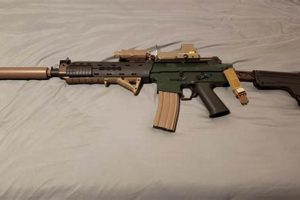
Recreational simulations centered around the Second World War era, utilizing realistic replica weaponry that discharges non-lethal projectiles, form a niche segment within the broader airsoft hobby. These simulations often involve participants dressing in historically accurate uniforms and employing tactical strategies that reflect the period. As an example, a scenario might recreate a specific battle, tasking one team with defending a fortified position while the other attempts to breach it.
This specific type of historical simulation offers several benefits. It provides a tangible way to engage with history, fostering an understanding of the strategies, equipment, and challenges faced by soldiers during that global conflict. Moreover, the emphasis on teamwork, strategy, and physical activity provides a stimulating and engaging experience for participants. The activity also encourages the study of historical details, leading enthusiasts to research uniforms, tactics, and equipment to enhance the authenticity of their experience.
The following sections will delve deeper into the specific aspects of this historical recreational activity, including the types of equipment used, the common scenarios played, and the ethical considerations involved in accurately portraying historical events through simulated combat.
Essential Considerations for Historical Simulation Enthusiasts
Engaging in historically themed simulations requires careful planning and attention to detail. The following tips aim to enhance the authenticity and enjoyment of the experience, while also promoting safety and responsible conduct.
Tip 1: Authenticity in Gear and Appearance: Accurate portrayal requires research into the specific impression being created. For instance, a representation of a U.S. paratrooper from the Normandy landings necessitates meticulous sourcing of correct uniform items, webbing, and weaponry relevant to that specific unit and time period.
Tip 2: Scenario Planning and Historical Accuracy: Scenario design should be informed by historical events, but adapted for a safe recreational environment. Recreating Operation Market Garden, for example, could involve objectives based on securing bridges, but must avoid overly complex or dangerous maneuvers that could compromise player safety.
Tip 3: Weaponry Maintenance and Safety: Replica firearms must be maintained in proper working order and handled with the same respect as real firearms. Regular cleaning and lubrication are essential for reliable operation, and adherence to site safety rules is paramount.
Tip 4: Understanding Tactical Doctrine: Familiarizing oneself with the tactical doctrines employed by historical units enhances the realism and strategic depth of scenarios. For instance, understanding German small unit tactics on the Eastern Front can inform defensive strategies and improve team coordination.
Tip 5: Respect for Historical Context: Acknowledge the gravity and human cost of the historical events being simulated. Refrain from glorifying war or trivializing the suffering of those involved. Memorials and moments of silence can be incorporated to foster respect.
Tip 6: Communication and Teamwork: Effective communication and teamwork are crucial for success in any scenario. Utilizing period-correct communication methods, such as hand signals or field telephones (where appropriate), can further enhance the immersive experience.
Tip 7: Physical Fitness and Preparedness: Participating in these simulations often requires a degree of physical exertion. Maintaining a reasonable level of fitness and ensuring adequate hydration are essential for a safe and enjoyable experience.
Adhering to these considerations enhances the overall experience by promoting safety, historical accuracy, and responsible engagement with the past. By carefully planning and executing scenarios, participants can gain a deeper appreciation for the events they are recreating.
The subsequent sections will address specific equipment options and further considerations for ensuring safety and historical accuracy in these activities.
1. Historical weapon replicas

Historical weapon replicas form a cornerstone of recreating the atmosphere of World War II within the context of airsoft simulations. These replicas, meticulously designed to mirror the appearance and handling of firearms used during the conflict, serve to immerse participants in the historical setting. The cause-and-effect relationship is evident: authentic replicas enhance the realism of the experience, leading to more engaging and educational simulations. For example, the use of an airsoft replica of a Thompson submachine gun by a participant portraying an American soldier in a simulated urban combat scenario contributes significantly to the visual and tactical authenticity of the event.
The importance of accurate replicas extends beyond mere aesthetics. The weight, balance, and operational characteristics of these replicas influence tactical decisions made by participants. A participant wielding an airsoft replica of a Karabiner 98k, a common German rifle, must consider its bolt-action mechanism when planning engagements, mirroring the limitations faced by soldiers during the war. Furthermore, the adherence to historical accuracy in these replicas often promotes a deeper understanding of the technological constraints and design choices prevalent during the era. Conversely, using inaccurate or anachronistic replicas detracts from the historical fidelity and diminishes the educational value of the simulation.
Understanding the connection between historical weapon replicas and simulations provides a pathway to more authentic and immersive scenarios. The challenges lie in sourcing high-quality replicas that meet both historical accuracy and airsoft safety standards. In summary, the use of carefully selected and maintained replicas elevates the experience and serves as a tangible connection to the history being reenacted, promoting respect and appreciation for the past, while highlighting safety as a paramount concern.
2. Authentic uniform accuracy

Authentic uniform accuracy constitutes a critical element in simulations recreating combat during World War II. The degree to which participants replicate the uniforms worn by soldiers of the period directly influences the immersive quality and educational potential of such events.
- Historical Detail and Identification
The accuracy of uniform details, including insignia, rank markings, and unit patches, allows for immediate visual identification of specific military units and nationalities. For example, the precise replication of a German Waffen-SS uniform, complete with appropriate collar tabs and shoulder boards, instantly conveys information about the soldier’s affiliation and status. This level of detail is essential for accurately portraying the complex organizational structures of the wartime military.
- Psychological Immersion and Role-Playing
Wearing an accurate uniform enhances psychological immersion and facilitates more convincing role-playing. A participant dressed in a meticulously replicated U.S. Marine Corps uniform from the Pacific Theater may internalize aspects of the historical character, such as discipline and determination, to a greater extent than if the uniform were inaccurate or incomplete. This psychological component contributes to the overall realism and engagement of the simulation.
- Material Authenticity and Wear Patterns
The types of materials used in the uniforms and the manner in which they are worn provide insights into the practicalities of military life during World War II. Reproducing the canvas webbing of a British soldiers gear or the faded appearance of a sun-bleached American field jacket adds another layer of authenticity. Wear patterns, reflecting the harsh conditions of combat, further contribute to the realism and convey the physical demands placed on soldiers.
- Impact on Tactical Decision-Making
Uniform accuracy can indirectly influence tactical decision-making in simulated scenarios. For example, the use of accurate camouflage patterns, such as the German “splinter” pattern, impacts the effectiveness of concealment and concealment-based tactics. Participants may be more inclined to utilize historical camouflage techniques and tactics if they are wearing accurate reproductions of the uniforms designed for those purposes.
The pursuit of authentic uniform accuracy, while demanding, significantly elevates the quality of simulations. It provides a tangible connection to the past, enhances the immersive experience, and promotes a deeper understanding of the historical context. The investment in accurate uniforms demonstrates respect for the historical events being recreated and contributes to the overall educational value of these simulated combat scenarios.
3. Tactical scenario immersion
Tactical scenario immersion represents a cornerstone of engaging simulations, serving as the catalyst for a historically accurate and emotionally resonant experience. Within the specific context of recreating WWII engagements, the level of immersion directly correlates with the educational and entertainment value derived from the activity. The cause-and-effect relationship is evident: a well-designed scenario that faithfully reflects the strategic and logistical challenges of the period fosters a deeper understanding of the complexities of warfare during that era. The absence of such immersion reduces the activity to a generic shooting game, devoid of meaningful historical context.
Importance as a component lies in replicating the core elements of WWII combat. This includes the integration of terrain features relevant to specific battles (e.g., hedgerows in Normandy, bombed-out buildings in Stalingrad), the implementation of communication protocols reflective of the technology available at the time (e.g., field telephones, coded radio messages), and the enforcement of tactical doctrines aligned with the military strategies of the period (e.g., Blitzkrieg tactics, island-hopping campaigns). An example is the simulation of the Battle of the Bulge, where players must navigate dense forests and contend with supply shortages, mirroring the challenges faced by American forces during that campaign. Such scenarios require meticulous planning and attention to detail, ensuring that the simulated environment accurately reflects the historical reality.
Understanding the practical significance of tactical scenario immersion leads to the creation of more engaging and educational experiences. By meticulously recreating historical settings and enforcing era-appropriate tactics, these endeavors offer participants a tangible connection to the past, fostering a deeper appreciation for the sacrifices and strategic considerations that shaped the course of WWII. The primary challenge lies in balancing the need for historical accuracy with the safety and practical limitations of a recreational environment. Ultimately, the goal is to create an immersive experience that is both historically informative and enjoyable, contributing to a broader understanding of one of the most significant events in human history.
4. Safety gear mandates

The implementation of safety gear mandates within the context of recreational simulations recreating World War II combat represents a critical intersection of historical realism and participant well-being. While aiming for historical accuracy through equipment and uniform choices, the inherent risks associated with projectile-based activities necessitate the adoption of modern safety standards, often exceeding those present during the actual conflict. The cause-and-effect relationship is direct: the absence of comprehensive safety gear mandates inevitably leads to an increased risk of injury, potentially jeopardizing the activity’s sustainability and participants’ health. The stringent enforcement of these mandates is paramount to ensuring a safe and enjoyable experience for all involved.
The importance of safety gear mandates as a component stems from the nature of airsoft projectiles. While non-lethal, these projectiles can still inflict injury, particularly to the eyes, face, and exposed skin. Therefore, mandatory protective eyewear, typically meeting ANSI Z87.1 standards or equivalent, is universally required at organized events. Additionally, many events mandate lower face protection, such as mesh masks, to prevent dental and facial injuries. Some simulations may also require full-seal goggles to prevent fogging or particulate entry, depending on the environment. In instances of dense foliage or close-quarters combat scenarios, the use of impact-resistant gloves and appropriate footwear becomes essential to mitigate potential injuries from environmental hazards or accidental impacts. The requirement for and enforcement of these measures are directly proportional to the mitigation of risk.
The careful balance between historical immersion and modern safety requirements presents a continuous challenge. While participants might prefer to forgo safety gear in favor of strict historical accuracy, the organizers bear the ultimate responsibility for participant safety. A solution lies in the selection of safety gear that minimizes visual disruption while providing adequate protection. The enforcement of safety gear mandates is therefore non-negotiable. The long-term viability of this unique form of recreation depends upon prioritizing participant welfare, ensuring a safe and enjoyable environment, and upholding a commitment to responsible historical reenactment.
5. Ethical reenactment portrayal
Ethical reenactment portrayal within the context of simulated World War II engagements using airsoft equipment represents a critical element in differentiating respectful historical engagement from insensitive appropriation. The connection between this ethical consideration and the activity itself is undeniable: the act of recreating historical events, particularly those marked by immense suffering and loss, necessitates a conscious effort to avoid trivialization, glorification, or distortion of the past. The cause-and-effect is clear: neglecting ethical considerations can lead to the perpetuation of harmful stereotypes, the desensitization to the atrocities of war, and the erosion of respect for the victims and survivors.
Ethical reenactment’s importance lies in its role as a safeguard against historical revisionism and the propagation of misinformation. For instance, simulating a battle involving the Waffen-SS requires careful attention to the historical context of that organization’s actions, avoiding any romanticization of its involvement in war crimes. Similarly, portraying specific wartime events must be done with sensitivity, acknowledging the human cost and avoiding the reduction of complex historical realities into simplistic narratives of victory and defeat. It also extends to avoiding the use of symbols and imagery associated with hate groups or ideologies, even if they were historically accurate to a specific unit or faction. Practical application can be seen through the inclusion of educational components within the simulations, such as pre-event briefings that provide historical context and emphasize the importance of responsible portrayal. In this case, the ethical considerations help participants and event organizers to handle a difficult topic of the historical reality.
Ultimately, understanding and prioritizing ethical reenactment portrayal contributes to a more meaningful and responsible engagement with history. The challenge lies in balancing the desire for realism with the need to avoid causing offense or perpetuating harmful narratives. This responsibility falls on both event organizers and individual participants, requiring a commitment to historical accuracy, sensitivity, and respect for the past. Upholding these principles ensures that these recreations serve as opportunities for education, remembrance, and a deeper appreciation of the complexities of the Second World War and its lasting impact.
Frequently Asked Questions about WWII Airsoft
This section addresses common inquiries regarding recreational simulations centered on the Second World War, utilizing airsoft equipment. It aims to clarify the nuances of the activity and dispel common misconceptions.
Question 1: What differentiates simulating WWII era engagements from standard airsoft games?
The distinction lies in the emphasis on historical accuracy. Simulations of World War II engagements typically involve replicating specific battles, utilizing era-appropriate weapons, uniforms, and tactics. This focus on historical detail distinguishes them from generic airsoft games, which often prioritize fast-paced action over authenticity.
Question 2: What are the primary safety considerations in WWII airsoft?
Safety considerations are paramount. All participants are required to wear appropriate eye protection, typically ANSI Z87.1 rated goggles or equivalent. Lower face protection is also strongly recommended. Adherence to site safety rules, including muzzle velocity limits for airsoft weapons, is mandatory.
Question 3: How important is historical accuracy in terms of weaponry?
The use of accurate weapon replicas is generally considered highly desirable. However, practical considerations, such as availability and cost, may influence individual choices. Regardless of the specific replica used, adherence to safety standards and responsible handling practices remains essential.
Question 4: What ethical considerations should be observed during these simulations?
Ethical considerations are of utmost importance. Participants should avoid glorifying or trivializing the suffering and loss associated with World War II. Reenactments should be approached with respect and sensitivity, avoiding the propagation of harmful stereotypes or ideologies.
Question 5: What is the typical cost associated with participating in a WWII airsoft event?
The cost can vary significantly depending on the event and the level of historical accuracy desired. Expenses may include event fees, travel costs, uniform and equipment purchases, and airsoft weapon maintenance. Budgeting and research are advisable.
Question 6: What are the common scenarios or battles replicated in WWII airsoft?
A wide range of scenarios are commonly replicated, including battles from the Eastern Front, the Western Front, and the Pacific Theater. Examples include the Battle of the Bulge, the invasion of Normandy, and engagements on Guadalcanal. Scenario selection often depends on the availability of suitable terrain and the interests of the participating individuals.
In summation, engaging in simulations demands a balanced approach that prioritizes safety, historical accuracy, and ethical considerations. Responsible participation ensures that these events serve as educational and engaging experiences for all involved.
The subsequent section will outline further resources and avenues for those seeking to deepen their engagement with this specialized form of historical simulation.
Conclusion
This exploration has outlined key aspects that constitute the simulation, ranging from the necessity of accurate replica weaponry and authentic uniforms to the ethical considerations that must govern participation. The activity’s potential to provide an immersive and educational experience hinges upon a dedication to historical accuracy, adherence to stringent safety protocols, and a commitment to responsible portrayal of the events being recreated.
By embracing these principles, individuals involved can ensure that recreations serve as meaningful opportunities for learning, remembrance, and a deeper understanding of the Second World War. The future of this simulation depends on a continued emphasis on historical integrity and ethical conduct, fostering a community dedicated to honoring the past while prioritizing the safety and well-being of all participants.