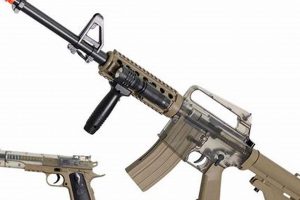
These replicas are designed to closely resemble firearms manufactured by Walther, a German arms company renowned for its pistols and other weapons. These non-lethal devices project small, spherical projectiles using compressed gas or spring mechanisms, offering a recreational activity that simulates firearm handling in a controlled environment. An example of this would be a model mirroring the Walther PPQ, adapted for this type of projectile and used in simulated tactical scenarios.
The significance of these items lies in their role in training, simulation, and recreational activities. They allow enthusiasts to practice marksmanship, tactical maneuvers, and firearm safety without the risks associated with live ammunition. Historically, replicas of this nature have grown in popularity as awareness of responsible firearm handling and the appeal of realistic simulations have increased.
The subsequent sections will delve into the various models available, their technical specifications, usage scenarios, and the legal considerations surrounding their ownership and operation. This analysis will provide a comprehensive overview of this specific type of recreational device.
Operational and Maintenance Guidance
Optimal performance and longevity of Walther airsoft replicas require adherence to specific operational and maintenance procedures. These guidelines aim to maximize reliability and user safety.
Tip 1: Ammunition Compatibility: Utilize only high-quality, seamless BBs of the recommended weight. Deformed or low-quality projectiles can cause internal damage and reduce accuracy. For example, using 0.20g or 0.25g BBs, depending on the model’s power output, is generally advisable.
Tip 2: Gas System Maintenance: For gas-powered models, regularly inspect and lubricate the gas magazine and valve components. Silicone oil is recommended for lubrication. Avoid petroleum-based lubricants, as they can degrade rubber seals.
Tip 3: Battery Care (AEG Models): If operating an AEG version, use only compatible batteries with the correct voltage and amperage. Overcharging or deep discharging batteries can reduce their lifespan and pose a safety hazard.
Tip 4: Cleaning Procedures: After each use, clean the barrel using a cleaning rod and silicone oil. This removes debris that can affect accuracy and range. Proper cleaning also prevents BB jams.
Tip 5: Storage Practices: Store the item in a cool, dry place away from direct sunlight and extreme temperatures. This prevents warping and degradation of plastic and rubber components. Remove the magazine and battery (if applicable) before storing.
Tip 6: Safety Protocol: Always engage the safety mechanism when not actively using the replica. Never point the device at anything that is not intended to be targeted. Eye protection is mandatory for all users and bystanders.
Adherence to these practices will enhance the user experience and extend the operational life of these devices. Proper care ensures consistent performance and prevents potential malfunctions.
The following section will address legal considerations and responsible usage guidelines to ensure safe and compliant operation.
1. Model variations

The diversity in model variations directly impacts the utility and appeal of Walther airsoft replicas. As a component of this category, the range of available models dictates the degree to which enthusiasts can replicate real-world firearm handling experiences or engage in specific types of airsoft gameplay. For example, a compact pistol model, such as a replica of the Walther PPK, serves well for close-quarters scenarios, offering maneuverability and ease of concealment. Conversely, a rifle-style replica, mirroring the Walther G36, provides enhanced range and accuracy, suitable for open-field engagements. The cause-and-effect relationship is clear: greater model variety translates to a broader range of applicable scenarios and user preferences catered to by these devices.
Understanding this diversity is practically significant for both consumers and retailers. Consumers can make informed purchasing decisions aligned with their intended use cases, while retailers can strategically stock models that cater to diverse market segments. Furthermore, the availability of different models fosters a sense of realism, a key driver for many airsoft participants seeking authentic tactical simulations. For instance, an individual intending to simulate law enforcement training exercises might prioritize models closely resembling standard-issue sidearms, while a recreational player could opt for a more unconventional or customized variant.
In summary, the availability and characteristics of different models is a crucial element of airsoft devices. It determines the potential applications, user satisfaction, and overall market relevance. Challenges arise in balancing realism with playability and maintaining adherence to legal restrictions. The range of models defines the scope and appeal within the overall category of this specialized recreational equipment.
2. Power sources

Power sources constitute a fundamental aspect of Walther airsoft replicas, directly influencing their performance characteristics, operational costs, and user experience. The type of power source employed dictates the projectile velocity, firing rate, and overall reliability of the device. Common power sources include compressed gas (typically CO2 or green gas), electric motors (powering Automatic Electric Guns, or AEGs), and spring mechanisms. Each method offers distinct advantages and disadvantages that impact the suitability of a particular replica for specific applications. For example, a gas-powered model may provide a more realistic recoil sensation but requires a consistent supply of gas cartridges, incurring ongoing operational expenses. In contrast, an AEG offers a higher rate of fire and utilizes rechargeable batteries, but may lack the immediate responsiveness of a gas-powered system. Spring-powered models are generally less expensive but require manual cocking before each shot, limiting their rate of fire and practical utility in rapid-engagement scenarios.
The importance of understanding the relationship between power sources and these replicas extends beyond mere operational mechanics. It also informs responsible usage and maintenance practices. For instance, improper storage of gas cartridges can lead to leaks or explosions, while neglecting battery maintenance in AEGs can diminish their performance and lifespan. Furthermore, the choice of power source can impact the device’s compliance with local regulations, as some jurisdictions impose restrictions on projectile velocity. Therefore, a comprehensive understanding of the power source’s characteristics, limitations, and maintenance requirements is essential for safe and effective operation.
In summary, the power source represents a critical determinant of these devices performance, cost-effectiveness, and user satisfaction. Challenges include balancing realism with practicality, ensuring safety through proper handling and maintenance, and adhering to evolving regulatory landscapes. Consideration of the power source is integral to the selection, operation, and responsible ownership of these airsoft replicas.
3. Material quality
Material quality represents a critical determinant of the overall performance, durability, and user satisfaction associated with Walther airsoft replicas. The constituent materials directly impact the device’s weight, resistance to wear and tear, and its ability to withstand the stresses of regular use. For instance, a model constructed primarily of high-grade polymer may offer a lighter weight and greater resistance to environmental factors, such as moisture and corrosion. Conversely, a replica featuring a metal slide and barrel assembly may provide a more realistic feel and enhanced durability, particularly in high-stress areas. The choice of materials, therefore, influences the device’s longevity and suitability for different gameplay scenarios. A failure in a critical component due to substandard materials can render the replica unusable or even pose a safety risk.
The importance of material quality is practically significant from both a consumer and manufacturer perspective. Consumers seek replicas that offer a balance between realism, durability, and affordability. A higher initial investment in a model constructed with superior materials can result in lower long-term maintenance costs and a more satisfying user experience. Manufacturers, on the other hand, must carefully select materials that meet performance requirements while remaining cost-effective. This necessitates rigorous testing and quality control processes to ensure that the final product meets the expectations of the target market. For example, a common upgrade performed by airsoft enthusiasts involves replacing polymer internal components with metal counterparts to enhance reliability and increase the replica’s resistance to damage during intense gameplay.
In summary, material quality significantly influences the performance, durability, and user experience. Challenges exist in balancing realism, cost-effectiveness, and performance requirements. Material composition is a crucial element in the overall quality and responsible enjoyment of Walther airsoft replicas.
4. Accuracy expectations
Achievable precision constitutes a pivotal aspect of any device emulating firearm characteristics. The degree to which an airsoft replica can consistently and predictably project its projectile significantly influences its utility for training, recreational target shooting, and simulated tactical scenarios. In the context of Walther airsoft replicas, defined expectations hinge on several interconnected factors.
- Barrel Quality and Hop-Up System
The internal barrel quality, including its bore diameter and smoothness, directly impacts projectile trajectory. The hop-up system, a mechanism that imparts backspin to the BB, extends range and flattens the flight path. Higher-quality barrels and precisely adjustable hop-up units translate to more predictable and accurate shots. For instance, a well-maintained inner barrel coupled with a correctly calibrated hop-up may allow for consistent target engagement at distances of 50-75 feet with minimal deviation.
- Power Source Consistency
Variations in power output directly affect shot-to-shot consistency. In gas-powered models, fluctuations in gas pressure can lead to inconsistencies in projectile velocity and trajectory. Similarly, inconsistent battery performance in AEGs can affect accuracy. Spring-powered models, while mechanically simpler, are also subject to variations based on the user’s cocking technique. A stable and regulated power source is, therefore, paramount for maintaining accuracy expectations.
- Ammunition Quality and Weight
The quality and weight of the BBs utilized significantly impact accuracy. Seamless, high-quality BBs with consistent weight distribution are essential for predictable flight paths. Imperfections in BBs, such as seams or variations in diameter, can induce unpredictable deviations. Lighter BBs may achieve higher initial velocities but are more susceptible to wind and air resistance, while heavier BBs offer greater stability but may require more power to propel effectively.
- External Factors and User Skill
Environmental conditions, such as wind and temperature, can significantly influence projectile trajectory. User skill in aiming, trigger control, and understanding the replica’s characteristics also plays a critical role. Even the most accurate replica will perform poorly in the hands of an inexperienced user or under adverse weather conditions. Proper technique and environmental awareness are, therefore, essential components of achieving realistic accuracy expectations.
Collectively, these elements contribute to the achievable level of precision. These devices can range from basic plinking tools with limited accuracy to highly refined training aids capable of simulating real-world firearm performance within certain constraints. The extent to which these factors are optimized determines the end-user’s satisfaction and the replica’s suitability for its intended purpose.
5. Legal Compliance
Adherence to legal regulations forms an integral component of owning and operating Walther airsoft replicas. The legal landscape surrounding these devices varies significantly across jurisdictions, demanding a thorough understanding of local laws to ensure responsible ownership and usage.
- Federal and State Regulations
National and regional laws often govern the permissible projectile velocity, overall appearance, and allowable usage scenarios. Some jurisdictions may classify airsoft replicas as imitation firearms, subjecting them to restrictions similar to those applied to actual firearms. Examples include requirements for orange tip markings to distinguish them from real firearms and prohibitions on carrying them in public spaces. Non-compliance can result in fines, confiscation of the device, or even criminal charges.
- Age Restrictions and Parental Consent
Many locales impose age restrictions on the purchase and use of airsoft replicas, often requiring parental consent for minors. These regulations aim to mitigate the risk of accidental injury or misuse. Retailers bear the responsibility of verifying the age of purchasers, and parents must ensure that minors are properly supervised during operation. Violations can lead to penalties for both the individual and the retailer.
- Transportation and Storage Laws
Specific regulations often dictate how airsoft replicas must be transported and stored. Typically, they must be transported in a closed case or container, separate from ammunition or power sources, to prevent accidental or unauthorized use. Safe storage practices, such as keeping them out of reach of children and in a secure location, are also frequently mandated. Improper transportation or storage can result in legal repercussions.
- Public Display and Brandishing
Displaying or brandishing an airsoft replica in public can lead to serious legal consequences, as it may be perceived as a threat and cause public alarm. Law enforcement officers may respond as if the device were a real firearm, potentially resulting in arrest or the use of force. It is imperative to avoid any action that could lead to misinterpretation or create a public safety concern.
These multifaceted legal considerations underscore the importance of responsible ownership and usage of Walther airsoft replicas. Ignorance of applicable laws is not a valid defense, and individuals are accountable for complying with all relevant regulations. Consulting with legal professionals or local law enforcement agencies can provide clarity on specific requirements within a given jurisdiction, ensuring lawful and safe operation of these devices.
Frequently Asked Questions
The following questions address common inquiries and concerns regarding Walther airsoft devices. This information intends to provide clarity and promote responsible ownership.
Question 1: What are the primary differences between gas-powered and electric-powered models?
Gas-powered versions typically offer a more realistic recoil sensation and require periodic replacement of gas cartridges. Electric-powered versions, or AEGs, utilize rechargeable batteries and generally provide a higher rate of fire. Maintenance requirements also differ, with gas models requiring lubrication of seals and electric models necessitating battery care.
Question 2: Is an orange tip legally required on these devices?
The necessity of an orange tip marking varies by jurisdiction. Many regions mandate this visual indicator to distinguish the replica from a real firearm. However, regulations can differ significantly, and it is imperative to consult local laws to ensure compliance.
Question 3: What type of ammunition is recommended, and why?
High-quality, seamless BBs of the weight recommended by the manufacturer are essential. Irregular or low-quality BBs can cause internal damage and reduce accuracy. The recommended weight typically ranges from 0.20g to 0.25g, depending on the model’s power output.
Question 4: How should these replicas be properly stored when not in use?
Proper storage involves keeping the replica in a cool, dry place away from direct sunlight and extreme temperatures. The magazine and battery (if applicable) should be removed before storing. This prevents warping, degradation of components, and accidental discharge.
Question 5: What safety precautions should be observed during operation?
Eye protection is mandatory for all users and bystanders. The safety mechanism should be engaged when the replica is not actively in use. The device should never be pointed at anything that is not intended to be targeted, and responsible handling practices should always be observed.
Question 6: What are the potential legal ramifications of brandishing one of these replicas in public?
Brandishing an airsoft replica in public can result in serious legal consequences, including arrest and potential criminal charges. Law enforcement may respond as if the device were a real firearm, and such actions can create public alarm and safety concerns.
Adherence to these guidelines and a thorough understanding of local laws are crucial for ensuring safe, responsible, and legal operation of these replicas.
The subsequent section will provide a conclusion summarizing the key takeaways from this discussion.
Conclusion
The preceding analysis has explored the multifaceted aspects of Walther airsoft replicas, encompassing their operational mechanics, safety protocols, legal considerations, and user expectations. Key points include the importance of model selection, power source understanding, material quality assessment, realistic accuracy expectations, and strict adherence to applicable regulations. These elements collectively influence the performance, safety, and legality of owning and operating these devices.
Responsible ownership necessitates informed decision-making, diligent maintenance practices, and a commitment to upholding the law. As the technology and recreational applications evolve, continued awareness of safety guidelines and legal frameworks remains paramount. The pursuit of realistic simulation should not compromise responsible conduct and adherence to established regulations. Further education and engagement with relevant communities will contribute to safe and lawful enjoyment within this domain.