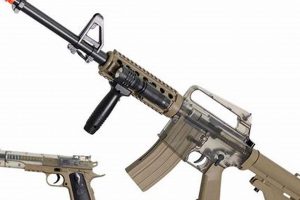
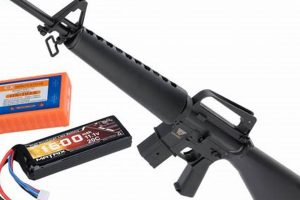
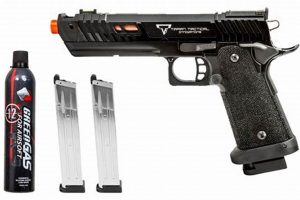
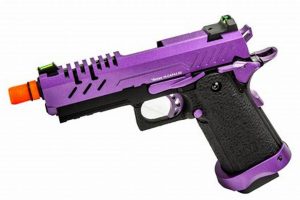
These specialized airsoft implements are designed to simulate real firearms in appearance, weight, and operation, with the express purpose of providing a realistic training experience or engaging in competitive simulation games. For example, a model might replicate the ergonomics and functionality of a standard military rifle, allowing users to practice weapon handling and tactical maneuvers.
The significance of these devices lies in their utility for force-on-force training, recreational skirmishes, and historical reenactments. They offer a safer and more cost-effective alternative to live firearms training for law enforcement, military personnel, and security professionals. Their development reflects a growing interest in realistic simulation and tactical engagement across various fields.
The subsequent sections will delve into the various types available, their common features, performance considerations, and safety protocols. Furthermore, a discussion of upgrade options and maintenance practices will provide a comprehensive understanding of these tools.
Optimizing Performance
Enhancing effectiveness in airsoft engagements requires careful consideration of multiple factors. Proper preparation and equipment management are paramount.
Tip 1: Prioritize Internal Component Upgrades: Replacing stock internal parts, such as the hop-up unit, inner barrel, and motor, can significantly improve accuracy, range, and rate of fire.
Tip 2: Maintain Consistent Power Source: Utilizing high-quality batteries or gas canisters ensures consistent performance and minimizes the risk of malfunctions during gameplay. Regularly inspect and replace power sources as needed.
Tip 3: Optimize Hop-Up Adjustment: Fine-tuning the hop-up unit is crucial for achieving optimal projectile trajectory. Experiment with incremental adjustments to maximize range and accuracy based on BB weight and environmental conditions.
Tip 4: Ensure Proper Lubrication: Regular lubrication of gears, pistons, and other moving parts minimizes friction and wear, extending the lifespan and improving the overall reliability.
Tip 5: Choose Appropriate Ammunition: Utilizing high-quality, seamless BBs of the correct weight for the specific airsoft implement and environment will contribute to improved accuracy and reduce the risk of jamming.
Tip 6: Regular Cleaning and Maintenance: Disassemble and clean the airsoft gun after each use, removing dirt and debris that can impede performance. This preventative maintenance ensures consistent functionality.
Implementation of these strategies can noticeably improve performance and reliability, translating to a more competitive and enjoyable airsoft experience.
The following sections will address safety protocols and ethical considerations related to the use of airsoft implements.
1. Realism
Realism in tactical airsoft implementations is a critical factor influencing their training utility and simulation value. The closer the device replicates the form, feel, and function of a real firearm, the more effectively it can be used for practicing weapon manipulation, tactical maneuvers, and force-on-force scenarios.
- External Aesthetics and Dimensions
The accurate replication of a real firearm’s external appearance, including dimensions, weight distribution, and material composition, is paramount. Discrepancies can disrupt muscle memory and negatively impact training effectiveness. Replicated models often utilize polymer bodies and metal components to mimic the texture and heft of actual firearms. Examples include M4 and AK platform replicas.
- Functional Similarity
The operation of these devices must closely mirror that of the real firearm it emulates. This includes the manipulation of controls such as the selector switch, magazine release, bolt catch, and trigger. A functional replica allows the user to practice reloading drills, clearing malfunctions, and engaging targets in a manner consistent with handling a real weapon. The feedback from these operations, like the recoil impulse, is also simulated.
- Accessory Compatibility
Compatibility with real-steel accessories, such as optics, lights, lasers, and slings, enhances the realism and allows for the customization and personalization of the device to suit specific user needs and operational requirements. Utilizing real-steel accessories on these devices provides a more authentic training experience and ensures compatibility across different platforms.
- Training Value
Ultimately, the degree of realism dictates the value of the device as a training tool. A high degree of fidelity enables the development of proper weapon handling skills, tactical decision-making, and stress management in a simulated environment. It allows for the safe and cost-effective practice of techniques that would otherwise be impractical or dangerous to perform with live firearms. The implementation of realistic airsoft devices allows for comprehensive training scenarios with minimal risk.
The various levels of realism contribute to the effectiveness of tactical airsoft implements for various applications, including military training, law enforcement drills, and recreational skirmishes. Investing in realistic models can translate to substantial improvements in user proficiency and tactical competency.
2. Performance

Performance represents a critical element dictating the practical effectiveness of tactical airsoft devices. Superior performance translates to enhanced accuracy, increased range, and improved reliability in simulated combat scenarios, directly influencing a user’s ability to achieve objectives. Conversely, subpar performance can undermine training effectiveness and diminish the competitive advantage during recreational skirmishes. A common example illustrating this connection involves the implementation of upgraded hop-up units, which demonstrably enhance projectile trajectory and extend effective range, providing a tangible performance boost.
Analyzing performance metrics extends beyond mere projectile velocity. Factors such as trigger response, cyclic rate, and gas efficiency significantly impact the user experience and overall effectiveness. For instance, a faster trigger response enables quicker target engagement, while a higher cyclic rate enhances suppressive fire capabilities. Similarly, efficient gas usage minimizes the need for frequent canister changes, maintaining operational continuity. These performance characteristics often necessitate careful selection of internal components and meticulous maintenance procedures. Consider the practical application in force-on-force training exercises, where reliable performance under pressure is paramount for simulating real-world combat conditions accurately.
In summary, the correlation between performance and the tactical airsoft device is unequivocal. High-performing units offer significant advantages in both training and recreational contexts, while performance deficiencies can impede user effectiveness. A thorough understanding of performance metrics and their underlying factors is essential for optimizing the selection, customization, and maintenance of these devices. Potential challenges include balancing performance enhancements with regulatory restrictions and budgetary constraints. The overarching goal remains achieving optimal performance within the confines of safety and legality.
3. Customization
Customization is an integral aspect of tactical airsoft implementations, allowing users to tailor their devices to specific mission requirements, personal preferences, and performance objectives. This adaptability is a key differentiator, enhancing both the training utility and competitive effectiveness.
- Ergonomic Adjustments
The ability to modify grip angles, stock configurations, and accessory placement is crucial for achieving optimal weapon handling. Adjustable stocks, pistol grips, and foregrips allow users to tailor the interface to their individual anatomy and shooting style. For example, a user might install an angled foregrip to improve weapon control during rapid firing or a different stock to optimize cheek weld with a specific optic. Improved ergonomics translate to greater comfort, enhanced control, and faster target acquisition.
- Performance Upgrades
Internal components, such as the hop-up unit, inner barrel, motor, and gearbox, can be upgraded to enhance accuracy, range, rate of fire, and overall reliability. High-performance motors increase trigger response and cyclic rate, while precision inner barrels and upgraded hop-up units improve projectile accuracy and range. For instance, a user might install a tightbore inner barrel and a high-torque motor to improve both accuracy and trigger response. Such enhancements directly impact the device’s performance capabilities in simulated combat scenarios.
- Optical Sight Integration
The mounting of optical sights, such as red dot sights, holographic sights, and magnified scopes, is a common customization option that enhances target acquisition and engagement at various distances. Utilizing Picatinny rail systems, users can easily attach and detach optics based on mission requirements. For example, a user might equip a red dot sight for close-quarters combat or a magnified scope for longer-range engagements. Proper optic selection and zeroing are crucial for maximizing accuracy and effectiveness.
- External Accessory Attachment
The addition of external accessories, such as flashlights, lasers, and bipods, provides enhanced functionality and adaptability to different operational environments. Flashlights improve visibility in low-light conditions, while lasers aid in target designation. Bipods provide stability for long-range shooting. For example, a user might attach a weapon light to improve target identification in dark environments or a bipod for enhanced stability during long-range engagements. The selection and placement of external accessories contribute to overall operational effectiveness.
These diverse customization options underscore the adaptability inherent in tactical airsoft implementations. The ability to tailor these devices to specific needs and preferences enhances their utility as training tools and competitive implements. From ergonomic adjustments to performance enhancements and accessory integration, customization empowers users to optimize their equipment for maximum effectiveness.
4. Safety

The safe handling and responsible usage of tactical airsoft devices are paramount, given their realistic appearance and potential for causing injury if mishandled. Strict adherence to established safety protocols mitigates the risk of accidental harm to users, bystanders, and property. For instance, the consistent use of approved eye protection during gameplay is non-negotiable, as airsoft projectiles can cause serious ocular damage. Neglecting this fundamental safety measure directly leads to preventable injuries.
Furthermore, responsible ownership entails secure storage of these items when not in use, preventing unauthorized access, particularly by minors. Transportation should occur discreetly, employing appropriate cases or bags to avoid misidentification and potential public alarm. Field safety rules, including minimum engagement distances and velocity limits, must be rigorously enforced to prevent close-range injuries and ensure fair play. For example, many fields mandate a minimum engagement distance to prevent welts or bruising from close-range impacts. Respecting private property and avoiding public display in non-designated areas are also critical components of responsible ownership and usage.
In summary, integrating safety as an intrinsic element of tactical airsoft activities is not merely advisable but essential for preventing accidents and fostering a culture of responsible engagement. Overlooking safety guidelines can lead to severe consequences, reinforcing the need for comprehensive safety training and the consistent application of best practices. The long-term sustainability of the airsoft community hinges on prioritizing safety above all else.
5. Maintenance
Consistent and thorough maintenance is critical to ensuring the reliable operation, longevity, and consistent performance of tactical airsoft devices. Neglecting maintenance can lead to performance degradation, premature component failure, and increased risk of malfunctions during operation.
- Lubrication of Internal Components
Regular lubrication of gears, pistons, and other moving parts within the gearbox assembly reduces friction, minimizes wear, and ensures smooth operation. The type of lubricant used is crucial; silicone-based lubricants are generally preferred due to their compatibility with plastic and rubber components commonly found in airsoft guns. Failure to lubricate these components adequately can result in increased stress, overheating, and ultimately, component failure. Example: applying grease to the gear set within an AEG’s gearbox.
- Cleaning of the Inner Barrel
The inner barrel is a critical determinant of accuracy and range. Over time, residue from projectiles, dust, and debris can accumulate within the barrel, impeding projectile trajectory and reducing accuracy. Regular cleaning with a cleaning rod and appropriate cleaning solution removes these contaminants, restoring optimal performance. Neglecting barrel cleaning can lead to inconsistent shot patterns and a significant reduction in effective range. Example: using a cleaning rod and silicone oil to swab the inner barrel after each use.
- Inspection and Replacement of Seals and O-Rings
Seals and O-rings are essential for maintaining airtight integrity within the airsoft gun’s pneumatic system, ensuring efficient power delivery and consistent velocity. These components can degrade over time due to wear, exposure to temperature variations, and contact with lubricants. Regular inspection and timely replacement of worn or damaged seals and O-rings are crucial for maintaining optimal performance and preventing air leaks. Example: replacing the piston head O-ring in an AEG to prevent air leaks and maintain consistent FPS.
- Battery Maintenance and Storage
For electric-powered airsoft guns, proper battery maintenance and storage are essential for maximizing battery lifespan and ensuring reliable power delivery. Batteries should be properly charged using compatible chargers and stored in a cool, dry environment. Overcharging or deep discharging batteries can damage them, reducing their capacity and lifespan. Example: storing LiPo batteries in a fireproof bag and using a balance charger to ensure proper cell balancing.
These maintenance practices are not merely cosmetic; they are fundamental to preserving the operational integrity and prolonging the service life of tactical airsoft devices. Consistent adherence to these procedures translates to improved performance, reduced maintenance costs over time, and enhanced safety for users.
Frequently Asked Questions
The following section addresses common inquiries and clarifies potential misconceptions regarding these specialized airsoft implements.
Question 1: What constitutes a “tactical” airsoft gun?
The term generally refers to implements designed to closely mimic real-world firearms in appearance, functionality, and accessory compatibility. The intended purpose is to provide a realistic training experience or facilitate accurate simulation during recreational skirmishes.
Question 2: Are these implements regulated?
Regulations vary significantly by jurisdiction. Compliance with all applicable local, regional, and national laws is the sole responsibility of the owner and user. These regulations may govern ownership, transportation, permissible usage environments, and muzzle velocity limitations.
Question 3: What level of maintenance is required?
Regular maintenance is essential for reliable operation and longevity. This includes cleaning the inner barrel, lubricating internal components, inspecting and replacing seals, and properly storing batteries. The frequency of maintenance depends on usage intensity and environmental conditions.
Question 4: Can real firearm accessories be used on airsoft guns?
While some real firearm accessories may physically fit onto compatible airsoft guns, it is crucial to verify proper fitment and function. The use of certain real firearm accessories may alter the performance characteristics and potentially damage the airsoft gun. Safety considerations should always take precedence.
Question 5: What safety precautions should be observed?
Mandatory safety precautions include the use of ANSI-rated eye protection at all times during gameplay, adherence to minimum engagement distances, secure storage when not in use, and responsible transportation in appropriate cases or bags. Public display in non-designated areas should be avoided.
Question 6: What is the typical effective range?
Effective range varies depending on factors such as muzzle velocity, projectile weight, hop-up configuration, and environmental conditions. A well-maintained and properly tuned implement may achieve an effective range of 150-200 feet. Exceeding established field limits for engagement distances is not permissible.
These FAQs highlight the critical considerations for responsible ownership and operation. Prioritizing safety, understanding applicable regulations, and performing regular maintenance are essential for ensuring a positive and safe experience.
The subsequent section will explore different types and models available within the market.
Conclusion
This exploration has elucidated the multifaceted nature of tactical airsoft guns, encompassing realism, performance, customization, safety, and maintenance. The functionality extends beyond mere recreation, impacting training methodologies and simulation exercises. The implementation of standardized protocols and responsible practices remains paramount in maximizing their utility and minimizing potential risks.
The continued evolution of technology and regulatory frameworks will undoubtedly shape the future trajectory of these implements. Vigilant monitoring of industry standards and a commitment to ethical conduct are crucial for ensuring the long-term viability and responsible integration of tactical airsoft guns within both the recreational and professional domains. Further research and development should focus on enhancing safety features and promoting responsible usage practices across the community.