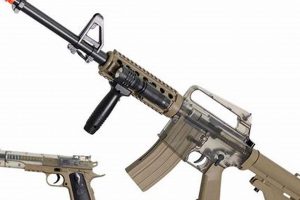
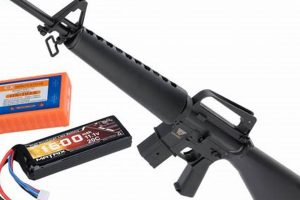
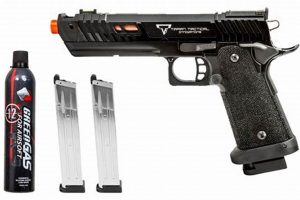
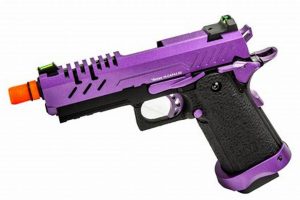
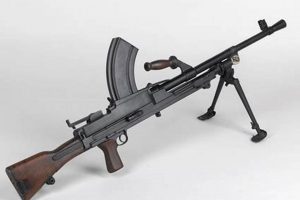
These compact, automatic replicas are designed to resemble submachine guns and utilize compressed gas or electric power to propel plastic projectiles. Often favored for their maneuverability in close-quarters battle scenarios, they offer a high rate of fire in a smaller package compared to other long guns used in simulated combat. Examples include models based on iconic firearms like the MP5, UZI, and P90.
The appeal of these implements stems from their practical advantages in certain gameplay styles and environments. Their smaller size makes them easier to wield in tight spaces, while their high firing rate provides a significant advantage in suppressive fire and close-range engagements. Historically, the development and popularization of these replicas mirrored the increasing prominence of their real-world counterparts in military and law enforcement applications. This has fueled their appeal among enthusiasts seeking realistic and immersive gameplay experiences.
Understanding the nuances of these implements requires delving into aspects such as the different power sources available (electric vs. gas), the various internal mechanisms that determine performance (gear ratios, hop-up systems), and the specific rules and regulations governing their use at different airsoft fields and events. Further research can also explore the modifications and upgrades available to enhance their performance and aesthetic appeal.
Optimizing Performance and Longevity
The effective use and maintenance of submachine gun airsoft replicas are crucial for ensuring optimal performance, extending their lifespan, and maximizing user satisfaction. The following guidelines provide insights into key considerations.
Tip 1: Battery Selection and Maintenance: When utilizing electric-powered models, employing high-quality batteries designed for airsoft use is crucial. Properly storing and charging batteries according to manufacturer instructions will prevent premature degradation and maintain consistent power output.
Tip 2: Internal Component Lubrication: Regular lubrication of internal gears and moving parts with appropriate silicone-based lubricants minimizes friction, reduces wear, and promotes smoother operation. Adhering to a maintenance schedule is critical.
Tip 3: Hop-Up Adjustment for Accuracy: The hop-up unit affects projectile trajectory. Proper adjustment based on projectile weight and environmental conditions is essential for achieving optimal range and accuracy. Experimentation and fine-tuning are necessary.
Tip 4: Barrel Cleaning and Maintenance: Regular cleaning of the inner barrel with a dedicated cleaning rod and appropriate cleaning solutions removes accumulated debris and ensures consistent projectile flight. A clean barrel directly impacts accuracy and range.
Tip 5: Gearbox Shimming for Efficiency: Properly shimming the gearbox minimizes internal stress and improves gear mesh, resulting in a quieter operation, reduced wear, and increased overall efficiency. This typically requires specialized knowledge and tools.
Tip 6: Gas System Maintenance (Gas Blowback Models): For gas blowback models, maintaining the gas seals and valves is crucial for preventing leaks and ensuring consistent gas pressure. Periodic cleaning and replacement of worn parts are necessary.
Tip 7: Storage Considerations: When not in use, these replicas should be stored in a clean, dry environment, away from direct sunlight and extreme temperatures. This prevents damage to internal components and minimizes the risk of warping or deterioration.
By implementing these strategies, users can significantly enhance the performance and reliability of their submachine gun airsoft replicas, extending their operational lifespan and maximizing their effectiveness in gameplay scenarios.
Understanding these best practices allows for a more informed approach to ownership and maintenance, ensuring a more enjoyable and rewarding experience. The subsequent sections will explore specific modifications and upgrades that can further enhance performance.
1. Compact Form Factor
The compact form factor is a defining characteristic of submachine gun airsoft replicas, directly influencing their tactical application and user preference. The reduced overall length and weight, compared to rifle-length airsoft guns, allows for enhanced maneuverability within confined spaces and urban environments. This facilitates quicker target acquisition and transitions between firing positions, offering a significant advantage in close-quarters battle (CQB) scenarios where agility is paramount. The prevalence of models based on platforms like the MP5 and UZI, both known for their real-world compact designs, underscores the importance of this feature in the airsoft context. These models replicate the balance and handling characteristics of their real-world counterparts, providing a realistic training experience and competitive edge.
The practical significance of the compact form factor extends beyond CQB. The reduced size makes these replicas easier to transport and store, appealing to players with limited space or those who frequently travel to different airsoft fields. Furthermore, the lighter weight reduces fatigue during extended gameplay, allowing for sustained performance throughout the duration of an event. The compact design also lends itself to easier concealment, a factor that may be relevant in certain types of airsoft games or training exercises that emphasize stealth and ambushes. Airsoft players often modify and enhance these models based on this inherent form factor.
In summary, the compact form factor is not merely an aesthetic feature of submachine gun airsoft replicas; it is a fundamental design element that dictates their suitability for specific tactical roles and enhances the overall player experience. The benefits of enhanced maneuverability, ease of transport, and reduced fatigue contribute directly to improved performance and enjoyment. While other factors such as rate of fire and power source are also crucial, the compact form factor remains a key differentiator that defines the unique advantages offered by submachine gun airsoft replicas. Understanding this connection informs purchasing decisions and influences tactical deployment strategies within the airsoft arena.
2. High Rate of Fire

The high rate of fire is an intrinsic characteristic closely associated with submachine gun airsoft replicas. This feature significantly impacts gameplay tactics, effective range, and overall user experience, making it a key consideration for prospective buyers and experienced players alike. The capability to rapidly discharge a large volume of projectiles provides distinct advantages in certain engagement scenarios.
- Suppressive Fire Capabilities
The increased rate of fire inherent in these replicas enables effective suppressive fire. This tactic involves saturating an area with projectiles, forcing opposing players to remain in cover and limiting their ability to maneuver or return fire. Submachine gun airsoft replicas, by their nature, excel in this role compared to single-shot or slower-firing alternatives. The effectiveness of suppressive fire depends not only on the rate of fire but also on factors such as projectile weight, accuracy, and the opposing player’s cover.
- Close-Quarters Engagement Dominance
Within confined spaces and short-range engagements, a high rate of fire provides a decisive advantage. The ability to quickly engage multiple targets or overwhelm a single target with a barrage of projectiles increases the likelihood of a successful outcome. While accuracy may be compromised at longer distances, the sheer volume of projectiles fired in close proximity often compensates for this, creating a significant threat to opposing players.
- Ammunition Consumption Considerations
The high rate of fire characteristic necessitates careful consideration of ammunition consumption. Players utilizing these replicas must carry sufficient ammunition to sustain prolonged engagements and avoid running out of projectiles at critical moments. This may involve carrying multiple magazines or utilizing high-capacity magazines, which can increase the overall weight and bulk of the player’s loadout. Effective ammunition management is crucial for maximizing the benefits of a high rate of fire.
- Mechanical Stress and Durability
The rapid cycling of internal components associated with a high rate of fire places increased stress on the replica’s mechanical systems. This can potentially lead to accelerated wear and tear, requiring more frequent maintenance and potentially shortening the overall lifespan of the replica. Selecting models constructed with durable materials and employing proper maintenance practices, such as lubrication and component replacement, can mitigate these risks.
In conclusion, the high rate of fire offered by submachine gun airsoft replicas presents a complex trade-off between tactical advantages and potential drawbacks. While it provides superior suppressive capabilities and dominance in close-quarters engagements, it also necessitates careful ammunition management and consideration of mechanical stress. A thorough understanding of these factors is essential for making informed purchasing decisions and employing these replicas effectively in gameplay scenarios. Careful balancing of these factors can provide a substantial advantage in a variety of airsoft contexts.
3. Close Quarters Battle
The association between submachine gun airsoft replicas and close quarters battle (CQB) environments is fundamentally intertwined, influencing the design, application, and perceived effectiveness of these implements. The inherent characteristics of these replicas, specifically their compact form factor and high rate of fire, directly address the challenges presented by confined spaces and rapid-engagement scenarios. CQB, by definition, emphasizes dynamic movement, swift target acquisition, and decisive engagement within constricted operational areas. The reduced length of a submachine gun airsoft replica facilitates easier maneuvering through doorways, hallways, and other narrow passages, allowing operators to maintain a higher degree of mobility and responsiveness. This is in contrast to longer rifle-style replicas, which can prove cumbersome and impede movement in such environments.
The high rate of fire characteristic of these replicas provides a significant advantage in CQB situations where engagements are often fleeting and require immediate suppressive fire. The ability to saturate an area with projectiles can disrupt enemy positioning, limit their ability to return fire, and create opportunities for maneuver and advancement. Consider, for example, simulated room clearing exercises where operators utilize these replicas to quickly engage multiple targets within a confined space, relying on the high volume of fire to neutralize threats rapidly. The effectiveness of this tactic is contingent upon proper training, weapon handling, and adherence to safety protocols. The compact size of the replica also aids in weapon retention during close-range physical engagements, a factor of paramount importance in CQB scenarios. Real-world examples of law enforcement and military units employing submachine guns in urban warfare and building clearing operations further validate the practical significance of this association.
In summary, the connection between submachine gun airsoft replicas and close quarters battle is predicated on the replicas inherent design advantages, which directly address the tactical demands of confined-space engagements. The compact size and high rate of fire enable enhanced maneuverability, swift target acquisition, and effective suppressive fire, providing operators with a decisive advantage in CQB scenarios. However, challenges remain in the areas of ammunition management, mechanical stress, and the need for specialized training. Understanding the nuances of this relationship is crucial for both prospective buyers and experienced players seeking to optimize their performance in CQB-oriented airsoft events. The practical application of these replicas in CQB simulations underscores their importance as specialized tools for close-range engagements, mirroring their real-world counterparts in military and law enforcement applications.
4. Electric/Gas Powered
The power source of a submachine gun airsoft replica is a fundamental determinant of its performance characteristics, operational requirements, and overall user experience. The dichotomy between electric-powered (AEG – Automatic Electric Gun) and gas-powered (GBB – Gas Blowback, or non-blowback) systems presents distinct advantages and disadvantages, influencing factors such as rate of fire, realism, maintenance demands, and temperature sensitivity. A comprehensive understanding of these power source differences is essential for making informed purchasing decisions and optimizing gameplay.
- Automatic Electric Guns (AEGs): Consistency and Reliability
AEGs utilize rechargeable batteries to power an electric motor, which in turn drives a gearbox to compress air and propel projectiles. This system offers a consistent rate of fire, relative insensitivity to temperature fluctuations, and generally lower operating costs compared to gas-powered alternatives. The internal components, such as gears, pistons, and motors, require periodic maintenance and may be subject to wear over time. Examples include the ubiquitous MP5 AEG and the P90 AEG, both renowned for their reliability and ease of use.
- Gas Blowback (GBB) Systems: Realism and Recoil Simulation
GBB systems employ compressed gas, typically propane or CO2, to propel projectiles and simulate recoil, enhancing the realism of the firing experience. These replicas often feature realistic blowback action, where the slide or bolt reciprocates with each shot, mimicking the operation of a real firearm. However, GBB systems are more sensitive to temperature changes, with performance potentially degrading in colder conditions. They also require more frequent maintenance of gas seals and valves to prevent leaks. Common examples include the MP7 GBB and the UZI GBB, prized for their realistic operation.
- Gas Non-Blowback (NBB) Systems: Efficiency and Quiet Operation
NBB systems use compressed gas solely to propel projectiles, without simulating recoil. This results in greater gas efficiency, allowing for more shots per gas fill, and a quieter firing sound compared to GBB systems. NBB systems are often favored for stealth-oriented gameplay. However, the lack of blowback action diminishes the realism of the firing experience. Examples include certain pistol replicas that prioritize efficiency over realistic operation. While less common in submachine gun replicas, NBB systems represent an alternative power source for specialized applications.
- Hybrid Systems: Emerging Technologies and Performance Trade-offs
Emerging technologies have led to the development of hybrid systems that attempt to combine the advantages of both electric and gas power sources. Examples include electro-pneumatic systems that use electric power to control gas valves, offering a degree of programmability and efficiency. However, these systems are often more complex and may require specialized knowledge for maintenance and repair. The trade-offs between performance, complexity, and cost must be carefully considered when evaluating hybrid systems.
The choice between electric and gas power sources for submachine gun airsoft replicas ultimately depends on individual preferences, gameplay priorities, and budget considerations. AEGs offer consistency, reliability, and lower operating costs, while GBB systems provide enhanced realism and recoil simulation. NBB systems prioritize efficiency and quiet operation, while hybrid systems represent emerging technologies with potential performance advantages. Understanding these nuances allows players to select the power source that best aligns with their specific needs and expectations. The continual evolution of power source technology ensures an ongoing diversification of options within the submachine gun airsoft replica market.
5. Realistic Replicas

The pursuit of realism is a driving force within the submachine gun airsoft replica market, profoundly influencing design, manufacturing processes, and consumer demand. The degree to which these implements accurately replicate the appearance, weight, and handling characteristics of their real-world counterparts significantly impacts their appeal to enthusiasts, collectors, and those seeking training tools. The demand for realistic replicas stems from a desire for immersive gameplay experiences, authentic historical reenactments, and the development of practical firearms handling skills in a safe and controlled environment. Submachine gun airsoft replicas, in particular, benefit from this emphasis on realism due to the iconic status of many of the firearms they emulate, such as the MP5, UZI, and P90. The external dimensions, materials, and markings are often meticulously reproduced to mirror the real firearm. For instance, high-end models may feature stamped steel receivers, polymer furniture with accurate textures, and engraved trademarks, enhancing their visual authenticity.
The internal mechanisms and functional aspects of realistic replicas are also crucial. Features such as realistic disassembly procedures, functional charging handles, and authentic magazine release mechanisms contribute to a more immersive and educational experience. Gas blowback (GBB) systems, in particular, play a significant role in enhancing realism by simulating the recoil and cycling action of a real firearm. However, achieving a high degree of realism often entails trade-offs in terms of cost, performance, and durability. Models with intricate internal mechanisms may require more frequent maintenance and be more prone to malfunctions. The use of high-quality materials and robust construction techniques is essential for ensuring that realistic replicas can withstand the rigors of regular use. Furthermore, legal restrictions on the replication of certain firearm features, such as functional suppressors or simulated full-auto fire, may limit the extent to which realism can be achieved. Despite these challenges, manufacturers continue to innovate and push the boundaries of realism, employing advanced materials, manufacturing processes, and electronic control systems to create increasingly accurate and immersive replicas.
In summary, the demand for realistic submachine gun airsoft replicas is a significant driver of innovation and product development within the airsoft industry. The pursuit of realism influences not only the external appearance of these implements but also their internal mechanisms, functional aspects, and overall handling characteristics. While achieving a high degree of realism may entail trade-offs in terms of cost, performance, and durability, manufacturers continue to strive for greater accuracy and authenticity to meet the demands of discerning enthusiasts and those seeking practical training tools. The ongoing evolution of materials, manufacturing processes, and electronic control systems promises to further enhance the realism and sophistication of submachine gun airsoft replicas in the years to come.
6. Customization Potential

The capacity for modification is a defining characteristic influencing the appeal and functionality of submachine gun airsoft replicas. This potential allows users to tailor their implements to specific gameplay styles, performance requirements, and aesthetic preferences.
- Internal Component Upgrades
Enhancements to internal mechanisms, such as gearsets, motors, and hop-up units, directly impact performance metrics. Replacing stock components with aftermarket options allows for increased rate of fire, improved accuracy, and enhanced durability. Examples include upgrading to high-torque motors for faster trigger response or installing precision inner barrels for improved shot grouping. Such modifications require technical expertise and a thorough understanding of internal mechanics.
- External Accessory Integration
The integration of external accessories, such as optics, foregrips, and tactical lights, expands the functional capabilities of the replica. Rail systems, commonly found on many models, provide a standardized platform for attaching these accessories. Examples include mounting red dot sights for rapid target acquisition or adding vertical foregrips for improved handling and recoil control. The selection of accessories is largely driven by individual preferences and tactical requirements.
- Aesthetic Modifications
Changes to the external appearance, including paint jobs, furniture swaps, and custom engravings, allow for personalization and aesthetic expression. Cerakote coatings provide enhanced durability and a wide range of color options. Examples include replicating the appearance of specific real-world firearms or creating unique custom designs. Aesthetic modifications do not typically impact performance but contribute to the overall user experience.
- Power System Modifications
Alterations to the power system, such as battery upgrades or gas system modifications, can significantly impact performance and reliability. Upgrading to higher-voltage batteries in electric models increases rate of fire and trigger response. Modifying gas systems in gas blowback models can improve gas efficiency and recoil impulse. These modifications require careful consideration of compatibility and potential risks to internal components.
The customization potential inherent in submachine gun airsoft replicas allows for a high degree of user agency in tailoring their implements to specific needs and preferences. However, it is essential to approach modifications with caution, ensuring compatibility and adhering to safety guidelines. The extensive aftermarket support available for many models facilitates a wide range of customization options, contributing to the enduring popularity of these replicas within the airsoft community. This potential, however, can create legal issues if a replica too closely resembles a real firearm after modification.
Frequently Asked Questions
The following questions address common inquiries regarding submachine gun airsoft replicas, providing clarification on key aspects relevant to performance, safety, and legal considerations.
Question 1: What distinguishes submachine gun airsoft replicas from other types of airsoft guns?
The primary distinctions lie in size, intended role, and rate of fire. Submachine gun airsoft replicas are generally more compact than rifle-length variants, designed for close-quarters engagements, and often exhibit a higher rate of fire. These features cater to specific tactical scenarios.
Question 2: What are the typical power sources for these replicas, and how do they differ?
The dominant power sources are electric (AEG) and gas (GBB/NBB). AEGs utilize rechargeable batteries, providing consistent performance and lower operating costs. Gas-powered variants employ compressed gas, offering increased realism through simulated recoil, albeit with temperature sensitivity.
Question 3: What safety precautions must be observed when handling submachine gun airsoft replicas?
Eye protection is mandatory at all times. The replica should always be treated as a real firearm, with the muzzle pointed in a safe direction. Responsible handling and adherence to field rules are paramount for preventing injuries and accidents.
Question 4: What regulations govern the ownership and use of submachine gun airsoft replicas?
Regulations vary significantly depending on jurisdiction. Some regions mandate specific markings or colorations to distinguish airsoft replicas from real firearms. Adherence to local laws regarding transportation, storage, and permissible use locations is crucial.
Question 5: How does one optimize the performance of these replicas for competitive gameplay?
Performance optimization typically involves internal component upgrades, such as high-torque motors, precision inner barrels, and enhanced hop-up units. These modifications require technical expertise and careful consideration of compatibility.
Question 6: What maintenance procedures are essential for ensuring the longevity of submachine gun airsoft replicas?
Regular maintenance includes cleaning the inner barrel, lubricating internal components, inspecting gas seals (for gas-powered variants), and properly storing batteries (for electric models). These procedures minimize wear and prevent malfunctions.
Proper understanding and application of the information contained herein are essential for responsible ownership and effective utilization of submachine gun airsoft replicas. Compliance with safety guidelines and legal regulations remains paramount.
The subsequent section will delve into advanced techniques for enhancing the performance and tactical application of these replicas.
Concluding Insights
This exploration has elucidated the multifaceted nature of submachine gun airsoft replicas. It has outlined the significance of form factor, rate of fire, power source, and customization potential in shaping their functionality and tactical deployment. Furthermore, it emphasized the critical importance of adhering to safety protocols and legal regulations governing their ownership and use. A thorough understanding of these aspects is paramount for responsible and effective utilization of these implements within the airsoft arena.
The continued development of materials, power systems, and manufacturing techniques will likely further refine the performance, realism, and customization options available to users of submachine gun airsoft replicas. Responsible utilization and adherence to established safety protocols remain crucial for ensuring the continued safe and enjoyable use of these tools within the airsoft community. The future of submachine gun airsoft guns is contingent upon users continuing to act with respect and concern for both the hobby and the broader public image of airsoft.