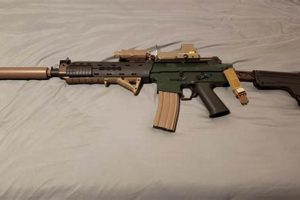
The concept involves participants in the sport of airsoft taking on the role of an opposing force, often mimicking military units or irregular combatants distinct from the conventional “friendly” forces. These roles typically require specific equipment, camouflage patterns, and tactical approaches to differentiate them from the main player base. For example, one team might emulate a specific nation’s military while the opposing force utilizes equipment and tactics reminiscent of insurgents or a different military doctrine.
This role-playing aspect enhances the immersive experience, fostering a deeper understanding of different combat strategies and perspectives. The practice allows participants to explore unconventional tactics and equipment loadouts, promoting adaptability and problem-solving skills within a controlled environment. Historically, this style of play emerged as airsoft evolved beyond simple target shooting, seeking to recreate more realistic and engaging scenarios inspired by military simulations and popular culture. It contributes significantly to the realism and strategic depth of airsoft games.
Understanding the nuances of this opposing force dynamic is crucial for developing effective strategies and appreciating the diverse range of playstyles within the airsoft community. The following sections will delve deeper into specific equipment choices, common tactical approaches, and the overall impact on the airsoft experience.
Enhancing the Airsoft Experience
Successful engagement within the opposing force role demands meticulous preparation and a nuanced understanding of asymmetric warfare principles. The following tips are designed to improve effectiveness and contribute to a more immersive and challenging airsoft experience.
Tip 1: Camouflage Selection: Adherence to realistic camouflage patterns is paramount. Research the environment of operation and select camouflage that effectively blends with the dominant terrain features. Generic patterns are often less effective than those specifically designed for woodland, desert, or urban settings.
Tip 2: Weapon Modification and Loadout: Mimic the weapons and equipment used by the real-world counterpart being portrayed. Restrict loadouts to equipment that is both realistic and practical for the intended role. Avoid excessive or anachronistic gear that detracts from authenticity.
Tip 3: Tactical Maneuvering: Employ tactics consistent with the opposing force’s doctrine. Utilize flanking maneuvers, ambushes, and reconnaissance techniques to disrupt enemy formations. Prioritize concealment and cover to minimize exposure.
Tip 4: Communication Protocols: Establish clear and concise communication channels. Utilize codewords, hand signals, and standardized reporting procedures to relay critical information effectively and minimize the risk of miscommunication.
Tip 5: Objective Prioritization: Focus on objectives that align with the opposing force’s strategic goals. Disrupt supply lines, capture key terrain features, or inflict casualties on high-value targets to achieve a decisive advantage.
Tip 6: Adaptability and Resourcefulness: The opposing force role often necessitates improvisation and resourcefulness. Be prepared to utilize limited resources effectively and adapt to unexpected challenges.
Tip 7: Physical Fitness: Participating as the opposing force may require navigating rough terrain and prolonged periods of exertion. Maintain adequate physical fitness to endure the demands of extended engagements.
By implementing these guidelines, participants can enhance their effectiveness and contribute to a more immersive and realistic airsoft environment. The ability to convincingly portray an opposing force enriches the experience for all involved, fostering a deeper appreciation for tactical principles and historical accuracy.
Further exploration of specific loadouts, tactics, and scenario design will provide additional insights into maximizing the impact of this role within the airsoft community.
1. Tactical Doctrine

Tactical doctrine forms the bedrock of effective opposing force (OPFOR) airsoft operations. It provides a structured framework guiding decision-making and coordinating actions, mirroring real-world military or paramilitary procedures. In OPFOR airsoft, adherence to a defined tactical doctrine elevates realism, enhances strategic depth, and ensures a challenging and immersive experience for all participants.
- Maneuver Warfare
Maneuver warfare, a key component, emphasizes outflanking and disrupting enemy formations rather than direct confrontation. OPFOR units may utilize flanking attacks, ambushes, and infiltration tactics to exploit vulnerabilities. Real-world examples include insurgent groups using asymmetric tactics against larger, conventionally armed forces. In airsoft, this translates to OPFOR teams prioritizing speed, agility, and deception over sheer firepower.
- Command and Control
Effective command and control is crucial for coordinating OPFOR activities. This involves establishing clear lines of communication, delegating authority, and implementing standardized operating procedures. Hierarchical structures, mirroring those of the imitated force, are often employed. For example, an OPFOR team emulating a guerilla cell might utilize a decentralized command structure with limited radio communication, relying instead on pre-arranged signals and messengers. This demands clear roles, responsibilities, and understanding of assigned missions.
- Logistics and Sustainment
Logistics and sustainment directly impact the OPFOR’s operational capabilities. Maintaining a consistent supply of ammunition, batteries, and other essential equipment is critical for prolonged engagements. OPFOR teams may simulate limited logistical capabilities by restricting ammunition loads or establishing hidden supply caches. Real-world examples include insurgent forces relying on captured supplies or local support networks. This element forces resourcefulness and tactical awareness.
- Intelligence Gathering
Intelligence gathering provides the OPFOR with critical information about enemy positions, movements, and intentions. This involves reconnaissance patrols, observation posts, and the utilization of informants. OPFOR teams may simulate intelligence gathering by scouting ahead, monitoring enemy radio transmissions, or interrogating captured players (in accordance with pre-established game rules). This enhances tactical awareness and enables preemptive action.
The implementation of a well-defined tactical doctrine significantly elevates the realism and challenge of OPFOR airsoft. It compels participants to think strategically, coordinate effectively, and adapt to evolving circumstances. By mirroring the tactics and procedures of real-world forces, OPFOR teams contribute to a more immersive and educational airsoft experience.
2. Weaponry Realism
Weaponry realism serves as a cornerstone in opposing force airsoft, significantly impacting the immersive quality and tactical considerations of the game. The accuracy and authenticity of weapons representations contribute directly to the player’s experience and strategic decision-making process.
- Weapon Type and Era Accuracy
Accurate representation of weapon types and their respective eras is vital. An opposing force emulating a modern military unit must employ replicas of current-issue firearms, while a force representing a historical conflict should utilize airsoft replicas consistent with that period. Erroneous weapon choices detract from the authenticity and undermine the scenario’s credibility. For example, equipping a simulated Vietnam-era force with modern optics or accessories would be a significant departure from historical accuracy.
- External Modification and Accessories
External modifications and accessories contribute substantially to realism. The appropriate use of optics, grips, and other attachments that are characteristic of the force being represented enhances visual fidelity and operational accuracy. Conversely, the addition of incorrect or anachronistic accessories diminishes the authenticity. A force representing a specific nation’s military would benefit from using optic replicas that were used in the same era as the firearms being used. A force emulating a specific group with limited supplies may use nothing more than the standard iron sights.
- Rate of Fire and Magazine Capacity
The rate of fire and magazine capacity of airsoft replicas should align as closely as possible with their real-world counterparts. This aspect affects tactical considerations, such as ammunition management and fire support capabilities. Exaggerated or unrealistic rates of fire detract from the intended experience. Most conventional firearms fire rates are fixed. However, some irregular forces may utilize semi-automatic rifles that have been modified to fire automatically.
- Weapon Maintenance and Condition
Simulating weapon maintenance and condition enhances the immersive experience. Representing the wear and tear on weapons, particularly in scenarios depicting prolonged operations or resource scarcity, adds a layer of realism. Weathering and simulated malfunctions can replicate the challenges associated with weapon reliability in adverse conditions.
The degree of commitment to weaponry realism within opposing force airsoft significantly shapes the overall experience. By prioritizing accuracy in weapon selection, modification, and usage, participants contribute to a more credible and engaging simulation. Conversely, deviations from realism can diminish the immersive qualities and undermine the intended tactical dynamics. Weaponry Realism is one facet of what brings OPFOR Airsoft to a better stage of simulation, rather than a casual match.
3. Camouflage Authenticity

Camouflage authenticity is paramount in opposing force (OPFOR) airsoft, functioning as a visual indicator of affiliation and a critical component of concealment. The effectiveness of OPFOR units is directly linked to their ability to blend into the operational environment, relying heavily on camouflage patterns that accurately reflect the indigenous flora and terrain.
- Environmental Conformance
Camouflage patterns must demonstrably conform to the specific environment where the OPFOR unit operates. This includes considering factors such as vegetation type, color palette, and seasonal variations. For instance, a woodland pattern in a desert environment provides negligible concealment, compromising the OPFOR’s ability to conduct reconnaissance, ambushes, or other clandestine operations. Real-world examples include the utilization of arid-region patterns by special forces units in the Middle East or the adoption of temperate woodland patterns by guerilla forces in European forested areas. In OPFOR airsoft, selecting the appropriate pattern is not merely aesthetic; it directly impacts tactical effectiveness.
- Historical Accuracy
For scenarios depicting historical conflicts or representing specific military/paramilitary groups, camouflage patterns must align with those historically utilized by the portrayed force. Inaccurate camouflage choices can detract from the scenario’s authenticity and undermine the immersive experience for all participants. For example, utilizing a modern digital camouflage pattern when portraying a force from the Vietnam War era would be historically inaccurate. Researching the camouflage patterns commonly used by the intended OPFOR unit during the relevant time period is crucial for maintaining historical fidelity. In airsoft, this focus on detail enhances the storytelling aspect and provides a more educational simulation.
- Pattern Disruption and Silhouette Concealment
The effectiveness of a camouflage pattern lies in its ability to disrupt the wearer’s silhouette and break up the outline against the surrounding environment. Patterns with high contrast and irregular shapes are generally more effective at achieving this. Solid color uniforms, while perhaps representing a specific military aesthetic, often lack the disruptive qualities necessary for effective concealment. Real-world military camouflage designs, such as Multicam or MARPAT, utilize complex patterns designed to mimic natural textures and shadows, thereby disrupting the wearer’s form. In OPFOR airsoft, selecting patterns with strong disruptive capabilities enhances concealment, reducing the likelihood of detection by opposing forces.
Camouflage authenticity is not merely a superficial detail within OPFOR airsoft. It represents a tangible commitment to realism, impacting tactical effectiveness and enhancing the immersive qualities of the game. By prioritizing accurate camouflage choices, participants contribute to a more credible and engaging simulation of opposing forces, enriching the overall airsoft experience.
4. Scenario Immersion

Scenario immersion is a critical element in opposing force airsoft, directly impacting player engagement and the perceived realism of the simulation. A well-constructed scenario draws participants into the narrative, enhancing the overall experience and fostering a deeper understanding of the tactical dynamics being portrayed. This immersion is not simply aesthetic; it influences decision-making, team cohesion, and the perceived stakes of the engagement.
- Accurate Depiction of Objectives
Scenario immersion hinges on objectives that are consistent with the role and capabilities of the opposing force being represented. Objectives should not be arbitrary; rather, they must reflect the strategic goals and operational priorities of the simulated entity. For example, a scenario involving an insurgent OPFOR might focus on disrupting supply lines, conducting ambushes, or gathering intelligence, mirroring real-world tactics. Conversely, a scenario with a conventional military OPFOR might center on securing key terrain, conducting reconnaissance, or engaging enemy forces in direct combat. The objectives drive the narrative and guide the OPFOR’s actions, contributing significantly to scenario immersion.
- Authentic Environmental Elements
The environment in which the scenario unfolds plays a crucial role in creating immersion. The terrain, weather conditions, and presence of non-player characters (NPCs) all contribute to the overall atmosphere. Authentic environmental elements can include realistic fortifications, simulated civilian populations, and ambient sounds that evoke the setting being portrayed. For instance, a scenario set in a simulated urban environment might feature abandoned vehicles, debris-strewn streets, and sound effects of distant gunfire or explosions. These elements create a more believable and engaging environment, enhancing the overall sense of immersion for participants.
- Consistent Rules of Engagement (ROE)
The rules of engagement (ROE) govern the permissible use of force within the scenario, and their consistency is paramount for maintaining immersion. The ROE should align with the characteristics of the opposing force being represented, reflecting their tactical doctrines, ethical considerations, and legal constraints. For example, an OPFOR representing a law enforcement agency might be subject to stricter ROE than an OPFOR representing a paramilitary group. Clear and consistent ROE ensure that participants understand the boundaries of acceptable behavior and contribute to a more realistic and immersive experience.
- Props and Special Effects
The use of props and special effects can significantly enhance scenario immersion. These elements can include simulated explosives, smoke grenades, pyrotechnics, and realistic props such as weapons caches, intelligence documents, or communication devices. These props should be used judiciously to avoid detracting from the overall realism. A well-placed simulated improvised explosive device (IED), for example, can dramatically increase the tension and sense of danger within a scenario, forcing participants to exercise caution and adapt their tactics. The judicious integration of props and special effects can elevate the scenario’s immersive qualities.
These facets of scenario immersion work synergistically to create a believable and engaging environment for opposing force airsoft. By prioritizing accurate objectives, authentic environmental elements, consistent ROE, and appropriate use of props, scenario designers can create experiences that transport participants into the heart of the simulation, fostering a deeper appreciation for the tactical and strategic complexities of the scenarios being portrayed.
5. Communication Protocols
Communication protocols are integral to the effective operation of any opposing force (OPFOR) in airsoft, mirroring real-world military and paramilitary communication structures. These protocols dictate how information is transmitted, received, and acted upon, directly impacting coordination, situational awareness, and ultimately, mission success.
- Standardized Terminology and Codewords
The use of standardized terminology and codewords reduces ambiguity and ensures clarity in communication, especially in high-stress situations. Real-world military units employ standardized language to convey complex information efficiently. In OPFOR airsoft, implementing similar systems enhances realism and reduces the risk of misinterpretation. For example, specific codewords might designate enemy locations, planned maneuvers, or emergency situations, ensuring rapid and unambiguous communication between team members.
- Hierarchical Communication Structures
Emulating hierarchical communication structures, mirroring those of the force being represented, facilitates efficient information flow. Establishing clear chains of command and designated communication roles ensures that critical information reaches the appropriate individuals in a timely manner. A squad leader, for instance, might relay information from the team leader to individual squad members, while also receiving updates and reports from subordinates. This structure mirrors real-world military organizations and promotes streamlined decision-making within the OPFOR unit.
- Radio Communication Discipline
Maintaining radio communication discipline is crucial for preventing information overload and minimizing the risk of detection by opposing forces. This involves adhering to established protocols for transmitting messages, avoiding unnecessary chatter, and using appropriate communication channels. Real-world military units implement strict radio silence policies in certain situations to avoid revealing their positions. In OPFOR airsoft, enforcing similar discipline enhances realism and forces players to prioritize essential communication.
- Contingency Communication Plans
Developing contingency communication plans addresses potential communication failures or disruptions. This includes establishing alternative communication methods, such as hand signals or pre-arranged meeting points, in the event that radio communication is compromised. Real-world military units train extensively on contingency communication protocols to ensure operational effectiveness even under adverse conditions. In OPFOR airsoft, preparing for communication disruptions enhances adaptability and promotes resourcefulness among team members. For example, designating a series of visual signals for basic commands ensures communication can continue even if radio is lost.
These facets of communication protocols, when implemented effectively, contribute significantly to the realism and strategic depth of OPFOR airsoft. They foster improved coordination, enhanced situational awareness, and a more challenging and immersive experience for all participants, mirroring the communication challenges faced by real-world military and paramilitary forces.
6. Objective Focus
Objective focus represents a fundamental aspect of opposing force (OPFOR) airsoft, shaping tactical decisions and overall mission success. The degree to which an OPFOR unit prioritizes and adheres to its assigned objectives directly influences its effectiveness and the immersive quality of the game for all participants. It dictates resource allocation, tactical maneuvering, and the overall strategic approach.
- Mission-Specific Prioritization
OPFOR units must prioritize objectives that directly align with their assigned mission parameters. This requires a clear understanding of the scenario’s overall narrative and the OPFOR’s role within that narrative. Objectives may range from disrupting enemy supply lines to capturing strategic locations or extracting high-value targets. Real-world examples include insurgent groups targeting infrastructure to destabilize a region or special forces units conducting reconnaissance missions to gather intelligence. In OPFOR airsoft, this translates to directing efforts and resources towards completing the primary mission objective rather than engaging in indiscriminate skirmishes.
- Resource Allocation and Management
Effective objective focus necessitates the judicious allocation of resources, including ammunition, medical supplies, and personnel. The OPFOR unit must strategically distribute resources to maximize its chances of achieving its assigned objectives. This may involve prioritizing specific members of the team or allocating more resources to key areas of operation. Real-world military logistics often involve prioritizing resources based on operational needs and strategic priorities. In OPFOR airsoft, resource management becomes a critical factor, forcing players to make tactical decisions based on limited supplies and personnel.
- Adaptability and Contingency Planning
Maintaining objective focus requires adaptability and the ability to adjust tactics in response to changing circumstances. The OPFOR unit must be prepared to deviate from its initial plan if unforeseen challenges arise, while still remaining committed to achieving its primary objectives. This involves developing contingency plans for various scenarios and empowering team members to make autonomous decisions in the field. Real-world military operations often encounter unexpected obstacles, requiring commanders to adapt their strategies on the fly. In OPFOR airsoft, adaptability becomes essential for overcoming challenges and achieving objectives in a dynamic environment.
- Ignoring Secondary Engagements
A key aspect of maintaining objective focus involves the ability to ignore secondary engagements that do not directly contribute to achieving the primary objective. This requires discipline and a clear understanding of the overall mission parameters. Engaging in unnecessary firefights or distractions can divert resources and attention away from the main goal, ultimately hindering the OPFOR’s success. Real-world military doctrine often emphasizes the importance of maintaining focus on the primary mission, even in the face of significant distractions. In OPFOR airsoft, the ability to resist the temptation to engage in tangential conflicts is a hallmark of a well-disciplined and effective unit.
The facets outlined above emphasize that the OPFOR in airsoft, unlike a generic adversary, operates with defined goals. The extent to which an OPFOR team embodies these principles distinguishes a casual engagement from a more immersive and strategically compelling airsoft experience. Focusing on mission-specific prioritization, resources, adaptability, and minimizing distraction from secondary targets all culminate in effective OPFOR operation. This contributes significantly to a richer narrative and more strategically engaging game.
7. Asymmetric Warfare
Asymmetric warfare, a conflict between groups with significantly unequal resources and capabilities, finds a tangible expression within the framework of opposing force (OPFOR) airsoft. The principles of asymmetric warfare often dictate the tactics, strategies, and equipment choices employed by the OPFOR, creating unique challenges and opportunities for both sides involved.
- Exploitation of Vulnerabilities
Asymmetric warfare often involves exploiting vulnerabilities of the stronger adversary, rather than directly confronting their strengths. In OPFOR airsoft, this translates to targeting supply lines, conducting ambushes in areas with limited visibility, or utilizing unconventional tactics to disrupt the opposing force’s operations. For example, an OPFOR unit simulating an insurgent group might focus on disrupting the enemy’s communication networks or logistics convoys, rather than engaging in direct firefights. Real-world examples include the use of IEDs by insurgent groups to target armored vehicles or the exploitation of cyber vulnerabilities to disrupt critical infrastructure.
- Leveraging Terrain and Environment
Asymmetric warfare often emphasizes the use of terrain and environment to gain an advantage over the stronger adversary. This can involve utilizing dense vegetation for concealment, setting traps in difficult terrain, or exploiting weather conditions to limit the enemy’s visibility. In OPFOR airsoft, this might translate to setting up ambushes in dense woodland areas, utilizing natural obstacles to create chokepoints, or operating during inclement weather to reduce the opposing force’s effectiveness. Real-world examples include the Viet Cong’s extensive use of tunnels and booby traps during the Vietnam War or the Taliban’s reliance on mountainous terrain in Afghanistan.
- Information Warfare and Propaganda
Asymmetric warfare often incorporates information warfare and propaganda to undermine the enemy’s morale, gain popular support, or manipulate public opinion. In OPFOR airsoft, this might translate to distributing leaflets with propaganda messages, spreading misinformation to sow discord within the opposing force, or utilizing social media to influence public perception of the conflict. Real-world examples include the use of social media by terrorist organizations to recruit new members and spread their ideology or the dissemination of propaganda by governments to influence public opinion during times of war.
- Adaptability and Innovation
A hallmark of asymmetric warfare is adaptability and innovation in response to changing circumstances. The weaker force must constantly adapt its tactics and strategies to counter the strengths of the stronger adversary and exploit new opportunities. In OPFOR airsoft, this might involve experimenting with new weapon configurations, developing unconventional tactics, or utilizing improvised equipment. This adaptability is crucial for maintaining effectiveness and disrupting the opponent’s plans. For example, a force in a real-world scenario may utilize a combination of civilian vehicles and drones for surveillance and attacks, adapting readily to whatever they have available. This is the core principle of asymmetric warfare: constantly seeking innovative and unexpected advantages.
The implementation of asymmetric warfare principles within OPFOR airsoft enriches the tactical dimension and promotes creative problem-solving. By emulating the challenges and constraints faced by weaker forces in real-world conflicts, participants gain a deeper appreciation for the complexities of asymmetric warfare and the importance of adaptability, resourcefulness, and unconventional tactics.
Frequently Asked Questions Regarding OPFOR Airsoft
This section addresses common inquiries surrounding the opposing force (OPFOR) role within the sport of airsoft, providing clarity on its purpose, execution, and impact on gameplay.
Question 1: What differentiates OPFOR airsoft from standard team-based play?
OPFOR airsoft involves one team intentionally assuming the role of a distinct, often adversarial, force, employing specific tactics, equipment, and camouflage patterns to differentiate themselves from conventional “friendly” forces. Standard team-based play typically lacks this level of dedicated role-playing and distinct force representation.
Question 2: Is specific equipment required for OPFOR airsoft roles?
While not always mandatory, specific equipment is highly recommended to enhance the realism and immersive qualities of the OPFOR experience. This includes camouflage patterns, weapon types, and accessories that align with the characteristics of the force being represented.
Question 3: How does OPFOR airsoft contribute to the overall airsoft experience?
OPFOR airsoft enhances the realism and strategic depth of airsoft games. It fosters a deeper understanding of different combat strategies and perspectives, promotes adaptability and problem-solving skills, and creates a more immersive and engaging simulation for all participants.
Question 4: What are some common tactical approaches employed by OPFOR units?
Common tactical approaches include flanking maneuvers, ambushes, reconnaissance techniques, and asymmetric warfare principles. The specific tactics employed will vary depending on the characteristics of the force being represented and the objectives of the scenario.
Question 5: Does OPFOR airsoft require specialized training or expertise?
While specialized training or expertise is not mandatory, a basic understanding of military tactics, equipment, and communication protocols is beneficial for effectively portraying an OPFOR role. Research and preparation are highly recommended.
Question 6: How can one ensure ethical and responsible participation in OPFOR airsoft scenarios?
Ethical and responsible participation involves adhering to established game rules, respecting the boundaries of other players, and avoiding the use of tactics or equipment that could cause harm or discomfort. Maintaining a focus on safety and sportsmanship is paramount.
The concepts presented serve to clarify the intent and best practices associated with OPFOR participation. Emphasis on authenticity, realism and safety remain fundamental.
Further exploration of scenario design and advanced tactical considerations will be addressed in subsequent sections.
OPFOR Airsoft
This exposition has elucidated the multifaceted nature of opposing force airsoft, underscoring its significant impact on the realism and strategic depth of the sport. By emphasizing accurate portrayal, tactical proficiency, and objective-driven gameplay, participants elevate the airsoft experience beyond mere recreational engagement. The principles of asymmetric warfare, historical accuracy, and communication discipline further refine the OPFOR role, creating a challenging and immersive simulation.
The commitment to authentic representation and strategic execution remains paramount within this domain. Further exploration of advanced tactics, scenario development, and community engagement will undoubtedly shape the future of OPFOR airsoft, reinforcing its significance as a conduit for tactical understanding and immersive recreation. The responsibility for preserving realism and promoting ethical gameplay rests on the collective shoulders of the airsoft community.