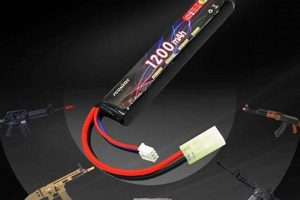
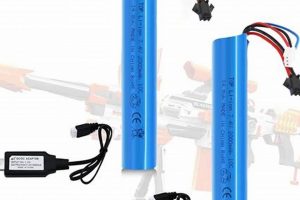
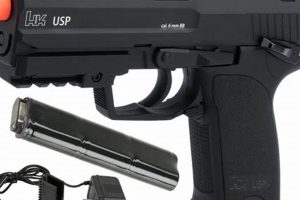
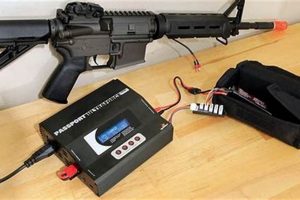
The category encompasses devices specifically engineered to replenish the energy stores of nickel-metal hydride (NiMH) batteries used in airsoft electric guns (AEGs). These charging units are vital for maintaining the operational readiness of AEGs, as they provide the necessary electrical current to restore the battery’s capacity after use. An example would be a smart charger capable of detecting the full charge state of an NiMH battery pack commonly found in airsoft rifles.
Effective and safe power replenishment is paramount for the longevity and consistent performance of airsoft AEGs. The use of appropriate charging equipment mitigates the risk of overcharging, which can lead to battery damage, reduced lifespan, or even hazardous situations. Historically, basic chargers delivered a constant current, often resulting in overcharging. Modern intelligent devices offer more sophisticated charging algorithms, optimizing the process and safeguarding battery health. Benefits include extended battery lifespan, consistent power delivery during gameplay, and enhanced safety during the charging cycle.
The following sections will delve into the different types of these charging units, key features to consider when selecting one, and best practices for maximizing battery life and ensuring safe operation. Understanding these factors is crucial for any airsoft enthusiast relying on NiMH battery-powered AEGs.
Charging Best Practices
The following guidelines are intended to promote the safe and effective usage of charging units specifically designed for nickel-metal hydride (NiMH) batteries in airsoft electric guns (AEGs). Adherence to these practices can prolong battery life and ensure optimal performance during gameplay.
Tip 1: Use a Smart Charger. Smart charging units automatically detect when a battery is fully charged and cease the charging process. This prevents overcharging, which can damage the battery and shorten its lifespan. An example of a smart charger is one that utilizes delta peak detection to identify the point of full charge.
Tip 2: Avoid Deep Discharges. Allowing NiMH batteries to completely discharge can negatively impact their capacity and performance. It is advisable to recharge the battery before it is fully depleted. Observe performance degradation in the AEG’s firing rate as an indicator of impending discharge.
Tip 3: Store Batteries Properly. When not in use, store NiMH batteries in a cool, dry place. Avoid extreme temperatures, as they can degrade battery performance. A storage temperature between 15C and 25C is generally recommended.
Tip 4: Monitor Charging Progress. Periodically check the charging status of the battery. While smart chargers provide automatic cut-off, observing the process can help identify potential issues, such as overheating or unusually long charging times.
Tip 5: Use the Correct Voltage and Current. Ensure that the charging unit’s voltage and current settings are compatible with the NiMH battery pack being charged. Incorrect settings can lead to damage or safety hazards. Refer to the battery manufacturer’s specifications for recommended charging parameters.
Tip 6: Inspect Batteries and Chargers Regularly. Before each charging session, inspect the battery pack and charging unit for any signs of damage, such as frayed wires, cracked casings, or corrosion. Discontinue use if any damage is detected.
Tip 7: Calibrate the Charger Periodically. Some advanced charging units offer calibration settings. Performing periodic calibration can improve the accuracy of the charging process and optimize battery performance. Consult the charger’s manual for calibration instructions.
Following these charging best practices contributes to the overall reliability and cost-effectiveness of airsoft electric guns by maximizing the usable life of NiMH battery packs and minimizing the risk of damage or malfunction.
The subsequent sections will cover troubleshooting common issues and offer further insights into advanced battery management techniques.
1. Voltage Compatibility

Voltage compatibility represents a fundamental requirement when selecting a power replenishment unit for nickel-metal hydride (NiMH) batteries utilized in airsoft electric guns (AEGs). The electrical potential supplied by the power replenishment unit must align with the nominal voltage of the battery pack to ensure proper charging and prevent potential damage. A mismatch in voltage can lead to either undercharging, resulting in insufficient power storage, or overcharging, which can cause overheating, cell damage, or even battery failure. The cause-and-effect relationship is direct: incorrect voltage application negatively impacts the battery’s chemical and physical integrity.
Consider an example involving an 8.4V NiMH battery pack commonly found in airsoft rifles. Employing a charging unit designed for a 9.6V battery would likely result in overcharging, shortening the lifespan of the 8.4V pack and potentially creating a safety hazard. Conversely, attempting to charge the same 8.4V battery with a 7.2V charging unit may not provide sufficient energy transfer, leading to inadequate performance during airsoft gameplay. Smart chargers that offer voltage selection options are valuable in mitigating these risks, allowing the user to specify the correct voltage for the battery pack being charged.
In conclusion, voltage compatibility is not merely a technical specification but a critical parameter influencing the safe and effective operation of NiMH battery-powered airsoft AEGs. Understanding and adhering to the correct voltage requirements minimizes the risk of battery damage, optimizes performance, and contributes to a safer and more reliable airsoft experience. Selecting a charging unit without verifying voltage compatibility is a significant oversight that can have detrimental consequences. This understanding is intrinsically linked to extending the useable life and effective performance of rechargeable batteries used in airsoft sports.
2. Ampere Rating

The ampere rating of a nickel-metal hydride (NiMH) battery charger significantly influences the charging speed and overall battery health within the context of airsoft electric guns (AEGs). A careful consideration of this parameter is crucial for maintaining battery longevity and ensuring readiness for airsoft gameplay.
- Charging Speed and Ampere Rating
Higher ampere ratings facilitate faster charging times. For example, a charger with a 1A output will generally charge a battery more quickly than a charger with a 0.5A output, assuming the battery can safely handle the higher current. The trade-off is that faster charging can generate more heat within the battery, potentially reducing its lifespan if not carefully managed. Selecting the appropriate ampere rating balances the need for rapid charging with the desire to preserve battery health.
- Battery Capacity and Ampere Rating
The capacity of the NiMH battery pack (measured in mAh) should inform the selection of the charger’s ampere rating. As a general guideline, a charging current of 1/10th the battery’s mAh rating (a “C/10” charge rate) is considered a safe and gentle approach, minimizing heat buildup and promoting long-term battery health. For instance, a 1600mAh battery could be safely charged at 160mA. Some batteries can tolerate higher charge rates, but consulting the manufacturer’s specifications is essential.
- Heat Generation and Ampere Rating
Charging at higher ampere ratings produces more heat within the battery. Excessive heat can degrade the battery’s internal components and reduce its overall capacity and lifespan. Smart chargers that monitor battery temperature and adjust the charging current accordingly are beneficial in mitigating this risk. The ambient temperature also plays a role; charging in a cool environment helps dissipate heat more effectively.
- Charger Efficiency and Ampere Rating
The efficiency of the charger impacts the amount of energy delivered to the battery versus the amount of energy consumed from the power source. Inefficient chargers may waste energy as heat, potentially leading to longer charging times and increased operating costs. Selecting a charger with a high efficiency rating minimizes energy waste and contributes to more effective charging. This is often reflected in the charger’s build quality and internal components.
In summary, the ampere rating of a NiMH power replenishment unit is a critical factor influencing both the speed and safety of the charging process for airsoft AEG batteries. Balancing the charging speed with the potential for heat generation and considering the battery’s capacity are essential for maximizing battery lifespan and ensuring reliable performance on the airsoft field. A well-informed decision regarding the ampere rating is integral to responsible battery management.
3. Smart Charging
Smart charging, within the context of nickel-metal hydride (NiMH) battery charging for airsoft applications, represents a significant advancement over traditional charging methods. It incorporates intelligent algorithms and electronic sensors to optimize the charging process, mitigating risks associated with overcharging and maximizing battery lifespan. A “smart” charger continually monitors battery parameters, such as voltage, current, and temperature, adjusting the charging profile accordingly. This feedback loop ensures that the battery receives the appropriate amount of charge without exceeding its safe operating limits. A direct cause-and-effect relationship exists: employing a smart charger leads to a healthier battery and prolonged operational use. The absence of smart charging features can result in accelerated battery degradation and potential safety hazards. For example, a non-smart charger delivering a constant current can continue to pump energy into a fully charged NiMH battery, generating excessive heat and causing irreversible damage to the battery’s internal cells.
A key component of smart charging is delta peak detection. NiMH batteries exhibit a slight voltage drop (the “delta peak”) when they reach full charge. Smart chargers are designed to detect this voltage drop and automatically terminate the charging process, preventing overcharging. This is a fundamental aspect of extending battery life and maintaining consistent performance. Furthermore, many smart chargers incorporate additional features, such as automatic trickle charging, which provides a small maintenance current to compensate for self-discharge during storage, keeping the battery at an optimal state of readiness. Another practical application is the ability to select charging profiles tailored to specific battery types or charging needs. Some smart chargers allow users to specify the battery capacity (mAh) and desired charging current, providing greater control over the charging process. This level of customization is particularly useful for airsoft enthusiasts who may have a variety of NiMH battery packs with different specifications.
In conclusion, smart charging is an indispensable feature of modern nickel-metal hydride battery power replenishment units used in airsoft. It provides a level of protection and optimization that is simply not possible with traditional charging methods. While smart chargers may represent a slightly higher initial investment, the long-term benefits of extended battery lifespan, improved safety, and enhanced performance far outweigh the cost. Challenges remain in ensuring that all smart chargers accurately detect the delta peak and effectively manage heat generation, but ongoing advancements in charging technology continue to improve the reliability and effectiveness of these devices. Smart charging stands as a cornerstone of responsible battery management in the airsoft community.
4. Delta Peak Detection
Delta peak detection serves as a critical function within nickel-metal hydride (NiMH) battery charging systems designed for airsoft electric guns (AEGs). This technology enables the charger to identify precisely when a battery reaches its full charge capacity, preventing overcharging, which can significantly reduce battery lifespan and pose safety risks. NiMH batteries, unlike lithium-based counterparts, exhibit a slight voltage drop (the delta peak) immediately after reaching full charge. Chargers equipped with delta peak detection continuously monitor the battery’s voltage during the charging cycle. Upon detecting this subtle decrease in voltage, the charger automatically terminates the charging process. The absence of this feature necessitates manual monitoring to prevent damage.
The incorporation of delta peak detection directly influences the operational longevity and reliability of NiMH batteries used in airsoft AEGs. Overcharging, resulting from the lack of this detection mechanism, can lead to increased internal battery temperature, electrolyte degradation, and ultimately, a reduced capacity for energy storage. In practical terms, an airsoft player using a charger lacking delta peak detection may experience a rapid decrease in battery performance during gameplay, requiring more frequent battery changes. In contrast, a smart charger equipped with delta peak detection preserves battery health, enabling consistent power delivery and extending the battery’s useful life. For example, a player charging a 1600mAh NiMH battery without delta peak detection may find its capacity reduced to 1200mAh within a few charging cycles due to overcharging damage. A charger with delta peak detection would likely maintain the battery’s original capacity for a significantly longer period. The accuracy and sensitivity of the delta peak detection circuitry are paramount. Some lower-quality chargers may exhibit false positives, prematurely terminating the charging cycle and resulting in an incomplete charge.
In summary, delta peak detection is an indispensable component of effective and safe NiMH charging solutions for airsoft applications. Its presence directly translates to extended battery life, consistent performance, and reduced risk of damage or malfunction. While charger cost may be a factor, the long-term benefits of delta peak detection far outweigh the initial investment by minimizing the need for frequent battery replacements and ensuring reliable AEG operation. The consistent understanding and appreciation for such intricate charging techniques are essential to the safe and extended functioning of an AEG.
5. Overcharge Protection

Overcharge protection represents a fundamental safety mechanism integrated into nickel-metal hydride (NiMH) battery chargers used in airsoft electric guns (AEGs). Its primary function is to prevent the excessive flow of electrical current into a battery once it has reached its full charge capacity. Uncontrolled charging beyond this point can lead to detrimental consequences, including elevated battery temperatures, electrolyte degradation, internal pressure buildup, and, in extreme cases, battery rupture or fire. The inclusion of overcharge protection directly mitigates these risks, ensuring the safe and reliable operation of both the battery and the charger. A cause-and-effect relationship is evident: the absence of overcharge protection invariably increases the likelihood of battery damage and potential hazards.
Different overcharge protection methods exist. Some chargers employ voltage monitoring circuits that halt the charging process when the battery voltage reaches a predetermined threshold. Others utilize temperature sensors that detect excessive heat buildup and interrupt the charging current. More sophisticated chargers combine both voltage and temperature monitoring for enhanced safety. An example of the practical significance of overcharge protection can be observed in the context of extended charging periods. Without this feature, leaving an NiMH battery connected to a charger overnight would likely result in overcharging and subsequent damage. With overcharge protection in place, the charger automatically terminates the charging process once the battery is full, preventing any further current flow. This feature is particularly valuable for users who may inadvertently leave batteries connected to chargers for extended durations. The cost of a charger with effective overcharge protection is typically offset by the increased lifespan of the batteries and the reduced risk of property damage or personal injury.
In conclusion, overcharge protection is not merely an ancillary feature but an essential safety component of nickel-metal hydride (NiMH) battery chargers intended for use with airsoft electric guns (AEGs). Its presence significantly enhances the safety and reliability of the charging process, protecting both the battery and the user from potential hazards. While challenges remain in ensuring the consistent effectiveness of overcharge protection circuits across different charger models, its importance in responsible battery management cannot be overstated. The informed selection of a charger with robust overcharge protection is a crucial step in ensuring the long-term performance and safety of airsoft AEG battery systems.
6. Discharge Functionality
Discharge functionality, when integrated into a charging unit for nickel-metal hydride (NiMH) batteries used in airsoft electric guns (AEGs), serves a crucial role in battery management and lifespan extension. It allows for the controlled depletion of a battery’s charge before storage or before recharging, potentially improving performance and longevity. Its relevance lies in the specific characteristics of NiMH batteries and how they respond to various charge and discharge cycles.
- Purpose of Controlled Discharge
The primary purpose of controlled discharge is to mitigate the “memory effect,” a phenomenon sometimes associated with NiMH batteries where repeated partial discharges can lead to a reduction in the battery’s perceived capacity. While the memory effect is less pronounced in modern NiMH batteries compared to older nickel-cadmium (NiCd) batteries, cycling the battery through a full discharge-charge cycle can still help maintain optimal performance. For example, if an airsoft player consistently uses only 50% of a battery’s capacity before recharging, a discharge function can fully deplete the battery before the next charge, theoretically helping to prevent capacity reduction over time.
- Discharge Rate and Battery Health
The discharge rate, or the speed at which the battery is depleted, is a critical parameter. A discharge unit integrated within the charging device must control this rate to avoid damaging the battery. A high discharge rate can generate excessive heat and stress the battery’s internal components, potentially shortening its lifespan. A low discharge rate, while gentler on the battery, may take a considerable amount of time to fully deplete the charge. Most chargers offering discharge functionality provide adjustable discharge rate settings to cater to different battery sizes and user preferences. For example, discharging a 1600mAh NiMH battery at a rate of 0.2A (200mA) would take approximately 8 hours.
- Integration with Smart Chargers
Discharge functionality is commonly found in more advanced, “smart” charging units. These units typically offer automatic cycling modes, where the battery is automatically discharged and then recharged. This process can be beneficial for restoring battery capacity or for preparing the battery for long-term storage. A smart charger might cycle an NiMH battery three times to attempt to break down any crystalline formations that could reduce the cells capacity. This requires a charger that can manage both the discharge and charge cycles automatically. It also must know when to stop so as to not damage the battery.
- Storage Preparation
For long-term storage, it is generally recommended to store NiMH batteries with a partial charge (approximately 40%). Some charging units with discharge functionality allow the user to discharge the battery to a specific voltage level, approximating this optimal storage state. This practice can help minimize self-discharge and prevent the battery from becoming deeply discharged during storage, which can be detrimental to its health. To properly store the battery, a discharge cycle may be started to the point where 40% of capacity remains.
The integration of discharge functionality into charging units for NiMH batteries in airsoft applications represents a valuable tool for optimizing battery performance and extending lifespan. However, it is crucial to understand the principles of controlled discharge and to utilize the functionality appropriately to avoid unintended consequences. Its benefits must be weighed against its use.
7. Safety Certification

Safety certification plays a critical role in ensuring the reliable and hazard-free operation of nickel-metal hydride (NiMH) battery charging units designed for airsoft electric guns (AEGs). These certifications, granted by independent testing organizations, signify that a charging unit has undergone rigorous evaluation to meet established safety standards. The presence of recognized safety certifications is a crucial indicator of a charging unit’s quality and its ability to operate without posing a fire risk, electrical shock hazard, or other potential dangers.
- Underwriters Laboratories (UL) Listing
UL listing signifies that a charging unit has been tested and certified by Underwriters Laboratories (UL) to meet specific safety requirements. UL standards cover a wide range of electrical safety aspects, including insulation, grounding, and protection against overcurrent and overvoltage. For example, a UL-listed NiMH charger will have been subjected to tests simulating various fault conditions to ensure that it will safely shut down or contain any potential hazards. In the context of airsoft, a UL listing provides assurance that the charging unit is unlikely to cause a fire or electrical hazard during use.
- CE Marking (European Conformity)
The CE marking indicates that a charging unit complies with the applicable health, safety, and environmental protection requirements established by the European Union. To obtain CE marking, manufacturers must demonstrate conformity with relevant European directives, such as the Low Voltage Directive (LVD) and the Electromagnetic Compatibility (EMC) Directive. For instance, a CE-marked NiMH charger will have been tested to ensure that it does not emit excessive electromagnetic interference that could disrupt other electronic devices. CE marking is essential for charging units sold within the European Economic Area and serves as a general indicator of quality and safety compliance.
- RoHS Compliance (Restriction of Hazardous Substances)
RoHS compliance restricts the use of certain hazardous substances, such as lead, mercury, cadmium, hexavalent chromium, polybrominated biphenyls (PBBs), and polybrominated diphenyl ethers (PBDEs), in electrical and electronic equipment. RoHS compliance is essential for minimizing the environmental impact of charging units and ensuring that they do not pose a health risk to users. For example, a RoHS-compliant NiMH charger will not contain excessive levels of lead in its solder joints or other components. RoHS compliance is often indicated by a specific marking on the product or packaging.
- Testing Laboratory Recognition
Accreditation by recognized testing laboratories further validates the safety of certified NiMH chargers. Organizations like TV Rheinland and Intertek conduct independent testing and certification, often exceeding standard requirements. Accreditation ensures transparency in the testing and certification process, and provides another layer of confidence in the safety and reliability of the device in question.
The presence of safety certifications provides a level of assurance that a NiMH battery charging unit has been designed and manufactured to meet established safety standards. While certification alone does not guarantee absolute safety, it significantly reduces the risk of hazards and serves as a valuable indicator of a charging unit’s overall quality. Selecting a charging unit with appropriate safety certifications is a crucial step in responsible battery management for airsoft AEGs.
Frequently Asked Questions
The following questions address common concerns and misconceptions regarding the use of nickel-metal hydride (NiMH) battery charging units in the context of airsoft electric guns (AEGs). The objective is to provide clear and informative answers to promote safe and effective battery management.
Question 1: What is the optimal charging current for a 1600mAh NiMH battery used in an airsoft AEG?
A charging current of approximately 1/10th of the battery’s capacity (C/10) is often recommended for safe and gentle charging. Therefore, a charging current of 160mA (0.16A) is suitable. Higher charging currents can be used if the battery manufacturer specifies a higher acceptable rate, but caution should be exercised to avoid excessive heat buildup. Adhering to manufacturer guidelines is crucial for maximizing battery lifespan.
Question 2: Can a lithium polymer (LiPo) battery charger be used to charge a NiMH battery?
No. LiPo and NiMH batteries have fundamentally different charging requirements and characteristics. Attempting to charge an NiMH battery with a LiPo power replenishment unit can lead to overcharging, battery damage, and potentially hazardous situations, including fire. It is imperative to use a charger specifically designed for NiMH batteries.
Question 3: Is it necessary to fully discharge an NiMH battery before recharging it?
Modern NiMH batteries do not exhibit the pronounced “memory effect” that was characteristic of older nickel-cadmium (NiCd) batteries. While occasional full discharge cycles can be beneficial for recalibrating the battery’s capacity, it is not generally necessary to fully discharge an NiMH battery before each recharge. Partial discharges followed by recharging are acceptable.
Question 4: What safety certifications should one look for when purchasing an NiMH battery charging unit for airsoft?
Look for certifications such as UL (Underwriters Laboratories) listing and CE marking (European Conformity). These certifications indicate that the charging unit has been tested and certified to meet specific safety standards related to electrical safety, electromagnetic compatibility, and other potential hazards. RoHS compliance (Restriction of Hazardous Substances) is also desirable.
Question 5: How should NiMH batteries be stored when not in use for extended periods?
NiMH batteries should be stored in a cool, dry place, away from direct sunlight and extreme temperatures. It is generally recommended to store NiMH batteries with a partial charge (approximately 40%). This can help minimize self-discharge and prevent the battery from becoming deeply discharged during storage, which can be detrimental to its health.
Question 6: What are the warning signs that an NiMH battery is failing or nearing the end of its lifespan?
Warning signs may include a noticeable decrease in battery capacity (shorter run times), significantly longer charging times, excessive heat buildup during charging or use, physical swelling of the battery pack, or corrosion on the battery terminals. If any of these signs are observed, the battery should be replaced.
Effective battery management is paramount for ensuring the reliable and safe operation of airsoft electric guns. By adhering to recommended charging practices and addressing potential issues promptly, the lifespan and performance of NiMH batteries can be significantly enhanced.
The subsequent section will explore advanced topics in NiMH battery maintenance and troubleshooting.
Conclusion
The preceding exploration of “nimh battery charger airsoft” has illuminated the critical factors influencing battery performance, lifespan, and overall safety within the airsoft context. Key considerations, including voltage compatibility, ampere rating, smart charging functionalities (particularly delta peak detection), overcharge protection mechanisms, and the judicious use of discharge capabilities, significantly impact the user experience. Safety certifications, such as UL listing and CE marking, provide valuable assurance of a charger’s adherence to established standards.
Effective management of power replenishment systems for airsoft electric guns demands a commitment to understanding these principles. Prudent selection and utilization of “nimh battery charger airsoft” technology will not only maximize the reliability and performance of equipment but will also contribute to a safer and more sustainable practice within the airsoft community. Continued vigilance and adherence to manufacturer guidelines remain paramount in safeguarding both equipment and personnel.