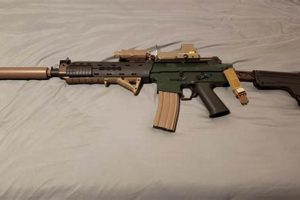
An electronic component acting as a switch within an airsoft electric gun (AEG), it regulates the flow of electricity from the battery to the motor. This device, often a Metal-Oxide-Semiconductor Field-Effect Transistor, is integrated into the AEG’s wiring to improve performance and longevity. A common application involves bypassing the mechanical trigger contacts, which can be susceptible to wear and arcing.
This enhancement provides several advantages, notably increased rate of fire, improved trigger response, and protection of the trigger contacts from damage. Historically, standard AEGs relied on direct connection between the trigger and the motor circuit, leading to performance limitations and potential component failure. Implementation addresses these issues, resulting in a more reliable and efficient AEG system.
The subsequent sections will delve into the specific benefits of incorporating such a component, various types available, installation considerations, and troubleshooting common issues. Understanding these aspects allows informed decisions regarding upgrading or maintaining airsoft electric guns.
Enhancing Airsoft AEG Performance
Optimizing an AEG’s performance necessitates understanding and proper implementation strategies relating to electronic components. The following recommendations provide insight into maximizing efficiency and reliability.
Tip 1: Select a Compatible Unit: Ensure the chosen component is rated for the AEG’s voltage and current requirements. Incompatibility can lead to component failure or diminished performance.
Tip 2: Prioritize Heat Management: These components generate heat during operation. Adequate heat sinking or airflow is crucial to prevent overheating and potential damage.
Tip 3: Consider Active Braking Features: Integrated active braking can improve trigger response by quickly stopping the motor after each shot. This is especially beneficial for semi-automatic fire.
Tip 4: Implement Proper Wiring: Use high-quality, low-resistance wiring to minimize voltage drop between the battery and the motor. This will improve overall system efficiency.
Tip 5: Utilize a Fuse: Integrating a fuse into the circuit will protect the system from overcurrent conditions. Choose a fuse rating appropriate for the AEG’s power draw.
Tip 6: Professional Installation: If unfamiliar with electrical work, seeking professional installation minimizes risk of damage to the AEG or personal injury.
Tip 7: Regular Inspection: Periodically inspect the component for signs of wear or damage. Address any issues promptly to prevent further complications.
Adhering to these guidelines can significantly improve an AEG’s performance, extend its lifespan, and enhance the overall airsoft experience.
The final section will summarize the key benefits and offer concluding remarks on the integration and maintenance of these components within AEG systems.
1. Trigger contact protection

The vulnerability of mechanical trigger contacts in Airsoft Electric Guns (AEGs) necessitates a robust protection mechanism. Standard AEGs rely on these contacts to directly route high currents to the motor. This direct current flow results in arcing across the contacts each time the trigger is pulled, causing progressive wear, carbon buildup, and eventual failure. This degradation diminishes the AEG’s responsiveness and reliability.
Integration of a electronic component serves as a crucial protective measure. The component acts as an electronic switch, isolating the trigger contacts from the high-current motor circuit. When the trigger is activated, a negligible current flows through the contacts, signaling the component to activate the main power circuit. As a result, the trigger contacts experience minimal wear, significantly extending their operational life. A practical example involves prolonged usage of an AEG in rapid-fire scenarios. Without the electronic component, trigger contacts might fail prematurely, requiring costly repairs or replacements. Conversely, an AEG equipped with this component can withstand extended high-rate-of-fire usage without significant contact degradation.
In essence, the deployment of this specific component provides a critical layer of protection for the trigger contacts in AEGs. This enhancement not only improves the AEG’s overall reliability but also reduces the frequency of maintenance and repairs. Understanding the cause-and-effect relationship between direct current flow, trigger contact degradation, and the mitigation offered by the component is paramount for optimizing AEG performance and longevity.
2. Increased Rate of Fire

Enhancement of an airsoft electric gun’s (AEG) rate of fire (ROF) is a primary objective for many users. Integration of a specific electronic component can significantly contribute to achieving this objective, influencing various aspects of the AEG’s performance.
- Reduced Trigger Contact Resistance
Standard AEGs route high current through the mechanical trigger contacts. This creates resistance, limiting current flow to the motor and hindering ROF. By acting as an electronic switch, this component bypasses the trigger contacts, minimizing resistance in the circuit. The result is a more direct and efficient power delivery to the motor, facilitating faster cycling and an increased ROF.
- Improved Motor Efficiency
The regulation of voltage and current flow optimizes motor performance. In traditional AEG setups, voltage fluctuations and current spikes can hinder motor efficiency, resulting in lower ROF. The component provides a stable and consistent power supply, ensuring the motor operates at its peak potential. This leads to faster motor spin-up and cycling times, directly translating to a higher ROF.
- Faster Cycle Time
The cycle time, which is the time taken for the gearbox to complete a full rotation and fire a BB, is a key determinant of ROF. By reducing trigger contact resistance and improving motor efficiency, it allows for a faster cycle time. This reduced cycle time directly contributes to the AEG’s ability to fire more rounds per second.
- Protection Against Battery Sag
During rapid firing, the AEG’s battery can experience voltage sag, reducing its output and hindering motor performance. By efficiently regulating voltage and minimizing energy loss through heat, it can help mitigate battery sag, maintaining a more consistent power supply to the motor. This ensures a sustained high ROF, even during prolonged bursts of fire.
The cumulative effect of these factors results in a measurable increase in an AEG’s ROF upon component implementation. This enhancement not only improves the AEG’s competitive performance but also provides a more responsive and satisfying user experience. It’s important to note that achieving optimal ROF also relies on other factors, such as battery quality, motor type, and gearbox configuration, all of which work in conjunction to maximize the AEG’s potential.
3. Improved trigger response

The enhancement of trigger response in airsoft electric guns (AEGs) is intrinsically linked to the incorporation of an electronic component. The sluggish trigger response often encountered in standard AEGs stems from the inherent limitations of mechanical trigger contacts and their impact on electrical current flow. The integration of this component directly addresses these limitations, yielding a more immediate and efficient activation of the AEG’s motor. Without it, the user experiences a noticeable delay between trigger pull and motor activation, impacting accuracy and responsiveness, particularly in rapid-fire scenarios. A primary mechanism for trigger response improvement involves bypassing the mechanical trigger switch. These switches often exhibit resistance, reducing the amount of voltage and current that reach the motor. The component acts as a relay and uses the trigger as a signal to activate the motor. This results in the motor receiving more power to turn. In essence, it decreases the delay in power delivery allowing for near instantaneous motor start up.
Further contribution to improved trigger response is achieved through the use of active braking features available in some advanced component designs. Active braking refers to the application of a reverse current to the motor immediately after the trigger is released, rapidly decelerating the motor and gearbox. This function prevents overspin, a phenomenon where the AEG fires an extra shot due to residual momentum in the gearbox. Active braking is invaluable in semi-automatic firing modes, preventing accidental double-taps and ensuring precise shot placement. A practical example involves comparing two AEGs, one with and one without active braking. The AEG with the active braking feature will exhibit a crisper and more predictable trigger response in semi-automatic mode. The AEG without the component will most likely have overspin which will decrease its trigger response time.
In summary, the integration of an electronic component within an AEG significantly enhances trigger response through direct electrical current path optimization and optional active braking functionality. These enhancements not only elevate the AEG’s overall performance but also refine the user’s interaction with the weapon, rendering it a more effective tool in competitive scenarios. The practical implications of this improvement manifest as increased accuracy, faster follow-up shots, and a more consistent shooting experience.
4. Voltage regulation

Voltage regulation plays a critical role in the functionality and longevity of airsoft electric guns (AEGs), particularly when considering the integration of electronic components. Consistent voltage supply ensures optimal performance and prevents damage to sensitive electronic circuits.
- Stable Power Delivery
AEGs require a consistent voltage to operate efficiently. Fluctuations in voltage can lead to inconsistent motor speeds, decreased rate of fire, and unpredictable trigger response. Voltage regulation, provided by the component, ensures that the motor and other electronic components receive the correct voltage, regardless of variations in battery charge level or load. For instance, as a battery discharges, its voltage decreases. Voltage regulation compensates for this drop, maintaining a stable voltage to the motor.
- Component Protection
Electronic components within AEGs are designed to operate within specific voltage ranges. Overvoltage can cause immediate damage, while undervoltage can lead to malfunction or reduced performance. Regulation safeguards these components by preventing voltage spikes and dips, thereby extending their lifespan. An overvoltage situation, caused by a faulty battery or charger, could damage the delicate circuitry without proper protection.
- Improved Motor Efficiency
Motors perform optimally within a specific voltage range. Voltage regulation ensures that the motor receives the correct voltage for its design, maximizing efficiency and reducing heat generation. A motor operating outside its designed voltage range will experience reduced torque, lower speed, and increased energy consumption, ultimately shortening its lifespan. Correcting these fluctuations is imperative.
- Consistent Performance Under Load
Under heavy load, such as during rapid firing, the voltage supplied by the battery can drop significantly. Voltage regulation maintains a stable voltage to the motor, ensuring consistent performance even during sustained firing. Without this, the rate of fire may decrease as the battery voltage drops, leading to inconsistent performance in practical applications.
Therefore, voltage regulation is crucial for maintaining the stability, reliability, and longevity of airsoft electric guns equipped with electronic components. By ensuring a consistent and appropriate voltage supply, it protects sensitive electronics, optimizes motor performance, and provides a more consistent and predictable airsoft experience.
5. Heat dissipation
An inherent consequence of electronic operation, particularly within power-switching devices, heat generation directly impacts the reliability and lifespan of these components. The efficient removal of this heat, termed heat dissipation, becomes crucial for maintaining optimal performance and preventing premature failure, especially in the context of airsoft electric guns (AEGs) where space constraints and operational demands exacerbate thermal challenges.
Integration involves the regulation of current flow to the AEG motor, a process that inevitably produces heat as a byproduct of electrical resistance. The magnitude of heat generated is proportional to the square of the current and the resistance within the component. Without adequate heat dissipation mechanisms, the component’s temperature will rise, potentially exceeding its maximum operating temperature. This thermal overload can lead to performance degradation, instability, and, ultimately, permanent damage to the electronic components. Effective heat dissipation strategies often include the use of heat sinks, thermally conductive materials, and forced-air cooling, each designed to facilitate the transfer of heat away from the component and into the surrounding environment.
In summary, heat dissipation is not merely a supplementary consideration but an integral design element. Its proper implementation ensures the stable and reliable operation. Failure to address these thermal considerations can lead to a shortened lifespan and compromised performance, negating the benefits. Therefore, a comprehensive understanding of heat dissipation principles and their application is essential for maximizing the effectiveness in airsoft AEGs.
6. Battery efficiency
In airsoft electric guns (AEGs), battery efficiency directly influences operational effectiveness. The integration of a specific electronic component can significantly impact battery performance, either improving or degrading its efficiency depending on design and implementation. Examining facets of this relationship is essential for optimizing AEG performance and extending battery lifespan.
- Reduced Trigger Contact Resistance
Standard AEGs experience energy loss due to resistance in the trigger contacts. The electronic component bypasses these contacts, reducing resistance and minimizing energy wasted as heat. A lower resistance circuit allows more energy to be delivered to the motor, increasing overall efficiency and extending battery runtime. For example, an AEG with a high-resistance trigger circuit may drain the battery 20% faster compared to an AEG with electronic component that reduces resistance.
- Optimized Current Flow
Unregulated current flow can lead to inefficient energy usage. Some advanced electronic components incorporate features that regulate current delivery to the motor, matching the power draw to the operational requirements. This prevents the motor from drawing excessive current during periods of low load, such as when the AEG is idle. This controlled current delivery maximizes the utilization of the battery’s capacity.
- Minimizing Heat Generation
Inefficient energy transfer manifests as heat. The lower the resistance in the AEG electrical system, the less heat is generated. Less energy is lost as heat, resulting in less energy wasted. Heat is wasted energy; thus, keeping the heat at a minimum, means that the airsoft is more efficient. Batteries also have less heat and last longer.
Collectively, the facets of reduced resistance, optimized current flow, and minimized heat generation contribute to improved battery efficiency. The implementation of electronic components can yield substantial benefits, extending battery life and enhancing overall AEG performance.
7. System reliability
System reliability, in the context of airsoft electric guns (AEGs), denotes the consistency and dependability of the AEG’s operation over an extended period. The integration of an electronic component significantly influences this reliability, acting as a critical component within the AEG’s electrical system. Failures in the electrical system, such as those stemming from trigger contact arcing or voltage instability, directly compromise the AEG’s ability to function consistently. These failures manifest as inconsistent firing rates, trigger unresponsiveness, or, in extreme cases, complete system shutdown. The electronic component addresses these vulnerabilities by bypassing the mechanical trigger switch, mitigating contact wear, regulating voltage flow, and, in some advanced models, providing diagnostic feedback. An example involves a scenario where a standard AEG, subjected to frequent use, experiences trigger contact burnout within a few months. Conversely, an AEG equipped with the device, operating under similar conditions, maintains consistent performance for an extended period, attributable to the protection afforded to the trigger contacts and the stabilization of the electrical circuit.
Furthermore, advanced units offer additional features that enhance system reliability. Active braking, for instance, reduces gearbox stress by preventing overspin, thereby prolonging the lifespan of internal components. Diagnostic capabilities allow for early detection of potential issues, facilitating proactive maintenance and preventing catastrophic failures. A practical application of this involves monitoring the component’s temperature. Overheating indicates a potential problem, such as excessive motor load or insufficient lubrication within the gearbox, prompting the user to address the issue before it escalates into a more severe malfunction. The component becomes an active participant in maintaining the AEG’s overall health, rather than merely a passive component.
In summary, the incorporation contributes directly to AEG system reliability by mitigating common electrical failure points, stabilizing voltage flow, and, in advanced implementations, providing diagnostic capabilities. Understanding the intricate relationship between the component and system reliability allows for informed decisions regarding AEG upgrades and maintenance, ensuring consistent and dependable performance on the field. Challenges remain in ensuring proper installation and compatibility with various AEG models, highlighting the need for careful consideration and potentially professional installation to fully realize the benefits.
Frequently Asked Questions
The following section addresses common inquiries regarding the functionality, benefits, and implementation of an electronic enhancement device, often misrepresented, within airsoft electric guns.
Question 1: What is the primary function?
The primary function is to regulate electrical current flow from the battery to the motor within an airsoft electric gun. This regulation reduces stress on mechanical trigger contacts and optimizes motor performance.
Question 2: What are the tangible benefits of integration?
Tangible benefits include increased rate of fire, improved trigger response, and prolonged lifespan of trigger contacts due to reduced arcing.
Question 3: Does this component increase the power output (FPS) of an AEG?
This specific component does not directly increase the muzzle velocity (FPS) of an AEG. Its primary function is to improve electrical efficiency and performance, not to modify the AEG’s power output.
Question 4: Is professional installation required?
Professional installation is highly recommended, particularly for individuals unfamiliar with electrical wiring and AEG internals. Improper installation can damage the device or the AEG.
Question 5: Are all devices compatible with all AEGs?
No, not all units are universally compatible. Selection of a device requires careful consideration of the AEG’s voltage and current requirements. Consult product specifications and compatibility guides to ensure proper pairing.
Question 6: What are the potential drawbacks or risks associated with using this component?
Potential drawbacks include increased complexity of the AEG’s electrical system and the possibility of malfunction if the device is incorrectly installed or improperly maintained. Overheating can also pose a risk if adequate heat dissipation is not provided.
This FAQ section clarifies common misconceptions and provides essential information for those considering incorporating this enhancement device. Careful research and informed decision-making are paramount for successful implementation.
The next section will delve into specific models available on the market, offering a comparative analysis of features and performance characteristics.
Conclusion
This article has provided a comprehensive examination of a key component within airsoft electric guns. The exploration encompassed its function in regulating electrical current, the benefits of enhanced trigger response and rate of fire, and the importance of voltage regulation and heat dissipation for system reliability. Understanding these aspects is crucial for informed decision-making regarding AEG upgrades and maintenance.
The strategic integration is not merely an enhancement but a critical modification that can elevate the performance and longevity of airsoft electric guns. Continued research and development in this area promise further advancements in AEG technology. Careful consideration of individual needs and technical specifications remains paramount for optimizing the airsoft experience.