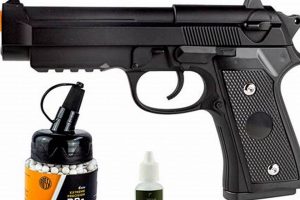
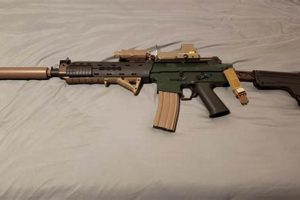
These specialized projectiles, utilized in airsoft guns, incorporate a luminescent compound activated by ultraviolet light. Upon firing, the pellets pass through a tracer unit, a device that briefly exposes them to UV light. This process causes the projectiles to glow in flight, creating a visible streak in low-light conditions. This illumination aids in tracking the path of the shots, especially during nighttime or indoor games.
The employment of these glowing pellets offers a significant tactical advantage. Players can more easily assess shot accuracy and adjust their aim accordingly. Furthermore, the visual effect enhances the realism and immersive experience of airsoft simulations, particularly in scenarios that mimic military operations or close-quarters combat. The initial development and adoption of this technology stemmed from the need for improved visibility in low-light airsoft engagements, enhancing both gameplay and training effectiveness.
The subsequent sections will delve into the construction materials, performance characteristics, variations, and proper handling procedures associated with these specialized airsoft projectiles, ensuring comprehensive understanding and safe utilization.
Airsoft Tracer BBs
The following guidelines outline best practices for maximizing the effectiveness and safety of luminescent airsoft projectiles during gameplay.
Tip 1: Tracer Unit Compatibility: Ensure compatibility between the projectiles and the tracer unit. Using mismatched components can result in reduced luminescence or damage to the equipment. Consult manufacturer specifications before combining different brands.
Tip 2: Battery Maintenance: Tracer units require adequate power for optimal performance. Regularly inspect and maintain the batteries to ensure sufficient UV light output. Diminished brightness reduces projectile visibility.
Tip 3: Storage Conditions: Store these specialized projectiles in a cool, dry place, away from direct sunlight. Exposure to extreme temperatures or humidity can degrade the luminescent coating, affecting their glow intensity and consistency.
Tip 4: Ammunition Weight Consistency: Utilize consistent weight and quality ammunition. Variation in weight can affect trajectory and accuracy, negating the advantages of tracer functionality.
Tip 5: Hop-Up Adjustment: Properly adjust the hop-up system on the airsoft gun. Incorrect hop-up settings can lead to erratic flight paths, rendering the illuminated trail less effective for aiming corrections.
Tip 6: Low-Light Environments: These projectiles are most effective in low-light or nighttime scenarios. During daylight hours, the illumination is significantly reduced, diminishing their tactical advantage.
Tip 7: Environmental Considerations: Exercise caution when using these projectiles in outdoor environments. Be mindful of the potential impact on wildlife and ecosystems. Collect spent rounds responsibly to minimize environmental contamination.
Adhering to these recommendations enhances the accuracy, realism, and overall safety associated with utilizing luminescent airsoft ammunition, providing a distinct advantage in appropriate operational environments.
The subsequent section will address the specific types and technical specifications relevant to the selection and application of these specialized projectiles.
1. Luminescence Activation

Luminescence activation constitutes a fundamental process enabling the functionality of specialized airsoft projectiles. This process involves the excitation of specific chemical compounds within the projectile, resulting in the emission of visible light. Understanding the nuances of this activation mechanism is crucial for optimizing performance and ensuring the proper utilization of these projectiles during low-light airsoft operations.
- Phosphorescent Compound Excitation
The core of luminescence activation resides in the presence of phosphorescent materials embedded within the projectile’s structure. These compounds, typically metal sulfides doped with activators, absorb energy in the form of ultraviolet (UV) light emitted by the tracer unit. Upon absorbing UV photons, the phosphorescent material enters an excited state. This state is inherently unstable, prompting the material to release the absorbed energy as photons of visible light, resulting in the characteristic glowing effect. The efficiency of this excitation process directly influences the projectile’s brightness.
- Wavelength Matching
Optimal luminescence activation hinges on the precise matching of wavelengths between the UV light emitted by the tracer unit and the absorption spectrum of the phosphorescent compound. Mismatched wavelengths lead to inefficient energy transfer, resulting in diminished luminescence. Consequently, selecting a tracer unit and projectile combination designed for spectral compatibility is paramount. Deviations in wavelength matching can significantly reduce the effectiveness of the projectiles, negating the intended advantage of enhanced visibility in low-light conditions.
- Activation Time and Intensity
The duration and intensity of UV exposure influence the brightness and longevity of the projectile’s luminescence. Insufficient exposure results in a weak and quickly fading glow, whereas excessive exposure can potentially degrade the phosphorescent compound over time. The design of tracer units typically incorporates timers and intensity controls to regulate UV output, ensuring consistent and optimal activation. The specific activation time required depends on the compound used in production of the projectile.
- Environmental Factors
Environmental conditions can impact the luminescence activation process. Extreme temperatures or humidity levels can negatively affect the stability and performance of the phosphorescent compounds. Exposure to prolonged sunlight can also degrade these materials, reducing their ability to efficiently absorb and emit light. Proper storage of the projectiles in a cool, dry, and dark environment is crucial for maintaining their optimal luminescence capabilities and prolonging their service life.
These interconnected facets of luminescence activation underscore the importance of selecting compatible equipment, understanding the underlying chemical processes, and adhering to proper handling and storage procedures. Maximizing the efficiency of luminescence activation directly translates to enhanced visibility and improved tactical advantages in low-light airsoft scenarios, the main benefits for using airsoft tracer bbs.
2. Trajectory Visibility

Trajectory visibility, concerning luminescent airsoft projectiles, relates directly to the visual discernment of a projectile’s flight path. This visual tracking facilitates improved accuracy and tactical awareness, particularly in diminished lighting conditions. Factors influencing this visibility are diverse and interconnected.
- Ambient Light Interference
Ambient light levels directly affect trajectory visibility. High ambient light, such as daylight, overwhelms the luminescence, rendering the projectile’s trail largely undetectable. Conversely, low ambient light, like that found in indoor arenas or nighttime environments, enhances the contrast between the projectile’s glow and the surroundings, thereby maximizing visibility. The effectiveness is inversely proportional to ambient light intensity.
- Luminescence Intensity
The inherent intensity of the projectile’s luminescence is a critical determinant of trajectory visibility. This intensity is governed by the type and concentration of phosphorescent materials incorporated within the projectile, as well as the efficiency of the tracer unit’s UV illumination. Higher luminescence intensity allows the projectile’s path to remain visible over a greater distance and amidst moderate ambient light. Factors like storage conditions, UV exposure duration, and material degradation can affect this intensity.
- Projectile Velocity and Spin
The projectile’s velocity and spin influence the visual appearance of the trajectory. Higher velocity reduces the time the projectile remains visible in any given location along its path, potentially shortening the perceived trail. Spin, imparted by the airsoft gun’s hop-up system, stabilizes the projectile’s flight and contributes to a more consistent and predictable trajectory, thus aiding in visual tracking. Deviations from a stable flight path impair the ability to accurately assess the projectile’s course.
- Observer Visual Acuity and Perception
Individual visual acuity and perceptual capabilities play a role in trajectory visibility. Factors such as eyesight, color perception, and attention span affect an observer’s ability to discern and track the projectile’s flight. Additionally, the presence of visual obstructions or distractions can further impede visibility. Training and experience in interpreting projectile trajectories under various lighting conditions can mitigate these limitations.
These factors collectively determine the effectiveness of enhanced visual tracking of specialized projectiles. Optimizing luminescence intensity, controlling for ambient light, ensuring consistent projectile flight, and accounting for observer capabilities are essential for maximizing the tactical advantages afforded by increased trajectory visibility.
3. Material Composition

The material composition of luminescent airsoft projectiles critically affects their performance, safety, and environmental impact. The core material typically consists of a polymer, often ABS (Acrylonitrile Butadiene Styrene) or PLA (Polylactic Acid), chosen for its moldability, structural integrity, and cost-effectiveness. Imbedded within this polymer matrix are phosphorescent compounds, typically strontium aluminate or zinc sulfide doped with rare earth elements. These compounds absorb and re-emit light, providing the luminescent effect. The selection and concentration of these materials directly influence the projectile’s glow intensity and duration. For example, a higher concentration of strontium aluminate generally results in a brighter, longer-lasting glow, but may also increase the projectile’s cost and weight. Furthermore, the presence of additives, such as stabilizers and lubricants, affects the projectile’s consistency and feeding reliability within airsoft guns. Variations in material mixtures will change how the airsoft tracer bbs act in the airsoft equipment.
The choice of polymer also impacts the projectile’s biodegradability. While traditional ABS is not biodegradable, PLA, derived from renewable resources, offers a more environmentally friendly alternative. However, PLA may exhibit lower impact resistance and greater sensitivity to moisture and heat, potentially affecting its accuracy and lifespan. Manufacturing processes significantly influence the final product’s characteristics; precise control over polymer mixing, injection molding, and cooling rates is essential to ensure consistent weight, density, and sphericality. Inconsistent dimensions can lead to erratic flight paths and reduced accuracy, negating the advantages of the luminescent tracer effect. These properties influence not only the longevity of the ammunition but the overall health and safety of the players and the environment they play in.
In summary, the material composition of luminescent airsoft projectiles represents a critical engineering trade-off between performance, cost, environmental considerations, and safety. Optimal material selection necessitates a comprehensive understanding of polymer science, phosphorescent compounds, and manufacturing processes. The evolution of these materials continues to drive innovation in airsoft technology, leading to brighter, more accurate, and more environmentally responsible projectiles. Challenges remain in achieving a perfect balance between these competing factors, but ongoing research and development are steadily improving the overall quality and sustainability of this specialized ammunition. To this day, developers are continuing to find new combinations of materials.
4. Weight Consistency

Weight consistency constitutes a critical parameter influencing the performance and accuracy of airsoft tracer BBs. Deviations in weight among individual projectiles within a batch can lead to significant variations in trajectory, range, and overall effectiveness. Maintaining uniform weight is therefore essential for realizing the full tactical advantage afforded by these specialized projectiles.
- Impact on Ballistic Trajectory
Variations in weight directly affect a projectile’s ballistic trajectory. Lighter projectiles experience a greater degree of acceleration under the same propulsive force, resulting in a flatter trajectory and potentially longer range. Conversely, heavier projectiles exhibit a more pronounced arc and reduced range. Inconsistent weight leads to unpredictable shot placement, undermining the user’s ability to accurately engage targets. For example, a mix of heavier and lighter BBs within the same magazine would cause shots to scatter vertically, reducing the probability of hitting the intended target at longer ranges.
- Effect on Hop-Up System Performance
The hop-up system, designed to impart backspin on the projectile, relies on consistent weight to function optimally. Variations in weight disrupt the effectiveness of the hop-up unit, leading to inconsistencies in lift and range. Projectiles that are significantly lighter may experience excessive lift, causing them to overshoot the target, while heavier projectiles may not receive sufficient lift, resulting in a shorter range. A correctly adjusted hop-up for a specific weight will perform sub-optimally with any deviation, impacting the consistency of shot groupings.
- Influence on Propulsive Energy Transfer
The efficiency of energy transfer from the airsoft gun’s propulsion system (e.g., gas or spring) to the projectile is dependent on consistent weight. Projectiles with lower mass require less energy to accelerate to a given velocity, while heavier projectiles require more. Inconsistent weight can lead to variations in muzzle velocity, further exacerbating the inconsistencies in trajectory and range. This is particularly noticeable in gas-powered airsoft guns, where fluctuations in gas pressure can compound the effects of weight inconsistency.
- Relationship to Manufacturing Tolerances
Achieving consistent weight in airsoft tracer BBs necessitates stringent manufacturing tolerances. Minute variations in the amount of material used in each projectile can lead to measurable differences in weight. High-quality manufacturers employ precision molding and weighing techniques to minimize these variations. Lower-quality BBs often exhibit wider weight tolerances, resulting in compromised performance and accuracy. Consequently, selecting projectiles from reputable manufacturers known for their quality control is crucial for ensuring optimal performance.
The interwoven relationship between these factors highlights the critical importance of weight consistency in realizing the intended benefits of airsoft tracer BBs. Consistent weight translates to predictable trajectories, reliable hop-up performance, efficient energy transfer, and, ultimately, enhanced accuracy and tactical effectiveness. Therefore, selecting high-quality BBs with minimal weight variations is paramount for maximizing performance during gameplay.
5. Tracer Unit Compatibility
Successful utilization of airsoft tracer BBs hinges significantly on tracer unit compatibility. The tracer unit serves as the activating mechanism for the luminescent properties of these specialized projectiles. Proper matching of the unit and the ammunition is therefore essential for achieving optimal performance and reliability. Mismatched components can result in diminished luminescence, reduced accuracy, and potential damage to the equipment.
- Wavelength Synchronization
The emission spectrum of the tracer unit’s UV light source must align with the excitation spectrum of the phosphorescent material embedded within the BBs. Incompatibility in wavelengths results in inefficient energy transfer, leading to a weak or non-existent glow. For instance, if a tracer unit emits predominantly in the UV-A range, while the BBs are designed for UV-B activation, the luminescence will be significantly reduced. This synchronization is a key factor in maximizing the visibility of the projectiles in low-light conditions.
- Physical Dimensions and Feeding Mechanisms
The physical dimensions of the BBs must be compatible with the tracer unit’s feeding mechanism. Oversized or irregularly shaped BBs can jam the unit, while undersized BBs may not properly engage with the activation mechanism. This compatibility extends to the BB’s surface finish; rough surfaces can impede smooth feeding and activation, while excessively smooth surfaces may not provide adequate grip for the feeding mechanism. Proper physical compatibility ensures reliable and consistent activation of the BBs.
- Energy Output and Activation Time
The energy output of the tracer unit’s UV light source, as well as the activation time, must be sufficient to fully charge the phosphorescent material in the BBs. Insufficient energy output or short activation times can result in a weak and quickly fading glow. Conversely, excessive energy output or prolonged activation times can potentially degrade the phosphorescent material over time. The design and adjustment of the tracer unit must therefore provide a balance between adequate charging and material longevity.
- Material Compatibility and Durability
The materials used in the tracer unit and the BBs must be chemically compatible to prevent degradation or damage to either component. Some BB materials may react negatively with the tracer unit’s internal components, leading to corrosion or reduced performance. Additionally, the BBs must be durable enough to withstand the forces exerted during feeding and firing without fracturing or disintegrating within the unit. Proper material compatibility and durability ensure the long-term reliability of both the tracer unit and the ammunition.
These factors underscore the interconnectedness of tracer unit design and BB composition. Selecting matched components, adhering to manufacturer recommendations, and regularly maintaining the equipment are crucial steps in ensuring the effective and reliable utilization of airsoft tracer BBs. The synergistic relationship between these components is ultimately what delivers the desired tactical advantage in low-light airsoft engagements.
Frequently Asked Questions
The following addresses common inquiries regarding the application, performance, and safety of luminescent airsoft projectiles.
Question 1: Are specialized airsoft tracer BBs safe for use in all airsoft guns?
The compatibility of these projectiles varies depending on the specific airsoft gun and tracer unit. It is imperative to consult the manufacturer’s recommendations to ensure proper function and avoid potential damage to the equipment. Misuse can lead to malfunctions or safety hazards.
Question 2: What factors influence the brightness and visibility of these projectiles?
Luminescence intensity is governed by the type and concentration of phosphorescent materials within the projectile, the energy output of the tracer unit, and the ambient lighting conditions. Higher quality projectiles and tracer units, combined with lower ambient light, generally result in greater visibility.
Question 3: How should specialized airsoft tracer BBs be stored to maintain their effectiveness?
These projectiles should be stored in a cool, dry location, shielded from direct sunlight and extreme temperatures. Exposure to such conditions can degrade the luminescent compounds and reduce their effectiveness over time.
Question 4: What is the typical effective range of these projectiles compared to standard airsoft BBs?
The effective range of these projectiles is primarily determined by the airsoft gun’s power and hop-up system, not the projectile’s luminescent properties. However, the added weight of the luminescent material may slightly affect the overall range and trajectory compared to standard BBs of the same weight.
Question 5: Do specialized airsoft tracer BBs pose any environmental concerns?
The environmental impact depends on the composition of the projectile. Biodegradable options, typically made from PLA, are available and represent a more environmentally responsible choice compared to traditional ABS plastic BBs. Responsible disposal practices are always recommended.
Question 6: How does the use of specialized airsoft tracer BBs affect gameplay tactics?
These projectiles enhance the ability to track shot trajectories, particularly in low-light environments, enabling players to make more accurate adjustments and improve their targeting. This can significantly alter tactical approaches and increase engagement effectiveness in appropriate scenarios.
Understanding the nuances of these projectiles is critical for safe and effective utilization within the airsoft environment.
The subsequent section will explore emerging trends and technological advancements related to these specialized airsoft projectiles.
Conclusion
This exploration has illuminated the multifaceted aspects of specialized airsoft projectiles. From luminescence activation and trajectory visibility to material composition, weight consistency, and tracer unit compatibility, each element significantly impacts their functionality. Strategic advantages conferred by these projectiles in low-light environments are undeniable, yet responsible and informed utilization remains paramount. These attributes of these products impact the overall airsofting experience.
Continued advancements in material science and tracer unit technology promise further enhancements in performance, safety, and environmental responsibility. Prudent selection, conscientious application, and adherence to best practices will ensure that airsoft engagements utilizing airsoft tracer bbs remain a safe and tactically enriching experience. This necessitates ongoing vigilance and a commitment to responsible innovation within the airsoft community.