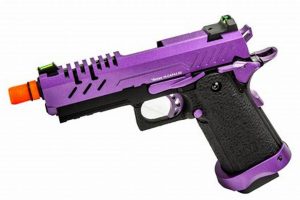
The operation of an airsoft replica involves several key steps to ensure safe and effective use. These steps range from initial preparation, including understanding the specific model and its mechanisms, to responsible handling during simulated combat scenarios. Proficiency is acquired through practice and adherence to safety protocols.
Proper handling contributes to the longevity of the equipment, prevents accidents, and promotes a more realistic and enjoyable recreational experience. A solid understanding of these principles also fosters responsible behavior within the airsoft community. Originally developed as a training aid, the popularity of these devices has expanded significantly, becoming a recreational activity enjoyed by many.
The following sections will detail essential aspects of operation, including safety precautions, loading procedures, firing techniques, and maintenance guidelines. Furthermore, information on selecting appropriate protective gear and understanding field regulations will be provided to ensure a well-rounded understanding of the activity.
Operation Guidance
The following tips provide practical guidance for safe and effective handling of airsoft replicas. Adherence to these suggestions can enhance user experience and minimize the risk of injury or equipment damage.
Tip 1: Prioritize Eye Protection: ANSI Z87.1 rated goggles or a full face mask are indispensable. Projectiles can cause serious eye injury. Ensure the protective eyewear fits securely and provides comprehensive coverage.
Tip 2: Understand the Specific Model: Different airsoft replicas operate with varying mechanisms (AEG, gas, spring). Review the manufacturer’s instructions to comprehend loading, firing, and maintenance procedures specific to the model.
Tip 3: Utilize Appropriate Ammunition: Use high-quality, seamless BBs of the correct weight (typically 0.20g or 0.25g). Using low-quality or incorrect ammunition can damage the internal components.
Tip 4: Master Loading Techniques: Load magazines properly to prevent jams. Avoid overfilling magazines, as this can damage the spring mechanism. Employ speed loaders when applicable.
Tip 5: Practice Safe Firing Practices: Always point the airsoft replica in a safe direction. Keep the finger off the trigger until ready to fire. Avoid shooting at close range without appropriate safety measures.
Tip 6: Maintain the Airsoft Replica Regularly: Clean the barrel after each use. Lubricate internal components as recommended by the manufacturer. Store the replica in a safe, dry place.
Tip 7: Follow Field Regulations: Adhere to all field rules regarding muzzle velocity limits, engagement distances, and prohibited areas. Understanding and respecting these regulations is crucial for safe gameplay.
These tips, when consistently applied, contribute significantly to responsible handling, enhancing both the safety and enjoyment of the activity. Understanding the mechanics, utilizing correct ammunition, and applying safe handling practices are important. The subsequent conclusion will reinforce the core principles of responsible usage and ongoing learning within the community.
1. Safety Precautions

Safety precautions are integral to operating an airsoft device correctly. Lack of adherence leads to potential injury. The operation of an airsoft device inherently involves the projection of projectiles, thus requiring mandatory use of ANSI Z87.1 rated eye protection. Failing to use appropriate eye protection can result in severe ocular trauma, ranging from corneal abrasions to permanent vision loss.
Beyond eye protection, safe operation includes understanding muzzle velocity limitations established by specific fields or organizations. Exceeding these limits poses a heightened risk of injury to other participants. Responsible handling dictates maintaining safe engagement distances, which vary depending on the replicas power and field regulations. Moreover, storage practices are vital. Leaving these devices unsecured can lead to accidental discharge by unauthorized individuals, including children, with potentially harmful consequences.
Therefore, comprehensive knowledge and strict adherence to safety protocols are not merely recommended but are fundamentally necessary. The operation of an airsoft device, without concurrent and conscientious application of safety measures, creates unacceptable risk. Safety is not an optional add-on but an intrinsic element of responsible operation, ensuring participant well-being and promoting a positive environment.
2. Model Familiarization

Model familiarization forms a cornerstone of proficient and safe operation. Each airsoft replica, whether spring-powered, electric-powered (AEG), or gas-powered, possesses unique operating characteristics and internal mechanisms. Ignorance of these specific attributes directly correlates with increased risk of malfunction, damage to the replica, and potential injury to the user or bystanders. For instance, attempting to load an AEG magazine into a gas-powered replica will inevitably result in failure and potential damage. Similarly, failing to understand the hop-up adjustment mechanism on a particular model will lead to inaccurate projectile trajectory and compromised performance. The specific battery voltage required for an AEG, or the proper gas pressure for a gas-powered replica, are critical parameters that demand specific understanding. Model familiarization isn’t merely a suggestion, but rather, an essential precondition for responsible handling.
The practical implications of thorough familiarization extend beyond basic functionality. A detailed understanding of a particular model’s disassembly and reassembly procedures facilitates proper maintenance, including cleaning, lubrication, and component replacement. This capability reduces the likelihood of costly repairs and extends the lifespan of the replica. Furthermore, recognizing the specific trigger mechanism and fire selector settings of a model allows the operator to adjust their firing technique for optimal accuracy and rate of fire. In a simulated combat scenario, this tactical advantage can be decisive. Therefore, understanding and adapting to a model’s specific design represents a fundamental skill for any serious participant.
In summary, model familiarization is not an optional exercise; it is an integrated component of skillful and responsible handling. The challenges involved stem from the sheer diversity of airsoft replica models available, necessitating diligent research and practical experience with each specific type. Overcoming these challenges through consistent learning and hands-on practice contributes significantly to both individual proficiency and the overall safety of the airsoft community, connecting to the broader theme of responsible use and continuous improvement.
3. Ammunition Selection
Ammunition selection constitutes a critical determinant in the functionality, performance, and longevity of an airsoft device. The correlation between appropriate ammunition and proper utilization cannot be overstated; incorrect selection can induce malfunctions, degrade accuracy, and potentially damage internal components.
- BB Weight and Velocity
BB weight directly affects projectile velocity and trajectory. Lighter BBs (e.g., 0.12g) exhibit higher initial velocity but are susceptible to wind drift and have reduced range. Heavier BBs (e.g., 0.25g, 0.28g) maintain momentum better, offering improved accuracy and range, particularly in outdoor environments. Selecting the correct weight is crucial for optimizing performance within specific field regulations and replica power output. Using excessively light BBs in high-powered replicas can lead to inconsistent shots and potential damage.
- BB Material and Quality
BBs are typically manufactured from plastic or biodegradable materials. High-quality BBs possess a seamless, polished surface, ensuring smooth passage through the barrel and minimizing friction. Low-quality BBs often exhibit imperfections, such as seams or dimples, which can cause jams, erratic flight paths, and internal wear. The use of substandard ammunition can also void warranties, as the resulting damage is directly attributable to user negligence. Employing seamless, high-grade BBs is essential for optimal replica performance and longevity.
- BB Size Consistency
Standard airsoft BBs measure 6mm in diameter. Variations in size, even within fractions of a millimeter, can significantly impact feeding reliability and accuracy. BBs that are too large can jam in the magazine or barrel, while those that are too small may not engage the hop-up system effectively, resulting in reduced range and accuracy. Consistent BB size is particularly crucial for replicas with tightbore barrels, where even minor variations can cause significant problems. Utilizing BBs from reputable manufacturers who maintain strict quality control standards mitigates the risk of size inconsistencies.
- Biodegradable Considerations
Many airsoft fields mandate the use of biodegradable BBs to minimize environmental impact. These BBs are typically composed of polylactic acid (PLA) or other plant-based materials. While biodegradable BBs offer an eco-friendly alternative, they may exhibit different ballistic characteristics compared to standard plastic BBs. They can also be more susceptible to moisture, potentially leading to degradation and jams. Selecting biodegradable BBs that are specifically designed for airsoft use, and storing them in a dry environment, is crucial for maintaining performance and reliability.
In conclusion, meticulous ammunition selection directly influences the safe, reliable, and accurate operation of an airsoft device. BB weight, material quality, size consistency, and biodegradability are all critical factors that necessitate careful consideration. Failing to account for these parameters can compromise replica performance, increase the risk of malfunctions, and potentially lead to equipment damage or personal injury.
4. Loading Procedures

Loading procedures represent a foundational aspect of operating an airsoft replica effectively. The proper execution of these procedures directly influences the device’s reliability, reduces the likelihood of malfunctions, and ensures consistent performance during simulated engagements. Adherence to recommended loading protocols is essential for realizing the full potential of an airsoft replica.
- Magazine Compatibility and Types
Magazines are not universally interchangeable across different airsoft models or even within different variants of the same model. Utilizing an incompatible magazine can result in failure to feed BBs into the chamber, damage to the magazine or the replica, or both. Airsoft magazines vary in design and capacity, including low-capacity (low-cap), mid-capacity (mid-cap), and high-capacity (hi-cap) types. Low-cap magazines typically hold around 30-50 BBs and require manual winding or no winding at all, while mid-cap magazines hold around 70-150 BBs, and hi-cap magazines hold upwards of 200 BBs and often require frequent winding. Understanding the specific magazine type compatible with a given airsoft replica and the associated winding or loading mechanisms is critical. Using the incorrect type of magazine or not loading properly will lead to poor performance.
- BB Loading Techniques and Tools
Effective BB loading techniques are essential for preventing jams and ensuring consistent feeding. Employing speed loaders is highly recommended, as they facilitate rapid and efficient loading of magazines without damaging the BBs. Care must be taken to avoid overfilling magazines, as this can place excessive stress on the magazine spring and lead to feeding issues. BBs should be loaded into the magazine smoothly and evenly to prevent them from becoming misaligned or jammed. The type of speed loader used also depends on the magazine type (ex: a traditional speed loader for a hi-cap magazine or a specific tool for a mid-cap).
- Winding Mechanisms and Maintenance
High-capacity (hi-cap) magazines incorporate a winding mechanism that advances BBs within the magazine body. The proper operation of this mechanism is crucial for consistent feeding. The magazine must be wound periodically to ensure that sufficient BBs are forced into the feeding channel. Overtightening or aggressive winding can damage the internal components of the magazine, while insufficient winding will result in intermittent feeding. Regular maintenance, including cleaning and lubrication of the winding mechanism, is essential for preserving magazine functionality. Maintenance includes clearing out dirt from the winding mechanisms to ensure it works smoothly.
- Magazine Seating and Retention
Secure magazine seating within the magazine well is paramount for reliable operation. A properly seated magazine ensures that the BB feeding nozzle aligns correctly with the magazine, allowing for seamless BB transfer into the chamber. Insufficient magazine seating can result in misfeeds, jams, and inconsistent firing. Many airsoft replicas incorporate magazine release mechanisms that retain the magazine within the well. Proper functioning of this release is essential for quick magazine changes during gameplay. Understanding how the magazine properly clicks into place as well as how the magazine will be properly retained for gameplay is extremely important.
In summary, precise adherence to appropriate loading procedures directly contributes to enhanced reliability, improved performance, and reduced malfunctions. The details concerning magazine compatibility, loading tools and techniques, winding mechanisms, and secure seating form an integrated whole. Ignoring or improperly executing one component can negatively impact overall device function. Understanding, practicing, and routinely applying those procedures will contribute to safe and reliable performance.
5. Firing Techniques

The execution of firing techniques is intrinsically linked to operational proficiency. Effective employment of these techniques maximizes accuracy, range, and overall effectiveness in simulated engagements. Inadequate technique undermines the intended use, leading to inconsistent results and reduced tactical advantage. The correlation is evident in competitive scenarios, where individuals exhibiting superior firing skills consistently outperform those lacking fundamental proficiency. Mastering these skills is therefore a prerequisite for those seeking to responsibly and effectively utilize the device.
Practical applications of proper firing techniques extend beyond competitive environments. Correct stance, grip, and trigger control significantly reduce the likelihood of accidental discharge and improve shot placement. For example, maintaining a stable stance and consistent trigger pull minimizes muzzle movement during firing, resulting in tighter groupings. Understanding the relationship between projectile trajectory and hop-up settings allows for accurate targeting at varying distances. Adjusting firing techniques to accommodate environmental factors, such as wind, further enhances accuracy. Such tactical nuance is essential for any individual seeking to skillfully control the firing in real-world situations.
In summary, firing techniques form an indispensable component. The challenges involved in mastering these techniques stem from the need for consistent practice and adaptation to diverse environmental conditions and replica types. Overcoming these challenges through disciplined training and continuous refinement contributes to both individual skill and overall safety, directly reinforcing the importance of responsible device utilization.
6. Maintenance Schedule

A regularly followed maintenance schedule is inextricably linked to the correct use of an airsoft device. Failure to adhere to a consistent maintenance routine directly compromises the device’s operational integrity, leading to diminished performance, increased risk of malfunction, and potential long-term damage. Therefore, understanding and implementing a maintenance schedule is not an optional addendum, but a fundamental component of proper handling.
The consequences of neglecting maintenance are multifaceted. Accumulation of dirt, debris, and lubricant residue within the barrel and internal mechanisms directly impacts projectile trajectory and velocity consistency. This results in decreased accuracy and unpredictable firing patterns. Furthermore, unlubricated gears and pistons within electric-powered devices experience increased friction, leading to accelerated wear and potential mechanical failure. Gas-powered devices are susceptible to seal degradation and gas leaks if not properly maintained, resulting in reduced power output and inconsistent cycling. Spring-powered replicas can suffer from spring fatigue and reduced compression if not regularly inspected and maintained.
A comprehensive maintenance schedule should include several key elements: regular cleaning of the barrel and hop-up unit to remove accumulated debris, lubrication of internal components with appropriate lubricants (silicone-based lubricants are typically recommended), inspection of seals and O-rings for wear or damage, and proper storage in a dry environment to prevent corrosion. The frequency of maintenance depends on usage patterns; however, a basic cleaning and lubrication should be performed after each use, with more in-depth maintenance conducted periodically. Consistent adherence to this schedule ensures optimal performance, prolongs the lifespan of the device, and minimizes the risk of malfunctions. Therefore, maintenance is not a separate activity but an integral aspect of responsible device operation.
7. Field Regulations

Field regulations are the governing principles that dictate safe and fair play during organized airsoft activities. These rules are not arbitrary; they are meticulously crafted to mitigate risk, ensure equitable competition, and foster a positive recreational environment. The correct operation of an airsoft replica is intrinsically linked to adherence to these field regulations. Ignoring or circumventing these rules undermines the safety and integrity of the activity.
- Muzzle Velocity Limits
Muzzle velocity limits are a cornerstone of field regulations. These limits, typically expressed in feet per second (FPS) with a 0.20g BB, define the maximum kinetic energy a projectile can possess. Exceeding these limits increases the risk of injury to participants. Fields commonly enforce these limits through chronograph testing, where replicas are fired through a device that measures the projectile’s velocity. Operators who modify their replicas to exceed these limits are typically barred from participation. Understanding and adhering to muzzle velocity limits is a paramount consideration when operating an airsoft device. This applies to the device selection to ensure it abides by fields rules and also responsible modification that does not lead to exceeding limits.
- Engagement Distances
Minimum engagement distances dictate the closest proximity at which a player can engage another player. These distances are established to reduce the risk of injury from close-range impacts. Airsoft projectiles, even at legal muzzle velocities, can cause discomfort or minor injury when fired at close range, particularly to sensitive areas. Fields typically establish different minimum engagement distances based on replica type (e.g., sniper rifles may have longer minimum engagement distances). Violating these distances can result in penalties, ranging from warnings to ejection from the field. Therefore, understanding and respecting minimum engagement distances is a crucial aspect of responsible gameplay and handling. Always consider the minimum engagement distances and avoid shooting at opponents below that distance.
- Protective Gear Requirements
Field regulations invariably mandate the use of specific protective gear. Eye protection is universally required, typically in the form of ANSI Z87.1 rated goggles or a full-face mask. Some fields may also require lower face protection, such as a mesh mask or balaclava, to protect teeth and other vulnerable areas. Failure to wear the required protective gear is grounds for immediate expulsion from the field. The rationale behind these requirements is self-evident: airsoft projectiles can cause serious injury, and protective gear is the primary defense against such injury. Protective gear like goggles that are too loose might not properly protect the eyes and could potentially lead to serious injury. Wearing field mandated protective gear is not merely a formality; it is an essential element of safe participation.
- Safe Zones and No-Fire Zones
Safe zones and no-fire zones are designated areas where replica firing is strictly prohibited. These zones are typically located near the staging area, parking lot, or other non-combat areas. The purpose of these zones is to provide a safe environment for players to remove their protective gear, adjust their equipment, and interact without the risk of accidental discharge. Violating these zones is considered a serious infraction and can result in immediate ejection from the field. Always ensure that the replica is unloaded and the safety is engaged when entering a safe zone. Refrain from handling the replica in a manner that could be perceived as threatening or unsafe. Safe zones are meant to be areas where players can relax and prepare for the game, free from the risk of being hit by projectiles. Therefore, strict adherence to these regulations is paramount for maintaining a safe and orderly environment.
In conclusion, field regulations serve as the framework within which airsoft activities are conducted safely and fairly. Understanding and adhering to these regulations is not merely a suggestion; it is a prerequisite for responsible participation. Muzzle velocity limits, engagement distances, protective gear requirements, and safe zones all contribute to a controlled environment where the risks associated with the activity are minimized. The conscientious operator recognizes the importance of these regulations and actively strives to uphold them, thereby fostering a positive and enjoyable experience for all participants. These rules exist to help protect all individuals at the field.
Frequently Asked Questions
This section addresses common inquiries regarding the safe and effective handling. The following questions and answers offer concise and authoritative guidance.
Question 1: What constitutes adequate eye protection?
Adequate eye protection comprises ANSI Z87.1 rated goggles or a full-face mask. These provide verified impact resistance. Ensure a secure fit that prevents projectile entry from any angle. Regular inspection for damage is also recommended.
Question 2: How should a magazine be loaded to prevent malfunctions?
Magazines should be loaded using a speed loader when possible. Avoid overfilling. Ensure proper alignment of BBs within the magazine. Periodically inspect the magazine for dirt or debris that could impede feeding. Load smoothly and avoid applying excessive force.
Question 3: What is the significance of muzzle velocity limits?
Muzzle velocity limits, typically measured in feet per second (FPS), are designed to minimize the risk of injury. Exceeding established FPS limits violates field regulations and poses an unacceptable safety risk. Chronograph testing is frequently used to verify compliance.
Question 4: How often should an airsoft replica be cleaned and lubricated?
A basic cleaning and lubrication should occur after each use. More thorough maintenance, including disassembly and internal cleaning, should be conducted periodically, depending on frequency of use. Refer to the manufacturer’s instructions for specific recommendations.
Question 5: What steps should be taken before storing an airsoft device?
Prior to storage, the device should be unloaded, cleaned, and lightly lubricated. The battery should be removed from electric-powered models. Store the device in a secure, dry location, away from direct sunlight and extreme temperatures.
Question 6: What are the primary considerations when selecting ammunition?
Select ammunition of the correct weight (typically 0.20g or 0.25g) and material (high-quality, seamless BBs). Use only ammunition specifically designed for airsoft devices. Avoid using low-quality or recycled ammunition, as this can damage internal components.
The information presented herein offers a foundational understanding of operation best practices. Continuous learning and adaptation to specific device models and field regulations are essential for responsible participation.
The following section will present a comprehensive conclusion to this article.
Conclusion
This exploration of “how to use a airsoft gun” has detailed essential aspects, emphasizing safety precautions, model familiarization, ammunition selection, loading procedures, firing techniques, maintenance schedules, and adherence to field regulations. Each element contributes significantly to responsible and effective device utilization. A thorough understanding of these components mitigates risks, enhances performance, and promotes a positive operational environment.
The presented information serves as a foundation for responsible engagement. Continuous learning, adaptation to evolving technologies and regulations, and a commitment to safe practices are critical. The future of the activity depends on responsible participants who prioritize safety and respect. Furthering one’s knowledge through consistent education will ensure continued safe and successful usage.