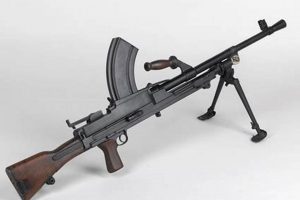
The process involves several key steps to ensure accuracy and safety. It encompasses loading the airsoft replica, assuming a stable stance, acquiring a clear sight picture, and applying controlled trigger pull. The proper execution of these techniques results in consistent and precise target engagement.
Mastering this skill is fundamental for participating in airsoft games and training scenarios. Proficiency enhances strategic gameplay, builds confidence, and promotes responsible handling of airsoft equipment. Furthermore, understanding the mechanics behind projectile propulsion adds to the overall appreciation of the sport.
This guide details the specific procedures for operating an airsoft replica. It will cover essential aspects such as safety precautions, stance and grip techniques, aiming methods, and trigger control to facilitate the effective and safe utilization of the equipment.
Essential Techniques
The following insights offer critical refinements to accuracy and effectiveness when employing airsoft weaponry. Implementing these techniques enhances both the experience and level of proficiency.
Tip 1: Prioritize Eye Protection: Always ensure appropriate eye protection is worn before handling any airsoft replica. This preventative measure safeguards against potential injury from projectiles.
Tip 2: Adopt a Stable Stance: Employ a balanced stance with feet shoulder-width apart. This foundation minimizes movement and enhances shot stability.
Tip 3: Master the Grip: Maintain a firm but relaxed grip on the replica. Excessive tension can introduce unwanted movement, negatively impacting accuracy.
Tip 4: Sight Alignment is Paramount: Consistently align the front and rear sights for precise aiming. Minor deviations can significantly alter the point of impact.
Tip 5: Practice Trigger Control: Apply smooth and gradual pressure to the trigger. Avoid jerking or slapping the trigger, as this disrupts the stability of the replica.
Tip 6: Account for Environmental Factors: Wind and distance affect the trajectory of the BB. Compensate accordingly to maintain accuracy at longer ranges.
Tip 7: Regular Maintenance is Key: Keep the airsoft replica clean and lubricated to ensure consistent performance and prolong its lifespan.
Adherence to these techniques promotes consistency and precision. This in turn improves individual performance in airsoft simulations and promotes safe handling.
These refined practices now lead into a broader discussion of safety protocols and responsible airsoft practices.
1. Safety First
The principle of “Safety First” is paramount when considering the act of shooting an airsoft replica. Prioritizing safety mitigates potential risks associated with projectile-based activities and ensures responsible participation.
- Mandatory Eye Protection
Eye protection, such as ANSI-rated goggles or a full face mask, is non-negotiable. Airsoft BBs are capable of causing serious eye injury. Wearing appropriate protection at all times during handling and operation of an airsoft replica is crucial to prevent potential harm.
- Adherence to Field Regulations
Each airsoft field or event has specific safety regulations regarding maximum FPS (feet per second) limits, minimum engagement distances, and prohibited actions. Familiarizing oneself with and adhering to these rules prevents accidents and ensures fair play.
- Responsible Handling Practices
Treating every airsoft replica as if it were a real firearm is a core tenet of safety. Keeping the muzzle pointed in a safe direction, keeping the finger off the trigger until ready to fire, and ensuring the replica is unloaded and safely stored when not in use are essential practices.
- Awareness of Surroundings
Maintaining constant awareness of one’s surroundings and the location of other individuals is vital. Avoiding firing in congested areas or towards unprotected individuals minimizes the risk of accidental injury. A clear understanding of the “line of fire” at all times is critical.
The facets of safety, when collectively applied, establish a secure foundation for utilizing airsoft replicas. Neglecting even one aspect compromises the overall safety of participants and bystanders. Strict adherence to these principles is essential for promoting a responsible and enjoyable airsoft experience.
2. Proper Stance

A direct correlation exists between stance and accuracy when employing an airsoft replica. Stance provides the foundational stability necessary for minimizing movement during the aiming and trigger-pull process. An unstable stance translates to increased wobble and inconsistent shot placement, regardless of the shooter’s skill level. Conversely, a well-executed stance serves as a platform for controlled and precise target engagement.
The specific stance employed can vary based on individual preferences and tactical considerations; however, certain principles remain constant. A balanced distribution of weight across both feet, typically positioned shoulder-width apart, creates a stable base. Leaning too far forward or backward disrupts this balance, increasing the likelihood of movement. Furthermore, aligning the body to face the target directly, or slightly angled depending on the individual’s dominant side, optimizes control and reduces strain. Airsoft competitions, for instance, often witness participants utilizing modified Weaver or Isosceles stances to maximize stability under pressure and time constraints.
In summary, proper stance is not merely a peripheral consideration; it is an integral component of effective airsoft replica handling. The stability afforded by a well-executed stance directly impacts accuracy and shot consistency. Neglecting this fundamental aspect diminishes the overall performance potential, irrespective of proficiency in other areas. Therefore, dedicating time to refine stance techniques is crucial for achieving optimal results.
3. Grip Consistency
Grip consistency exerts a significant influence on the accuracy and precision involved in effectively employing an airsoft replica. Fluctuations in the applied grip pressure or hand positioning introduce unintended movement and torque, directly impacting the stability of the replica and, consequently, the trajectory of the projectile. Therefore, maintaining a consistent grip is not merely a matter of comfort, but a fundamental element in the pursuit of accuracy.
The effect of grip inconsistencies can be observed through the phenomenon of shot deviation. Even slight variations in hand placement from shot to shot can cause subtle shifts in the muzzle’s orientation at the moment of discharge. This results in the projectile’s trajectory diverging from the intended point of impact. To mitigate this, experienced airsoft participants typically establish a repeatable grip technique, characterized by a consistent hand position, finger placement, and pressure applied to the replica’s frame. For example, an operator may meticulously index their trigger finger along the receiver when not actively engaging the trigger, ensuring a consistent reference point for each subsequent shot. This repeatable tactile feedback promotes muscle memory and minimizes grip variations.
In conclusion, grip consistency is an indispensable component of effective airsoft replica operation. The subtle yet demonstrable impact of grip variations on projectile trajectory underscores the importance of developing and maintaining a repeatable grip technique. By prioritizing grip consistency, airsoft participants enhance their accuracy and precision, ultimately improving overall performance and maximizing the enjoyment of the activity.
4. Sight Alignment
Sight alignment is a fundamental aspect of precision shooting when employing any projectile weapon, including an airsoft replica. It refers to the proper positioning of the shooter’s eye, the rear sight, and the front sight in a single, unified plane. Incorrect alignment introduces parallax error, causing the point of aim to deviate from the actual point of impact. Thus, achieving correct sight alignment is essential for accurately directing a projectile towards the intended target.
The practical significance of sight alignment is readily apparent in various airsoft scenarios. Consider a situation where a player attempts to engage a target at a moderate distance. If the sights are misaligned, even by a slight degree, the projectile will likely miss the target altogether. Conversely, a player who consistently achieves correct sight alignment will experience significantly improved accuracy and be able to engage targets effectively. Many airsoft optics, such as red dot sights, aim to simplify the process of proper sight alignment by projecting a single illuminated dot onto the target plane. However, even with these aids, understanding the principles of sight alignment remains crucial for obtaining optimal performance.
Ultimately, sight alignment serves as a crucial bridge between the operator’s intention and the projectile’s trajectory. While factors like wind and distance can influence a shot, proper sight alignment establishes the baseline for consistent and accurate shooting. Mastering this skill requires dedicated practice and a keen awareness of the visual cues involved. Neglecting sight alignment compromises accuracy and effectiveness, emphasizing its central role in achieving proficiency.
5. Trigger Control

Trigger control constitutes a critical component of proficient airsoft replica operation. Consistent and deliberate manipulation of the trigger mechanism directly influences shot accuracy and overall performance. Proper trigger control mitigates unintentional movement and promotes stable firing, essential for target engagement.
- Smooth and Consistent Pressure
Applying steady, gradual pressure to the trigger minimizes disturbances to the replica’s alignment during the firing sequence. Jerking or slapping the trigger induces unwanted movement, resulting in inaccurate shots. Consider the example of a competitive airsoft shooter maintaining a constant pressure until the replica discharges; this technique significantly reduces wobble and improves shot placement.
- Proper Finger Placement
Correct finger placement on the trigger impacts the leverage and control exerted. Positioning the pad of the index finger squarely on the trigger allows for a straight, rearward pull. Incorrect placement, such as using the fingertip, can cause the finger to slip or exert uneven pressure, affecting accuracy. Many experienced users advocate for consistent finger placement as a cornerstone of effective operation.
- Follow Through
Maintaining trigger pressure momentarily after the replica discharges prevents involuntary flinching or abrupt release of the trigger. This “follow-through” ensures consistent alignment throughout the entire firing cycle. Visualizing a continuous motion, even after the projectile has left the barrel, reinforces this essential technique.
- Resetting the Trigger
Controlled release of the trigger to the reset point allows for rapid follow-up shots without sacrificing accuracy. Releasing the trigger only to the reset point, rather than fully releasing it, minimizes unnecessary movement and reduces the time required to fire subsequent shots. Mastering the trigger reset enables proficient, controlled bursts of fire when appropriate.
The aforementioned facets underscore the importance of trigger control in achieving accurate and consistent shots when utilizing airsoft replicas. Skillful application of these techniques translates directly to enhanced performance and improved target engagement. Consistent practice and mindful attention to trigger manipulation contribute significantly to mastering the art of precision shooting in airsoft activities.
6. BB Trajectory

The flight path of a BB, known as its trajectory, is inextricably linked to the skill of effectively operating an airsoft replica. Understanding the factors influencing projectile trajectory is essential for achieving accuracy and consistent target engagement. A BB’s trajectory is not a straight line; it is a curved path affected by gravity, air resistance, and, in some cases, the Magnus effect imparted by a hop-up unit. Ignoring these influences leads to inaccurate shots, particularly at longer ranges. Therefore, compensating for these factors is a critical component of accurate airsoft marksmanship.
For instance, gravity consistently pulls the BB downwards, causing it to drop below the initial line of sight. The longer the distance to the target, the more significant this drop becomes. Skilled airsoft participants instinctively adjust their aim upwards, a process often referred to as “holding over,” to compensate for this drop. Furthermore, air resistance slows the BB down, reducing its range and affecting its stability. Strong winds can also deflect the BB’s trajectory laterally, requiring the shooter to adjust their aim in the direction of the wind. The hop-up unit, a common feature in airsoft replicas, imparts backspin to the BB, generating lift and extending its effective range. However, an improperly adjusted hop-up can negatively impact trajectory, causing the BB to curve upwards or downwards excessively. Competitions often enforce strict hop-up regulations, emphasizing the significance of understanding its effect.
In conclusion, comprehending BB trajectory and its influencing factors is not merely academic; it is a practical requirement for anyone seeking proficiency with an airsoft replica. Mastering techniques for compensating for gravity, air resistance, and hop-up effects is essential for achieving accuracy at various distances and under varying environmental conditions. Recognizing the curved path of a BB and adjusting aim accordingly is fundamental to consistent target engagement and overall success in airsoft activities.
7. Maintenance Schedule

A direct correlation exists between the adherence to a structured maintenance schedule and the consistent, reliable operation of an airsoft replica. The ability to effectively utilize an airsoft device hinges not solely on the immediate act of firing, but rather on the preceding and subsequent care administered. Neglecting routine maintenance precipitates performance degradation, potential malfunctions, and a diminished effective lifespan. In essence, diligent upkeep serves as a foundational element for sustained and accurate operation.
The ramifications of neglecting maintenance manifest in several ways. Internal components, such as gears, pistons, and air seals, accumulate residue and friction over time. This accumulation reduces power output, diminishes range, and ultimately leads to mechanical failure. For instance, dried lubricant within the gearbox of an electric airsoft replica causes increased motor strain, reduced firing rate, and eventual gearbox seizure. Similarly, neglecting to clean the barrel of debris and residue impairs accuracy by disrupting the smooth passage of the BB. Proper cleaning and lubrication, as dictated by a consistent schedule, mitigate these risks and preserve optimal operating condition. High-end competitions, for example, mandate weapon checks to ensure compliance and prevent malfunctions stemming from inadequate maintenance.
In summation, a proactive maintenance schedule constitutes an indivisible aspect of proficient airsoft replica handling. The principles of stance, sight alignment, and trigger control become irrelevant if the device itself operates sub-optimally or fails altogether. Regular cleaning, lubrication, and component inspection are not merely recommended practices but rather essential prerequisites for maximizing performance, ensuring safety, and prolonging the functional lifespan of the airsoft device. By prioritizing maintenance, participants guarantee a reliable and effective shooting experience, thereby solidifying maintenance as a cornerstone element.
Frequently Asked Questions
The following addresses common inquiries regarding the accurate and safe operation of airsoft replicas.
Question 1: What constitutes the most crucial aspect of using this type of replica?
Eye protection is paramount. Appropriate eyewear must be worn at all times to prevent potential injury. This cannot be overstated.
Question 2: At what distance is this activity considered safe?
Safe engagement distances are contingent upon the specific field rules and the replica’s power output (FPS). Adherence to these established guidelines prevents potential injuries.
Question 3: How does environmental influence impact the trajectory of projectiles?
Wind and distance directly influence projectile trajectory. Shooters should compensate accordingly for these external factors to maintain accuracy.
Question 4: What steps facilitate the optimization of accuracy?
Maintaining a stable stance, consistent grip, proper sight alignment, and controlled trigger pull are essential for optimizing accuracy.
Question 5: What role does the hop-up unit play?
The hop-up unit imparts backspin to the projectile, extending its range. However, improper adjustment can negatively impact accuracy.
Question 6: How important is routine maintenance?
Regular maintenance is crucial for ensuring consistent performance, preventing malfunctions, and prolonging the lifespan of the replica.
Mastery of safe and accurate practices demands continuous learning and dedication.
Next we will conclude by summarizing the content.
Conclusion
The preceding sections detailed the critical facets of operating an airsoft replica. Mastery hinges on a holistic understanding of safety protocols, stance, grip, sight alignment, trigger control, BB trajectory, and maintenance. Each element contributes to the ability to accurately and responsibly engage targets.
The act of shooting an airsoft gun necessitates a commitment to responsible practice and continuous refinement of technique. By adhering to these principles, individuals promote safety and elevate performance, ensuring the continued integrity and enjoyment of the sport.