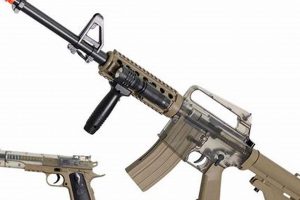
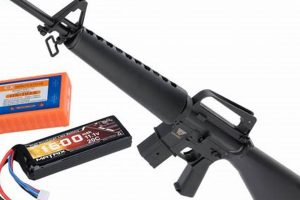
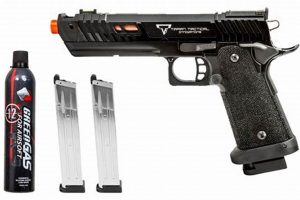
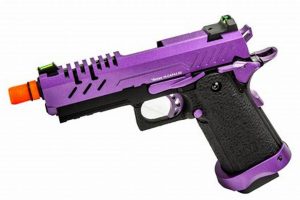
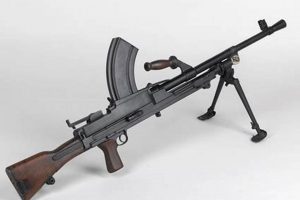
The process involves altering the internal or external components of these recreational firearms. Common adjustments include upgrading the spring for increased velocity, installing a tighter bore barrel for improved accuracy, or replacing the hop-up unit to enhance range. For example, changing the motor in an electric airsoft rifle can result in a higher rate of fire.
Modifications are undertaken to improve performance, customize aesthetics, or replicate real firearms more closely. Historically, adjustments were basic, involving simple spring replacements. As technology advanced, more sophisticated options like MOSFETs for electronic control and CNC machined parts became available, enabling precise and durable upgrades.
The following sections will detail specific modification techniques, focusing on enhancing power, accuracy, and external appearance. Each section will address the tools required, the procedures involved, and the potential impacts on overall functionality and legality.
Essential Considerations for Airsoft Firearm Alteration
Successful and safe alteration of airsoft firearms requires careful planning, appropriate tools, and a thorough understanding of the potential consequences.
Tip 1: Prioritize Safety. Before any modification, ensure the airsoft firearm is unloaded and the battery (if applicable) is disconnected. Eye protection is mandatory throughout the entire process.
Tip 2: Research Compatibility. Not all parts are universally compatible. Verify that the intended upgrade is designed for the specific airsoft firearm model to avoid damage or malfunction.
Tip 3: Use Appropriate Tools. Employ the correct tools for each task. Forcing components with inadequate tools can lead to stripped screws, broken parts, or personal injury.
Tip 4: Document the Process. Take photographs or notes during disassembly. This documentation serves as a valuable reference during reassembly, preventing errors and ensuring proper functionality.
Tip 5: Test Functionality Incrementally. After each modification, test the airsoft firearm in a controlled environment to ensure it functions as intended. Address any issues immediately.
Tip 6: Consider Legal Implications. Be aware of local regulations regarding airsoft firearm power limits and external modifications. Ensure all alterations comply with legal standards.
Tip 7: Understand Mechanical Impact. Modifications that increase power can significantly reduce the lifespan of internal components. Be prepared to replace worn parts more frequently.
Tip 8: Seek Professional Assistance. If uncertain about any aspect of the modification process, consult a qualified airsoft technician. Improper modifications can render the airsoft firearm unusable or unsafe.
Adhering to these considerations maximizes the likelihood of a successful and safe alteration, yielding improved performance and enjoyment of the airsoft firearm.
The concluding section will summarize the key aspects of modifying airsoft firearms and provide resources for further learning.
1. Power Enhancement

Power enhancement, in the context of modifying airsoft guns, refers primarily to increasing the muzzle velocity of the projectile. This is achieved through alterations that increase the force propelling the BB, commonly measured in feet per second (FPS). A direct correlation exists between modifications aimed at boosting power and the resultant increase in projectile velocity and, consequently, effective range. For instance, installing a stronger spring in a spring-powered or electric airsoft gun increases the force exerted on the piston, thereby increasing muzzle velocity. Similarly, a high-pressure gas system in a gas blowback (GBB) airsoft gun can be adjusted to deliver more force.
The significance of power enhancement stems from its direct impact on gameplay. Higher FPS allows for longer shots, making the user more effective in engagements. However, increased power also carries potential downsides. It can reduce the lifespan of internal components due to increased stress. Furthermore, many airsoft fields have strict FPS limits for safety reasons. Exceeding these limits renders the airsoft gun unusable at those fields and potentially violates local regulations. For example, many indoor fields enforce lower FPS limits than outdoor fields due to the closer engagement distances. Therefore, modifications aimed at power enhancement necessitate careful consideration of both performance gains and potential consequences.
In conclusion, power enhancement is a fundamental aspect of modifying airsoft guns, influencing range and engagement capabilities. However, it requires a balanced approach, acknowledging potential damage to components and strict adherence to safety regulations and field limits. The successful implementation of power enhancements hinges on a thorough understanding of the mechanical implications and the legal and safety boundaries governing airsoft activities.
2. Accuracy Improvement

Accuracy improvement, when discussing the modification of airsoft guns, centers on minimizing projectile deviation to achieve consistent shot placement. Multiple components and adjustments contribute to this goal, each affecting accuracy to varying degrees. Upgrading the inner barrel, for example, improves accuracy by reducing the BB’s movement within the barrel before exiting. This is achieved through tighter bore diameters and smoother internal finishes. Another critical component is the hop-up unit, which imparts backspin to the BB, generating lift and increasing range, but also affecting accuracy depending on its adjustability and consistency.
The importance of accuracy improvements arises from its impact on competitive play and target shooting. A more accurate airsoft gun allows for precise targeting, increasing the likelihood of hitting the intended target, leading to a tactical advantage. For instance, upgrading to a precision inner barrel alongside a high-quality hop-up bucking can tighten groupings significantly at longer ranges. Proper hop-up adjustment is critical: excessive hop-up leads to over-spin and vertical trajectory deviations, whereas insufficient hop-up results in a reduced range and increased bullet drop. The alignment of the barrel assembly within the outer barrel is also a relevant, but often overlooked, aspect that can be improved with barrel spacers.
Achieving optimal accuracy in airsoft gun modifications is an iterative process requiring a systematic approach. It begins with identifying the limiting factors in the existing setup, followed by targeted component upgrades and meticulous calibration. Potential challenges include component incompatibility, improper installation, and the need for specialized tools. In summary, accuracy improvement through airsoft gun modification is a multifaceted endeavor that relies on understanding the interplay of various components and a commitment to precision tuning. While power enhancements offer increased range, realizing effective range requires focusing on precision in shot placement.
3. External Customization
External customization represents a significant aspect of modifying airsoft guns, extending beyond mere aesthetic changes to encompass functional enhancements and personalized configurations. These modifications affect the user’s interaction with the firearm, impacting ergonomics, handling, and tactical capabilities.
- Attachment Rails and Accessory Mounting
The addition of Picatinny or M-LOK rail systems allows for the attachment of various accessories such as optics, foregrips, lights, and lasers. These attachments can improve target acquisition, handling stability, and low-light operational capabilities. For example, a vertical foregrip can enhance control during rapid firing, while a red dot sight speeds up target engagement.
- Stock and Grip Replacements
Replacing the stock and grip modifies the ergonomics of the airsoft gun, catering to individual preferences and improving comfort. Adjustable stocks allow users to customize the length of pull for optimal fit, while aftermarket grips provide improved texture and ergonomics for enhanced control. Examples include replacing a standard stock with a crane stock for battery storage or swapping a polymer grip for a rubberized one for better grip in wet conditions.
- External Barrel Modifications and Mock Suppressors
Modifying the external barrel or adding a mock suppressor alters the appearance and potentially the overall length of the airsoft gun. While mock suppressors typically serve an aesthetic purpose, they can sometimes be used to conceal an extended inner barrel. Different outer barrel lengths can affect maneuverability and weight distribution, altering the balance of the airsoft gun.
- Cosmetic Finishes and Camouflage
Applying custom paint jobs or camouflage patterns allows for personalization and improved concealment in specific environments. These finishes can range from simple color changes to complex multi-tone camouflage schemes. Cerakote and hydro-dipping are common methods used to achieve durable and visually appealing finishes, improving the aesthetic value and potential concealment capabilities of the airsoft gun.
In conclusion, external customization provides a wide array of options for modifying airsoft guns, ranging from functional enhancements to purely aesthetic changes. These modifications cater to individual preferences and tactical requirements, influencing the ergonomics, handling, and visual appearance of the airsoft gun. Understanding these aspects is essential for maximizing the potential of any airsoft gun modification project.
4. Internal Reliability

Internal reliability, in the context of modifying airsoft guns, directly influences the longevity and consistent performance of the weapon system following alterations. Modifications, particularly those aimed at increasing power or rate of fire, inherently place greater stress on internal components. This increased stress accelerates wear and tear, potentially leading to premature failure if the internal components are not upgraded to withstand the enhanced demands. For example, installing a more powerful spring without reinforcing the piston and gearbox can cause these weaker parts to break under the increased strain. Therefore, maintaining or improving internal reliability becomes a critical consideration in any modification project.
Enhancing internal reliability often involves replacing stock components with stronger alternatives. Common upgrades include reinforced gearsets, durable pistons with metal teeth, stronger springs, and improved air nozzles. Selecting high-quality components manufactured from robust materials, such as steel or reinforced polymers, is essential to withstand the increased stress. Furthermore, proper shimming of gears and lubrication of moving parts are critical for minimizing friction and wear, thereby extending the lifespan of internal components. Consider the scenario of a user upgrading an electric airsoft rifle (AEG) with a high-speed motor; without upgrading the gears to a hardened steel set, the stock gears may strip under the increased torque.
In summary, internal reliability is an indispensable aspect of airsoft gun modification. Addressing potential vulnerabilities through component upgrades and proper maintenance practices is paramount to ensuring consistent performance and preventing costly repairs. Failing to prioritize internal reliability can negate the benefits of other modifications, leading to diminished performance and a shortened lifespan for the airsoft gun. A comprehensive approach to modification must, therefore, consider the impact on internal components and implement necessary upgrades to maintain or improve overall reliability.
5. Legal Compliance

Legal compliance is an integral component of how to modify airsoft guns. Modifications that exceed legal velocity limits, alter required markings, or transform an airsoft device into something legally defined as a firearm carry significant repercussions. Cause and effect are directly linked: modifying an airsoft gun to exceed a field’s or jurisdiction’s FPS limit, for instance, results in the weapon being unusable at that field and potential legal penalties, respectively. Therefore, awareness of applicable laws and regulations is not merely advisable, but mandatory, when considering any modification.
The specific legal requirements surrounding airsoft guns vary considerably depending on geographical location. Some jurisdictions impose strict velocity limits, while others focus on visible markings and coloration to distinguish airsoft guns from real firearms. For example, some US states mandate an orange tip on the barrel of all airsoft guns. Removing or obscuring this orange tip could lead to confiscation of the airsoft gun and potential legal charges. Similarly, modifications that allow an airsoft gun to fire projectiles at velocities exceeding established limits could result in reclassification of the device as a firearm, subjecting the owner to stringent regulations and potential criminal penalties if non-compliant. The practical significance of this understanding is paramount: failure to comply with local laws can result in fines, confiscation of equipment, or even criminal charges.
In conclusion, legal compliance represents a non-negotiable aspect of airsoft gun modification. Ignorance of relevant laws offers no defense against potential legal consequences. Modifiers should proactively research and adhere to all applicable regulations to ensure their activities remain within legal boundaries. The responsibility lies with the individual to understand and abide by the law, safeguarding against legal ramifications and preserving the integrity of the sport.
Frequently Asked Questions About Airsoft Gun Modification
This section addresses common questions and concerns regarding modifying airsoft guns. The information aims to provide clarity on various aspects of modification, from performance enhancements to legal considerations.
Question 1: What are the primary benefits of modifying an airsoft gun?
The primary benefits include improved performance characteristics, such as increased range and accuracy; enhanced durability of internal components; and personalized customization for improved ergonomics and aesthetics. These benefits contribute to a more competitive and enjoyable airsoft experience.
Question 2: Is it legal to modify airsoft guns to increase their power?
The legality of modifying airsoft guns to increase power depends on local laws and regulations. Many jurisdictions have velocity limits for airsoft guns, and exceeding these limits may result in legal penalties. Prior research and adherence to local regulations are imperative.
Question 3: What are the most common internal upgrades for airsoft guns?
Common internal upgrades include reinforced gearsets, high-torque motors, tighter bore barrels, improved hop-up units, and durable pistons. These upgrades enhance performance, reliability, and longevity of the airsoft gun.
Question 4: How does modifying an airsoft gun affect its warranty?
Modifying an airsoft gun typically voids the manufacturer’s warranty. Altering the internal components or external structure may be considered misuse or tampering, thus nullifying any warranty coverage. Consider the ramifications prior to modification.
Question 5: What safety precautions should be taken when modifying airsoft guns?
Safety precautions include ensuring the airsoft gun is unloaded and the battery disconnected (if applicable). Eye protection is mandatory during disassembly and reassembly. A clear workspace and appropriate tools are essential to prevent accidents or damage.
Question 6: What are the potential risks associated with modifying airsoft guns?
Potential risks include damaging internal components through improper installation, voiding the manufacturer’s warranty, and violating local laws regarding velocity limits. Insufficient knowledge and improper techniques can lead to malfunctions or unsafe operation.
In summary, modifying airsoft guns presents potential benefits and risks. Success and safety depend on adequate knowledge, adherence to regulations, and careful execution. Prior research is strongly recommended before undertaking any modification project.
The following section will provide a glossary of common terms related to airsoft gun modification, ensuring a common understanding of the terminology used.
How to Modify Airsoft Guns
This exploration of how to modify airsoft guns has encompassed a range of critical considerations, from power enhancement and accuracy improvement to internal reliability and legal compliance. Modification, while potentially yielding performance gains and personalized aesthetics, presents inherent risks and responsibilities. Success demands a thorough understanding of mechanical principles, adherence to safety protocols, and a commitment to legal compliance.
Ultimately, the decision to modify an airsoft gun should be approached with diligence and informed awareness. Prioritize safety, respect legal limitations, and recognize the potential impact on the airsoft gun’s functionality and longevity. Whether seeking competitive advantage or personalized customization, responsible modification ensures the continued enjoyment and integrity of the sport.