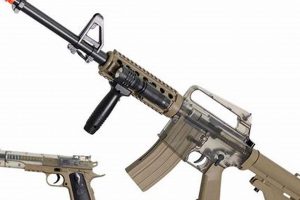
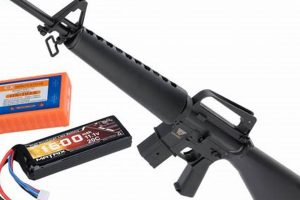
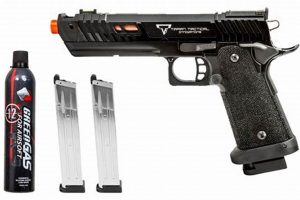
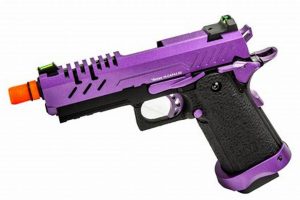
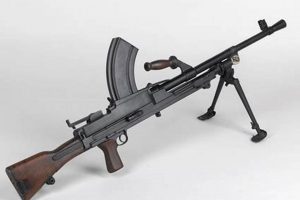
The manufacture of airsoft guns involves a multi-stage process transforming raw materials into functional replicas of firearms. This fabrication includes the creation of internal mechanisms, external housings, and various components that, when assembled, propel plastic projectiles. The method of producing these items utilizes a combination of automated manufacturing and hand assembly techniques.
The significance of understanding the fabrication process lies in appreciating the design and engineering necessary for accurate projectile delivery and the safe operation of the device. This knowledge also provides context for product quality, cost considerations, and potential modifications to improve performance. Historically, early models were primarily spring-powered, whereas contemporary models often employ electric or gas-powered propulsion systems.
The subsequent sections will delve into the specifics of material selection, the manufacturing techniques used for both internal and external components, the assembly process, and the quality control measures employed to ensure functionality and safety of the final product.
Production Considerations for Airsoft Devices
Optimizing the manufacturing process requires careful attention to detail and adherence to specific guidelines. These considerations ensure both product quality and operational safety.
Tip 1: Material Selection: Employ high-impact polymers for external components to ensure durability and resistance to damage. Internal mechanisms should utilize hardened steel or reinforced alloys to withstand stress and wear.
Tip 2: Precision Molding: Utilize precision injection molding techniques to create components with tight tolerances. This reduces internal friction and improves the accuracy and consistency of projectile velocity.
Tip 3: Gearbox Assembly: When constructing electric airsoft gun gearboxes, ensure proper lubrication of all gears and moving parts. Correct shimming is crucial to prevent premature wear and failure.
Tip 4: Hop-Up Unit Calibration: Calibrate the hop-up unit meticulously to optimize projectile trajectory and range. Variations in BB weight and quality necessitate careful adjustment.
Tip 5: Gas System Integrity: For gas-powered models, thoroughly inspect and test all seals and valves for leaks. Proper sealing is essential for maintaining consistent pressure and performance.
Tip 6: Quality Control Testing: Implement rigorous quality control procedures at each stage of manufacturing. This includes velocity testing, accuracy assessment, and structural integrity checks.
Tip 7: Safety Mechanism Validation: Ensure that safety mechanisms, such as trigger locks and safety switches, function reliably and prevent accidental discharge.
Adhering to these guidelines maximizes the longevity, performance, and safety of the manufactured item, minimizing potential issues related to functionality and user experience.
The following sections will delve into the materials and manufacturing processes, encompassing internal and external components, assembly practices, and the integration of quality control protocols to ensure the device’s functionality and safety in its final configuration.
1. Material Selection

Material selection represents a foundational element in airsoft gun manufacturing, directly influencing durability, performance, and overall product longevity. The choice of materials dictates the ability to withstand operational stresses, environmental conditions, and repetitive use cycles. Inadequate material selection can result in premature component failure, reduced accuracy, and compromised safety. For instance, using low-grade plastic for the receiver can lead to cracking or shattering under stress, rendering the device inoperable. The materials used contribute to the final weight, balance, and feel of the airsoft device, therefore influencing user experience and playability.
Specifically, high-impact polymers, such as ABS or nylon-reinforced plastics, are frequently chosen for external body components, providing a balance between impact resistance and cost-effectiveness. Internal mechanisms, which experience significant stress, typically require higher-grade materials like steel or aluminum alloys. Gears within the gearbox assembly benefit from hardened steel to minimize wear. The O-rings and seals in gas-powered models necessitate specialized elastomers capable of maintaining an airtight seal under pressure and temperature variations. The performance of any device depends not only on the mechanical and electronic design but also on the appropriateness of materials used in its construction.
In conclusion, material selection is an integral aspect of the production process, with direct consequences for the final product’s reliability, performance, and safety. The interplay between material properties, manufacturing costs, and intended application dictates the success or failure of the airsoft device. Proper understanding of material science and engineering principles is required to optimize the manufacturing approach.
2. Component Fabrication

Component fabrication constitutes a pivotal stage in the overall manufacturing process of airsoft devices. This phase determines the precision, durability, and functionality of individual parts that collectively contribute to the final product’s performance. Effective component fabrication directly influences the operational effectiveness and lifespan of the assembled product.
- Injection Molding of Polymer Components
Injection molding is a widely employed technique for producing external housings, magazines, and other plastic components. This process involves injecting molten polymer into a mold cavity, allowing it to cool and solidify into the desired shape. Variations in polymer type and mold design can affect impact resistance, dimensional accuracy, and surface finish. Deviations in injection parameters, such as temperature and pressure, can lead to defects, compromising the structural integrity of the airsoft device.
- CNC Machining of Metal Internals
Critical internal components, such as gears, pistons, and barrels, often require CNC (Computer Numerical Control) machining. This process utilizes computer-controlled cutting tools to precisely shape metal stock. The choice of metal alloy, machining tolerances, and cutting parameters affect the component’s strength, wear resistance, and dimensional accuracy. Inaccurate machining can result in poor gear mesh, air leaks, and reduced overall performance.
- Precision Casting of Smaller Parts
Smaller, intricate components, such as trigger mechanisms, selector switches, and hop-up units, may be manufactured using precision casting methods. This process involves pouring molten metal or alloy into a mold cavity and allowing it to solidify. Investment casting and die casting are common techniques. Factors such as mold material, pouring temperature, and cooling rate influence the component’s dimensional accuracy, surface finish, and mechanical properties. Casting flaws, such as porosity or inclusions, can lead to premature failure.
- Finishing and Surface Treatments
Post-fabrication finishing processes, such as deburring, polishing, and surface coating, are applied to enhance component performance and aesthetics. Deburring removes sharp edges and imperfections, preventing wear on mating parts. Polishing improves surface finish, reducing friction and enhancing appearance. Surface coatings, such as anodizing or plating, protect against corrosion and improve wear resistance. Improper finishing can compromise dimensional accuracy and negatively affect the component’s functionality.
In summary, the accuracy and quality of component fabrication are fundamental to the reliability and performance of airsoft devices. Employing appropriate manufacturing techniques and quality control measures ensures that each component meets the required specifications, leading to a well-functioning and durable product. The integration of advanced manufacturing processes and materials is essential for optimizing device performance and user satisfaction.
3. Assembly Processes
Assembly processes are integral to the final realization of manufactured airsoft devices, transforming individual components into functional units. The precision and methodology employed during assembly directly impact the device’s performance, reliability, and safety. Improper assembly can lead to malfunctions, reduced accuracy, and potential safety hazards.
- Gearbox Integration
The gearbox represents a critical internal assembly housing gears, pistons, and other components responsible for generating the power behind projectile propulsion. Precise alignment of gears and proper lubrication are essential for efficient operation. Incorrect assembly can cause premature wear, increased friction, and ultimately, gearbox failure. The integration of the gearbox into the receiver must also be precise to ensure proper alignment with the barrel and hop-up unit.
- Hop-Up Unit Installation
The hop-up unit imparts backspin to the projectile, extending its range and improving accuracy. Correct installation of the hop-up unit is vital for achieving optimal performance. Misalignment or improper sealing can result in inconsistent backspin, reduced range, and inaccurate shots. The hop-up unit must be precisely aligned with the barrel to ensure consistent projectile trajectory.
- External Component Attachment
The attachment of external components, such as the stock, handguard, and sights, contributes to the overall ergonomics and functionality of the device. Secure and proper attachment is necessary to prevent loosening or detachment during use. Incorrectly attached components can affect the user’s grip, aiming, and overall handling of the device.
- Wiring and Electrical Connections
For electric-powered airsoft devices, proper wiring and electrical connections are crucial for reliable operation. Incorrect wiring can lead to short circuits, battery drain, or damage to the motor and other electrical components. Secure connections and proper insulation are essential for ensuring safe and consistent performance.
The assembly processes directly define the operational capabilities of any device. These processes are vital for translating individual components into a functioning mechanism, highlighting the necessity for skilled technicians and stringent quality control measures to ensure that each completed unit adheres to established performance and safety standards. Adherence to specified assembly protocols guarantees an effective and reliable manufactured product.
4. Power Source Integration
Power source integration is a critical aspect of airsoft gun manufacturing, directly influencing performance characteristics such as firing rate, projectile velocity, and operational consistency. The design and implementation of the power source dictate the overall functionality and user experience of the final product.
- Spring-Powered Mechanisms
Spring-powered airsoft guns utilize a compressed spring to propel projectiles. These devices rely on manual cocking to compress the spring, storing potential energy until released. Examples include entry-level pistols and rifles. The spring’s strength, length, and material properties directly impact the projectile’s velocity and the user’s cocking effort. Inefficiencies in spring compression or release can lead to inconsistent power output.
- Gas-Powered Systems
Gas-powered airsoft guns employ compressed gas, such as CO2 or green gas, to propel projectiles. These systems utilize gas reservoirs and valves to regulate the release of gas behind the projectile. Examples include pistols and rifles designed for realistic recoil and higher firing rates. The gas pressure, valve design, and seal integrity directly influence the projectile’s velocity and the consistency of each shot. Leaks or inefficiencies in the gas system can result in reduced power and operational reliability.
- Electric-Powered (AEG) Systems
Electric-powered airsoft guns (AEGs) use a battery-powered motor to drive a gearbox, which in turn compresses a spring and propels projectiles. AEGs offer automatic firing capabilities and are prevalent in rifle and submachine gun replicas. The battery voltage, motor torque, gearbox gear ratio, and spring strength all affect the AEG’s firing rate, projectile velocity, and overall performance. Inefficient motor performance or gearbox friction can lead to reduced battery life and inconsistent power output.
- Hybrid Systems
Hybrid power systems combine elements of different power sources to optimize performance characteristics. An example could be a gas blowback system that uses an electric motor to cycle the action, thereby reducing gas consumption. Another example includes an airsoft gun powered by High Pressure Air (HPA) with regulators and electronic controller. This type of system offers enhanced consistency, adjustability, and responsiveness compared to single-source systems. These systems tend to be complicated and are found at higher price points.
The selection and integration of the power source are crucial factors in determining the performance, reliability, and user experience of manufactured airsoft guns. Each power source type presents unique engineering challenges and trade-offs that influence design decisions and overall product cost. The efficiency and consistency of the chosen power source significantly impact the device’s effectiveness in simulated combat scenarios.
5. Quality Assurance

Quality assurance (QA) is inextricably linked to the manufacturing process of airsoft devices. QA protocols, implemented at various stages, directly impact the reliability, safety, and overall performance. These protocols serve as critical control mechanisms, identifying potential defects and ensuring adherence to established manufacturing standards. Without rigorous QA processes, the devices are susceptible to inconsistencies in projectile velocity, inaccurate targeting, and premature mechanical failures, ultimately diminishing the user experience and potentially posing safety risks. For example, velocity tests ensure compliance with legal restrictions and prevent unsafe operating power. Mechanical stress tests validate the resilience of internal components.
Practical application of QA involves several methods. Dimensional inspections utilize precise measurement instruments to verify that individual parts conform to design specifications. Functional testing evaluates the operational integrity of assembled units, assessing firing rates, trigger response, and magazine feeding. Material analysis confirms that chosen materials possess the required strength, flexibility, and resistance to environmental factors. Batch testing of components before full-scale production helps identify design flaws early, preventing widespread manufacturing defects and saving costs. Implementing statistical process control (SPC) allows manufacturers to monitor production processes in real-time, detecting deviations from acceptable tolerances and initiating corrective actions.
In conclusion, a robust QA framework is indispensable to manufacturing a functioning and safe airsoft device. Rigorous inspection processes and functional testing are necessary for verifying that each unit meets performance expectations and adheres to stringent safety regulations. The integration of QA throughout the manufacturing workflow reduces defective units, improves consumer trust, and establishes a manufacturer’s reputation for reliability and quality in the competitive market.
Frequently Asked Questions
This section addresses common inquiries regarding the manufacturing processes, quality control, and performance aspects of airsoft devices, providing detailed and factual information.
Question 1: What materials are typically used in manufacturing airsoft devices, and why?
Airsoft devices commonly incorporate high-impact polymers such as ABS or nylon-reinforced plastics for external components due to their durability, cost-effectiveness, and impact resistance. Internal mechanisms often utilize metals like steel or aluminum alloys to withstand greater stress and ensure operational longevity. The choice depends on the specific component’s function and the desired balance between weight, strength, and cost.
Question 2: How does the fabrication process affect the accuracy and performance of an airsoft device?
Fabrication techniques directly influence accuracy and performance. Precision machining and injection molding create components with tight tolerances, reducing internal friction and air leaks. Correctly manufactured barrels with consistent internal diameters and well-aligned hop-up units promote stable projectile trajectories. Substandard fabrication leads to inconsistencies and diminished accuracy.
Question 3: What quality control measures are employed during the assembly process?
Assembly processes are subject to strict quality control. Velocity tests, accuracy assessments, and structural integrity checks ensure each unit functions as designed. Mechanical stress tests validate the resilience of internal components. Units that fail quality control are rejected or reworked to meet established performance standards.
Question 4: What are the key differences between manufacturing spring-powered, gas-powered, and electric-powered airsoft devices?
Manufacturing spring-powered devices centers on producing a reliable spring mechanism, which stores and releases energy with each cycle. Gas-powered systems require precision valves and gas reservoirs. Electric-powered systems integrate electric motors, gearboxes, and electronic control circuits. The choice of power source affects component complexity, operational cost, and the design and performance characteristics of the final airsoft device.
Question 5: How does hop-up unit design affect the flight path of the projectiles?
The design imparts backspin to the projectile, creating lift and extending range and accuracy. Adjustable hop-up units allow users to fine-tune backspin based on projectile weight and environmental conditions. Inconsistent or poorly designed hop-up units lead to unpredictable projectile trajectories.
Question 6: What are the safety considerations during manufacturing?
Safety is paramount. Stringent quality control checks test the reliability of safety mechanisms. Material selection focuses on robust polymers and metals to minimize component breakage. High-velocity testing ensures the device operates within safe projectile speed limits. All manufacturing complies with relevant international safety standards.
Understanding the various aspects of airsoft device manufacturing, from material selection to quality control, is essential for evaluating product quality and making informed purchasing decisions.
The following section will summarize the content, emphasizing the critical elements in achieving optimal airsoft device manufacturing.
Conclusion
The preceding discussion elucidates the intricate processes involved in the manufacture of airsoft guns. A multifaceted undertaking, the fabrication encompasses stringent material selection, precise component fabrication, meticulous assembly procedures, effective power source integration, and rigorous quality assurance protocols. Each stage directly impacts the final product’s functionality, reliability, and adherence to safety standards. The discussed approaches affect durability, performance, and long-term viability.
A comprehension of the involved processes provides manufacturers and end-users with a discerning perspective on the factors influencing product quality, performance, and safety. With constant advancements and improvements being sought for optimal manufacturing techniques, continued innovation is anticipated within the airsoft manufacturing industry.