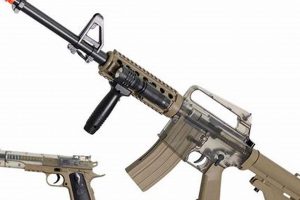
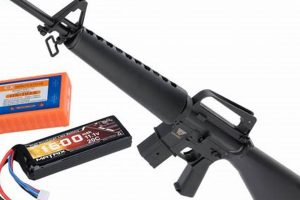
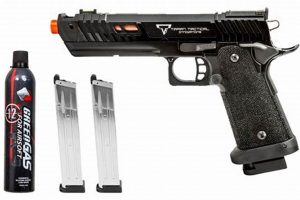
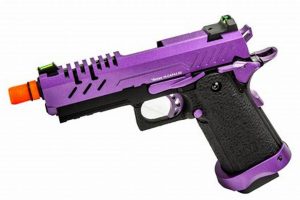
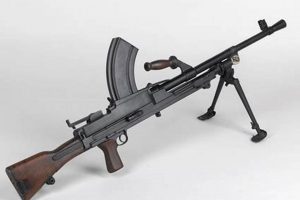
Firearm concealment, specifically within the context of airsoft simulations, can be achieved through various methods. One approach involves utilizing camouflaged material designed to be affixed to the replica weapon. This material is intended to disrupt the weapon’s outline and blend it into the surrounding environment, mimicking natural foliage or terrain.
Effective camouflage enhances a player’s ability to remain undetected during gameplay, offering tactical advantages such as improved ambushing capabilities and reduced visibility to opposing players. Historically, field-expedient camouflage has been crucial for military operations, and this principle translates to the airsoft arena, where gaining a competitive edge is paramount.
The following sections will delve into the different types of materials used for this purpose, application techniques, and considerations for selecting the most suitable option based on specific environmental conditions and gameplay styles.
Practical Considerations for Firearm Concealment in Airsoft
Optimizing camouflage effectiveness for airsoft replica weapons requires careful consideration of several factors. The following tips provide guidance for achieving superior concealment and tactical advantage.
Tip 1: Material Selection: Prioritize materials that closely resemble the dominant vegetation in the intended environment. Consider color, texture, and seasonal variations. For example, arid environments necessitate tan and brown tones, while woodland settings benefit from greens and browns.
Tip 2: Secure Attachment: Ensure that the material is securely fastened to the replica weapon to prevent snagging or detachment during movement. Utilize appropriate attachment methods such as zip ties, paracord, or specialized adhesive solutions designed for tactical gear.
Tip 3: Mimic Natural Patterns: Avoid creating symmetrical or artificial patterns. Observe natural environments and replicate the random, organic distribution of foliage. Overlapping layers and varied textures enhance the illusion of blending into the surroundings.
Tip 4: Minimize Silhouette: Focus on breaking up the weapon’s outline to reduce its recognizability. Extend the camouflage material beyond the weapon’s profile to further distort its shape against the background. Particular attention should be paid to obscuring the barrel, stock, and scope.
Tip 5: Environmental Adaptation: Regularly adjust the camouflage to match changing environmental conditions. Consider adding or removing foliage to reflect seasonal shifts or variations in terrain. This dynamic adaptation is critical for maintaining optimal concealment effectiveness.
Tip 6: Weight Considerations: Opt for lightweight materials to avoid adding excessive weight to the replica weapon, which can negatively impact maneuverability and handling. Balance camouflage effectiveness with practical weight considerations.
Tip 7: Durability Assessment: Select durable materials that can withstand the rigors of airsoft gameplay, including exposure to the elements and potential abrasion. Materials resistant to tearing and fading ensure long-term camouflage performance.
Implementing these strategies maximizes concealment effectiveness and enhances a player’s tactical advantage within the airsoft environment. Proper application and maintenance are essential for achieving optimal results.
The final section will address advanced techniques and considerations for maintaining camouflage integrity and adapting to evolving tactical scenarios.
1. Environmental Blending

Environmental blending constitutes a foundational principle in the effective utilization of camouflaged weapon coverings for airsoft. The primary objective is to minimize the visual contrast between the replica weapon and its operational surroundings. When executed effectively, this blending significantly reduces the likelihood of detection by opposing players, thereby enhancing the user’s tactical advantage. Failure to adequately blend into the environment negates the camouflaging effect, rendering the weapon covering ineffective and potentially drawing unwanted attention.
The selection of appropriate colors, textures, and patterns directly impacts the degree of environmental blending achieved. For instance, a dark green weapon covering, while suitable for a dense woodland environment, would be conspicuously out of place in a desert setting characterized by light brown and tan hues. Similarly, the addition of local vegetation, such as leaves and twigs, further enhances blending by replicating the immediate surroundings. The cause-and-effect relationship is readily apparent: accurate environmental replication results in superior concealment, while mismatched camouflage compromises the user’s position.
Therefore, a comprehensive understanding of the operational environment is paramount. Prior to deployment, airsoft participants should thoroughly assess the terrain, vegetation, and lighting conditions. This assessment informs the selection of suitable materials and the subsequent application of camouflage techniques. Adaptability is also crucial; adjustments may be required as environmental conditions change throughout gameplay. By prioritizing environmental blending, users maximize the effectiveness of weapon coverings and gain a strategic edge in airsoft engagements.
2. Silhouette Disruption

Silhouette disruption represents a critical component of effective firearm camouflage, particularly concerning specialized concealment methods. The objective is to negate the weapon’s readily identifiable shape, preventing an opponent’s immediate recognition of the object as a firearm. Camouflage focuses on color and texture, silhouette disruption alters the weapon’s profile by obscuring its defined outline. The effectiveness of concealment depends on the synergy between these two concepts, with silhouette disruption playing a decisive role in visual obfuscation.
Applications of materials on replica firearms aim to extend and distort the original form. Extending the covering beyond the barrel’s tip, stock edges, and optical sight perimeters produces a jagged profile that merges with the background texture. In woodland environments, attaching artificial foliage that overhangs the weapon’s edges creates a similar effect, mimicking the natural irregularity of vegetation. The absence of these alterations allows the weapon’s hard edges and familiar shape to remain visible, compromising the camouflage and increasing the likelihood of detection. An effective application transforms the weapon from a recognizable object to an indistinguishable part of the environment.
The significance of silhouette disruption extends beyond mere aesthetic considerations; it directly influences the operator’s tactical advantage. Disrupted profiles hinder rapid identification, enabling operators to secure a positional advantage or initiate engagements on their terms. In conclusion, integrating silhouette disruption techniques into firearm camouflaging is crucial for maximizing concealment effectiveness and achieving operational success. Understanding, and implementing, silhouette disruption significantly increases the operator’s survivability and overall effectiveness in simulated combat scenarios.
3. Material Durability
Material durability directly influences the longevity and effectiveness of any ghillie-style weapon covering within the context of airsoft. The simulated combat environment exposes these coverings to considerable wear and tear, encompassing abrasion from vegetation, impact from simulated projectiles, and exposure to various weather conditions. The selection of insufficiently durable materials invariably leads to premature degradation of the covering, diminishing its camouflage capabilities and necessitating frequent replacement. This increased maintenance burden diverts resources and potentially compromises tactical effectiveness during gameplay.
Consider, for example, the use of delicate fabrics susceptible to tearing when constructing such a covering. Even minor snags on branches or underbrush can initiate substantial damage, unraveling the camouflage and rendering the covering conspicuous. Conversely, incorporating rugged, tear-resistant materials like ripstop nylon or reinforced burlap ensures the covering maintains its structural integrity throughout extended use. Such durable materials withstand repeated exposure to environmental stressors, preserving the camouflage pattern and preventing the covering from becoming a liability.
Ultimately, material durability represents a pivotal consideration in the design and construction of a ghillie-style weapon covering. Prioritizing durable materials translates directly into reduced maintenance, enhanced camouflage effectiveness, and a more reliable tactical advantage within the airsoft environment. Failure to adequately address material durability undermines the purpose of the covering and negates its intended benefits.
4. Attachment Security

Attachment security is a paramount aspect of effective weapon camouflage in the airsoft arena. A camouflaged weapon covering, regardless of its aesthetic quality or mimicry of the environment, is rendered ineffective if it becomes detached or displaced during gameplay. This detachment not only compromises the camouflage, exposing the underlying weapon, but also presents a potential hazard to the user and other participants. The cause-and-effect relationship is direct: insecure attachment leads to compromised concealment, which in turn increases the risk of detection and tactical disadvantage. Without secure attachment, the effort invested in selecting and applying the camouflage is negated.
Various attachment methods are employed to ensure secure fastening, including zip ties, adhesive solutions, and woven netting. Each method offers distinct advantages and disadvantages concerning durability, ease of application, and resistance to environmental factors. For instance, while zip ties provide a quick and relatively secure attachment, they can be prone to breakage under stress. Conversely, specialized adhesives offer a more permanent bond but may be susceptible to degradation from moisture or temperature fluctuations. Woven netting provides a flexible and adaptable attachment solution, allowing for the integration of natural foliage and providing a degree of resilience against snags and tears. The selection of an appropriate attachment method should be dictated by the specific materials used for the weapon covering, the operational environment, and the anticipated intensity of gameplay.
In summary, attachment security constitutes an indispensable element of weapon concealment. Prioritizing robust and reliable attachment methods ensures that the camouflage remains intact throughout the duration of gameplay, providing a sustained tactical advantage and minimizing the risk of accidental detachment. While the selection of effective camouflage materials and patterns is crucial, secure attachment serves as the foundation upon which the entire concealment strategy rests. Addressing challenges related to attachment durability and adaptability enhances the overall effectiveness and reliability of weapon camouflage in airsoft simulations.
5. Weight Management

The integration of a ghillie-style wrap onto an airsoft replica weapon inevitably adds to its overall mass. Excessive weight impacts the user’s mobility, stamina, and weapon handling capabilities, potentially negating the advantages gained through camouflage. Effective weight management, therefore, is a crucial consideration in the design and application of such wraps. An example of neglecting this principle can be seen in improvised wraps utilizing heavy, non-breathable fabrics that, while offering excellent camouflage, render the weapon unwieldy and hinder rapid target acquisition. The practical consequence is a slower response time and decreased maneuverability, offsetting the benefits of concealment.
Selecting lightweight materials, such as synthetic fibers designed to mimic natural foliage, mitigates this problem. Implementing a minimalist design, focusing on strategically placed camouflage elements rather than complete encasement of the weapon, further reduces weight. Balancing camouflage effectiveness with weight considerations necessitates careful planning and material selection. For instance, opting for a lightweight mesh foundation overlaid with strategically placed strips of burlap or synthetic vegetation provides adequate concealment without significantly increasing the weapon’s overall mass. Another consideration is the method of attachment. Utilizing lightweight zip ties or paracord, rather than heavier adhesive solutions, minimizes the added weight.
In conclusion, weight management is not merely a peripheral concern, but an integral component of successful ghillie-style weapon camouflage in airsoft. Failure to address weight issues can transform a potentially advantageous modification into a detrimental impediment. Through strategic material selection, minimalist design, and careful attention to attachment methods, it is possible to achieve effective concealment without sacrificing maneuverability and weapon handling, ensuring that the camouflage enhances, rather than hinders, the user’s performance.
6. Adaptive Camouflage

Within the domain of simulated combat, the efficacy of a camouflaged weapon relies not only on initial concealment but also on its capacity to adapt to dynamic environmental conditions. Adaptive camouflage, in the context of weapon concealment, pertains to the ability to modify or adjust the camouflage pattern to suit fluctuating surroundings, ensuring consistent concealment effectiveness throughout an engagement. This adaptability is crucial for maintaining a tactical advantage in the varied and often unpredictable terrains encountered in airsoft scenarios.
- Dynamic Foliage Integration
Adaptive weapon coverings incorporate attachment points, such as netting or loops, allowing the rapid addition or removal of natural foliage from the surrounding environment. As an airsoft player moves from a woodland area to a more arid zone, elements like leaves or twigs can be incorporated or removed, adapting the wraps appearance to the immediate surroundings. This mimics the natural world, where organisms adjust their coloration to blend with their environment, like a chameleon changing its skin pigmentation. The implications are a concealment strategy responsive to environmental changes, maintaining effectiveness even across varied terrains.
- Reversible or Modular Color Schemes
Certain weapon coverings feature reversible designs with different color schemes on each side, or modular sections that can be interchanged. One side might display a woodland pattern, while the other presents a desert camouflage. In airsoft, this allows players to quickly adapt their weapon’s camouflage to match the prevailing environment. This approach mirrors military camouflage developments, where uniforms and equipment are designed with adaptable color schemes for different operational theaters. This provides flexibility to respond to changing environments without completely changing the concealment wrap.
- Adjustable Texture and Profile
Adaptive camouflage may also involve the ability to alter the texture or profile of the weapon covering. This could entail adding or removing three-dimensional elements to disrupt the weapon’s silhouette, or adjusting the overall shape of the covering to mimic natural forms. For example, adding strips of burlap or synthetic fibers can further disrupt the weapon’s outline, while removing them creates a sleeker profile. This is akin to military snipers adding vegetation to their ghillie suits to match the specific surroundings. An adjustable texture and profile allow for fine-tuning concealment to specific local conditions.
- Responsive Material Technology
Emerging technologies explore materials that react to environmental stimuli, such as temperature or light, by changing color or texture. While still largely theoretical in the context of airsoft weapon coverings, the potential exists for materials that automatically adapt to their surroundings, providing near-perfect camouflage in real-time. This concept draws inspiration from cephalopod camouflage, where squids and octopuses can dynamically alter their skin patterns to match their background. Responsive material technology could create near-perfect camouflage for many terrains.
The multifaceted approach of adaptive camouflage significantly enhances the utility of weapon coverings in airsoft scenarios. By integrating dynamic foliage integration, reversible color schemes, adjustable textures, and exploring responsive material technologies, camouflage can be tailored to a broad range of environmental conditions. Ultimately, a dynamic concealment strategy offers a tactical advantage by minimizing the risk of detection and maximizing the operator’s ability to engage opponents from concealed positions.
Frequently Asked Questions
The following addresses common inquiries regarding ghillie-style firearm concealment in the context of airsoft simulations, providing clarification on essential aspects and addressing potential misconceptions.
Question 1: Is a dedicated ghillie suit necessary for effective weapon concealment?
A full ghillie suit is not always necessary. Strategically applied camouflage on the weapon itself can provide significant concealment, particularly when combined with appropriate tactical gear and movement techniques. The suitability of a full suit versus a weapon wrap depends largely on the environment and gameplay style.
Question 2: How does one select the appropriate color palette for a ghillie gun wrap?
Color selection should be based on the dominant vegetation and terrain features of the intended operational environment. Prior observation and reconnaissance are crucial. Adaptability is key; additional elements can be integrated to match changing conditions.
Question 3: What materials are best suited for constructing a durable ghillie gun wrap?
Durable materials such as ripstop nylon, burlap, and synthetic foliage are recommended. These materials offer resistance to tearing, abrasion, and environmental degradation, ensuring the longevity of the wrap.
Question 4: How is attachment security maintained during rigorous gameplay?
Secure attachment is achieved through the use of zip ties, paracord, or specialized adhesive solutions designed for tactical gear. Attachment points should be reinforced to prevent snagging or detachment during movement.
Question 5: How does one minimize the impact of a ghillie gun wrap on weapon handling?
Weight management is crucial. Utilize lightweight materials and avoid excessive bulk. Distribute the camouflage elements strategically to minimize interference with weapon controls and maneuverability.
Question 6: How often should a ghillie gun wrap be inspected and maintained?
Regular inspection and maintenance are essential. Check for damage, loose attachment points, and color fading. Repairs should be conducted promptly to maintain the wrap’s effectiveness.
These points underscore the importance of informed decision-making and diligent maintenance in maximizing the benefits of ghillie-style weapon concealment.
The next section will explore advanced camouflage techniques and tactical applications in greater detail.
Ghillie Gun Wrap Airsoft
The preceding exploration has illuminated the multifaceted nature of ghillie gun wrap airsoft. Key considerations encompass environmental blending, silhouette disruption, material durability, attachment security, weight management, and adaptive camouflage techniques. Each element contributes to the overall effectiveness of the weapon covering, impacting a player’s tactical advantage and concealment capabilities within the airsoft environment.
Ultimately, the successful implementation of ghillie gun wrap airsoft necessitates a comprehensive understanding of both environmental dynamics and tactical requirements. Continued research, development, and practical application of advanced camouflage methodologies remain essential for optimizing concealment strategies and achieving a decisive edge in simulated combat scenarios. Diligence and informed practices will ensure maximum advantage.