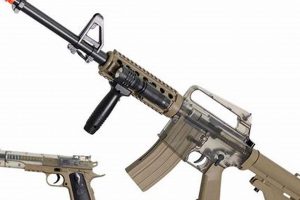
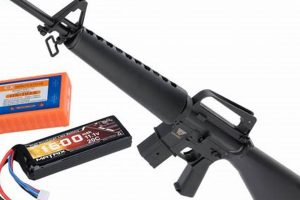
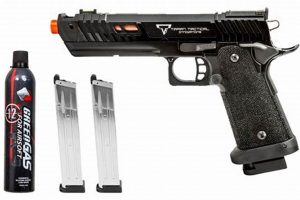
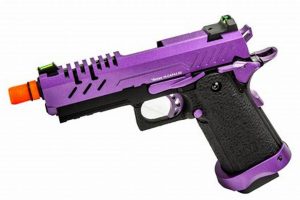
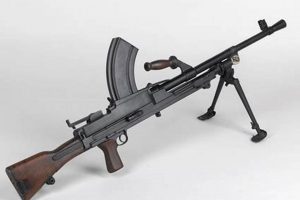
The term refers to a type of airsoft weapon specifically designed for use in close quarters battle (CQB) environments. These environments are typically characterized by tight spaces, limited visibility, and frequent engagements at short distances. An example would be a compact, maneuverable rifle utilized within an indoor airsoft arena.
The significance of such a weapon lies in its ability to provide users with an advantage in these restrictive environments. A shorter barrel length and lighter weight contribute to improved handling and quicker target acquisition. Historically, the development of these specialized airsoft markers mirrored the evolution of real-world firearms tailored for urban warfare and room-clearing operations, emphasizing maneuverability and ease of use.
The subsequent sections of this article will delve into specific features, modifications, and tactical considerations associated with optimizing equipment for close-quarters airsoft engagements. Further discussion will cover the selection process, performance characteristics, and safe handling practices applicable to this particular type of airsoft marker.
Optimizing Performance with CQB Airsoft Markers
The following guidance offers critical insights for maximizing effectiveness when employing equipment designed for close-quarters battle within the airsoft arena. Prioritizing these points enhances performance and ensures safe operation.
Tip 1: Prioritize Maneuverability: A primary characteristic is its compact size. Choosing a model with a shorter barrel and overall length allows for easier navigation of tight corners and confined spaces. Examples include pistol-caliber carbines or shortened rifle variants.
Tip 2: Opt for Lightweight Construction: Reduced weight improves reaction time and reduces fatigue during extended engagements. Consider models constructed from polymer or lightweight alloy materials. This is especially beneficial during dynamic, fast-paced scenarios.
Tip 3: Enhance Target Acquisition: Rapid target engagement is crucial. Equip the marker with a red dot sight or holographic sight for quick and intuitive aiming. Ensure the optic is properly zeroed for optimal accuracy at typical CQB engagement distances.
Tip 4: Modify for Enhanced Grip and Control: Improved grip contributes to better weapon handling and stability. Consider aftermarket grips, foregrips, or hand stops to enhance control, especially when firing in rapid succession.
Tip 5: Implement a High-Capacity Magazine: Frequent reloading disrupts the flow of gameplay. Utilize high-capacity magazines to minimize downtime and maintain a continuous rate of fire. However, understand local field regulations regarding magazine capacity limits.
Tip 6: Ensure Reliable Power Source: A consistent power source is essential for reliable operation. Use high-quality batteries appropriate for the marker’s specifications. Carry spare batteries to avoid unexpected power loss during critical moments.
Adhering to these recommendations will significantly enhance a player’s effectiveness within close-quarters airsoft environments. Prioritizing maneuverability, target acquisition, and reliability are key factors in achieving a tactical advantage.
The subsequent section will address common modifications and customization options for further optimizing equipment for specific CQB scenarios and individual playstyles.
1. Compact Dimensions
The defining characteristic of equipment suited for close-quarters battle (CQB) is often its reduced size. “Compact Dimensions” are intrinsically linked to the utility and effectiveness of a “cqb airsoft gun”. The direct causal relationship stems from the need for enhanced maneuverability within confined spaces. A larger, less wieldy piece of equipment restricts movement, slows target acquisition, and increases the risk of entanglement within the environment. Consider, for example, a standard-length airsoft M4 rifle compared to a short-barreled version; the reduced length offers a clear advantage in navigating tight corners and doorways commonly found in CQB arenas.
The importance of this dimensional aspect is further emphasized by its impact on reaction time. A smaller profile translates to quicker transitions between firing positions and faster target tracking. The practical significance of understanding this connection is that players can prioritize size and weight when selecting and modifying their equipment. Modifications such as shortening the barrel, utilizing folding stocks, or replacing heavier components with lighter alternatives directly contribute to improved handling and responsiveness in CQB scenarios. For instance, converting a full-length airsoft rifle into a pistol-caliber carbine represents a practical application of prioritizing “Compact Dimensions” for enhanced performance.
In summary, “Compact Dimensions” are not merely a desirable attribute, but a crucial component of equipment designed for close-quarters airsoft engagements. This understanding allows for informed equipment selection, strategic modifications, and ultimately, improved tactical performance within the confined spaces that define CQB environments. The challenge remains in balancing the need for compactness with other factors such as range and accuracy, requiring careful consideration of the overall design and intended application.
2. Lightweight Construction

Lightweight construction is a critical consideration when evaluating equipment for close-quarters battle (CQB) airsoft scenarios. Its impact on maneuverability, endurance, and overall effectiveness cannot be overstated. The following details explore key facets of this element.
- Reduced Fatigue
The implementation of lighter materials minimizes physical strain on the operator during prolonged engagements. Carrying a heavy load significantly impairs stamina and reaction time. A reduced overall weight allows for sustained, aggressive movement and reduces the onset of fatigue. Example materials contributing to weight reduction include polymer receivers, lightweight aluminum alloys, and skeletonized components.
- Enhanced Agility
Lighter equipment facilitates quicker transitions between firing positions and improved agility within confined spaces. A smaller mass allows for more rapid changes in direction and faster target acquisition. This agility translates directly into a tactical advantage when navigating tight corridors and engaging multiple adversaries simultaneously. Consider the difference between maneuvering with a fully loaded, metal-bodied airsoft rifle versus a polymer-based variant.
- Improved Weapon Handling
Lighter weapons are inherently easier to control, particularly during rapid firing or while moving. Reduced weight allows for a more stable shooting platform and reduces the likelihood of overcorrection. This enhanced control translates to improved accuracy and target tracking, especially during dynamic engagements. The ease of handling is a significant factor in maintaining a high level of performance under pressure.
- Material Selection
The choice of materials plays a pivotal role in achieving lightweight construction without compromising durability. Polymer receivers, lightweight aluminum alloys, and composite components offer significant weight savings compared to traditional steel or heavier alloys. Careful material selection ensures that the equipment remains robust enough to withstand the rigors of CQB airsoft while minimizing the burden on the operator.
In summary, lightweight construction is an essential element in optimizing equipment for CQB airsoft engagements. By prioritizing reduced weight through material selection and design, players can enhance their maneuverability, reduce fatigue, and improve overall combat effectiveness. The benefits of a lighter loadout directly translate to a tactical advantage in the close-quarters environment.
3. Rapid Target Acquisition
Rapid target acquisition is a crucial component of equipment designed for close-quarters battle (CQB), significantly influencing the user’s effectiveness in dynamic, fast-paced environments. The compact nature of specialized equipment necessitates the ability to quickly identify and engage threats within confined spaces. Equipment optimized for CQB, commonly featuring shorter barrel lengths and lighter weights, contributes directly to faster aiming and target tracking speeds. This correlation underscores the importance of rapid target acquisition as a key design consideration, impacting the choice of accessories and overall ergonomics. As an illustrative example, a red dot sight mounted on a short-barreled rifle enables instinctive aiming, allowing for immediate responses to emerging threats in enclosed environments. This quick response capability separates effective pieces of equipment from less suitable alternatives, as delays in target acquisition can prove detrimental in CQB scenarios. Understanding this connection allows players to prioritize modifications and accessories that enhance aiming speed and accuracy.
The practical significance of rapid target acquisition extends beyond simple reaction time. Efficient target engagement minimizes exposure time, reducing the risk of being targeted by opposing forces. Furthermore, quicker target acquisition facilitates effective engagement of multiple targets in rapid succession, enhancing a player’s overall combat effectiveness. This capability is amplified by accessories such as vertical foregrips, which improve weapon handling and stability during rapid firing. For instance, implementing a high-intensity weapon-mounted light, coupled with a red dot sight, ensures clear target identification and rapid engagement even in dimly lit environments. The synergy between the equipments design and ancillary components contributes to an overall system optimized for rapid target acquisition.
In conclusion, rapid target acquisition is not merely a desirable attribute, but a fundamental requirement for equipment intended for CQB scenarios. The correlation between the design of a “cqb airsoft gun” and its ability to facilitate rapid target acquisition is evident through features like compact dimensions, optimized ergonomics, and the integration of aiming accessories. The challenge lies in balancing the need for speed with accuracy and target identification, requiring careful consideration of individual playstyles and environmental conditions. By prioritizing rapid target acquisition, players can significantly enhance their performance and maintain a competitive edge in close-quarters engagements.
4. High Rate of Fire
High rate of fire (ROF) is a significant attribute when considering equipment optimized for close-quarters battle (CQB). The confined environments and short engagement distances characteristic of CQB scenarios often necessitate the ability to deliver a high volume of projectiles rapidly. In these situations, ROF can be a decisive factor in suppressing opposing players, securing advantageous positions, and achieving overall mission objectives. For equipment specifically designed for CQB, a higher ROF directly translates to an increased probability of hit, particularly when engaging moving targets or firing from compromised positions. An example would be an airsoft electric gun (AEG) modified with a high-speed motor and enhanced gears to achieve a rate of fire exceeding 20 rounds per second, providing a clear tactical advantage in close-range engagements.
The practical application of a high ROF extends beyond simple target saturation. It can be employed to create a temporary barrier of BBs, effectively suppressing enemy movement and allowing friendly forces to advance or maneuver. Furthermore, a high ROF can compensate for slight aiming errors, increasing the likelihood of a successful hit even if the initial shot is off target. However, it is crucial to note that a high ROF must be balanced with factors such as accuracy and ammunition capacity. Simply increasing the ROF without addressing these factors can lead to decreased effectiveness and rapid ammunition depletion. The appropriate implementation of a high ROF is dependent upon the user’s tactical approach, the specific environmental conditions, and the capabilities of their equipment.
In summary, a high rate of fire holds considerable importance for equipment intended for close-quarters battle, offering significant tactical advantages in terms of suppression, target saturation, and enhanced hit probability. The key is to understand the nuanced relationship between ROF, accuracy, and ammunition management, ensuring that the ROF is optimized for the specific requirements of the engagement. The challenge lies in achieving this balance while remaining within the established rules and regulations of the airsoft field. Prioritizing a well-rounded approach, focusing on both ROF and other critical attributes, ultimately contributes to improved performance within the CQB environment.
5. Enhanced Maneuverability

Enhanced maneuverability is intrinsically linked to the effectiveness of equipment designed for close-quarters battle (CQB). The defining characteristic of a “cqb airsoft gun” is its ability to be wielded effectively within confined spaces. This inherent connection establishes a cause-and-effect relationship: the design of a “cqb airsoft gun” is directly influenced by the need for enhanced maneuverability, and increased maneuverability improves a player’s tactical capabilities within CQB environments. The importance of this characteristic cannot be overstated; the ability to quickly navigate tight corners, transition between firing positions, and react to rapidly changing situations is paramount to success in CQB scenarios. For instance, a compact airsoft submachine gun, designed for easy handling and rapid deployment, exemplifies the practical application of enhanced maneuverability in close-quarters engagements.
The practical significance of enhanced maneuverability extends beyond simple movement. It directly impacts target acquisition speed, accuracy, and the ability to engage multiple targets simultaneously. A weapon that is easy to handle allows the user to maintain a stable firing platform while moving, leading to improved accuracy under pressure. Moreover, enhanced maneuverability facilitates rapid transitions between primary and secondary weapons, enabling quick adaptation to changing tactical situations. A player equipped with a lightweight, compact carbine can swiftly switch to a sidearm when confronted with extremely close-range threats, effectively mitigating risk. This demonstrates the crucial role enhanced maneuverability plays in maintaining tactical flexibility and maximizing combat effectiveness.
In summary, enhanced maneuverability is a cornerstone of equipment intended for CQB airsoft. The ability to move swiftly and efficiently within confined spaces is not merely a desirable attribute, but a fundamental requirement for success. While achieving enhanced maneuverability often involves compromises in other areas, such as range or firepower, the benefits in terms of tactical flexibility and responsiveness are undeniable. The ongoing challenge lies in balancing these competing priorities to create equipment that is optimally suited for the dynamic and demanding nature of close-quarters engagements.
6. Durable Internal Components

The reliability and longevity of equipment designed for close-quarters battle (CQB) hinge significantly on the robustness of its internal components. These parts, subjected to increased stress from rapid firing and frequent use, necessitate superior construction to withstand the rigors of intense CQB engagements.
- Gearbox Reinforcement
The gearbox, housing the gears and piston, is a central component susceptible to failure under high stress. Reinforced gearboxes, constructed from stronger metals and featuring improved designs, mitigate the risk of cracking or shattering during rapid firing. For instance, a reinforced gearbox shell can withstand the stresses generated by high-torque motors and high-tension springs, commonly employed to increase rate of fire and projectile velocity. This reinforcement is crucial for maintaining consistent performance over extended periods.
- Piston Durability
The piston, responsible for compressing air and propelling the projectile, experiences significant impact forces with each cycle. Upgraded pistons, featuring stronger materials like polycarbonate or aluminum, and reinforced teeth, resist wear and tear. A piston with reinforced teeth, for example, is less likely to strip under the stress of a high-speed gearset, ensuring reliable operation and extending the lifespan of the equipment.
- Motor Endurance
The motor provides the power to drive the gearbox and propel the projectile. High-torque motors, while enhancing performance, can also generate significant heat and stress on other components. Motors with improved heat dissipation, reinforced brushes, and durable windings are essential for sustained operation under demanding conditions. A motor with high-temperature windings, for instance, can withstand the heat generated during prolonged rapid firing, preventing premature failure.
- Hop-Up Unit Integrity
The hop-up unit imparts backspin to the projectile, extending its range and improving accuracy. Durable hop-up units, constructed from robust materials and featuring precise adjustment mechanisms, maintain consistent performance over time. A metal hop-up chamber, for example, is less prone to warping or cracking compared to plastic alternatives, ensuring consistent projectile trajectory and minimizing accuracy degradation.
The incorporation of these durable internal components is paramount for ensuring the reliable operation and extended lifespan of equipment intended for CQB. The increased stress and demands placed on these parts necessitate a focus on quality materials and robust construction, ultimately contributing to a more effective and dependable platform for close-quarters engagements.
7. Adjustable Hop-Up System
An adjustable hop-up system is a critical component in an airsoft gun, directly impacting its range and accuracy. Within the context of a “cqb airsoft gun,” its significance requires careful consideration. While close-quarters battle typically involves short engagement distances, the adjustable hop-up remains crucial for optimizing projectile trajectory within those limited ranges. The cause is the backspin applied to the projectile, counteracting gravity and allowing for a flatter, more predictable flight path. The effect is increased accuracy and effective range, even in confined spaces. A properly adjusted hop-up compensates for variations in projectile weight and environmental factors, ensuring consistent performance. For instance, a user might need to adjust the hop-up to counteract a slight upward or downward deviation in the projectile’s flight path at a distance of 30 feet, a common engagement range in indoor airsoft arenas. The adjustable nature of the system is therefore vital for maintaining accuracy, regardless of the specific circumstances of the engagement.
The practical significance of understanding this connection lies in the ability to fine-tune the “cqb airsoft gun” for optimal performance within the specific confines of the playing field. An improperly adjusted hop-up can lead to inaccurate shots, making it difficult to effectively engage targets, even at close range. Furthermore, consistent projectile trajectory is essential for predicting where the projectile will impact, allowing for more accurate and effective fire. The ability to adjust the hop-up allows the user to adapt to different projectile weights or environmental conditions, ensuring consistent performance. For example, a change in humidity levels can affect the trajectory of the projectile, requiring a minor adjustment to the hop-up to maintain accuracy. Understanding the dynamics of projectile flight and the impact of the hop-up system is therefore essential for maximizing the effectiveness of equipment in CQB scenarios.
In summary, while the short engagement distances in CQB might suggest a diminished role for an adjustable hop-up system, its ability to fine-tune projectile trajectory remains crucial for maximizing accuracy and effective range. The adjustable nature of the system allows the user to adapt to varying conditions and projectile types, ensuring consistent performance in diverse CQB environments. The challenge lies in finding the optimal hop-up setting for a given situation, which requires practice and experimentation. Properly utilized, an adjustable hop-up system is an invaluable asset in achieving superior performance with a “cqb airsoft gun”.
Frequently Asked Questions
The following section addresses common inquiries concerning equipment specifically designed for close-quarters battle within the airsoft context. These questions aim to provide clarity and informed perspectives on pertinent aspects.
Question 1: What distinguishes an equipment intended for CQB from standard airsoft markers?
Equipment designed for CQB typically exhibits shorter barrel lengths, lighter overall weights, and features optimized for maneuverability in confined spaces. Standard airsoft markers may prioritize range and accuracy over handling, rendering them less suitable for close-quarters engagements.
Question 2: What is the ideal rate of fire for equipment used in CQB scenarios?
While a high rate of fire can be advantageous for suppression and target saturation, it is crucial to balance this with ammunition capacity and accuracy. A rate of fire of 15-25 rounds per second is often considered optimal for CQB, providing sufficient suppressive fire without excessive ammunition consumption.
Question 3: Are aftermarket upgrades essential for improving the performance of an equipment designated for CQB?
Aftermarket upgrades can significantly enhance performance, but are not always essential. Enhancements such as reinforced internal components, high-torque motors, and improved hop-up units can increase reliability, rate of fire, and accuracy. However, a well-maintained stock equipment can still be effective in CQB scenarios.
Question 4: What safety precautions are particularly important when utilizing equipment within close proximity to other players?
Adherence to established safety protocols, including the use of full-seal eye protection and face protection, is paramount. Maintaining a safe engagement distance, typically dictated by field rules, is also crucial for minimizing the risk of injury.
Question 5: What is the recommended projectile weight for equipment utilized in CQB engagements?
Lighter projectiles, typically ranging from 0.20g to 0.25g, are often preferred for CQB due to their higher velocity and flatter trajectory at short distances. However, the optimal projectile weight may vary depending on the specific equipment and hop-up configuration.
Question 6: What role does equipment maintenance play in preserving the performance of a designated for CQB?
Regular maintenance, including cleaning the barrel, lubricating internal components, and inspecting for wear and tear, is essential for maintaining performance and preventing malfunctions. Neglecting maintenance can lead to reduced accuracy, decreased rate of fire, and potential component failure.
In summation, the selection, configuration, and maintenance of equipment directly influence its effectiveness within CQB airsoft environments. Understanding these factors is crucial for maximizing performance and ensuring safe participation.
The following section will provide a comparative analysis of various models, highlighting their strengths, weaknesses, and suitability for different CQB scenarios.
Conclusion
The preceding analysis has explored the multifaceted attributes and considerations associated with equipment intended for close-quarters battle within the airsoft domain. Critical aspects, including compact dimensions, lightweight construction, rapid target acquisition, high rate of fire, enhanced maneuverability, durable internal components, and adjustable hop-up systems, were examined. Each facet contributes to the overall effectiveness of such implements within restrictive environments.
The responsible and informed application of this information is paramount. As technological advancements continue to influence equipment design and performance, a thorough understanding of these principles will remain vital for ensuring optimal tactical execution and adherence to safety protocols. Continued research and practical experience are essential for maximizing the potential of “cqb airsoft gun” within this evolving landscape.