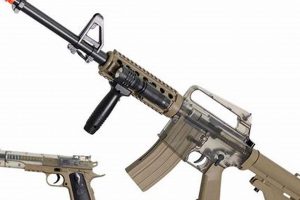
The inquiry into whether a projectile weapon designed for recreational use can cause mortality in avian species is a complex one. The potential for harm depends on several factors, including the projectile’s velocity, the distance to the target, the size and species of the bird, and the area of impact. While these devices are not designed to be lethal, under certain conditions, the kinetic energy transferred upon impact could inflict serious injury or death. The likelihood of fatality increases significantly with closer proximity and vulnerable areas being struck.
Understanding the risks associated with these devices extends beyond simple recreational use. Ecological implications arise from their potential impact on bird populations, particularly in urban or suburban environments where both humans and birds coexist. Furthermore, legal and ethical considerations must be addressed. Many jurisdictions have regulations regarding the discharge of air guns, and inflicting harm on wildlife, even unintentionally, can carry legal consequences. From a broader perspective, responsible use demands a clear awareness of potential harm and a commitment to minimizing any adverse effects on the environment and its inhabitants.
Therefore, the following discussion will delve into specific factors that contribute to the risk of avian mortality from these devices. This will include an examination of projectile types, velocity considerations, potential injuries, and mitigation strategies to prevent harm to bird populations.
Preventing Avian Injury from Airsoft Guns
Responsible use of airsoft guns necessitates awareness of the potential for harm to birds. Adherence to the following guidelines can minimize the risk of injury or fatality to avian wildlife.
Tip 1: Conduct Activities in Designated Areas: Confine airsoft activities to indoor ranges or designated outdoor areas where bird presence is minimal. Avoid environments known to be frequented by birds, such as parks, wooded areas, or near bird feeders.
Tip 2: Exercise Vigilance and Awareness: Prior to and during airsoft activities, observe the surrounding environment. Halt or postpone activities if birds are observed in the immediate vicinity.
Tip 3: Employ Reduced Velocity Settings: If the airsoft gun allows for adjustable velocity settings, select the lowest setting practical for the intended activity. Lower velocities reduce the impact force of projectiles, thereby mitigating potential harm.
Tip 4: Utilize Biodegradable Projectiles: Opt for biodegradable projectiles instead of plastic alternatives. While not directly preventing impact, this choice reduces the long-term environmental impact if projectiles are dispersed into natural habitats.
Tip 5: Educate Participants on Ethical Considerations: Ensure all participants understand the potential risks to wildlife and the importance of responsible use. Emphasize the ethical imperative to avoid harming birds or other animals.
Tip 6: Advocate for Responsible Airsoft Practices: Promote responsible airsoft practices within the community. Encourage adherence to safety guidelines and ethical considerations regarding wildlife.
Tip 7: Support Habitat Conservation: Contribute to local habitat conservation efforts. Protecting bird habitats reduces the likelihood of encounters between birds and airsoft activities.
By implementing these preventative measures, individuals and groups can significantly reduce the risk of injury or death to birds associated with airsoft gun use. Prioritizing ethical considerations and environmental awareness is paramount.
The following section will explore the legal ramifications and ethical considerations surrounding the interaction between airsoft activities and wildlife protection.
1. Velocity

The velocity of an airsoft projectile directly correlates with its potential to inflict harm. A higher velocity translates to greater kinetic energy upon impact. This increased energy amplifies the risk of penetration, blunt force trauma, and internal injuries, thereby increasing the likelihood of severe injury or mortality to a bird struck by the projectile. The relationship is a direct one: as velocity increases, so does the potential for harm.
For example, a standard airsoft gun might fire a projectile at 300 feet per second (FPS). This velocity, while considered safe for recreational use with appropriate protective gear, can still impart significant force upon a small bird. If that same gun were modified to increase the FPS to 400 or higher, the risk of causing a fatal injury to a bird increases substantially. The force delivered can easily fracture bones or cause internal bleeding, even with a small, lightweight projectile.
Understanding this relationship between velocity and potential harm is crucial for responsible airsoft practices. Modifying airsoft guns to increase velocity without considering the ecological consequences presents a clear and avoidable danger to avian wildlife. Therefore, maintaining adherence to standard velocity limits, and awareness of the surroundings is an integral component in minimizing the risk to bird populations during airsoft activities.
2. Proximity
Proximity, in the context of airsoft activities and avian vulnerability, directly amplifies the lethality potential of an airsoft gun. The closer the range between the weapon and a bird, the less time the projectile has to decelerate due to air resistance, resulting in a greater transfer of kinetic energy upon impact. This heightened energy transfer significantly increases the likelihood of serious injury or fatality. The effect of distance, therefore, serves as a critical variable in determining the severity of consequences when a bird is struck.
Consider two scenarios: In the first, an airsoft projectile strikes a bird at a distance of 50 feet. At this range, the projectile has already lost a significant portion of its initial velocity. While impact is still possible, the force is considerably reduced. Conversely, if the same projectile strikes a bird at a distance of 5 feet, the impact is far more forceful. The projectile retains almost all of its initial velocity, leading to a substantially greater risk of penetration, bone fracture, or internal organ damage. This direct correlation between proximity and impact force underscores the importance of vigilance and responsible practices during airsoft activities.
Understanding the significance of proximity is crucial for minimizing risks to avian wildlife. It emphasizes the need for extreme caution in environments where birds are present, particularly in close quarters. Responsible airsoft participants must prioritize situational awareness and exercise restraint, refraining from discharging the weapon if birds are observed nearby. This heightened awareness, coupled with ethical considerations, can significantly reduce the potential for accidental harm and contributes to a more responsible approach to airsoft activities.
3. Impact point
The anatomical location of impact from an airsoft projectile plays a critical role in determining the severity of injury, and subsequently, the likelihood of mortality in birds. Vulnerable areas, such as the head, neck, and torso, house vital organs and skeletal structures that, when compromised, significantly increase the risk of fatality. A direct hit to the head, for example, can cause traumatic brain injury, while impact on the torso can damage the heart, lungs, or other critical organs. In contrast, a hit to a less vulnerable area, such as a wingtip or leg, may result in a non-fatal injury, although even these injuries can impair a bird’s ability to fly or forage, ultimately affecting its survival.
Consider a scenario where a bird is struck in the chest by an airsoft projectile. The force of impact can cause pulmonary contusions (bruising of the lungs) or even puncture the lung, leading to pneumothorax (collapsed lung). These injuries can severely compromise the bird’s respiratory function, leading to asphyxiation or secondary complications such as infection. Conversely, if the same projectile strikes the bird on a non-vital area like the tail feathers, the injury is likely to be less severe. The bird may experience temporary pain or discomfort, but its overall survival is less likely to be threatened. The precise location of impact is thus a critical determinant in assessing the potential for lethal consequences.
In conclusion, the specific area of the body struck by an airsoft projectile is paramount in assessing the potential for avian mortality. Impacts to vital organs and structures dramatically increase the risk of fatality, while hits to less vulnerable areas may result in non-lethal injuries. Understanding this relationship highlights the importance of exercising extreme caution and avoiding aiming at birds during airsoft activities. Mitigation efforts should prioritize preventing any impact, regardless of the intended target area, to minimize the risk to avian wildlife. This knowledge underscores the crucial role of ethical considerations and responsible practices within the airsoft community.
4. Bird Size

The physical dimensions of a bird are a significant determinant in assessing its vulnerability to injury from airsoft projectiles. Smaller birds, due to their lower mass and more fragile skeletal structures, are inherently more susceptible to serious harm or mortality compared to larger species.
- Mass and Momentum Transfer
A bird’s mass directly influences the momentum transfer upon impact. A smaller bird, with less mass, experiences a greater proportional change in velocity and is more likely to be displaced or suffer internal injuries from the same force compared to a larger, more massive bird. Even a low-velocity projectile can impart sufficient force to cause significant harm to a small bird.
- Skeletal Vulnerability
The skeletal structure of smaller birds is typically more delicate and less robust than that of larger birds. Their bones are thinner and more easily fractured. Consequently, the impact of an airsoft projectile is more likely to cause bone fractures, particularly in the wings or legs, severely impairing the bird’s ability to fly, forage, and evade predators.
- Organ Proximity and Protection
Smaller birds have less internal space and less protective tissue surrounding their vital organs. This means that the organs are more closely packed together and more vulnerable to blunt force trauma. An impact that might only cause a minor contusion in a larger bird could potentially cause life-threatening damage to the heart, lungs, or liver of a smaller bird.
- Surface Area to Volume Ratio
Smaller birds have a higher surface area to volume ratio, meaning they lose heat more rapidly. Injuries that compromise their feathers or insulation can quickly lead to hypothermia, even in relatively mild conditions. This makes them more vulnerable to secondary effects of injury, further reducing their chances of survival.
In summation, the size of a bird is a critical factor influencing the potential for an airsoft gun to cause injury or death. Smaller birds are inherently more vulnerable due to their lower mass, more fragile skeletal structure, closely packed organs, and higher surface area to volume ratio. Understanding this vulnerability is crucial for responsible airsoft practices and for taking measures to minimize the risk of harm to avian wildlife. Airsoft participants must recognize that even seemingly harmless projectiles can have devastating consequences for smaller bird species.
5. Projectile Type

The composition and characteristics of airsoft projectiles, commonly referred to as BBs, directly influence their potential to cause injury to birds. While typically constructed from plastic, variations exist in weight, size, and material composition, each contributing to the severity of impact upon avian targets. Heavier projectiles, or those made from denser materials, retain more kinetic energy and therefore pose a greater risk of causing blunt force trauma or penetration injuries. Conversely, lighter, less dense projectiles dissipate energy more rapidly, reducing the immediate risk of severe trauma. However, even seemingly innocuous projectiles can inflict harm, particularly to smaller bird species.
Real-world examples illustrate the significance of projectile type. Standard plastic BBs, commonly used in recreational airsoft activities, have been documented to cause bruising, lacerations, and bone fractures in small birds. In certain instances, these injuries have resulted in secondary complications such as infection or impaired mobility, ultimately leading to mortality. Furthermore, the increasing availability of biodegradable BBs, while environmentally beneficial, do not necessarily eliminate the immediate risk of physical harm upon impact. Although biodegradable, these projectiles still possess sufficient mass and velocity to cause injury, particularly at close range or when striking vulnerable areas of the bird’s anatomy. The choice of projectile, therefore, remains a crucial consideration in minimizing the potential for harm to avian wildlife.
In conclusion, the type of projectile used in airsoft activities is a significant factor determining the potential for avian injury or mortality. While the severity of impact varies depending on the projectile’s weight, density, and material composition, all airsoft projectiles pose a degree of risk, particularly to smaller bird species. Responsible airsoft practices must include careful consideration of projectile selection, with a preference for lighter, less dense options, coupled with strict adherence to safety guidelines and ethical considerations regarding wildlife protection. Mitigation strategies should prioritize preventing any impact to birds, regardless of the projectile type, to minimize the potential for harm. This understanding emphasizes the interconnectedness between projectile characteristics, impact dynamics, and the ethical responsibilities of airsoft participants.
6. Regulation
The establishment and enforcement of regulations governing airsoft guns directly influence the potential for avian mortality. The absence or laxity of regulations can lead to increased risk of injury or death to birds, whereas stringent regulations, properly enforced, can significantly mitigate that risk. This causal relationship is demonstrable through examination of jurisdictions with varying levels of oversight.
The core purpose of regulation in this context is to control factors contributing to avian harm. This includes velocity limits, restrictions on use in areas frequented by wildlife, and stipulations regarding projectile type. For example, some regions mandate maximum projectile velocities for airsoft guns, effectively reducing the kinetic energy and potential for injury. Others prohibit their discharge in parks or near wildlife sanctuaries, thus minimizing the likelihood of encounters between airsoft activities and bird populations. A practical instance is seen in municipalities that impose fines for discharging airsoft guns within city limits, thereby discouraging their use in urban environments where birds are prevalent. Furthermore, some regulations stipulate the mandatory use of biodegradable projectiles, minimizing long-term environmental impact should projectiles enter natural habitats.
In conclusion, effective regulation is paramount in minimizing the risk of avian mortality associated with airsoft gun use. Its importance lies in its ability to directly control factors contributing to potential harm. Challenges remain in ensuring consistent enforcement and adaptation to evolving airsoft technology. Recognizing this connection and prioritizing responsible regulation are essential components of responsible recreation and wildlife conservation. The ethical implications of unregulated airsoft gun use extend beyond individual responsibility, requiring a community commitment to conservation through legal frameworks.
Frequently Asked Questions Regarding Airsoft Guns and Avian Safety
The following questions and answers address common concerns and clarify misunderstandings about the potential impact of airsoft guns on bird populations.
Question 1: What is the likelihood of an airsoft gun causing lethal harm to a bird?
The potential for lethal harm depends on several factors, including projectile velocity, range, the size of the bird, and the area of impact. While not designed to be lethal, under specific circumstances, airsoft guns can cause serious injury or death to birds.
Question 2: Do regulations exist concerning the use of airsoft guns to protect wildlife?
Yes, many jurisdictions have regulations regarding the discharge of air guns, including airsoft guns. These regulations may prohibit their use in certain areas or mandate specific safety precautions. Inflicting harm on wildlife, even unintentionally, may carry legal consequences.
Question 3: What types of injuries can airsoft projectiles inflict on birds?
Airsoft projectiles can cause a range of injuries, including bruising, lacerations, bone fractures, and internal organ damage. The severity of the injury depends on the factors previously mentioned.
Question 4: Are certain types of airsoft projectiles safer for birds than others?
While all airsoft projectiles pose a potential risk, lighter, less dense projectiles generally pose a lower risk of causing severe injury. Biodegradable projectiles, while environmentally beneficial, do not eliminate the immediate risk of physical harm upon impact.
Question 5: What precautions should be taken when using airsoft guns to minimize the risk to birds?
Precautions include using airsoft guns in designated areas, exercising vigilance for nearby birds, employing reduced velocity settings, utilizing biodegradable projectiles, and educating participants about the ethical considerations of wildlife safety.
Question 6: How does bird size influence its vulnerability to airsoft projectiles?
Smaller birds are generally more vulnerable to injury from airsoft projectiles due to their lower mass, more fragile skeletal structures, and closely packed vital organs.
Responsible airsoft practices, awareness of potential risks, and adherence to regulations are paramount in protecting avian wildlife.
The following section will provide a comprehensive conclusion summarizing the key points discussed and offering actionable steps for promoting responsible airsoft practices.
Can an Airsoft Gun Kill a Bird
The investigation into whether an airsoft gun can kill a bird reveals a complex interplay of factors. Projectile velocity, proximity, impact point, bird size, projectile type, and the presence or absence of effective regulations all contribute to the potential for avian mortality. While these devices are designed for recreational purposes, the circumstances under which they are used significantly influence their capacity to inflict harm on vulnerable avian species. The cumulative effect of these factors underscores the inherent risk associated with airsoft gun use in environments where birds are present.
Recognizing this risk necessitates a commitment to responsible practices and heightened awareness. Mitigation strategies, encompassing adherence to regulations, conscientious projectile selection, and vigilance in natural environments, are essential for minimizing potential harm to bird populations. Ultimately, safeguarding avian wildlife from unintended injury requires a concerted effort by airsoft participants, lawmakers, and the broader community to prioritize ethical considerations and promote responsible recreational practices. The ongoing pursuit of responsible airsoft practices remains paramount in ensuring the well-being of avian ecosystems.