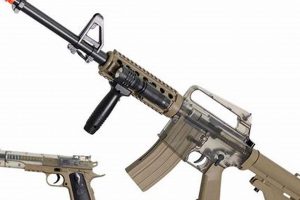
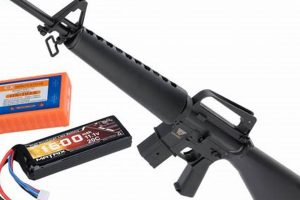
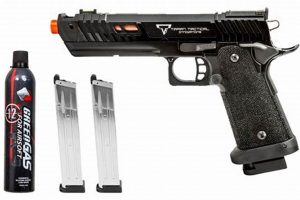
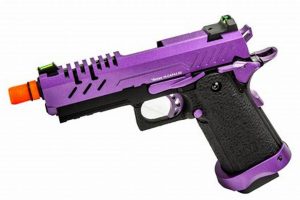
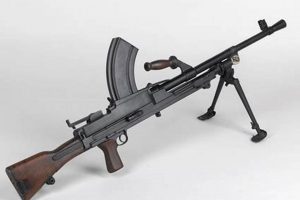
The array of equipment used in airsoft skirmishes is varied, mirroring real-world firearm designs in appearance and function. These replicas, powered by compressed gas or electricity, project spherical plastic projectiles. The design choices reflect a spectrum of operational preferences and gameplay styles.
Understanding the available options is crucial for informed participation in the sport. Selection impacts maneuverability, effective range, rate of fire, and overall tactical role within a team. Historical influences from military and law enforcement applications are evident in numerous models, reflecting the desire for realism.
The following sections will delve into specific categories, outlining their individual attributes and operational characteristics. The discussion will cover spring-powered, electric-powered (AEGs), and gas-powered variants, along with their associated advantages and disadvantages in different scenarios.
Selection Considerations
Prior to acquiring equipment, careful evaluation of various factors is essential. These considerations ensure optimal performance and suitability for the intended role.
Tip 1: Range Assessment: Determine the primary engagement distance anticipated during gameplay. Spring-powered models may be suitable for close-quarters combat, while electric-powered offer greater effective range.
Tip 2: Rate of Fire: Consider the desired rate of projectile discharge. Electric-powered models provide automatic firing modes, advantageous for suppressing opponents, while spring-powered require manual cocking between each shot.
Tip 3: Power Source: Evaluate the practicality of different power sources. Gas-powered models offer realistic recoil but require consistent gas refills. Electric-powered models utilize rechargeable batteries, necessitating charging infrastructure.
Tip 4: Durability Assessment: Inspect construction materials for robustness. Metal components generally exhibit greater resilience compared to plastic alternatives, particularly in high-stress areas such as the gearbox.
Tip 5: Legal Compliance: Adhere to all local regulations regarding ownership and usage. Projectile velocity limits and permissible locations for operation vary by jurisdiction.
Tip 6: Budget Allocation: Establish a realistic budget, considering not only the initial purchase price but also ongoing maintenance and accessory costs. High-performance options often necessitate a greater financial investment.
Tip 7: Ergonomic Considerations: Assess the comfort and handling characteristics of different designs. Weight distribution, grip texture, and adjustability features contribute to operator fatigue and aiming proficiency.
Thorough consideration of these factors will contribute to an informed selection process, ensuring a positive and effective gameplay experience. Prioritize safety and adherence to established rules.
The subsequent sections will provide in-depth analyses of specific mechanical and operational aspects of the equipment, building upon these foundational recommendations.
1. Spring-powered replicas

Spring-powered replicas represent a foundational category within the spectrum of options available. Their operational mechanism, relying on manually compressed springs to propel projectiles, dictates their performance characteristics and suitability for specific gameplay scenarios. The simplicity of design offers a cost-effective entry point, making them accessible to novice participants. This accessibility contributes significantly to the overall prevalence of these in introductory contexts and backyard target practices.
The dependence on manual cocking limits their rate of fire compared to electric or gas-powered counterparts. This inherent limitation necessitates a deliberate and accurate aiming approach, favoring precision over sustained suppressive fire. This characteristic makes them suitable for scenarios emphasizing stealth and calculated engagement, mirroring the role of marksman or designated hitters. Furthermore, their mechanical simplicity translates to increased reliability and reduced maintenance requirements, diminishing the need for specialized technical expertise.
Consequently, spring-powered variants serve as an important gateway into the broader sport, familiarizing new players with basic safety protocols and marksmanship techniques. While not possessing the advanced features of other classes, they instill fundamental skills applicable across all varieties. The economic accessibility of spring airsoft further broadens the appeal, supporting the entire ecosystem of airsoft sports through the introduction of more and more beginners.
2. Electric-powered automatics

Electric-powered automatics (AEGs) constitute a significant subset within the broader category of equipment. Their prevalence stems from the balance they strike between performance, versatility, and operational cost. These devices utilize electric motors to power gearboxes, cycling pistons that compress air and propel projectiles. This mechanism allows for both semi-automatic and fully automatic firing modes, significantly enhancing their tactical application compared to manually operated counterparts. The reliance on rechargeable batteries provides a consistent power source, eliminating the need for frequent gas refills. This characteristic makes them well-suited for prolonged skirmishes and sustained engagements.
The internal complexity of AEGs necessitates a greater understanding of mechanical and electrical principles for maintenance and repair. However, this complexity also allows for extensive customization and performance enhancements. Aftermarket components, such as upgraded motors, gears, and inner barrels, enable users to tailor their replicas to specific gameplay styles and requirements. For instance, a high-torque motor combined with reinforced gears can increase the rate of fire, while a precision inner barrel can improve accuracy at longer ranges. The robust performance and adaptability of AEGs have solidified their position as the preferred choice for many experienced players, particularly in organized airsoft leagues and milsim (military simulation) events.
In summary, electric-powered automatics represent a pivotal component within equipment choices, providing a combination of automatic firing capability, consistent power, and customization options. Their adoption has fundamentally shaped tactical strategies and gameplay dynamics. While requiring a greater initial investment and technical knowledge, the enhanced performance and versatility offer a clear advantage in many scenarios, making them a mainstay in the airsoft landscape.
3. Gas blowback realism

Gas blowback (GBB) systems in airsoft equipment represent a design approach focused on replicating the operational feel of real firearms. This mechanism uses compressed gas to cycle the bolt or slide, simulating the recoil impulse experienced with live ammunition. The presence of a blowback action significantly increases the level of realism, influencing the user’s interaction with the device. This design is primarily implemented in pistol and rifle formats, enhancing the training experience and providing a more immersive simulation.
The incorporation of GBB systems impacts various aspects of operation. It demands greater gas consumption per shot compared to non-blowback alternatives. This affects the number of shots possible per gas fill and may necessitate the use of higher-capacity magazines. The added mechanical complexity can also increase maintenance requirements and the potential for malfunctions. However, the improved handling characteristics and tactile feedback offered by GBB systems often outweigh these drawbacks for individuals prioritizing realism and training applications. A common example is the use of GBB pistols for force-on-force training by law enforcement and military personnel, where realistic weapon handling is crucial.
In summary, gas blowback realism is a defining feature within specialized equipment. This enhances the simulation, offering an engaging experience. The trade-offs between realism, gas efficiency, and maintenance need to be considered. The pursuit of realistic operational characteristics via GBB systems highlights a design choice prioritizing authenticity, impacting the overall airsoft experience and catering to a specific segment of the player base.
4. Close-quarters carbines

Close-quarters carbines represent a specialized category. It is designed for engagements in confined spaces. Their attributes cater to the needs of operations conducted within buildings, urban environments, and dense vegetation. Understanding their specific characteristics is crucial when evaluating equipment selection. This selection will influence both gameplay style and tactical effectiveness.
- Compact Dimensions
The defining feature of close-quarters carbines is their reduced overall length. Shorter barrels and collapsible stocks enhance maneuverability in tight spaces. This allows operators to navigate doorways, hallways, and confined areas with greater ease. Examples of real-world counterparts include the M4A1 with a shortened barrel and the MP5 submachine gun. In airsoft, this translates to faster target acquisition and reduced risk of snagging on obstacles.
- High Rate of Fire
Many close-quarters carbines are designed for rapid target engagement. Select-fire capabilities are common. This enables operators to transition between semi-automatic and fully automatic modes as needed. High rates of fire provide suppressive capabilities, allowing a user to dominate engagements. Examples include the Classic Army CA416 and the Krytac Trident MKII PDW. These can achieve rates exceeding 20 rounds per second.
- Lightweight Construction
Reduced weight contributes to enhanced agility and reduced operator fatigue. Lightweight materials, such as polymer receivers and aluminum alloy handguards, are often incorporated into their design. This makes them ideal for dynamic movement and prolonged use in confined environments. The G&G ARP 9 is a notable example. It weighs only 2.1 kilograms, promoting ease of handling and rapid transitions between firing positions.
- Enhanced Ergonomics
Ergonomic features are prioritized to optimize weapon handling and control. These include adjustable stocks, pistol grips, and accessory rails. These contribute to operator comfort and allow for the attachment of tactical accessories such as sights, lights, and foregrips. The Tokyo Marui MP5 A5, for example, features an adjustable stock and ambidextrous controls. This allows user customization for optimal performance.
The characteristics of close-quarters carbines make them well-suited for specific scenarios. These require rapid maneuverability and a high rate of fire. They are a significant component. They are a significant component of the airsoft arsenal. They cater to specialized roles within team-based gameplay. Their design reflects the demands of urban combat and close-range engagements.
5. Long-range sniper rifles

Within the broader category of equipment, long-range sniper rifles represent a specialized segment designed for engagements at extended distances. These replicas prioritize accuracy and precision over rate of fire, mirroring the role of snipers in military and law enforcement contexts. Their characteristics influence tactical approaches and demand a skillset focused on marksmanship and concealment.
- High-Powered Spring or Gas Systems
Long-range effectiveness necessitates enhanced power output. Spring-powered sniper rifles typically employ heavy-duty springs requiring significant cocking force, while gas-powered variants utilize high-pressure gas reservoirs to achieve increased projectile velocities. For example, the Accuracy International Arctic Warfare (AWM) sniper rifle, often replicated in airsoft, demands a robust propulsion system to reach extended ranges. These systems translate to increased effective range and impact force in airsoft scenarios.
- Precision Inner Barrels
Accuracy is paramount in long-range engagements. Precision inner barrels, characterized by tight bores and polished surfaces, minimize projectile deviation and promote consistent flight paths. Examples include Prometheus and PDI inner barrels, renowned for their tight tolerances and ability to enhance accuracy. In the context of “airsoft types of guns,” this translates to improved grouping at extended ranges, allowing for more effective target engagement.
- Adjustable Hop-Up Units
Hop-up units impart backspin to projectiles, counteracting gravity and extending range. Adjustable hop-up systems allow users to fine-tune the amount of backspin, optimizing performance for various projectile weights and environmental conditions. The use of adjustable hop-up units, such as those found in the Tokyo Marui VSR-10, is crucial for achieving consistent and accurate shots at long distances in airsoft.
- Optics and Sighting Systems
Effective long-range engagement requires magnified optics for target identification and precise aiming. Scopes with adjustable magnification levels, ranging from 3-9x to 6-24x, are commonly used. These optics, often modeled after real-world counterparts such as Leupold or Schmidt & Bender scopes, allow for accurate target acquisition and shot placement at extended distances, enhancing the sniper’s effectiveness on the field.
The attributes of long-range sniper rifles reflect a specific tactical role within the airsoft environment. These prioritize accuracy and range over maneuverability and rate of fire. They contribute to diverse gameplay styles and specialized roles within team-based scenarios. Their design considerations, mirroring real-world sniper rifles, enhance the realism and simulation aspects of the sport, catering to players seeking a more challenging and immersive experience.
6. Support weapon platforms
Support weapon platforms within the diverse array of airsoft equipment are designed to provide sustained firepower and area denial capabilities. These replicas, often mimicking real-world light machine guns (LMGs) and general-purpose machine guns (GPMGs), fulfill a distinct tactical role by suppressing enemy positions and supporting advancing teammates. Their characteristics differentiate them from other airsoft types of guns, focusing on volume of fire over pinpoint accuracy or maneuverability.
- High-Capacity Magazines or Ammunition Systems
A defining characteristic of support weapon platforms is their ability to carry large quantities of ammunition. This is achieved through the use of high-capacity magazines, often drum or box-type, or even motorized feeding systems that continuously load projectiles into the firing mechanism. Examples from real life include the M249 Squad Automatic Weapon (SAW) and the M60 machine gun. In airsoft, these translate to magazine capacities ranging from several hundred to several thousand rounds, allowing for prolonged periods of sustained fire without frequent reloading.
- Automatic Firing Modes
Support weapons are almost exclusively designed for automatic fire. This capability allows them to saturate an area with projectiles, suppressing enemy movement and providing cover for advancing teammates. Select-fire options, allowing for single shots or short bursts, may be present but the primary function remains full automatic fire. Replicas of weapons such as the PKM and the MG42 emphasize this aspect of firepower, delivering a high volume of projectiles downrange.
- Bipods and Stabilization Systems
Due to their weight and the need for stable firing platforms, support weapons often incorporate bipods or other stabilization systems. These allow the operator to maintain a consistent point of aim, improving accuracy and reducing fatigue during sustained firing. Folding bipods are common, allowing for both mobile and stationary operation. The M240 machine gun, frequently emulated in airsoft, exemplifies this design feature.
- Reinforced Internals and Durable Construction
The demands of sustained automatic fire place significant stress on internal components. Support weapon platforms typically feature reinforced gearboxes, high-torque motors, and durable external construction to withstand prolonged use. Materials such as steel and aluminum are frequently employed in critical areas to ensure reliability and longevity. The A&K M249 series, for instance, utilizes a robust metal construction to withstand the rigors of prolonged airsoft engagements.
In summation, support weapon platforms offer a distinct tactical advantage within the diverse realm of airsoft types of guns, enabling users to project substantial firepower and control the battlefield. These characteristics are essential to creating different roles and strategic options on the airsoft field.
Frequently Asked Questions About Airsoft Weaponry
This section addresses common inquiries regarding the selection, operation, and maintenance of different airsoft equipment types. The answers provided aim to offer a comprehensive understanding of critical aspects.
Question 1: What distinguishes spring-powered replicas from electric-powered models?
Spring-powered replicas require manual cocking before each shot, limiting their rate of fire. Electric-powered models utilize electric motors for automatic or semi-automatic firing, offering a higher rate of projectile discharge.
Question 2: How does gas blowback (GBB) functionality affect the operation of airsoft weapons?
Gas blowback systems simulate the recoil impulse of real firearms by using compressed gas to cycle the bolt or slide. This enhances realism but increases gas consumption and maintenance requirements.
Question 3: What advantages do close-quarters carbines offer in confined environments?
Close-quarters carbines feature compact dimensions and high rates of fire, enhancing maneuverability and target engagement speed in tight spaces.
Question 4: What key features should be considered when selecting long-range sniper rifles?
Important features include high-powered spring or gas systems, precision inner barrels, adjustable hop-up units, and magnified optics for accurate target engagement at extended distances.
Question 5: What is the primary purpose of support weapon platforms in airsoft gameplay?
Support weapon platforms provide sustained firepower and area denial capabilities, suppressing enemy positions and supporting advancing teammates with a high volume of projectile discharge.
Question 6: What safety precautions must be observed when handling any type of equipment?
Adherence to safety protocols is paramount. Eye protection is mandatory, and all applicable local regulations pertaining to projectile velocity limits and permissible locations for use must be observed.
In conclusion, informed decision-making requires careful consideration of specific needs and gameplay preferences when selecting airsoft equipment. Understanding the operational characteristics and inherent limitations of each “airsoft types of guns” is crucial for optimal performance and safe participation.
The subsequent section will provide guidance on proper care and maintenance, ensuring longevity and consistent performance.
Conclusion
The preceding exploration of equipment choices has illuminated the diverse array of options available. From spring-powered entry-level models to high-performance electric automatics and gas blowback replicas prioritizing realism, the selection caters to a spectrum of preferences and tactical roles. Understanding the nuances of close-quarters carbines, long-range sniper rifles, and support weapon platforms is crucial for informed participation and strategic deployment.
The informed selection and responsible operation are paramount for a safe and engaging experience. It is imperative to emphasize the critical importance of adhering to safety protocols and local regulations. Continued education and informed decision-making are essential for navigating the evolving landscape. The ongoing advancements in technology and design will further refine the capabilities and applications, underscoring the need for persistent awareness and adaptability.