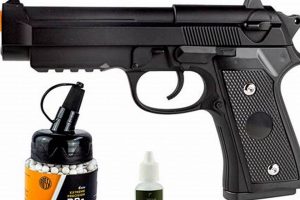
The primary mechanism behind propulsion in many introductory-level airsoft handguns is a compressed helical component. Upon manual cocking, this element stores potential energy. Subsequent release of the trigger unleashes this energy, driving a piston forward. This piston, in turn, forces air through a nozzle, propelling a projectile. An example is found in entry-level replicas where user action directly compresses said part before each shot.
This component’s function is critical to the power output and reliability of these recreational devices. A stiffer or more robust variant typically translates to higher velocity, albeit at the cost of increased cocking effort. Historically, improvements in material science and manufacturing have led to more durable and consistent performance in these power sources, making them a vital element in the broader airsoft market. Its presence in an airsoft pistol marks the foundation for its ability to simulate weapon mechanics.
The following sections will delve into specific types, maintenance considerations, potential upgrades, and performance characteristics related to this essential component within airsoft handguns. These factors are critical to understand for optimal performance and longevity of the equipment.
Essential Considerations for Airsoft Pistol Helical Power Units
Maximizing the effectiveness and lifespan of this critical component requires attention to specific maintenance and usage practices. These guidelines will improve performance and reduce the risk of failure.
Tip 1: Correct Installation: Ensure proper orientation of the part during installation. Incorrect placement can lead to premature wear and reduced power output. Consult the manufacturer’s documentation for specific instructions.
Tip 2: Consistent Lubrication: Apply a small amount of silicone grease to the coils periodically. This minimizes friction and prevents corrosion, ensuring smooth operation and prolonged life.
Tip 3: Avoid Over-Compression: Do not exceed the recommended compression limits during the cocking process. Over-compressing the part can permanently deform or weaken its structure, leading to inconsistent performance.
Tip 4: Regular Inspection: Examine the component for signs of wear, such as cracks, deformation, or loss of tension. Replace the part immediately if any damage is detected to maintain optimal performance.
Tip 5: Proper Storage: When storing the airsoft pistol for extended periods, release the tension on the part. Leaving it compressed can accelerate fatigue and reduce its lifespan.
Tip 6: Match to Airsoft Pistol Model: Always ensure the replacement component is specifically designed for the make and model of the airsoft pistol. Incompatible parts can cause damage or malfunction.
Adhering to these recommendations ensures reliable operation and extends the lifespan of the handgun’s power source, leading to a more enjoyable and cost-effective airsoft experience.
The subsequent sections will explore various types and potential upgrades related to this system within airsoft handguns. These factors are critical to understand for optimal customization and performance.
1. Material Composition

The performance and longevity of an airsoft pistol component responsible for propulsion are intrinsically linked to its material composition. The choice of material directly influences factors such as tensile strength, fatigue resistance, and corrosion susceptibility. Inferior materials, like low-grade carbon steel, may exhibit premature failure under repeated stress, leading to inconsistent power output or complete breakage. Conversely, higher-grade alloys, such as spring steel (e.g., SAE 9254), offer enhanced resilience and maintain their mechanical properties over a longer lifespan.
A real-world example illustrates the impact of material choice: two identical airsoft pistols, one using a spring made from standard carbon steel and the other from spring steel, were subjected to a rigorous testing regime of repeated cycling. The carbon steel component exhibited noticeable deformation and a decrease in power after approximately 5,000 cycles. In contrast, the spring steel component showed no significant degradation in performance even after exceeding 15,000 cycles. This demonstrates the tangible advantage of selecting materials specifically engineered for high-stress applications.
In summary, understanding the material composition of this critical part is essential for evaluating its durability and predicting its long-term performance. The selection of appropriate materials is vital for ensuring consistent power output and maximizing the lifespan of the handgun. Utilizing materials with superior properties is key for enhanced reliability and reducing the frequency of replacements, therefore, reducing total operating expenses.
2. Coil Count

The quantity of active coils within an airsoft pistol component influences its performance characteristics. This number, directly impacting the overall spring rate and compression behavior, is a crucial design parameter.
- Impact on Spring Rate
A higher number of active coils generally leads to a lower spring rate, meaning a reduced force is required to achieve a specific compression distance. Conversely, a lower number of active coils will typically result in a higher spring rate. This relationship affects the energy storage capacity and the force delivered during the firing cycle. For example, a component with fewer coils might provide a faster projectile velocity but require a more substantial force to compress.
- Influence on Compression Distance
The coil count directly affects the maximum compression distance achievable before coil bind occurs (where coils compress completely, preventing further movement). A greater number of coils typically allows for a longer compression stroke. This factor is essential for optimizing the air volume displaced by the piston and, subsequently, the projectile velocity. Pistols designed for high power often incorporate a greater coil count to maximize compression distance.
- Durability Considerations
The number of coils can indirectly affect the durability. All other factors being equal, a spring with fewer coils undergoing the same compression distance will experience higher stress levels in each individual coil. This heightened stress can accelerate fatigue and lead to premature failure. Springs with a greater coil count will distribute the compression stress across a larger number of coils, potentially extending the component’s lifespan.
- Relationship to Pistol Size and Design
The internal dimensions of the airsoft pistol dictate the feasible range for coil count. Subcompact models, for example, may necessitate a design with fewer coils or a smaller overall component length, potentially impacting power output. Conversely, larger pistol designs can accommodate longer components with a higher coil count, enabling greater customization of performance characteristics. Therefore, the internal mechanical space available within the model will drastically limit and influence the coil count of its spring.
The coil count is not an isolated variable. It interacts with other characteristics, such as wire diameter and material properties, to determine the overall performance of the part. Modifying the coil count without considering these related factors can lead to unintended consequences. For instance, an increase in the coil count without adjusting the wire diameter may result in a weaker component with reduced power output. Consequently, a holistic design approach is essential for optimizing the airsoft pistol’s propulsion system.
3. Wire Diameter

The physical thickness of the material used in the construction of an airsoft pistol’s propulsion component, referred to as wire diameter, is a critical determinant of its overall performance and durability. This characteristic directly influences the component’s stiffness, energy storage capacity, and resistance to fatigue. Its selection is a compromise between these factors.
- Stiffness and Spring Rate
A larger wire diameter directly translates to increased stiffness in the spring. This increased stiffness raises the spring rate, meaning a greater force is required to compress it a given distance. A higher spring rate, in turn, can result in a greater projectile velocity upon release. For instance, an upgrade involving the replacement of a component featuring a larger wire diameter is often used to increase the power output of an airsoft pistol, typically at the expense of increased cocking effort.
- Energy Storage Capacity
The energy storage capacity of the helical power unit is directly proportional to the wire diameter. A thicker wire can withstand greater stress and deformation without permanent damage, allowing it to store more potential energy when compressed. This increased energy storage translates to a higher muzzle velocity. An illustration would be comparing two nearly identical components, however, one has a larger wire diameter with a higher stored energy capacity, and the other with a lower wire diameter will expel much less kinetic energy during firing.
- Durability and Fatigue Resistance
A larger wire diameter generally improves the durability and fatigue resistance of the spring. The thicker material can withstand more cycles of compression and release before succumbing to metal fatigue and failure. A real-world demonstration would be comparing two materials under stress where, over the long term, the one with more volume would be able to withstand the compression as it has more material. A thicker diameter will generally last longer as a result.
- Compatibility and Cocking Effort
Increasing the wire diameter has implications for compatibility and ease of use. A thicker wire requires more force to compress, potentially making the pistol harder to cock. This can be a limiting factor, especially in designs where the cocking mechanism relies solely on manual effort. Furthermore, clearance issues may arise if the upgraded component is too thick for the pistol’s internal dimensions. Due to potential limitations, careful design must be considered when upgrading to a larger wire diameter as other mechanics may be affected or be incompatible.
In summary, the selection of the appropriate wire diameter for an airsoft pistol system is a complex engineering decision. It requires careful consideration of the desired power output, durability requirements, and user ergonomics. An optimal selection balances these competing factors to achieve the desired performance characteristics while ensuring reliable and comfortable operation. Careful selection is key to the longevity of the overall structure.
4. Spring Rate

Spring rate, measured in force per unit of displacement (e.g., Newtons per millimeter), defines the stiffness of an airsoft pistol’s helical component. It governs the relationship between the force required to compress the component and the resulting compression distance. A higher spring rate indicates a stiffer component requiring more force for compression, while a lower spring rate indicates a more flexible component requiring less force for equivalent compression. This characteristic directly influences the muzzle velocity of the projectile. Increasing the spring rate generally results in a higher muzzle velocity, assuming other factors remain constant, due to the greater potential energy stored and released. However, this also increases the cocking effort required to compress the component, impacting user ergonomics. For example, an airsoft pistol with an upgraded power source featuring a significantly higher spring rate will likely deliver a more powerful shot but require considerably more force to cock, potentially reducing the user’s firing rate and increasing fatigue.
The selection of the spring rate involves careful consideration of the airsoft pistol’s design and intended use. A spring rate that is too high may exceed the pistol’s structural limitations, leading to premature wear or even damage. Conversely, a spring rate that is too low may result in inadequate power output. Moreover, the spring rate must be compatible with other components, such as the piston and nozzle, to ensure efficient energy transfer and consistent performance. For instance, a high spring rate paired with a lightweight piston might result in excessive piston head slam, potentially damaging the cylinder head. Conversely, a low spring rate paired with a heavy piston could lead to inefficient compression and reduced muzzle velocity. Matching these characteristics is necessary for optimal performance.
In summary, the spring rate is a critical parameter governing the performance and usability of an airsoft pistol. Its selection requires balancing the desired muzzle velocity, cocking effort, and component compatibility. Understanding the relationship between spring rate and these factors is essential for optimizing the airsoft pistol’s performance and ensuring reliable operation. Modification without proper consideration could cause premature wear, lower performance, or total failure.
5. Pre-compression

Pre-compression, in the context of an propulsion component within an airsoft pistol, refers to the intentional compression of the component during the initial assembly or cocking phase, before the full trigger pull. This design feature significantly impacts the energy storage, power output, and operational characteristics. The integration of pre-compression introduces a baseline tension, meaning the piston is already under load at the start of its travel. The immediate effect is a reduction in the initial lag time typically observed when the component begins to compress. Real-world applications show that pistols with pre-compression often exhibit improved shot-to-shot consistency and a potentially higher muzzle velocity for a given spring rate. The existence and correct application are crucial in optimizing airsoft pistol mechanics.
The practical significance of pre-compression lies in its influence on the air volume and pressure dynamics within the cylinder. By initiating the compression process before the piston begins its full stroke, a higher pressure can be achieved more rapidly. This is akin to partially filling a container before forcefully injecting the remaining volume; the pre-existing volume facilitates a quicker pressure build-up. In scenarios where a shorter barrel or a lighter projectile is used, pre-compression can be particularly beneficial in maximizing the energy transfer and achieving the desired ballistic performance. Many high-performance airsoft pistols incorporate adjustable pre-compression mechanisms to fine-tune the power output and cater to specific gaming scenarios or user preferences. The implementation of such adjustability enables a user to tune the response and power output to the intended purpose.
While pre-compression offers notable advantages, challenges exist. Excessive pre-compression can lead to increased stress on the component, potentially reducing its lifespan and increasing the risk of mechanical failure. Furthermore, the increased cocking effort associated with higher pre-compression may negatively impact user experience, particularly during prolonged use or rapid-fire scenarios. Therefore, a balanced approach is essential, carefully considering the trade-offs between power output, component durability, and user ergonomics. Understanding how pre-compression changes the behaviour of propulsion mechanics is crucial in ensuring optimal setup and performance in airsoft pistols, as modification without proper consideration will degrade their overall ability and reliability. The ability to correctly manipulate pre-compression is required to maximize performance.
6. Durability

The operational lifespan and consistent performance of an airsoft pistol are directly contingent upon the resilience of its primary power component. This component is subjected to repeated cycles of compression and release during operation. The extent to which this component can withstand these stresses without degradation defines its durability and, consequently, the overall reliability of the airsoft pistol. The materials used, manufacturing processes employed, and operating conditions experienced all contribute to its capacity to endure. For example, a component constructed from low-grade steel may exhibit premature fatigue and failure compared to one crafted from high-strength alloy, directly impacting the device’s usability and requiring more frequent replacements.
A critical factor influencing the power source’s endurance is its resistance to fatigue. Fatigue, in this context, refers to the weakening of the material structure due to repeated stress cycles. This becomes more noticeable over long periods. Airsoft pistols used extensively, such as in competitive scenarios or frequent recreational play, demand components capable of withstanding thousands of compression cycles without significant loss of power or structural integrity. The selection of materials with high fatigue limits, coupled with precise manufacturing tolerances, is crucial in ensuring prolonged and consistent performance. As an example, two identical airsoft pistols, differing only in the power source’s construction, can demonstrate vastly different lifespans under similar usage conditions. One, utilizing a less durable component, may require replacement after a few months of regular use, while the other, equipped with a more robust component, can function reliably for years.
Ultimately, understanding the durability characteristics of the airsoft pistol’s helical power component is essential for both manufacturers and users. Manufacturers must prioritize the selection of materials and manufacturing processes that maximize component lifespan, reducing warranty claims and enhancing product reputation. Users, in turn, can make informed decisions when purchasing or upgrading their airsoft pistols, selecting components that align with their usage patterns and performance expectations. Ignoring the durability aspect can lead to frequent maintenance, increased operational costs, and a diminished overall experience. As an example, purchasing higher quality and more durable internal components will result in higher sustained performance and lower frequency of replacement, resulting in a better overall experience.
7. Power Output
The energy imparted to an airsoft projectile, commonly referred to as power output and typically quantified as muzzle velocity (feet per second or FPS) or energy (Joules), is directly dictated by the mechanical characteristics of its helical component responsible for propulsion. This component acts as an energy storage device. Upon compression, it accumulates potential energy. The subsequent release of this energy propels the piston forward, forcing air through the cylinder and ultimately launching the projectile. A spring with a higher spring rate, indicating increased stiffness, stores more potential energy upon compression. This translates to greater force exerted on the piston and a more rapid expulsion of air, resulting in a higher velocity. Conversely, a more relaxed component yields lower kinetic energy.
However, power output isn’t solely determined by the spring rate. Factors such as material composition, wire diameter, and coil count interact to influence the overall energy transfer efficiency. A poorly manufactured spring, even with a high spring rate, may exhibit premature fatigue, leading to inconsistent performance and a decline in power output over time. Internal air leakage, piston weight, and barrel length further modulate the achievable projectile velocity. Consider two airsoft pistols with identical dimensions, both employing the same spring rate. One pistol, however, utilizes a high-quality component made from spring steel, while the other incorporates a less durable alternative. Over time, the inferior option will lose its initial stiffness due to material fatigue, resulting in a noticeable decrease in muzzle velocity, thus illustrating the importance of both the component’s design and material quality.
Therefore, maximizing power output in an airsoft pistol necessitates a holistic approach that considers the interactions between the helical component, piston assembly, air seal, and barrel characteristics. Understanding the relationship between this force component and the resulting kinetic energy allows for informed component selection and performance tuning. While a higher spring rate can often translate to greater power, a focus on material quality, precise manufacturing, and optimized component compatibility is essential for achieving consistent and reliable projectile speeds. The interplay and balance between all these design factors ultimately define the airsoft pistol’s performance envelope.
Frequently Asked Questions
The following section addresses common inquiries and misconceptions surrounding the helical components integral to propulsion in many airsoft pistols.
Question 1: What is the expected lifespan of an component utilized in an entry-level airsoft pistol?
The lifespan is contingent upon usage frequency, material composition, and operating conditions. A high-quality component, constructed from durable materials and subjected to moderate usage, can last for several years. Conversely, frequent use or exposure to extreme temperatures can shorten its lifespan.
Question 2: How does component stiffness impact the power output of an airsoft pistol?
Increased stiffness, quantified by a higher spring rate, generally correlates with greater projectile velocity. A stiffer part stores more potential energy upon compression, resulting in a more forceful expulsion of air and a higher velocity. However, this increase is typically accompanied by a greater cocking force.
Question 3: Can an airsoft pistol component be upgraded to increase its power output?
Upgrading to a component with a higher spring rate is a common method to increase power output. However, it is essential to ensure compatibility with the pistol’s internal components and structural limitations. Exceeding these limits can lead to premature wear or damage.
Question 4: What maintenance practices are recommended to extend the lifespan of an airsoft pistol propulsion component?
Regular lubrication with silicone grease minimizes friction and prevents corrosion. Consistent use of lubrication is recommended to ensure smooth operation and longevity. Avoid over-compression during cocking, and inspect the component regularly for signs of wear or damage.
Question 5: What are the potential consequences of using an incompatible replacement part?
Using an incompatible replacement component can lead to a range of problems, including reduced power output, inconsistent performance, and accelerated wear on other internal components. In severe cases, it can cause irreversible damage to the airsoft pistol.
Question 6: What factors should be considered when selecting a replacement airsoft pistol spring?
Key considerations include material composition, spring rate, wire diameter, and coil count. Select a component that is specifically designed for the make and model of the airsoft pistol and that aligns with the desired performance characteristics.
Proper maintenance, informed component selection, and responsible usage are crucial for maximizing the performance and longevity of airsoft pistols that utilize helical propulsion systems.
The succeeding section will explore advanced customization techniques and performance optimization strategies related to these essential components.
Conclusion
The preceding analysis has explored the critical role of the airsoft pistol spring in determining performance characteristics. Material composition, coil count, wire diameter, spring rate, pre-compression, and durability directly impact the power output, consistency, and operational lifespan. A thorough understanding of these parameters is essential for both manufacturers and users seeking to optimize airsoft pistol performance.
Continued advancements in materials science and manufacturing techniques offer the potential for further improvements in airsoft pistol technology. Prioritizing informed decision-making, based on a comprehensive understanding of component characteristics, is crucial for ensuring safe, reliable, and enjoyable operation. Further research and development into advanced spring designs will likely yield even greater improvements in airsoft pistol power and efficiency. The interplay of the various performance attributes is something enthusiasts should be taking into account.