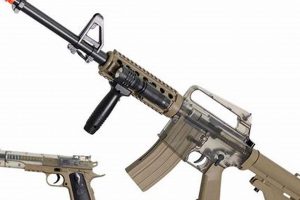
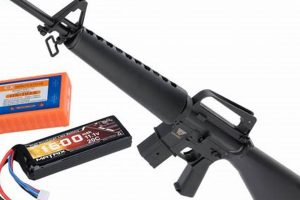
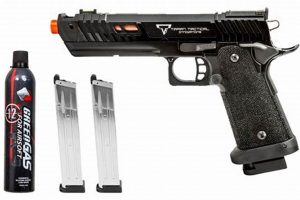
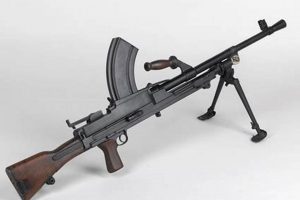
The degree to which an airsoft replica mirrors a real firearm in appearance, weight, and operation is a key consideration for many enthusiasts. This verisimilitude can range from cosmetic similarities to functional features like realistic disassembly and simulated recoil.
Authenticity enhances the training value for law enforcement and military personnel who use these devices for simulation. Furthermore, it intensifies the immersive experience for recreational players, contributing to a more engaging and challenging simulated combat scenario. The pursuit of greater likeness to actual firearms has driven innovation in airsoft design and manufacturing over the years.
The following discussion will examine specific aspects that contribute to this authenticity, including material choices, operational mechanics, and the legal considerations surrounding airsoft devices.
Enhancing Authenticity
Achieving a high degree of visual and functional fidelity in airsoft devices requires careful attention to detail. The following points outline key considerations for maximizing this realism.
Tip 1: Material Selection. Examine the materials used in construction. Metal alloys and high-density polymers often provide a more substantial feel and improved durability, closely resembling the materials found in actual firearms.
Tip 2: Operational Accuracy. Prioritize models that replicate the operating mechanisms of their real counterparts. This includes features such as bolt cycling, magazine release, and fire selector functionality.
Tip 3: Weight and Balance. Assess the weight and balance distribution. Accurate replication of these characteristics significantly contributes to a more genuine handling experience.
Tip 4: External Markings. Inspect external markings for accuracy and authenticity. Licensed replicas often feature trademarks and engravings that match the original firearm.
Tip 5: Disassembly Procedures. Consider models that allow for realistic disassembly and reassembly. This feature adds a layer of immersion and can aid in understanding the internal mechanics.
Tip 6: Aftermarket Accessories. Explore the availability of aftermarket accessories designed to enhance authenticity. These may include realistic sights, grips, and rail systems.
Tip 7: Internal Upgrades. Investigate internal upgrades that improve performance and sound. Upgraded gearboxes and motors can provide a more satisfying shooting experience.
These considerations are crucial for airsoft enthusiasts who value the immersive experience and training benefits offered by devices with enhanced authenticity. Prioritizing these factors leads to a more fulfilling and rewarding airsoft experience.
The subsequent sections will delve into legal limitations and the ethical considerations surrounding the use and modification of such highly-authentic devices.
1. Material Fidelity

Material fidelity in airsoft replicas is directly proportional to the perceived realism of the device. The use of materials closely resembling those found in actual firearms such as steel, aluminum alloys, and high-density polymers significantly elevates the user’s sensory experience. For example, an airsoft rifle constructed with a stamped steel receiver will provide a weight and tactile feedback that is vastly superior to one made entirely of plastic. The selection of appropriate materials directly impacts the device’s durability and its ability to withstand the rigors of simulated combat, further contributing to the overall sense of authenticity.
The pursuit of material fidelity is not solely about aesthetic likeness; it also influences the functionality and operational lifespan of the airsoft replica. Internal components made from hardened steel, for instance, will exhibit increased resistance to wear and tear, ensuring consistent performance over time. The selection of materials also affects the overall weight distribution of the device, crucial for simulating the handling characteristics of a real firearm. A balanced airsoft rifle allows for more accurate target acquisition and enhances the user’s ability to maneuver in dynamic scenarios.
In summary, material fidelity is a critical component in achieving verisimilitude in airsoft devices. It encompasses not only the visual similarity to genuine firearms but also the functional and tactile aspects that contribute to an immersive and realistic experience. The challenges associated with replicating materials at a commercially viable cost often necessitate trade-offs. However, a focus on key elements, such as receiver construction and internal component quality, provides a significant improvement in perceived realism. This directly affects the utility of these devices for both recreational and training purposes.
2. Weight Replication
Weight replication is a crucial element in the pursuit of realism in airsoft devices. The mass and distribution of weight significantly influence the handling characteristics and perceived authenticity of these replicas. Devices that accurately mimic the weight profile of their real firearm counterparts provide a more immersive and effective training experience.
- Muscle Memory Development
Accurate weight replication fosters the development of realistic muscle memory. Repeated handling of an airsoft device with a weight similar to the real firearm allows users to build familiarity with the firearm’s balance and handling characteristics. This is particularly important for training purposes, where the transfer of skills from the airsoft device to the actual firearm is desired.
- Recoil Simulation
While airsoft devices do not generate the same recoil as real firearms, weight plays a role in perceived recoil. A heavier device will exhibit more pronounced movement during firing, creating a more convincing simulation of recoil. The internal mechanisms designed to simulate recoil, such as blowback systems, are more effective when paired with a device that has substantial weight.
- Handling Dynamics
Weight distribution affects handling dynamics, influencing how the airsoft device is shouldered, aimed, and manipulated. Accurate weight replication allows users to practice proper shooting techniques and develop the necessary strength and control to handle a real firearm effectively. Devices with inaccurate weight distribution can hinder the development of proper technique and create unrealistic handling scenarios.
- Material Impact
The selection of materials significantly impacts weight replication. Metal alloys are often used to achieve a weight profile closer to that of real firearms. High-density polymers can also be utilized, but require careful design and construction to ensure accurate weight distribution. The internal components, such as the gearbox and battery, also contribute to the overall weight and must be considered in the design process.
Weight replication is a critical factor in achieving realism in airsoft devices. By accurately mimicking the weight and balance of real firearms, these replicas provide a more effective training tool and a more immersive recreational experience. The interplay between material selection, internal mechanisms, and weight distribution contributes to the overall sense of authenticity and utility of the airsoft device.
3. Operational Mimicry

Operational mimicry, in the context of airsoft devices, refers to the degree to which an airsoft gun replicates the functional characteristics of a real firearm. This encompasses aspects such as loading procedures, trigger mechanisms, fire selector operation, disassembly methods, and, where applicable, blowback actions. A higher degree of operational mimicry directly contributes to the overall realism of the airsoft gun, enhancing its utility for training and simulation purposes. For instance, an airsoft rifle that requires the user to insert a magazine, charge the bolt, and manipulate a fire selector mirroring the actions required with the real firearm provides a more immersive and instructive experience. The effectiveness of force-on-force training scenarios is amplified when the participants interact with equipment that closely emulates real-world counterparts.
The practical applications of operational mimicry extend beyond recreational use and training. Law enforcement agencies and military organizations utilize highly authentic airsoft replicas for scenario-based training exercises. The realistic handling and operation of these devices allow personnel to develop and refine weapon handling skills, practice tactical maneuvers, and improve decision-making under pressure. The use of airsoft guns in these contexts reduces the risk associated with live-fire training while still providing a challenging and realistic training environment. Furthermore, detailed operational mimicry aids in understanding the ergonomics and potential malfunctions of real firearms, contributing to a broader understanding of weapon systems.
In summary, operational mimicry is an indispensable element in achieving a convincing airsoft gun realistic. It influences the device’s value as a training tool, enhances the recreational experience, and contributes to a better understanding of firearm functionality. While challenges remain in perfectly replicating the intricacies of real firearms, continuous advancements in design and manufacturing strive to bridge the gap, resulting in increasingly sophisticated and operationally accurate airsoft devices.
4. Cosmetic Accuracy
Cosmetic accuracy plays a crucial role in determining the overall level of realism achieved in airsoft devices. The faithful replication of external features directly contributes to the user’s perception of authenticity, influencing both the training value and the immersive experience.
- External Markings and Trademarks
The presence and accuracy of external markings, including manufacturer trademarks, model designations, and serial numbers, are key indicators of cosmetic accuracy. Licensed replicas often feature authentic markings, enhancing their visual fidelity to the real firearm. Incorrect or missing markings can detract from the overall sense of realism.
- Dimensional Precision
Accurate replication of dimensions, including overall length, barrel length, and grip size, is essential for achieving a realistic feel. Deviations from the original firearm’s dimensions can affect handling characteristics and visual authenticity. Careful attention to dimensional precision is particularly important for replicas intended for training purposes.
- Surface Finish and Texturing
The surface finish and texturing of airsoft components contribute significantly to their visual and tactile realism. Replicating the finish of metal and polymer parts, including details such as parkerization or stippling, enhances the user’s sensory experience. The accuracy of surface finishes adds to the overall illusion of authenticity.
- Color Matching
Accurate color matching of components, including receivers, barrels, and grips, is crucial for achieving visual fidelity. Discrepancies in color can be immediately noticeable and detract from the realism of the airsoft device. Attention to color matching demonstrates a commitment to detail and contributes to a more convincing replica.
These elements of cosmetic accuracy collectively contribute to the perception of verisimilitude in airsoft devices. While functional accuracy and material fidelity are important, the visual appeal of a realistically detailed replica significantly enhances its value as a training tool and a collector’s item. The pursuit of cosmetic accuracy demonstrates a commitment to detail and contributes to a more immersive and satisfying airsoft experience.
5. Tactical Training
The efficacy of tactical training using airsoft devices is directly proportional to the degree of realism the devices possess. The more closely an airsoft gun mimics the form, function, and handling characteristics of an actual firearm, the more effectively it can be utilized for skill development and scenario replication. This extends beyond mere aesthetic similarity; the weight, balance, trigger pull, and operational controls all contribute to the development of accurate muscle memory and procedural familiarity. A realistic airsoft gun facilitates training exercises that more closely mirror real-world engagements, allowing trainees to internalize tactics and improve reaction times in a simulated environment before transitioning to live-fire scenarios or real-world operations.
For example, law enforcement agencies increasingly incorporate realistic airsoft guns into their training programs. These devices enable officers to practice room clearing, hostage rescue, and active shooter response tactics in a controlled environment without the inherent risks associated with live ammunition. The realistic feedback provided by the airsoft guns, coupled with the stress of a simulated encounter, allows officers to develop critical decision-making skills and refine their tactical proficiency. The ability to safely simulate close-quarters combat scenarios is invaluable for preparing officers for the unpredictable nature of real-world confrontations.
In summary, the value of tactical training hinges significantly on the realism of the tools employed. Airsoft guns that accurately replicate the characteristics of actual firearms offer a safe, cost-effective, and highly valuable means of preparing personnel for real-world tactical situations. The emphasis on realism in airsoft devices facilitates the development of crucial skills, enhances decision-making abilities, and ultimately contributes to improved performance in high-pressure environments. The challenge remains in continually refining airsoft technology to further bridge the gap between simulation and reality, thereby maximizing the benefits of tactical training.
6. Regulatory Compliance
The production, sale, and use of realistic airsoft guns are subject to varying degrees of regulation across different jurisdictions. The pursuit of verisimilitude in airsoft devices often necessitates careful consideration of legal limitations, as a replica that is too easily mistaken for a real firearm can trigger stricter regulatory oversight. Regulations may encompass markings requirements, color restrictions, and limitations on the overall size and weight of the device. Failure to comply with these regulations can result in seizure of the device, fines, or even criminal charges.
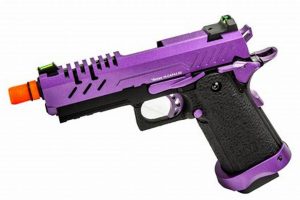
Consider, for example, regulations that mandate the presence of a blaze orange tip on the barrel of airsoft guns. This visual identifier is intended to distinguish the replica from a real firearm, reducing the risk of confusion and potential misidentification by law enforcement. Similarly, some jurisdictions impose restrictions on the materials used in the construction of airsoft guns, limiting or prohibiting the use of certain metal alloys to prevent the devices from being readily converted into functional firearms. The realistic appearance of an airsoft device, while desirable from a training or recreational standpoint, must be balanced against the need to comply with applicable legal requirements.
Understanding the legal framework governing airsoft devices is crucial for both manufacturers and users. Manufacturers must ensure that their products meet all applicable safety standards and comply with marking requirements. Users, in turn, are responsible for understanding and adhering to local regulations concerning the storage, transportation, and use of airsoft guns. The intersection of realistic design and regulatory compliance presents ongoing challenges, requiring vigilance and a commitment to responsible practices within the airsoft community.
Frequently Asked Questions
This section addresses common inquiries regarding the realistic attributes of airsoft guns, clarifying their features, limitations, and legal implications.
Question 1: What features contribute most significantly to the realistic appearance of an airsoft gun?
Material selection, dimensional accuracy, and faithful replication of external markings are paramount. Metal alloy receivers and high-density polymer components contribute substantially to the tactile and visual authenticity.
Question 2: To what extent can the operational mechanics of a real firearm be replicated in an airsoft gun?
Advanced airsoft models can mimic several key operational features, including magazine insertion, bolt cycling, and fire selector functionality. Certain models incorporate blowback mechanisms to simulate recoil, although the force generated is considerably less than that of a real firearm.
Question 3: What are the primary benefits of using realistic airsoft guns for training purposes?
Realistic airsoft guns facilitate the development of muscle memory and procedural familiarity with firearm handling techniques. The accurate weight, balance, and operational controls allow for effective scenario-based training without the risks associated with live ammunition.
Question 4: Are there legal restrictions on the degree of realism achievable in an airsoft gun?
Yes, regulations often dictate marking requirements, such as the presence of a blaze orange tip, to distinguish airsoft guns from real firearms. Certain jurisdictions may also restrict the use of specific materials to prevent easy conversion into functional weapons.
Question 5: How does the weight of an airsoft gun contribute to its perceived realism?
Weight plays a crucial role in replicating the handling characteristics of a real firearm. A heavier airsoft gun, with accurate weight distribution, enhances the user’s ability to shoulder, aim, and manipulate the device effectively. It also contributes to a more convincing simulation of recoil.
Question 6: What are the key considerations when selecting a realistic airsoft gun for tactical training?
Material fidelity, operational accuracy, weight replication, and ergonomic conformity are crucial factors. A realistic airsoft gun should closely mimic the form, function, and handling characteristics of the intended firearm to maximize training effectiveness.
In summary, the realism of an airsoft gun is determined by a confluence of factors, encompassing material quality, operational mimicry, and adherence to legal standards. A well-designed and constructed airsoft gun provides substantial benefits for training and recreational purposes, but it must always be handled responsibly and in compliance with applicable regulations.
The following section will explore the ethical considerations associated with owning and utilizing realistic airsoft devices.
Realistic Airsoft Devices
The preceding exploration has highlighted the multifaceted nature of devices simulating authentic firearms. The convergence of material fidelity, operational mimicry, cosmetic accuracy, and adherence to regulatory standards defines the value and utility of these replicas. Achieving a high degree of verisimilitude enhances training efficacy and enriches the recreational experience, though it simultaneously necessitates responsible ownership and stringent adherence to legal mandates.
The pursuit of these devices carries with it a responsibility to understand and respect their potential impact. Future innovation must prioritize safety, ethical considerations, and ongoing compliance with evolving legal frameworks. The airsoft community must actively promote responsible practices to ensure the continued viability and positive perception of this evolving technology.