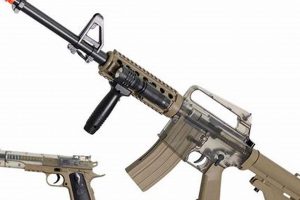
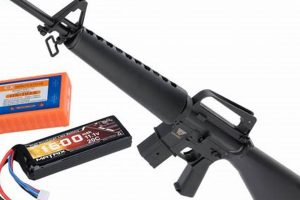
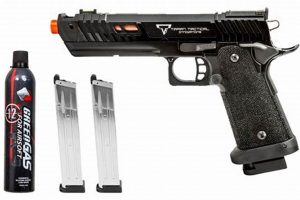
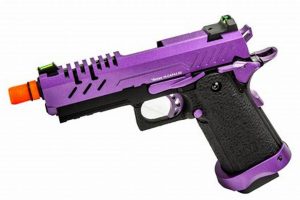
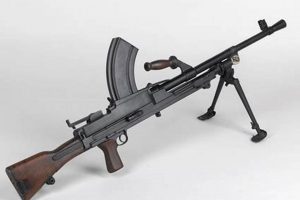
The creation of scaled replicas resembling firearms, specifically for airsoft sports, through additive manufacturing processes is gaining traction. These reproductions are often based on digital designs and constructed layer-by-layer from materials like plastic or nylon using a 3D printer. An instance would be replicating a specific rifle design to enhance the realism of airsoft gameplay.
The appeal stems from the potential for customizability and cost-effectiveness compared to commercially available airsoft guns. Individuals can modify existing designs or create entirely new ones, tailored to their preferences and needs. Furthermore, the accessibility of 3D printing technology and readily available digital models lower the entry barrier to obtaining specialized or rare airsoft replicas. This facilitates a more personalized and engaging experience within the airsoft community.
The subsequent discussion will delve into the design considerations, material choices, and safety precautions associated with creating these replicas, as well as address legal and ethical implications relevant to their production and use.
Tips for Airsoft Replica Creation via Additive Manufacturing
The following guidelines address considerations for successfully creating airsoft replicas utilizing three-dimensional printing technology. Adhering to these recommendations promotes functionality, durability, and safety during the creation process.
Tip 1: Material Selection is Critical: Employ materials with adequate impact resistance and tensile strength. Acrylonitrile Butadiene Styrene (ABS) and Polyethylene Terephthalate Glycol (PETG) are viable options. Conduct thorough research regarding material properties to align with the intended application and stress load.
Tip 2: Layer Adhesion Optimization: Prioritize proper layer adhesion to prevent structural weaknesses. Adjust printer settings such as nozzle temperature, bed temperature, and print speed. Insufficient layer adhesion can lead to premature failure during use.
Tip 3: Design for Structural Integrity: Incorporate design features that enhance the overall strength. Internal supports, fillets, and thicker walls at stress points are recommended. Finite Element Analysis (FEA) software can aid in identifying potential weak points in the design.
Tip 4: Post-Processing for Enhanced Durability: Implement post-processing techniques to improve the surface finish and structural integrity. Sanding, smoothing, and coating with protective layers can significantly enhance resistance to wear and tear.
Tip 5: Accuracy and Tolerances: Calibrate the 3D printer meticulously to ensure dimensional accuracy. Precise dimensions are vital for proper assembly and functionality. Consider the tolerances of internal components to avoid jamming or malfunctions.
Tip 6: Safety Mechanisms Integration: Design and implement functional safety mechanisms, such as triggers and safeties, replicating those found on authentic firearms. Ensure these mechanisms operate reliably and effectively to prevent accidental discharge.
Tip 7: Adherence to Legal Regulations: Prior to engaging in the construction of airsoft replicas, meticulously review and comply with all applicable local, regional, and national regulations regarding the manufacturing, ownership, and modification of imitation firearms. Compliance is paramount to avoid legal ramifications.
By incorporating these guidelines, individuals engaged in the additive manufacturing of airsoft replicas can increase the likelihood of producing durable, functional, and safe products. Emphasizing material science, design principles, and adherence to regulations contributes to a responsible and successful creation process.
The following section will address the legal and ethical considerations surrounding the creation and utilization of airsoft replicas.
1. Design precision

Design precision serves as a foundational element in the creation of airsoft replicas via additive manufacturing. Accurate and detailed digital models are essential to realizing a functional and reliable product. Discrepancies in the initial design phase will propagate throughout the manufacturing process, potentially leading to performance issues and safety concerns.
- Dimensional Accuracy
Maintaining dimensional accuracy is paramount. Slight deviations from intended measurements can cause misalignment of components, affecting the gun’s firing mechanism and overall operation. Examples include improperly sized magazine wells leading to feeding issues, or incorrectly scaled trigger mechanisms resulting in malfunctions. Ensuring accurate measurements during the design phase mitigates such problems.
- Functional Integration
Design precision directly affects the functional integration of various parts. Complex designs with intricate internal mechanisms require a high degree of accuracy to ensure proper interaction between components. For example, the interaction between the piston, gears, and cylinder within a gearbox must be precisely designed to achieve the desired rate of fire and power output. Failure to account for these relationships can lead to performance degradation or failure.
- Tolerances and Fit
Appropriate tolerances must be incorporated into the design to allow for proper fit between mating parts. Additive manufacturing processes inherently possess dimensional limitations, and designs must account for these. Parts that are too tightly fitted may bind or require excessive force for assembly, while excessively loose parts may rattle or fail to maintain alignment. Precise design consideration of tolerances is crucial for successful assembly and operation.
- Replication of Aesthetics
Beyond functionality, design precision also impacts the aesthetic fidelity of the replica. Airsoft enthusiasts often seek highly accurate reproductions of real firearms. This necessitates meticulous attention to detail in replicating the contours, features, and markings of the original design. Accurate replication enhances the realism and collectible value of the product.
In summary, design precision is a non-negotiable aspect of creating airsoft replicas using additive manufacturing. It influences not only the functionality and reliability of the product but also its aesthetic appeal. Accurate digital models, proper consideration of tolerances, and a focus on functional integration are all critical for achieving a successful outcome. These elements contribute directly to user satisfaction and the overall quality of the replica.
2. Material strength

The durability and operational lifespan of an airsoft replica significantly depend on the strength of the materials used in its construction. Additive manufacturing, while offering design flexibility, presents limitations concerning material properties. The selected material must withstand the stresses associated with repeated firing, impact from projectiles or falls, and environmental factors such as temperature and humidity. Failure to account for these factors can result in component breakage, malfunctions, and a diminished lifespan for the airsoft replica. For example, a trigger assembly printed from a brittle polymer may fracture under the repeated stress of normal operation, rendering the replica unusable. The choice of material directly influences the reliability and longevity of the finished product.
Furthermore, material strength impacts the safety of the user. A weak or brittle material used in critical components, such as the receiver or barrel, can lead to catastrophic failures during operation. Such failures may result in projectile misdirection or fragmentation, posing a risk of injury to the user or bystanders. Therefore, the selection process must prioritize materials with sufficient tensile strength, impact resistance, and flexural modulus to ensure safe operation under anticipated conditions. Industry standards and material testing data should be consulted to validate the suitability of selected materials. Practical applications involve testing printed components under simulated operational stresses to identify potential weaknesses and refine material choices.
In conclusion, material strength constitutes a critical factor in the creation of durable and safe airsoft replicas via additive manufacturing. Insufficient material strength can compromise functionality, reduce lifespan, and pose safety hazards. Challenges involve balancing material properties with printability and cost considerations. Future advancements in material science and additive manufacturing techniques may offer solutions to enhance the strength and durability of printed airsoft components, contributing to the overall reliability and safety of these replicas. Understanding the practical implications of material strength is therefore paramount for responsible design and manufacturing practices.
3. Printing accuracy
Printing accuracy is paramount in the realm of additive manufacturing for airsoft replicas. Deviations from intended dimensions and tolerances can significantly compromise functionality, reliability, and safety, making meticulous attention to detail essential throughout the printing process.
- Dimensional Fidelity and Component Integration
Achieving dimensional fidelity is crucial for the seamless integration of various components within the airsoft replica. Discrepancies between the printed parts and the design specifications can lead to misalignment, improper fit, and functional impairments. For example, if the magazine well is not printed to the exact dimensions, the magazine may not seat correctly, leading to feeding issues. Similarly, inaccuracies in the dimensions of the trigger mechanism can cause malfunctions or unsafe operation. Printing accuracy ensures that each component interacts as intended.
- Surface Finish and Aesthetic Replication
Printing accuracy extends beyond dimensional precision to encompass surface finish. A smooth, consistent surface finish is desirable, not only for aesthetic reasons but also to minimize friction between moving parts. Rough or uneven surfaces can increase wear and tear, reducing the lifespan of the replica. Furthermore, printing accuracy is essential for faithfully replicating the aesthetic details of the original firearm, which is a primary consideration for many airsoft enthusiasts. Inaccurate printing can result in a substandard appearance, diminishing the value and appeal of the replica.
- Tolerance Management and Mechanical Functionality
Managing tolerances effectively is a direct consequence of printing accuracy. Tolerances define the permissible variation in dimensions and are critical for ensuring that parts fit together and function correctly. Accurate printing enables the creation of tight tolerances, minimizing play and maximizing the efficiency of mechanical components. For instance, the piston assembly within a gearbox requires precise tolerances to ensure proper compression and consistent performance. Inaccurate printing can lead to excessive play, reduced power, and increased wear, ultimately affecting the performance of the airsoft replica.
- Material Properties and Structural Integrity
While material selection is critical, printing accuracy directly influences the realization of the material’s intended properties. Consistent layer adhesion and uniform density, both products of accurate printing, are essential for maximizing structural integrity. Voids, delaminations, or inconsistent layer bonding can significantly weaken the printed part, increasing the risk of failure under stress. This is particularly relevant for load-bearing components such as the receiver or barrel, where structural integrity is crucial for safe and reliable operation. Accurate printing ensures that the material performs as designed, maximizing its strength and durability.
Collectively, these facets underscore the indispensable role of printing accuracy in the successful creation of airsoft replicas through additive manufacturing. High printing accuracy not only enhances the functionality, reliability, and aesthetic appeal of the replica but also contributes significantly to its safety and longevity. Without meticulous attention to printing accuracy, the potential benefits of custom design and material selection are diminished.
4. Assembly methods
The integration of separately fabricated components is critical to realizing a functional airsoft replica. Additive manufacturing typically produces individual parts that require subsequent assembly. Therefore, the chosen assembly methods significantly influence the structural integrity, operational reliability, and overall performance of the final product. Precision in design and execution of these methods is paramount.
- Mechanical Fasteners
The utilization of screws, bolts, and pins represents a common approach to joining 3D-printed components. This method offers a degree of adjustability and ease of disassembly for maintenance or repair. However, careful consideration must be given to the placement and size of fastener holes to avoid weakening the surrounding material. Examples include securing the upper and lower receivers of an airsoft rifle or attaching external accessories like scopes or rails. The stress distribution around fastener points needs careful analysis to prevent premature failure under operational loads. Mismatched fastener sizes or improper torque can lead to thread stripping and compromised joint strength.
- Adhesive Bonding
Adhesive bonding provides an alternative to mechanical fasteners, creating a continuous joint that can distribute stress more evenly. Selecting the appropriate adhesive for the chosen 3D-printing material is critical. Cyanoacrylates, epoxies, and structural acrylics are frequently employed. Surface preparation, such as cleaning and abrasion, is essential to ensure adequate adhesion. Examples include bonding the halves of a pistol grip or attaching cosmetic components. Inadequate surface preparation or the selection of an incompatible adhesive can result in bond failure, compromising the structural integrity of the replica.
- Interlocking Features
Designing interlocking features directly into the 3D model offers a method of assembly that requires minimal or no additional hardware. These features can include snap-fit joints, dovetail slides, or mortise-and-tenon configurations. The design of interlocking features must account for the dimensional tolerances of the 3D printing process to ensure a secure and reliable fit. An example is the connection between a magazine and a magazine well, where interlocking features can ensure proper alignment and retention. Inaccurate design or printing can result in loose joints or the inability to assemble the components.
- Ultrasonic Welding
For thermoplastic materials, ultrasonic welding offers a method of creating strong, permanent joints. This process involves using high-frequency sound waves to generate heat at the joint interface, causing the plastic to melt and fuse together. Ultrasonic welding is suitable for joining components made from materials such as ABS or PLA. An example is the joining of two halves of a gearbox shell. Improper welding parameters, such as insufficient power or dwell time, can result in weak joints or material degradation.
The successful assembly of 3D-printed airsoft replicas hinges on a thorough understanding of the strengths and limitations of various assembly methods. The selection of the appropriate method depends on factors such as the material properties, the design complexity, the required strength, and the desired aesthetic. Careful planning and precise execution are essential to ensure the creation of a durable, reliable, and safe airsoft replica.
5. Safety mechanisms
The integration of functional safety mechanisms is a critical aspect of airsoft replicas fabricated through additive manufacturing. These mechanisms, designed to prevent unintended discharge and ensure safe handling, warrant meticulous attention during the design and construction phases. The absence or malfunction of such mechanisms can lead to hazardous situations and potential injuries.
- Trigger Lock Implementation
A trigger lock, often realized as a mechanical obstruction or a blocking device, prevents the trigger from being pulled, thereby disabling the firing mechanism. This feature is essential for preventing accidental discharge during storage, transportation, or handling. Examples include cross-bolt safeties or sliding mechanisms that physically block the trigger’s movement. Improper design or construction of a trigger lock can render it ineffective, compromising safety. In the context of airsoft replicas, a poorly designed trigger lock can fail to prevent the release of pressurized gas or a spring-loaded piston, resulting in unintended projectile launch.
- Selector Switch Functionality
The selector switch allows the user to select different firing modes, such as “safe,” “semi-automatic,” or “automatic.” When set to “safe,” the selector switch disables the firing mechanism, preventing discharge. The functionality of the selector switch relies on its ability to mechanically interrupt the trigger linkage or disconnect the power supply to the firing system. The switch must operate reliably and provide clear tactile feedback to indicate the selected firing mode. Design flaws or manufacturing defects in the selector switch can result in the replica firing unexpectedly or failing to engage the safety mode. This highlights the criticality of ensuring robust and reliable selector switch functionality in 3D-printed airsoft replicas.
- Anti-Reversal Latch Integrity
In airsoft replicas that utilize electric-powered gearboxes (AEGs), an anti-reversal latch prevents the gears from rotating backward after a shot is fired. This mechanism prevents the spring from unwinding and causing multiple shots to be fired unintentionally. The anti-reversal latch typically consists of a spring-loaded pawl that engages with teeth on the gearbox gears. Inadequate design or material strength of the anti-reversal latch can lead to its failure, resulting in gear slippage and potential damage to the gearbox. Ensuring the integrity and proper function of the anti-reversal latch is crucial for maintaining the controlled and predictable firing behavior of AEGs.
- Magazine Safety Mechanisms
Some airsoft replicas incorporate magazine safety mechanisms that prevent the replica from firing if the magazine is not properly inserted. This feature prevents accidental discharge if the user attempts to fire the replica without a magazine in place. Magazine safety mechanisms typically consist of a sensor that detects the presence of a magazine and a mechanical linkage that disables the trigger or firing system when the magazine is removed. Malfunctioning magazine safety mechanisms can lead to unexpected discharge or the inability to fire the replica with a magazine inserted. This underscores the importance of ensuring the reliable and consistent operation of magazine safety mechanisms in 3D-printed airsoft replicas.
The diligent implementation and validation of these safety mechanisms are vital in the responsible design and production of 3D-printed airsoft replicas. Furthermore, the design of these safety features must align with all relevant regulations and standards governing airsoft devices. Proper design ensures user safety and mitigates the risk of accidental injuries.
6. Legal compliance

The creation of airsoft replicas using three-dimensional printing necessitates stringent adherence to applicable legal regulations. The act of designing, manufacturing, possessing, and utilizing these items is subject to a complex interplay of federal, state, and local laws. Failure to comply can result in severe penalties, including fines, confiscation of property, and potential criminal charges. The replica’s visual similarity to actual firearms often triggers legal scrutiny, particularly regarding markings, colorations, and functional capabilities. For example, regulations may mandate the presence of a blaze orange tip to differentiate it from a real firearm, or restrict the replica’s muzzle velocity to specific limits.
Numerous jurisdictions have specific laws addressing imitation firearms. Some jurisdictions restrict their sale or possession, particularly to minors. Other laws regulate the modification of these items, prohibiting alterations that would make them more realistic or dangerous. Furthermore, federal laws concerning the manufacture and transfer of firearms may apply if the 3D-printed replica can be readily converted into a functional firearm. The legal landscape is constantly evolving, demanding ongoing vigilance and thorough investigation into relevant statutes. For example, a citizen could face legal consequences if they were to sell an 3D-printed airsoft gun model that lacks required safety markings within a jurisdiction that mandates such markings.
In summary, legal compliance represents a paramount concern for anyone involved in the creation of airsoft replicas through additive manufacturing. The intersection of existing firearms laws, regulations concerning imitation firearms, and the inherent capabilities of 3D printing technology creates a complex legal environment. Careful consideration of applicable laws, thorough documentation of design modifications, and adherence to established safety standards are essential for mitigating legal risks. Ultimately, responsible practices in design, manufacturing, and ownership are vital for ensuring legal compliance within this domain.
Frequently Asked Questions
This section addresses common inquiries concerning the design, production, and legal considerations associated with creating airsoft replicas utilizing three-dimensional printing technology.
Question 1: What materials are suitable for withstanding the stress of airsoft replica operation?
Acrylonitrile Butadiene Styrene (ABS) and Polyethylene Terephthalate Glycol (PETG) offer viable options. Nylon-based filaments provide increased durability, albeit at a higher cost and printing complexity. The specific material choice should align with the intended use, the power output of the replica, and the desired lifespan.
Question 2: What design considerations are crucial for ensuring the safety of 3D-printed airsoft guns?
Functional safety mechanisms, such as trigger locks and selector switches, are essential. Internal reinforcement and robust wall thicknesses should be incorporated to prevent structural failure. Furthermore, designs must adhere to all applicable regulations regarding imitation firearms to ensure safe and responsible use.
Question 3: What level of precision is required when designing digital models for airsoft replicas?
Dimensional accuracy is paramount. Precise measurements are necessary for proper component integration, functional reliability, and aesthetic fidelity. Tolerances must be carefully considered to ensure a secure fit between mating parts without compromising functionality. Deviations from intended dimensions can compromise the replicas performance and structural integrity.
Question 4: Are there legal restrictions on creating airsoft replicas using 3D printing?
Yes, numerous jurisdictions have laws regulating the manufacture, sale, and possession of imitation firearms. These regulations may stipulate specific markings, coloration requirements, or muzzle velocity limits. Prior to initiating any production activities, a thorough review of all applicable federal, state, and local laws is mandatory.
Question 5: What are the key challenges associated with achieving sufficient strength in 3D-printed airsoft components?
Layer adhesion, material properties, and design limitations present significant challenges. Optimizing printer settings, such as nozzle temperature and print speed, is crucial for maximizing layer adhesion. Careful material selection is required to ensure adequate tensile strength, impact resistance, and flexural modulus. Design strategies, such as incorporating internal supports and thickening walls at stress points, can further enhance structural integrity.
Question 6: How can printing accuracy be improved when creating airsoft replicas?
Printer calibration, material-specific settings, and proper bed adhesion are fundamental to enhancing accuracy. Utilizing high-resolution printing settings, employing support structures judiciously, and accounting for material shrinkage or warping can also contribute to improved dimensional fidelity. Post-processing techniques, such as sanding and smoothing, can refine surface finish and minimize imperfections.
In summary, the creation of airsoft replicas using additive manufacturing demands a comprehensive understanding of design principles, material science, printing techniques, and legal considerations. Diligence and adherence to established best practices are essential for producing safe, functional, and legally compliant items.
The following section will cover future trends in airsoft replica creation using 3D printing.
Conclusion
The preceding analysis has delineated essential considerations for “airsoft gun 3d print model” production, encompassing design accuracy, material robustness, safety mechanism integration, and legal compliance. These aspects collectively influence the viability and safety of the finished product. Addressing these elements proactively mitigates potential risks and promotes responsible practice.
Continued advancements in materials technology and additive manufacturing processes hold the potential to further refine the design and production of these replicas. A continued emphasis on safety, ethical considerations, and adherence to evolving legal frameworks remains paramount for stakeholders involved in this domain, fostering responsible innovation and preventing misuse. Continued research and careful evaluation are critical to navigate the complexities inherent in this intersection of technology, recreation, and regulation.