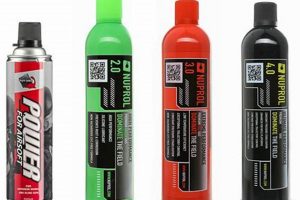
The compressed propellant used in certain airsoft guns enables the propulsion of projectiles. These propellants typically consist of either a blend of pressurized gases or solely carbon dioxide, supplied in canisters or cartridges. As an example, a green gas canister serves as the power source for a gas blowback pistol, expelling a plastic BB upon trigger activation.
Utilizing such propellants offers advantages like realistic operation in certain airsoft replicas, including recoil simulation and slide cycling. These characteristics enhance the immersive experience for users. Historically, the development of these propellants has allowed for increased realism and performance compared to spring-powered models, broadening the appeal of airsoft as a recreational activity.
Further discussion will detail the specific types of propellants available, their impact on airsoft gun performance, and the safety considerations surrounding their use. The following sections will also cover storage best practices and address common issues related to these compressed substances.
Essential Usage Guidance
The following recommendations are designed to optimize the performance and longevity of airsoft devices reliant on compressed gas propellants. Adherence to these guidelines ensures safe operation and consistent functionality.
Tip 1: Select the Appropriate Propellant: Propellant selection should correspond with the manufacturer’s recommendations for the specific airsoft gun model. Using higher pressure variants than specified can cause irreparable damage. Consider ambient temperature when choosing between green gas, red gas, or CO2.
Tip 2: Lubricate Regularly: Introduce silicone oil periodically during magazine refills or gas canister replacements. This practice maintains seal integrity and prevents premature wear of internal components, leading to smoother cycling and reducing gas leaks.
Tip 3: Store Canisters Properly: Store gas canisters in a cool, dry environment away from direct sunlight and extreme temperatures. Elevated temperatures increase internal pressure, posing a safety risk and potentially compromising canister integrity.
Tip 4: Monitor Fill Levels: Avoid overfilling magazines or gas reservoirs. Overfilling can lead to seal damage and inconsistent shot performance. Observe the fill valve during charging and cease filling when liquid propellant begins to vent.
Tip 5: Perform Routine Maintenance: Regularly inspect magazines and airsoft guns for signs of leaks, cracks, or other damage. Address any issues promptly to prevent further degradation and maintain operational reliability. Consider replacing o-rings annually or bi-annually, depending on frequency of use.
Tip 6: Use Quality Components: Employ high-quality magazines and gas canisters from reputable manufacturers. Inferior components may exhibit inconsistent gas output, increased leakage, or structural failures, leading to unreliable performance and potential safety hazards.
Tip 7: Purge Magazines Periodically: Occasionally purge magazines completely to remove accumulated residue and prevent valve clogging. This involves depressing the release valve until all remaining propellant is expelled. Follow by applying a small amount of silicone oil to the valve.
Implementing these strategies will contribute to the extended lifespan and reliable operation of airsoft equipment utilizing these propellants. Consistent maintenance and informed selection are key to optimizing performance and ensuring user safety.
The subsequent section will address troubleshooting common issues encountered with this type of airsoft equipment and provide potential solutions.
1. Pressure Regulation
Pressure regulation is a foundational principle governing the performance and safety of airsoft gas systems. Maintaining consistent and appropriate pressure is essential for achieving predictable projectile velocities, preventing damage to airsoft gun components, and ensuring user safety. The following points elaborate on specific facets of pressure regulation within this context.
- Consistent Velocity Output
Stable pressure allows for predictable projectile speeds. Inconsistent pressure leads to velocity fluctuations, affecting accuracy and range. Regulators mitigate these variations by maintaining a constant pressure output regardless of the gas source’s current pressure level. This is vital for competitive scenarios where shot consistency is paramount.
- Component Protection
Excessive pressure can damage internal components of airsoft guns, such as seals, valves, and nozzles. Pressure regulation prevents over-pressurization, safeguarding these parts from premature wear or catastrophic failure. Regulators can be set to a specific maximum pressure, ensuring components remain within their operational limits.
- Operational Safety
Uncontrolled pressure poses a safety risk. Over-pressurization can result in component rupture, potentially causing injury to the user or bystanders. Pressure regulation mechanisms act as a safety measure, preventing pressure from exceeding safe levels. Integrated relief valves provide an additional layer of protection by venting excess pressure in emergency situations.
- Gas Efficiency
Optimized pressure control can improve gas efficiency. By delivering gas at the minimum necessary pressure for effective projectile propulsion, waste is minimized. This can lead to more shots per gas fill, reducing operational costs and increasing convenience. Efficient pressure management is crucial for extended gameplay sessions.
These facets highlight the indispensable role of pressure regulation in airsoft gas systems. Proper pressure management not only enhances performance and extends the lifespan of equipment, but also contributes significantly to safe and reliable operation. In the absence of effective pressure regulation, the benefits of using these propellants are significantly diminished by the potential for damage and inconsistent performance.
2. Composition variance

The term “composition variance” in the context of airsoft gas refers to the varying chemical makeup of the propellants used to power airsoft guns. This variance is a critical factor influencing the performance, safety, and compatibility of these gas-powered systems. Different gases, or blends of gases, possess distinct pressure characteristics, material compatibility profiles, and environmental impacts. For example, green gas, a common propellant, primarily consists of propane mixed with silicone oil. In contrast, red gas often contains a higher proportion of propane or other additives, resulting in a higher pressure output. Carbon dioxide (CO2), another common option, exhibits significantly different pressure and expansion characteristics compared to propane-based gases. The correct selection of gas composition is therefore crucial for the proper functioning and longevity of the airsoft gun.
The selection of an inappropriate gas composition can have several detrimental effects. Using a higher pressure gas than recommended by the manufacturer can lead to over-stressing internal components, causing premature wear, leaks, or even catastrophic failures. Conversely, using a lower pressure gas may result in reduced projectile velocity, inconsistent cycling of blowback mechanisms, and a generally unsatisfactory user experience. Furthermore, the silicone oil content in some gases is intended to lubricate internal seals and components. Insufficient lubrication can lead to increased friction, accelerated wear, and gas leaks. Therefore, understanding the precise composition and properties of different airsoft gases is essential for ensuring optimal performance and preventing damage.
In summary, composition variance in airsoft gases represents a significant consideration for both performance and safety. Selecting the appropriate propellant for a given airsoft gun model and operating conditions is critical. Ignoring these compositional differences can lead to reduced performance, accelerated wear, or even component failure. Responsible use requires a thorough understanding of the various gases available and their respective properties, as well as strict adherence to the manufacturer’s recommendations. This understanding ultimately ensures the safe, reliable, and enjoyable operation of airsoft gas-powered systems.
3. Temperature sensitivity

The performance of compressed gas propellants used in airsoft guns exhibits significant temperature sensitivity. This sensitivity stems from the fundamental thermodynamic properties of gases, wherein temperature directly influences pressure. Specifically, as temperature increases, the pressure within a sealed gas container rises proportionally. This pressure variation directly affects the projectile velocity in an airsoft gun; warmer temperatures lead to higher pressures and thus, increased velocities, while colder temperatures result in lower pressures and reduced velocities. For example, a gas-powered airsoft pistol exhibiting a consistent 300 feet-per-second (FPS) velocity at 75F may experience a drop to 250 FPS or lower at 50F. This fluctuation presents a challenge for consistent targeting and gameplay.
The practical implications of temperature sensitivity extend beyond velocity variations. Changes in temperature also affect the consistency of gas expansion within the airsoft gun mechanism. In colder conditions, the gas may not fully expand, leading to reduced gas efficiency and potentially causing malfunctions such as incomplete cycling of blowback systems. Conversely, excessively high temperatures can cause over-pressurization, posing a safety risk and potentially damaging seals or other critical components within the gun. Field adjustments, such as changing to a lower-pressure gas in warmer conditions or carrying spare, pre-warmed magazines in colder conditions, are common strategies employed by experienced airsoft players to mitigate these effects. Selecting the appropriate gas type for the ambient temperature is a crucial factor in maintaining consistent performance and ensuring safe operation.
In summary, temperature sensitivity represents a significant variable influencing the performance and safety of gas-powered airsoft guns. Understanding the relationship between temperature and gas pressure, and implementing appropriate countermeasures, is essential for maximizing performance and mitigating potential risks. This understanding informs responsible usage, ensuring consistent operation across a range of environmental conditions. Ignoring temperature effects can lead to performance inconsistencies, equipment damage, and potentially hazardous situations.
4. Storage protocols
Adherence to specified storage protocols is paramount in maintaining the integrity and safety of compressed gas propellants used in airsoft weaponry. Improper storage can lead to degradation of the gas compound, increased risk of leaks, and potential hazards associated with pressure fluctuations and container failure.
- Temperature Control
Maintaining a stable temperature within recommended limits is critical. Exposure to extreme heat can cause pressure increases within the canister, potentially leading to rupture or leakage. Conversely, excessively cold temperatures may reduce the gas’s pressure and affect its performance. Storage in a climate-controlled environment, away from direct sunlight and heat sources, is essential.
- Ventilation Considerations
Adequate ventilation in the storage area is necessary to mitigate the risk of gas accumulation in the event of a leak. Should a canister develop a leak, proper ventilation allows for the dispersal of the gas, reducing the potential for asphyxiation or fire hazards. Storage areas should be well-ventilated and equipped with appropriate gas detection systems when storing large quantities.
- Physical Protection
Protecting canisters from physical damage is crucial for maintaining their structural integrity. Impacts, punctures, or other forms of physical stress can weaken the canister walls, increasing the likelihood of leaks or catastrophic failure. Canisters should be stored in a secure location, away from potential hazards such as falling objects or heavy machinery.
- Segregation and Compatibility
Proper segregation from incompatible materials is an essential aspect of safe storage. Contact with certain chemicals or substances can compromise the integrity of the canister or lead to hazardous reactions. Storage areas should be clearly marked and segregated to prevent accidental mixing or exposure to incompatible materials.
These storage protocols are not merely suggestions, but rather essential safety measures that contribute to the responsible handling and storage of gas-powered airsoft devices and their propellants. Neglecting these protocols can result in diminished performance, equipment damage, and potential safety risks. Strict adherence to these guidelines is imperative for all users and retailers of such products.
5. Performance impact

The performance of airsoft guns powered by compressed gas is intrinsically linked to the specific properties of the gas used. The gas’s characteristics directly influence factors such as projectile velocity, firing consistency, and operational efficiency, thereby determining the overall effectiveness of the airsoft gun in simulated combat scenarios.
- Velocity Consistency
The stability of the gas pressure output directly affects the consistency of projectile velocity. A gas with a stable pressure profile will yield more consistent velocities between shots, enhancing accuracy and predictability. Conversely, fluctuations in gas pressure due to temperature changes or inconsistent manufacturing processes can lead to velocity variations, negatively impacting shot-to-shot accuracy. For example, a lower-quality gas may exhibit significant velocity drops as the magazine empties, whereas a higher-quality gas will maintain a more consistent velocity throughout the magazine’s capacity.
- Cycling Rate and Recoil Simulation
In gas blowback (GBB) airsoft guns, the gas is responsible for cycling the slide or bolt, simulating the recoil of a real firearm. The pressure and expansion rate of the gas directly influence the speed and force of this cycling action. Higher-pressure gases will typically result in faster cycling rates and a more pronounced recoil effect, enhancing the realism of the experience. However, excessive pressure can also lead to increased wear and tear on internal components. Proper gas selection is crucial to balance performance and longevity.
- Gas Efficiency and Shot Count
The efficiency with which the gas propels the projectile determines the number of shots that can be fired from a single gas fill. Higher efficiency translates to more shots per fill, reducing the need for frequent refills during gameplay. Factors such as the gas’s expansion ratio, the gun’s internal sealing, and the ambient temperature all contribute to gas efficiency. An efficient system minimizes gas wastage, thereby increasing the cost-effectiveness and convenience of using gas-powered airsoft guns.
- Temperature Sensitivity Mitigation
As previously mentioned, the temperature sensitivity of compressed gasses significantly impacts performance. The degree to which a gas’s performance is affected by temperature variations determines its suitability for different climates and playing conditions. Certain gas blends are formulated to exhibit greater temperature stability, providing more consistent performance across a wider range of operating temperatures. Players operating in colder environments may opt for gases with additives that reduce the impact of low temperatures on gas pressure and performance.
These facets underscore the critical role of propellant selection in optimizing the performance of gas-powered airsoft guns. A comprehensive understanding of the gas’s properties, coupled with careful consideration of the operating environment and the specific characteristics of the airsoft gun, is essential for maximizing performance and ensuring a positive user experience. The proper choice will directly impact factors such as accuracy, realism, efficiency, and reliability.
6. Compatibility matrix

A compatibility matrix, in the context of compressed gas for airsoft applications, is a structured guide detailing the acceptable propellant types for specific airsoft gun models. This matrix functions as a crucial reference tool, outlining the permissible pressure ranges and chemical compositions for each firearm. Non-compliance with these specifications can result in mechanical failures, decreased performance, or even irreversible damage to the airsoft gun. For example, an airsoft pistol designed for green gas, which operates at a moderate pressure, could experience catastrophic damage if used with red gas, a higher-pressure alternative. The compatibility matrix, therefore, acts as a safeguard, preventing misuse and ensuring the longevity of the equipment.
Practical significance of a compatibility matrix extends beyond mere damage prevention. The correct propellant type directly influences the operational characteristics of the airsoft gun, including projectile velocity, gas efficiency, and blowback action. Utilizing an incompatible gas may lead to inconsistent shot velocities, reduced range, and a diminished sense of realism. Some higher-end airsoft replicas are highly sensitive to the precise gas composition, requiring specific lubricants or additives present in certain gas blends. A comprehensive compatibility matrix may also include information regarding optimal operating temperatures for each propellant, enabling users to make informed decisions based on prevailing environmental conditions. Retailers often provide compatibility charts to assist customers in selecting the correct gas for their specific model.
In summary, the compatibility matrix is a vital component in the responsible use of airsoft gas. It serves as a primary resource for ensuring safe and effective operation, preventing damage, and optimizing performance. Challenges associated with compatibility often arise from a lack of readily available information or misinterpretation of manufacturer’s specifications. Therefore, clear communication and easily accessible resources, such as comprehensive and regularly updated compatibility matrices, are essential for promoting responsible airsoft practices.
7. Leakage prevention

The prevention of gas leakage is a crucial aspect of maintaining the operational efficiency and safety of airsoft devices powered by compressed gas. The inherent design of these systems, involving pressurized reservoirs and intricate valve mechanisms, renders them susceptible to gas leaks if not properly maintained. Leakage not only reduces the number of shots obtainable from a single gas fill, thereby impacting gameplay, but also poses a safety hazard if the leaking gas accumulates in a confined space. The selection of appropriate seals and lubricants, coupled with regular maintenance, is therefore paramount. For example, a neglected O-ring on a magazine valve can degrade over time, resulting in a slow but persistent leak, ultimately depleting the gas supply even when the airsoft gun is not in use.
Several factors contribute to gas leakage in airsoft systems. These include the use of incompatible or low-quality seals, improper lubrication, over-pressurization, and exposure to extreme temperatures. Regular inspection and maintenance are essential for identifying and addressing potential leak sources. Applying silicone-based lubricants to seals and valves helps maintain their elasticity and prevent drying, thus minimizing the risk of leakage. Additionally, avoiding the use of excessive force when tightening gas canisters or magazines can prevent damage to seals and threads. Proper storage protocols, such as keeping airsoft guns and gas canisters away from direct sunlight and extreme temperatures, also contribute to the prevention of leakage.
In summary, leakage prevention is an integral component of responsible airsoft gas usage. Implementing a proactive maintenance routine, including regular inspection, lubrication, and adherence to proper storage protocols, significantly reduces the risk of gas leaks and ensures the consistent and safe operation of airsoft devices. Addressing potential leaks promptly not only enhances performance but also prolongs the lifespan of the equipment and minimizes potential hazards associated with pressurized gas systems. The proper understanding and implementation of leakage prevention strategies are therefore essential for all airsoft enthusiasts utilizing gas-powered weaponry.
Frequently Asked Questions Regarding Airsoft Gas Propellants
This section addresses common inquiries and misconceptions concerning compressed gas propellants used in airsoft weaponry. The following information aims to provide clarity and promote responsible handling practices.
Question 1: What types of propellants are commonly used, and what are their primary differences?
Airsoft guns typically utilize green gas, red gas, and CO2 as propellants. Green gas is primarily propane mixed with silicone oil, offering moderate pressure. Red gas generally consists of a higher propane concentration, resulting in increased pressure and performance. CO2, or carbon dioxide, exhibits significantly higher pressure than both green and red gas and requires specialized airsoft guns engineered to withstand its force.
Question 2: Is it permissible to use any type of gas in any airsoft gun?
No. The use of incorrect propellants can lead to severe damage or malfunction. The manufacturer’s specifications outline the compatible gas types for a given airsoft gun model. Utilizing a gas with a pressure rating exceeding the recommended limit can cause component failure and potential safety hazards.
Question 3: How does temperature affect the performance of airsoft guns utilizing compressed gas?
Temperature significantly influences gas pressure. Higher temperatures increase pressure, resulting in potentially higher projectile velocities and over-pressurization. Conversely, lower temperatures decrease pressure, leading to reduced velocity and potentially impacting blowback functionality. Selecting an appropriate gas blend based on ambient temperature is crucial for consistent performance.
Question 4: What are the recommended storage practices for compressed gas canisters?
Canisters should be stored in a cool, dry, and well-ventilated area, away from direct sunlight and sources of heat or ignition. Extreme temperatures can lead to dangerous pressure build-up or canister degradation. Furthermore, canisters should be stored in a location that prevents physical damage or accidental puncture.
Question 5: How can gas leaks be prevented in airsoft guns?
Regular maintenance, including lubrication of seals and O-rings with silicone oil, is essential for preventing leaks. Inspecting magazines and gas reservoirs for signs of damage or wear is also crucial. Overtightening gas canisters or magazines can also damage seals, increasing the risk of leakage.
Question 6: What are the potential safety hazards associated with compressed gas propellants?
Compressed gas propellants pose several potential safety hazards. Over-pressurization can lead to component rupture and potential injury. Leaking gas can create a fire hazard or displace oxygen, potentially leading to asphyxiation in confined spaces. Improper handling or storage can result in canister failure and projectile discharge. Always adhere to manufacturer’s safety guidelines and exercise caution when handling compressed gasses.
In summary, responsible handling and proper maintenance are paramount when using compressed propellants in airsoft systems. A thorough understanding of the gas properties, equipment compatibility, and safety protocols is essential for ensuring a safe and enjoyable experience.
The subsequent section will explore advanced techniques and modifications related to these systems, for informational purposes only and with a strong emphasis on responsible and safe practices.
Airsoft Gas
This exploration has comprehensively examined compressed propellants utilized in airsoft weaponry, focusing on composition variance, temperature sensitivity, storage protocols, performance impact, and safety considerations. These factors critically influence the functionality, reliability, and potential hazards associated with such systems. A thorough understanding of these elements is essential for responsible usage and the prevention of accidents.
The information presented serves as a foundation for informed decision-making and proactive maintenance. Adherence to established safety guidelines and a commitment to responsible handling are paramount. Continued vigilance and the dissemination of accurate information are vital for ensuring the safe and sustainable future of airsoft activities involving compressed gas propellants. Further research and development should prioritize enhanced safety features and environmentally conscious propellant alternatives.