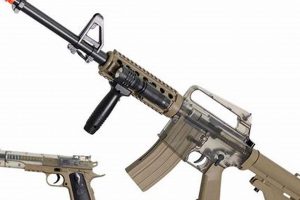
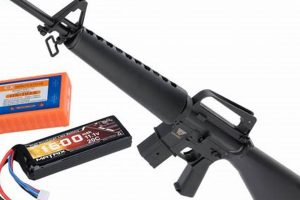
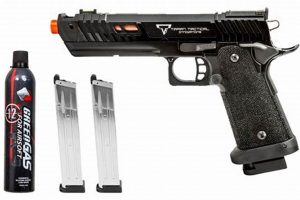
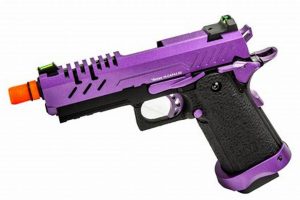
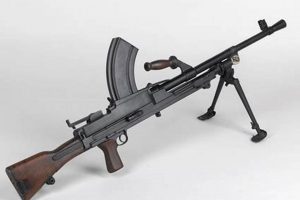
A covering, frequently constructed from adhesive-backed fabric or vinyl, designed to conform to the exterior of an airsoft weapon for the purpose of visual concealment. These coverings often feature camouflage patterns replicating natural environments, such as woodland, desert, or urban settings. Applying such a covering modifies the appearance of the airsoft replica without altering its mechanical function.
The application of these coverings enhances a player’s ability to blend into their surroundings, thereby increasing their tactical advantage during gameplay. This can be critical in scenarios where stealth and concealment are paramount. The use of visual disruption has historical precedent in military applications, where camouflage has long been employed to obscure personnel and equipment. In airsoft, this principle translates to minimizing visibility to opposing players.
The following sections will delve into specific types of patterns, application techniques, durability considerations, and legal aspects related to modifying the external appearance of airsoft guns through the use of visual concealment methods.
Airsoft Gun Camouflage Covering
The following are guidelines designed to optimize the application, performance, and longevity of camouflage coverings applied to airsoft guns.
Tip 1: Preparation is Paramount: Thoroughly clean and degrease the airsoft gun’s exterior surfaces prior to application. Residue, oils, or dirt will compromise the adhesive bond and result in premature peeling or bubbling. Isopropyl alcohol is an effective cleaning agent.
Tip 2: Pattern Alignment: When applying patterned coverings, ensure that the camouflage pattern aligns consistently across different segments of the gun. Inconsistent alignment detracts from the overall concealment effect and can appear visually disjointed.
Tip 3: Heat Application for Contours: Utilize a heat gun or hairdryer on a low setting to conform the covering to complex curves and corners. Heat softens the material, allowing it to stretch and mold more effectively. Exercise caution to avoid overheating and damaging the covering or the gun’s components.
Tip 4: Overlap Prevention: Avoid overlapping sections of the covering unless specifically designed for that purpose. Overlapping creates visible seams and increases the likelihood of peeling at the edges. Precision cutting is essential for a seamless appearance.
Tip 5: Edge Sealing: After application, carefully seal the edges of the covering with a blunt tool, such as a plastic card or the back of a spoon. This action secures the edges and prevents moisture or debris from infiltrating underneath the covering, which could lead to delamination.
Tip 6: Regular Inspection and Maintenance: Periodically inspect the covering for signs of wear, damage, or peeling. Promptly address any issues to prevent further degradation. Re-sealing edges or replacing damaged sections as needed will extend the covering’s lifespan.
Tip 7: Pattern Selection for Environment: Choose a camouflage pattern that closely matches the environment in which the airsoft gun will be used. Woodland patterns are effective in forested areas, while desert patterns are more suitable for arid environments. This selection increases the effectiveness of visual concealment.
Adherence to these guidelines will maximize the effectiveness and durability of camouflage coverings on airsoft guns, enhancing their performance in field scenarios.
Consideration of legal regulations pertaining to replica firearm appearance is also essential, which will be discussed further in the subsequent sections.
1. Concealment effectiveness

Concealment effectiveness, in the context of airsoft, refers to the degree to which a camouflage covering successfully obscures the outline and visual signature of an airsoft gun within a given environment. This is a crucial factor determining the practical utility of any camouflage solution applied to the equipment.
- Pattern Matching to Environment
The camouflage pattern must closely resemble the dominant colors, textures, and shapes of the operational environment. For example, a woodland pattern is effective in forested areas, while a desert pattern is more suitable for arid environments. Mismatched patterns compromise concealment, rendering the covering less effective. A digitally designed pattern may prove effective in transitional environments, as the fragmented shapes disrupt the outline more effectively than traditional analog patterns.
- Outline Disruption
Effective patterns break up the distinct shape of the airsoft gun, making it harder to identify against the background. This is achieved through irregular shapes, contrasting colors, and strategically placed shadows within the camouflage design. Patterns that merely blend colors without disrupting the outline are less successful.
- Color Palette Accuracy
The color palette of the camouflage covering must accurately reflect the colors present in the environment. Inaccurate or overly saturated colors can make the gun stand out, even if the pattern is otherwise effective. Subtle variations in color tone can significantly impact the overall concealment effect.
- Texture Simulation
Some advanced camouflage coverings incorporate subtle textures to mimic natural materials such as leaves, bark, or grass. These textures enhance the realism of the camouflage and further disrupt the gun’s outline, especially at close range. The added dimension improves blending with natural surroundings.
The ultimate measure of concealment effectiveness is the degree to which the airsoft gun blends seamlessly into its surroundings, minimizing its visibility to opposing players. Successful integration of pattern matching, outline disruption, color palette accuracy, and texture simulation contributes to optimal concealment, directly impacting a player’s tactical advantage.
2. Adhesive Durability

Adhesive durability is a critical determinant of the longevity and field performance of any covering applied to an airsoft gun. The adhesive layer is directly responsible for maintaining the covering’s bond to the gun’s surface, and its failure leads to peeling, bubbling, and ultimately, the detachment of the covering. This degradation compromises the camouflage effect and necessitates replacement or repair, incurring additional cost and time. The selection of an appropriate adhesive is therefore paramount in maximizing the value and utility of the covering.
The demands placed on adhesives in airsoft applications are considerable. Airsoft guns are exposed to a range of environmental factors, including temperature fluctuations, moisture, and physical abrasion. An adhesive susceptible to heat-induced softening will lose its grip in warm conditions, while one vulnerable to moisture will fail in humid environments. Constant handling and contact with vegetation or gear can abrade the edges of the covering, initiating peeling if the adhesive bond is weak. Military-grade adhesives, often employed in demanding outdoor applications, represent a benchmark for performance in this context. Examples of such adhesives include those based on acrylic or rubber compounds, formulated for high shear strength and environmental resistance.
Ultimately, understanding the relationship between adhesive properties and the environmental demands of airsoft usage is essential for selecting a covering that provides lasting performance. Manufacturers should provide clear specifications regarding adhesive composition and performance characteristics, enabling informed purchasing decisions. Compromising on adhesive quality results in premature failure and diminished return on investment, while prioritizing durability ensures a functional and aesthetically pleasing camouflage solution over the long term.
3. Material Composition

The material composition of an airsoft gun covering directly dictates its performance characteristics. The selection of base materials such as vinyl, fabric, or polymer films influences factors like flexibility, tensile strength, abrasion resistance, and environmental resilience. For example, a covering constructed from a high-grade vinyl offers superior resistance to tearing and water damage compared to one made from a thinner, less durable material. The specific composition of the adhesive layer is equally important, impacting adhesion strength, temperature sensitivity, and resistance to solvents. A covering employing an aggressive, solvent-based adhesive is likely to exhibit a stronger bond to the gun’s surface but may also pose a risk of damaging the underlying finish if not carefully applied.
The choice of materials also affects the print quality and longevity of the camouflage pattern. Materials designed for digital printing allow for high-resolution patterns with intricate details and vibrant colors. However, the inks used in the printing process must be resistant to fading and scratching to maintain the visual integrity of the camouflage over time. A covering employing UV-resistant inks will maintain its color vibrancy for a longer period compared to one using standard inks. Furthermore, the material’s texture can contribute to the overall concealment effect. A covering with a matte finish will reduce glare and reflection, minimizing the gun’s visibility, while a glossy finish may attract unwanted attention.
In summary, the material composition is an intrinsic element of an airsoft gun covering, influencing its durability, visual appeal, and overall effectiveness. Careful consideration of material properties ensures optimal performance in the field, contributing to a player’s concealment and tactical advantage. The trade-offs between different materials must be weighed based on specific operational needs and environmental conditions to achieve the desired balance of performance characteristics.
4. Pattern realism

Pattern realism, in the context of airsoft gun coverings, refers to the degree to which the camouflage pattern replicates actual environmental textures and colorations. It is a key factor influencing the effectiveness of visual concealment, with direct implications for tactical advantage.
- Color Accuracy and Environmental Correspondence
The accurate reproduction of colors found in the target environment is fundamental. Coverings employing colors that closely match local vegetation, soil, and rock formations provide superior blending. Examples include replicating the specific hues of deciduous forests or arid desert landscapes. Deviation from these natural color palettes reduces the covering’s effectiveness, making the airsoft gun more visible.
- Textural Mimicry and Detail Replication
Beyond color, the inclusion of realistic textures enhances concealment. This involves replicating patterns observed in nature, such as the bark of trees, the grain of wood, or the weave of foliage. High-resolution printing techniques are often employed to achieve this level of detail. Coverings lacking textural detail appear artificial and less convincing, particularly at close range.
- Scale and Proportion Fidelity
The scale of the camouflage pattern must be appropriate for the size of the airsoft gun. Patterns designed for use on large military vehicles, when scaled down for smaller items, might appear incongruous and ineffective. Careful consideration of the pattern’s scale ensures that the elements align with the dimensions of the object being camouflaged.
- Adaptation to Lighting Conditions
Real-world environments exhibit dynamic lighting. Some advanced camouflage patterns incorporate elements that react differently under varying light conditions, enhancing their adaptive camouflage capabilities. The selection of pattern can contribute to the overall concealment in any environmental condition.
Pattern realism fundamentally influences the ability of an airsoft camo gun wrap to effectively conceal the weapon within its operational environment. High levels of realism, achieved through accurate color matching, textural mimicry, scale fidelity, and lighting adaptation, contribute to a more convincing and effective camouflage solution.
5. Application method

The application method profoundly impacts the effectiveness and longevity of any covering designed for concealment on an airsoft gun. Improper application leads to compromised camouflage, reduced durability, and ultimately, a diminished tactical advantage. The inherent properties of adhesive-backed coverings necessitate meticulous adherence to specific procedures. For example, trapped air bubbles between the covering and the gun’s surface create visible imperfections that disrupt the camouflage pattern and weaken the adhesive bond. Similarly, inadequate surface preparation, such as failing to remove oil or debris, prevents proper adhesion, leading to peeling and premature failure. In both cases, the intended purpose of the coveringto provide effective concealmentis undermined by a deficient application method.
The application process typically involves several critical steps. Surface cleaning is paramount, utilizing solvents such as isopropyl alcohol to remove contaminants that impede adhesion. Careful measurement and cutting of the covering material ensure a precise fit, minimizing gaps or overlaps that could compromise concealment. Controlled application, often aided by heat guns to conform the covering to complex curves and corners, is essential for preventing air entrapment and ensuring uniform adhesion. Post-application edge sealing further secures the covering, preventing moisture and debris from undermining the adhesive bond. Skilled application requires patience, precision, and attention to detail. A trained professional can often achieve a seamless, durable finish that maximizes the covering’s concealment potential. In contrast, a rushed or careless application results in a substandard outcome, negating the benefits of a high-quality covering.
In summary, the application method is not merely a supplementary step but an integral component of an effective concealment solution. Deficiencies in application directly negate the benefits of even the most advanced materials and patterns. Prioritizing proper technique and adherence to best practices is essential for realizing the full potential of camouflage coverings on airsoft guns, maximizing their tactical utility and extending their lifespan. This emphasis ensures a worthwhile investment and an enhanced competitive edge.
6. Legal compliance
Legal compliance represents a critical consideration when employing any exterior modification to an airsoft gun, including the application of camouflage coverings. Regulations governing replica firearms vary considerably across jurisdictions. A primary concern centers on preventing the visual alteration of an airsoft gun in a manner that makes it indistinguishable from a real firearm. Such modifications can result in legal penalties, including confiscation of the airsoft gun and potential criminal charges. The effect of applying a realistic camouflage pattern, especially when combined with other cosmetic enhancements, can inadvertently create a more authentic appearance. Therefore, careful consideration of local laws is paramount before proceeding with any modifications.
Several real-world examples illustrate the potential consequences of non-compliance. In some regions, laws mandate the presence of a blaze orange tip on the barrel of any replica firearm to facilitate immediate visual differentiation. Covering this mandated marking with camouflage material directly violates the law. Other jurisdictions may restrict specific camouflage patterns associated with military or law enforcement use, viewing their application to a replica firearm as an attempt to impersonate authorized personnel. Ignoring these regulations can lead to misidentification by law enforcement and escalate potentially dangerous situations. Furthermore, the sale or transfer of modified airsoft guns that violate local laws may also result in legal repercussions for the seller or transferor.
The practical significance of understanding and adhering to legal requirements cannot be overstated. Before applying any camouflage covering, individuals should research and understand the specific laws applicable in their location. Maintaining documentation of the airsoft gun’s original condition and any modifications made is advisable. Consulting with local law enforcement or legal professionals can provide clarification on ambiguous regulations. Ultimately, responsible modification of airsoft guns necessitates a proactive approach to legal compliance, ensuring that aesthetic enhancements do not compromise safety or result in legal penalties. The challenges of navigating complex and often inconsistent regulations underscore the importance of diligent research and informed decision-making.
Frequently Asked Questions About Airsoft Gun Camouflage Coverings
The following section addresses common inquiries and misconceptions regarding the application, maintenance, and legality of camouflage coverings applied to airsoft guns.
Question 1: Do camouflage coverings affect the performance of an airsoft gun?
No, the application of camouflage coverings does not generally affect the internal mechanisms or firing capabilities of an airsoft gun. Coverings are designed to adhere to the exterior surfaces without interfering with internal components. However, care should be taken to avoid obstructing vents or moving parts during application. A poorly applied covering could, in rare circumstances, impede the proper function of external controls such as the fire selector switch.
Question 2: What is the typical lifespan of a camouflage covering on an airsoft gun?
The lifespan of a camouflage covering varies depending on several factors, including the quality of the material, the type of adhesive, the application technique, and the frequency of use. High-quality coverings, properly applied and maintained, can last for several seasons of regular airsoft play. Exposure to harsh environmental conditions, such as extreme temperatures or prolonged moisture, can accelerate wear and tear. Regular inspection and maintenance, including re-sealing edges and cleaning the surface, can extend the lifespan of the covering.
Question 3: Are all camouflage patterns equally effective?
No, the effectiveness of a camouflage pattern is highly dependent on the specific environment in which it is used. Patterns designed for woodland environments, for example, will be less effective in desert or urban settings. Selecting a pattern that closely matches the dominant colors and textures of the operational environment is crucial for maximizing concealment. Some advanced patterns incorporate elements designed to adapt to varying lighting conditions, enhancing their versatility.
Question 4: Can a camouflage covering be removed without damaging the airsoft gun?
Yes, camouflage coverings can typically be removed without causing significant damage to the airsoft gun, provided that the removal process is performed carefully. The use of heat, such as from a hairdryer or heat gun on a low setting, can soften the adhesive, making it easier to peel the covering away from the surface. Solvents, such as isopropyl alcohol or adhesive remover, can be used to dissolve any remaining adhesive residue. Avoid using abrasive tools or harsh chemicals, as these can scratch or damage the gun’s finish.
Question 5: Does applying a camouflage covering void the warranty on an airsoft gun?
The impact of applying a camouflage covering on the warranty of an airsoft gun depends on the specific terms and conditions of the warranty. Some manufacturers may void the warranty if modifications are made to the gun’s exterior, while others may not consider a camouflage covering to be a significant modification. It is advisable to consult the warranty documentation or contact the manufacturer directly to clarify the policy on modifications.
Question 6: Are there legal restrictions on the types of camouflage patterns that can be used on airsoft guns?
Yes, some jurisdictions impose restrictions on the types of camouflage patterns that can be used on airsoft guns, particularly those that closely resemble patterns used by military or law enforcement agencies. These restrictions are intended to prevent the unauthorized impersonation of official personnel. It is essential to research and comply with all applicable laws and regulations regarding camouflage patterns in the specific location where the airsoft gun is used.
In summary, camouflage coverings can be a valuable addition to an airsoft gun, enhancing concealment and tactical advantage. However, careful consideration of material quality, application technique, environmental factors, and legal regulations is essential for maximizing their effectiveness and ensuring responsible use.
The following sections will explore specific product recommendations and purchasing considerations for camouflage coverings suitable for airsoft guns.
Conclusion
The preceding exploration of “airsoft camo gun wrap” has encompassed definition, application techniques, material considerations, concealment effectiveness, and legal compliance. The implementation of such coverings represents a strategic decision, necessitating a comprehensive understanding of both practical benefits and potential ramifications. Choosing appropriate patterns, ensuring proper application, and adhering to legal mandates are critical for responsible and effective utilization.
The effective deployment of visual concealment methods contributes to enhanced tactical advantage in airsoft simulations. Continued vigilance regarding evolving legal landscapes and advancements in material science will further refine the capabilities and responsible application of “airsoft camo gun wrap” technologies in the future.