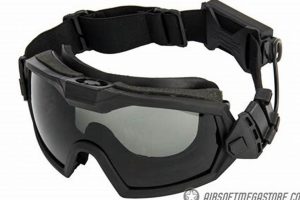
An airsoft goggles fan is a powered device, typically small and battery-operated, designed to be integrated within or attached to airsoft goggles. Its primary function is to circulate air within the goggle enclosure. This forced airflow mitigates fog buildup on the lens, ensuring clear vision during gameplay. For example, a player experiencing high humidity might employ this device to prevent their goggles from fogging, thus maintaining situational awareness.
The benefit of using such a device is enhanced visibility, which directly contributes to player safety and performance. Fogged lenses can obscure targets, creating potentially hazardous situations. Furthermore, maintaining a clear field of view improves reaction time and tactical decision-making. This technology emerged as a response to player demand for reliable solutions to combat lens fogging, a persistent challenge in airsoft, particularly in environments with high humidity or during periods of intense physical exertion.
The following discussion will delve into various aspects of such vision enhancement systems, including different models, power sources, mounting options, and comparative effectiveness, as well as considerations for selecting the appropriate device for individual needs and gameplay conditions. This will provide a comprehensive understanding of how to effectively utilize these tools in airsoft engagements.
Optimizing Airsoft Goggle Ventilation Systems
The effective implementation of airsoft goggle ventilation systems can significantly enhance gameplay. The following are crucial considerations for maximizing their utility:
Tip 1: Battery Selection is Critical. Opt for high-quality batteries appropriate for the device’s voltage requirements. Employing batteries with insufficient power can lead to diminished fan performance, while using overly powerful batteries can damage the system. Refer to the manufacturer’s specifications.
Tip 2: Regular Maintenance is Essential. Clean the fan unit periodically to remove accumulated dust and debris. A buildup of foreign particles can impede airflow and reduce the system’s efficiency. Use a small brush or compressed air for cleaning purposes.
Tip 3: Proper Goggle Fit Matters. Ensure the goggles fit securely and comfortably against the face to create an adequate seal. An improperly fitted goggle allows for increased moisture buildup, potentially overwhelming the ventilation system’s capacity.
Tip 4: Environmental Awareness is Important. In extremely humid conditions, consider pairing the ventilation system with anti-fog solutions applied directly to the lens. This dual approach provides an enhanced defense against fogging.
Tip 5: Evaluate Noise Level Considerations. Be mindful of the device’s noise output. Excessively loud fans can compromise stealth, particularly in close-quarters engagements. Prioritize models known for their quiet operation when concealment is paramount.
Tip 6: Secure and Stable Mounting is Key. Ensure the fan unit is securely and stably mounted to the goggles. A loose connection can lead to vibrations and potential dislodging during intense activity. Regularly inspect the mounting hardware.
Maximizing the benefits of a goggle ventilation system involves careful battery management, routine cleaning, correct goggle fitting, environmental awareness, consideration of noise output, and a secure mounting setup. These factors are critical for optimal performance.
The subsequent section will address troubleshooting common issues encountered when using such systems, providing solutions for maintaining clear vision in various airsoft scenarios.
1. Air Circulation

Air circulation is the central functional element facilitated by an airsoft goggle fan. The device’s primary purpose is to generate a constant flow of air within the sealed space of the goggles. This forced ventilation directly addresses the issue of fogging, which occurs when warm, moist air from the user’s respiration condenses on the cooler surface of the goggle lens. Without adequate air circulation, condensation will inevitably form, obscuring the wearer’s vision.
The effectiveness of an airsoft goggle fan is directly proportional to its ability to circulate air efficiently. For example, a fan with a low cubic feet per minute (CFM) rating may prove insufficient in environments with high humidity or during periods of intense physical exertion, resulting in continued fogging despite the device’s presence. Conversely, a fan that generates a strong and consistent airflow can effectively prevent fog buildup, maintaining clear vision for the user. Moreover, strategically designed air vents within the goggle frame, working in conjunction with the fan, optimize air distribution and maximize its impact on fog reduction. Some high-end goggle systems even incorporate variable fan speed settings, allowing the user to adjust the airflow based on environmental conditions and activity level, providing a tailored solution to fog mitigation.
Therefore, understanding the relationship between air circulation and the performance of an airsoft goggle fan is crucial for selecting an appropriate system. Insufficient airflow will render the device ineffective, while excessive airflow may lead to discomfort or increased battery consumption. The optimal balance depends on factors such as ambient temperature, humidity, and the intensity of physical activity. Consequently, a discerning evaluation of the fan’s specifications and a consideration of the intended operating environment are essential for ensuring clear vision and optimal performance in airsoft scenarios.
2. Fog Mitigation

Fog mitigation represents a critical functional requirement addressed by the integration of a fan within airsoft goggles. Condensation, arising from the temperature differential between the wearer’s perspiration and the external environment, obstructs vision, thereby compromising safety and competitive performance. The principle operational effect of an airsoft goggle fan lies in its capacity to disrupt this process. By generating a constant airflow, the device facilitates the evaporation of moisture before it accumulates on the lens surface, thus preserving optical clarity. The importance of effective fog mitigation within the context of airsoft gameplay is self-evident; a clear field of view is essential for target identification, tactical awareness, and accurate engagement. Without such measures, a player’s ability to participate effectively is severely impaired, potentially leading to misidentification of targets or increased susceptibility to injury.
Consider, for example, scenarios involving rapid transitions between indoor and outdoor environments, or prolonged periods of physical exertion in humid climates. In such situations, the rate of condensation accelerates, rendering standard anti-fog coatings quickly ineffective. An airsoft goggle fan operating in these conditions offers a distinct advantage, providing continuous protection against vision obstruction. Furthermore, the performance of the fan must be evaluated in conjunction with the design of the goggle itself. A well-designed goggle incorporates strategic ventilation ports that, when combined with the forced airflow from the fan, optimize the distribution of air across the lens surface, maximizing the effectiveness of fog mitigation efforts.
In summary, fog mitigation represents a foundational element of airsoft goggle fan technology. The ability to maintain a clear field of view is paramount for safe and effective gameplay. While anti-fog coatings offer a degree of protection, the active ventilation provided by a fan offers a more robust and reliable solution, particularly in challenging environmental conditions. Therefore, the selection of an airsoft goggle incorporating a functional and efficient fan mechanism is a critical decision for any serious airsoft participant.
3. Battery Life

Battery life is a critical performance parameter for airsoft goggles equipped with integrated fans. The duration of operational capability directly impacts the user’s ability to maintain clear vision and participate effectively in sustained airsoft engagements. Insufficient battery life renders the fan useless, negating its intended benefits and potentially compromising player safety.
- Battery Capacity and Fan Power Consumption
The relationship between battery capacity, measured in milliampere-hours (mAh), and fan power consumption, measured in milliamperes (mA), dictates the operational lifespan. A higher mAh rating indicates a larger energy reservoir, while a higher mA consumption rate reflects a greater energy demand. A fan with a high mA draw will deplete a battery more rapidly than a fan with lower power consumption. This relationship directly determines how long the fan can function continuously. For example, a 1000 mAh battery powering a fan consuming 50 mA will theoretically last for approximately 20 hours (1000 mAh / 50 mA = 20 hours) under ideal conditions. However, real-world performance may vary due to factors such as battery age, temperature, and manufacturing tolerances.
- Battery Type and Performance Degradation
The type of battery employed influences both its energy density and its performance characteristics over time. Lithium-ion (Li-ion) and nickel-metal hydride (NiMH) batteries are commonly used. Li-ion batteries offer higher energy densities and lower self-discharge rates compared to NiMH batteries, but they are also more susceptible to damage from overcharging or deep discharging. NiMH batteries are generally more robust but have lower energy densities and higher self-discharge rates. Over time, all rechargeable batteries experience a decline in capacity due to repeated charge-discharge cycles. This degradation reduces the effective operational time of the airsoft goggle fan, necessitating more frequent battery replacements or recharges.
- Fan Speed Settings and Energy Efficiency
Many airsoft goggle fans offer multiple speed settings to allow users to adjust airflow based on environmental conditions and activity levels. Operating the fan at a lower speed reduces power consumption, thereby extending battery life. However, reducing the fan speed may also decrease its effectiveness in mitigating fog buildup, particularly in humid conditions or during periods of intense exertion. Finding an optimal balance between fan speed and battery life is essential for maintaining clear vision without prematurely depleting the battery’s charge. For instance, using a lower fan setting during periods of low activity and increasing the speed only when needed can significantly extend battery life.
- External Power Sources and Charging Considerations
Some advanced airsoft goggle fan systems support external power sources, such as portable power banks, to extend operational time beyond the limitations of internal batteries. Connecting the fan to an external power source allows for continuous operation without the need for frequent battery replacements. Additionally, proper charging practices are crucial for maximizing battery lifespan. Overcharging or using incompatible chargers can damage the battery and accelerate its degradation. Following the manufacturer’s recommendations regarding charging voltage, current, and duration is essential for maintaining the battery’s health and ensuring reliable performance of the airsoft goggle fan.
The aforementioned factors collectively determine the usability and effectiveness of airsoft goggles incorporating fans. Understanding the interplay between battery capacity, power consumption, battery type, fan speed settings, and charging practices is crucial for selecting a system that provides adequate operational time to meet the demands of prolonged airsoft engagements. Careful consideration of these parameters ensures that the device remains a valuable asset rather than a liability due to insufficient power.
4. Noise Level

Noise level, in the context of airsoft goggle fans, represents a significant factor affecting a player’s tactical awareness and potential for detection during gameplay. The operational sound emitted by these devices, while often necessary for fog mitigation, can inadvertently compromise stealth and situational awareness.
- Fan Motor Acoustics
The primary source of noise emanates from the fan motor itself. Motor design, manufacturing tolerances, and operating speed collectively determine the acoustic profile. Inferior motor designs or worn components may produce higher decibel levels or irregular sounds, potentially alerting opposing players to one’s presence. Premium fan systems often employ dampened motors or optimized blade designs to minimize audible output. For instance, brushless motors generally operate more quietly than brushed motors due to reduced mechanical friction.
- Airflow Turbulence
Air movement within the goggle enclosure generates turbulence, contributing to the overall noise signature. The shape and size of the fan blades, as well as the design of the goggle’s ventilation ports, influence the intensity of airflow turbulence. Poorly designed systems may produce whistling or rushing sounds, further increasing audibility. Optimized designs feature aerodynamically shaped blades and carefully positioned ventilation ports to minimize disruptive airflow and reduce noise production.
- Environmental Amplification
The surrounding environment can amplify the perceived noise level. Confined spaces, such as indoor arenas or dense vegetation, tend to reflect and intensify sound waves, making the fan’s operation more noticeable. Conversely, open spaces with minimal reflective surfaces may dissipate sound more effectively. This environmental factor underscores the importance of selecting a goggle fan with a low noise signature, particularly when operating in acoustically sensitive environments.
- Operational Frequency
The specific operational frequency of the fan motor can also affect its perception. Higher frequency sounds tend to be more easily detected by human hearing. While overall decibel levels are important, the specific frequency range of the noise emitted can impact the device’s impact on stealth. Motors engineered to operate at lower, less noticeable frequencies can effectively reduce this unwanted auditory signature.
Consequently, the noise level of an airsoft goggle fan is not merely a matter of comfort but a tactical consideration. The ability to maintain stealth and preserve situational awareness depends, in part, on minimizing the device’s audible signature. The integration of quiet fan motor designs, optimized airflow management, and an awareness of environmental factors is crucial for players seeking a competitive advantage. Furthermore, the selection process should consider the intended operating environment, as the amplifying effects of certain locales can exacerbate the impact of even minimally noisy systems.
5. Mounting Stability

Mounting stability is a paramount consideration when integrating a fan into airsoft goggles. The secure and reliable attachment of the fan unit directly influences the device’s functionality, durability, and the user’s overall comfort and safety during gameplay. A poorly secured fan is prone to dislodging, vibration, and potential damage, negating its intended benefits and potentially causing distractions or even injuries.
- Security of Attachment Points
The design and integrity of the attachment points on both the fan unit and the goggles are critical for maintaining stability. Attachment mechanisms may include clips, screws, adhesive pads, or integrated mounting rails. The strength and durability of these components determine their ability to withstand the stresses of rapid movement, impacts, and environmental conditions. Weak or poorly designed attachment points are susceptible to breakage, leading to the detachment of the fan unit. For instance, a clip made from brittle plastic may crack under stress, while an adhesive pad may lose its grip over time, especially in humid conditions.
- Vibration Dampening Mechanisms
Fan operation inevitably generates vibrations that can loosen connections, create noise, and cause discomfort. Effective mounting systems incorporate vibration dampening mechanisms to mitigate these effects. These may include rubber gaskets, cushioning materials, or specialized dampening mounts. Vibration dampening reduces the transmission of vibrations to the goggles and the user’s head, enhancing comfort and preventing the loosening of attachment hardware. Without such measures, vibrations can accelerate wear and tear on the mounting components, leading to premature failure.
- Adjustability and Compatibility
Mounting systems should offer a degree of adjustability to accommodate different goggle models and user preferences. Universal mounting systems are designed to fit a wide range of goggles, while others are specifically designed for certain models. Adjustability allows users to fine-tune the position of the fan unit for optimal airflow and comfort. Incompatibility between the fan unit and the goggles can result in unstable or insecure mounting, compromising the device’s functionality and potentially damaging the goggles. Proper compatibility ensures a secure and stable fit, minimizing the risk of detachment during gameplay.
- Impact Resistance
Airsoft gameplay involves inherent risks of impacts from BBs or other objects. The mounting system should be designed to withstand these impacts without detaching or breaking. Robust mounting hardware and impact-resistant materials are essential for protecting the fan unit from damage. A poorly designed mounting system may shatter or dislodge upon impact, rendering the fan useless and potentially exposing the user to injury. Impact-resistant mounting systems provide added protection and ensure the fan remains securely attached during intense gameplay.
The mounting stability of an airsoft goggle fan is not merely a cosmetic detail but a crucial factor influencing its functionality, durability, and the user’s safety. A secure and stable mounting system ensures the fan remains operational under demanding conditions, providing consistent fog mitigation and enhancing the player’s overall experience. Therefore, careful consideration of the attachment mechanism, vibration dampening, adjustability, compatibility, and impact resistance is essential when selecting an airsoft goggle fan system.
6. Size and Weight
The size and weight characteristics of an airsoft goggle fan are critical factors influencing user comfort, mobility, and overall operational effectiveness. These parameters directly affect the balance and fit of the goggles, potentially impacting the player’s ability to perform in dynamic scenarios.
- Physical Dimensions and Goggle Compatibility
The physical dimensions of the fan unit dictate its compatibility with various goggle designs. An overly large fan may not fit securely within the goggle frame or may obstruct the user’s peripheral vision. Conversely, a fan that is too small may not provide adequate airflow for effective fog mitigation. Dimensions must be carefully considered to ensure seamless integration with the goggle system. For example, bulky fans can interfere with cheek weld when aiming rifles, impeding accuracy.
- Weight Distribution and Neck Strain
The weight of the fan, particularly its distribution, significantly affects neck strain and overall comfort during prolonged use. A heavy fan concentrated in one area of the goggles can create an imbalance, leading to fatigue and discomfort. Balanced weight distribution, achieved through strategic placement of the fan and battery, minimizes strain and enhances comfort. Lightweight materials, such as polymers, are often employed to reduce the overall weight of the fan unit.
- Profile and Obstruction
The profile, or outward extension, of the fan unit can create obstructions and increase the risk of snagging on vegetation or other objects during gameplay. A low-profile design minimizes these risks, allowing for greater freedom of movement and reduced interference with gear. Bulky fan units can impede movement in close quarters, hindering maneuverability and tactical effectiveness. A streamlined profile ensures unrestricted movement and minimizes the potential for interference.
- Aerodynamic Drag and Mobility
The size and shape of the fan unit can influence aerodynamic drag, particularly during rapid movements. A large, non-aerodynamic fan can create noticeable drag, potentially slowing the player down and increasing energy expenditure. A streamlined, aerodynamic design minimizes drag, allowing for greater speed and agility. This factor is particularly relevant for players who prioritize speed and maneuverability in their gameplay style.
The size and weight characteristics of an airsoft goggle fan represent a critical balance between functionality and practicality. Careful consideration of these parameters ensures optimal comfort, mobility, and overall effectiveness in airsoft engagements. The selection of a fan system should prioritize both its ability to mitigate fog and its impact on the user’s comfort and maneuverability, ultimately contributing to enhanced performance and safety on the field.
Frequently Asked Questions
The following addresses common inquiries regarding airsoft goggles employing integrated ventilation systems.
Question 1: What is the intended lifespan of an airsoft goggle fan?
The lifespan of the device is contingent upon several factors, including the quality of construction, frequency of usage, and adherence to maintenance protocols. High-quality units, properly maintained, may function effectively for multiple airsoft seasons. Conversely, inferior units or those subjected to neglect may exhibit premature failure.
Question 2: How does the devices power source impact its overall effectiveness?
The power source, typically a battery, directly influences operational runtime and fan speed. Batteries with higher milliampere-hour (mAh) ratings provide extended usage. Moreover, the type of battery lithium-ion versus nickel-metal hydride affects discharge characteristics and overall longevity.
Question 3: Can such a device be retrofitted onto existing airsoft goggles?
Retrofitting is possible, although it is not universally applicable. Compatibility depends on the goggle’s design and the availability of appropriate mounting hardware. Retrofitting may necessitate modifications to the goggles, potentially voiding any existing warranties. Factory-integrated systems are generally preferable for optimal performance and safety.
Question 4: What maintenance procedures are recommended for preserving the functionality of the fan?
Routine maintenance includes periodic cleaning of the fan blades and ventilation ports to remove dust and debris. Additionally, battery terminals should be inspected and cleaned to ensure proper electrical contact. Regular lubrication of the fan motor, if applicable, may also extend its lifespan.
Question 5: How does the device affect the overall profile and weight of the goggles?
The integration of a fan typically increases the goggle’s overall profile and weight. However, advancements in miniaturization have mitigated this effect. Modern designs strive for a balance between functionality and minimal intrusion. Heavier units may contribute to discomfort during extended use.
Question 6: Is there a correlation between fan speed and fog mitigation effectiveness?
A direct correlation exists. Higher fan speeds generally provide enhanced airflow, resulting in improved fog mitigation. However, excessively high speeds may increase noise and reduce battery life. Selecting an appropriate speed setting based on environmental conditions and activity level is crucial.
Airsoft goggle fans offer a significant advantage in maintaining clear vision, but require responsible use and maintenance for sustained performance.
The following will address safety precautions.
Airsoft Goggles Fan
The preceding discussion has explored numerous facets of the airsoft goggles fan, encompassing its operational mechanisms, performance considerations, and implications for player safety and effectiveness. The crucial function of fog mitigation, reliant on consistent air circulation, is intrinsically linked to battery life, noise level, mounting stability, and the device’s overall size and weight. Optimization necessitates a comprehensive understanding of these interdependencies and their impact on the user experience.
The discerning user will recognize that selecting an appropriate airsoft goggles fan demands a careful evaluation of individual needs and playing conditions. Investment in a well-engineered system, coupled with diligent maintenance, promotes enhanced visibility, improved tactical awareness, and ultimately, a safer and more rewarding airsoft experience. Continued development in materials and design promises further refinement of these devices, solidifying their role as indispensable components of protective gear.