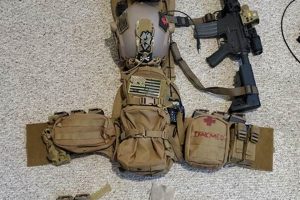
A configuration consists of protective headgear customized with various accessories for the airsoft sport. This setup often includes attachments like tactical lights for low-visibility environments, communication devices for team coordination, and protective elements such as face shields or goggles to ensure player safety. For example, a typical configuration might feature a ballistic-style helmet equipped with side rails for mounting accessories, a night vision mount, and integrated eye protection.
This configuration offers multiple benefits, primarily enhancing player safety and tactical effectiveness on the field. Head protection mitigates potential injuries from impacts, while accessories improve communication, visibility, and situational awareness. Historically, players began customizing helmets to suit specific roles and field conditions, leading to the development of a wide array of available accessories and mounting options.
The subsequent sections will delve into the specific components commonly incorporated into these configurations, considerations for selecting appropriate accessories, and best practices for assembling a functional and comfortable protective system for airsoft gameplay. This analysis will also cover safety standards and legal aspects applicable to the use of these configurations.
Airsoft Helmet Loadout
Optimizing headgear configuration enhances both safety and tactical capabilities during airsoft engagements. Thoughtful component selection and careful assembly are crucial for a functional and effective setup.
Tip 1: Prioritize Safety Certification. Ensure the base helmet meets or exceeds relevant impact resistance standards, such as those set by ANSI or EN. Verification of certification is paramount prior to field use.
Tip 2: Account for Intended Use. Consider the environment and gameplay style. CQB scenarios may necessitate increased facial protection, while outdoor play benefits from enhanced communication and illumination options.
Tip 3: Optimize Weight Distribution. Minimize strain by evenly distributing the weight of attached accessories. Counterweights positioned at the rear of the helmet can improve balance when using front-mounted devices like night vision goggles.
Tip 4: Secure Accessory Mounting. Employ appropriate mounting hardware (rails, shrouds, adapters) to ensure accessories are securely attached. Regular inspection of mounting points is essential to prevent equipment loss or malfunction.
Tip 5: Prioritize Communication. Integrate a reliable communication system, such as a headset with a push-to-talk (PTT) device, for seamless team coordination. Ensure compatibility with existing team communication infrastructure.
Tip 6: Choose Appropriate Eye Protection. Select ballistic-rated goggles or a full-face shield that integrates seamlessly with the helmet. Verify that eye protection meets relevant safety standards and offers adequate field of view.
Tip 7: Consider Camouflage. Adapt the helmet’s color and pattern to the surrounding environment. Utilize helmet covers or paint to match the terrain, enhancing concealment and tactical advantage.
Careful consideration of these tips will lead to a safer, more comfortable, and more effective headgear setup, increasing overall performance and enjoyment during airsoft activities.
The subsequent sections will explore specific accessory options and detailed assembly instructions to guide the construction of a personalized and optimized headgear configuration.
1. Protection

The primary function of headgear within the airsoft sport context revolves around protection. Configuration strategies focus on mitigating potential injuries caused by impacts from projectiles, falls, or collisions. A comprehensively configured protective system prioritizes safety without compromising comfort or tactical functionality.
- Impact Resistance Standards
Headgear must meet or exceed recognized impact resistance standards, such as ANSI Z87.1 or EN 1385. Compliance with these standards ensures the helmet’s structural integrity and ability to absorb energy from impacts. The absence of certification renders the headgear unsuitable for airsoft activities due to increased risk of injury.
- Face Shields and Goggles
Eye protection is a critical component of a protective configuration. Ballistic-rated goggles or full-face shields safeguard the eyes from projectile impacts. Integration with the helmet is crucial for a secure and comfortable fit, preventing gaps that could expose the eyes. Selection criteria should include impact resistance, anti-fog properties, and peripheral vision considerations.
- Padding and Suspension Systems
Internal padding and suspension systems contribute to both comfort and impact absorption. Adequate padding cushions the head during impacts, while the suspension system ensures a secure and stable fit. These systems should be adjustable to accommodate various head sizes and shapes, maximizing protection and minimizing discomfort.
- Retention Systems
A secure retention system, such as a chin strap, is essential for maintaining the helmet’s position during dynamic movements. The retention system should be adjustable and capable of withstanding significant force without failure, ensuring the helmet remains in place during impacts or strenuous activities.
The integration of these protective elements into a cohesive configuration contributes to a safer airsoft experience. Prioritization of certified components and proper fitting procedures are crucial for maximizing the effectiveness of protective headgear in mitigating potential injuries. Furthermore, regular inspection and maintenance of all protective components are necessary to ensure continued functionality and safety.
2. Communication

Effective team communication is a critical component of successful airsoft operations. Integration of communication systems into headgear configurations enhances situational awareness and facilitates coordinated tactics.
- Headsets and Microphones
Tactical headsets, when integrated into the configuration, permit hands-free communication among team members. These headsets often feature noise-canceling microphones that ensure clear voice transmission even in noisy environments. Examples include boom microphones attached to the helmet’s side and in-ear monitoring systems for receiving instructions.
- Push-to-Talk (PTT) Devices
PTT devices enable users to quickly and easily transmit voice communications. These devices connect to the headset and the radio, allowing the user to activate the microphone with a single button press. Commonly, PTT units are clipped onto tactical vests or secured to the configuration itself for rapid access.
- Radio Systems and Frequencies
Airsoft teams utilize various radio systems operating on designated frequencies. Frequency compatibility between all team members’ radios is paramount for effective communication. Regulations and legal aspects govern radio frequency usage; adherence to these guidelines is mandatory.
- Wiring and Cable Management
Proper cable management is essential for maintaining a streamlined and snag-free configuration. Cables connecting the headset, PTT device, and radio must be secured to the helmet to prevent entanglement and interference with movement. Solutions include cable ties, routing channels, and flexible connection points.
The seamless integration of these communication elements directly impacts tactical effectiveness and team coordination. A well-configured system enhances information sharing, enabling rapid response to changing battlefield dynamics. Improper implementation, conversely, can hinder communication and compromise overall performance.
3. Illumination

Illumination capabilities integrated into headgear serve a critical function in low-light airsoft environments. The tactical advantage conferred by supplementary lighting directly impacts a player’s ability to navigate, identify targets, and effectively engage in nighttime or indoor scenarios. The cause-and-effect relationship between adequate illumination and operational effectiveness is demonstrably significant.
Various illumination devices can be affixed to headgear configurations. Tactical flashlights with adjustable beam intensity provide focused light for target identification or signaling. Infrared (IR) strobes, invisible to the naked eye but detectable with night vision equipment, facilitate friendly identification and enhance team coordination under darkness. The selection of appropriate lighting solutions depends on the specific environment and objectives of the airsoft engagement. An example of a practical application is using a white light to momentarily blind an opponent in close-quarters combat, creating an opportunity to advance or disengage. Another application includes using an IR strobe to identify team members when using night vision.
Proper integration of lighting devices into headgear configurations requires consideration of weight distribution, mounting stability, and power source management. Excessive weight can induce fatigue, while unstable mounting can lead to equipment malfunction. Battery life and accessibility are also crucial factors. Understanding the practical significance of these considerations translates to a more functional and reliable lighting system, contributing to enhanced player safety and tactical proficiency. Challenges include balancing illumination needs with weight constraints and managing power consumption. Illumination is a critical component of comprehensive tactical gear strategies, directly impacting gameplay outcomes.
4. Identification
Within the context of airsoft gameplay, “identification” refers to the means by which players distinguish between friendly and opposing forces. Incorporation of appropriate identification markers into headgear configurations directly mitigates the risk of friendly fire incidents, enhancing safety and promoting a more organized and tactical playing environment. Failure to properly identify combatants can lead to misdirected fire, potentially resulting in injuries or disruption of strategic objectives. For example, the use of colored armbands, while common, may be insufficient in rapidly evolving combat scenarios or low-light conditions, underscoring the need for more conspicuous and readily identifiable markers integrated into a configuration.
Headgear offers an ideal platform for mounting various identification devices. Infrared (IR) strobes, visible only through night vision devices, provide a covert method for distinguishing friendly forces during nighttime operations. High-visibility panels or patches, often employing fluorescent colors or reflective materials, offer a clear visual cue in daylight conditions. Additionally, helmet-mounted cameras can record gameplay footage, providing a means to review engagements and identify potential instances of misidentification for training purposes. A practical application involves the use of team-specific colored helmet covers that can be quickly changed depending on the scenario, providing immediate visual differentiation at a distance.
The integration of reliable identification methods into headgear configurations is a crucial element of responsible airsoft gameplay. While various options exist, the selected method should be readily visible, easily distinguishable from opposing force markings, and appropriate for the anticipated lighting conditions. Challenges include ensuring consistent application of identification protocols across all team members and adapting to varying environmental factors that may impact the visibility of identification markers. Prioritizing effective identification strategies contributes to a safer and more enjoyable airsoft experience, directly supporting tactical effectiveness by minimizing the potential for friendly fire.
5. Counterbalance
The addition of accessories to headgear inherently shifts weight distribution, creating potential imbalances. This shift can induce neck strain, fatigue, and restricted movement, particularly during prolonged airsoft engagements. Counterbalance, as a component within the headgear configuration, directly addresses these issues by strategically redistributing mass, promoting a more stable and comfortable platform.
Implementation typically involves attaching weights to the rear of the helmet. These weights counteract the forward pull exerted by front-mounted devices such as night vision goggles or helmet-mounted cameras. The selection of appropriate counterbalance weight is contingent upon the mass of the accessories being supported and the individual user’s physical tolerances. Example: A user operating with night vision goggles may require a rear-mounted weight pouch containing several lead weights to offset the forward load. Proper calibration minimizes neck fatigue and allows for extended operational periods without significant discomfort.
The effective integration of counterbalance is crucial for optimizing the usability and functionality of headgear configurations. It mitigates physical strain, enhances comfort, and promotes greater maneuverability. Understanding the principles of weight distribution and implementing appropriate counterbalance measures are essential for creating a balanced and effective protective system.
Frequently Asked Questions
This section addresses common inquiries regarding the selection, configuration, and utilization of headgear for the airsoft sport. The information provided aims to clarify best practices and dispel potential misconceptions.
Question 1: What are the minimum safety standards headgear should meet?
At a minimum, airsoft headgear should comply with ANSI Z87.1 or EN 166 impact resistance standards. Verification of certification is imperative before field use to ensure adequate protection against projectile impacts.
Question 2: How does counterbalance improve headgear performance?
Counterbalance redistributes weight, offsetting forward-mounted accessories like night vision devices. This reduces neck strain, fatigue, and improves overall stability during dynamic movements.
Question 3: What factors should influence accessory selection for headgear?
Accessory selection should align with the intended playing environment and gameplay style. CQB environments may necessitate enhanced facial protection, while outdoor play benefits from improved communication and illumination capabilities.
Question 4: How important is proper cable management for communication systems?
Proper cable management is critical for preventing entanglement and ensuring uninterrupted communication. Securing cables to the helmet minimizes interference with movement and reduces the risk of damage to communication equipment.
Question 5: What are the legal considerations regarding radio frequency usage in airsoft?
Airsoft teams must adhere to all applicable regulations regarding radio frequency usage. Operating on unauthorized frequencies or exceeding permissible power limits can result in legal penalties. Prior verification of frequency allocation is mandatory.
Question 6: How does camouflage impact the effectiveness of headgear configurations?
Camouflage adapts the helmet’s appearance to the surrounding environment, enhancing concealment and tactical advantage. Utilizing appropriate helmet covers or paint schemes can significantly reduce visibility to opposing forces.
Proper attention to safety standards, weight distribution, accessory selection, communication systems, legal regulations, and camouflage techniques is essential for optimizing the performance and safety of headgear in airsoft.
The next section will provide specific examples of optimized configurations tailored to various airsoft scenarios.
Airsoft Helmet Loadout
This exploration has detailed the various components and considerations involved in constructing an effective protective configuration. From prioritizing impact resistance and integrating communication systems to optimizing weight distribution and ensuring proper identification, each element contributes to a safer and more tactically sound airsoft experience. Understanding the nuances of accessory selection and assembly is paramount for maximizing the utility of this equipment.
The meticulous assembly of protective headgear is not merely a superficial exercise; it represents a commitment to player safety and responsible engagement in the airsoft sport. Adherence to established safety standards, coupled with a thoughtful approach to configuration, ultimately determines the effectiveness of this critical gear. Continued vigilance regarding equipment maintenance and ongoing awareness of evolving tactical requirements remain essential for responsible participation.
![[Seal Team Six Inspired] DEVGRU Airsoft Loadout Guide + Setup Tips | Ultimate Airsoft Guide for Beginners, Tactics & Gear Reviews](https://airsoftica.com/wp-content/uploads/2025/12/th-735-300x200.jpg "[Seal Team Six Inspired] DEVGRU Airsoft Loadout Guide + Setup Tips Ultimate Airsoft Guide for Beginners, Tactics & Gear Reviews")
![Build Your Realistic Army Ranger Airsoft Loadout [Guide] | Ultimate Airsoft Guide for Beginners, Tactics & Gear Reviews](https://airsoftica.com/wp-content/uploads/2025/12/th-651-300x200.jpg "Build Your Realistic Army Ranger Airsoft Loadout [Guide] Ultimate Airsoft Guide for Beginners, Tactics & Gear Reviews")