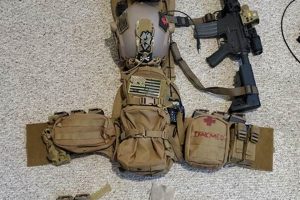
Replicating the gear and equipment configurations used by the United States Marine Corps in a simulated combat environment constitutes a specific approach to airsoft. This typically involves assembling a collection of tactical apparel, protective gear, and replica weaponry that mirrors the standard issue items used by Marines in various operational theaters. For example, an individual might select a specific era’s uniform, body armor, and rifle model to represent a Marine unit from that period.
The practice allows participants to experience a greater sense of realism and immersion during airsoft engagements. By adhering to the established guidelines and equipment conventions of a specific military branch, individuals can cultivate a deeper understanding of the operational considerations and tactical doctrines employed by that organization. Historically, these recreations have served as both a hobbyist pursuit and a training aid, offering insights into military tactics and unit cohesion.
The subsequent sections will delve into the specific components commonly found in these configurations, including camouflage patterns, tactical vests, weapon platforms, and essential accessories. Careful attention will be given to the rationale behind each item’s selection and its role in achieving a cohesive and authentic impression.
Marine Corps Airsoft Loadout
Proper planning and execution are paramount when assembling a realistic depiction of United States Marine Corps equipment for airsoft. Adherence to established standards and attention to detail are critical for achieving authenticity and operational effectiveness.
Tip 1: Research is Paramount: Thoroughly investigate the specific era and unit being replicated. Understand the authorized equipment lists and variations in gear deployment. For instance, differences exist between deployments in Iraq versus Afghanistan, or between infantry and reconnaissance units.
Tip 2: Camouflage Pattern Accuracy: Select the appropriate camouflage pattern for the intended impression. The Marine Corps has utilized patterns such as MARPAT Woodland and MARPAT Desert. Ensure the pattern matches the chosen era and operational environment.
Tip 3: Tactical Vest and Plate Carrier Selection: Choose a tactical vest or plate carrier that accurately represents the type issued to Marines during the targeted period. Variations include the MTV (Modular Tactical Vest), SPC (Scalable Plate Carrier), and newer systems. Ensure the color and configuration are accurate.
Tip 4: Replica Weapon Platform: Select an airsoft replica weapon that is representative of the firearms used by the Marine Corps. Typically, this involves M4/M16 variants. Pay attention to details such as optics, rail systems, and other accessories to match the intended configuration.
Tip 5: Essential Accessories: Include essential accessories such as magazine pouches, medical kits, and communication devices. These items should be consistent with the chosen unit and period, and positioned on the load-bearing equipment in a practical and accessible manner.
Tip 6: Footwear and Headgear: The selection of boots and helmets greatly contributes to the overall realism. Issue boots should be in good condition, while helmets should be outfitted with appropriate covers and accessories, such as night vision mounts, if applicable.
Tip 7: Weight and Distribution: Consider the weight and distribution of the loadout. A realistic loadout should simulate the weight of actual gear, but also be manageable for extended periods of movement and engagement.
By adhering to these considerations, the individual can construct a credible and functional representation of United States Marine Corps equipment, enhancing the airsoft experience through authenticity and practical application.
The subsequent section will address common errors to avoid when assembling a loadout, further refining the pursuit of accuracy.
1. Historical Accuracy

Historical accuracy forms a cornerstone of a credible representation of Marine Corps equipment in airsoft. It dictates the selection of camouflage patterns, tactical gear, and weapon platforms that accurately reflect the equipment issued during a specific time period or deployment. Deviation from accurate historical representation diminishes the realism and educational value of the airsoft experience. For example, utilizing a modern plate carrier with a camouflage pattern that was not yet in service during the depicted conflict would be historically inaccurate.
The importance of historical accuracy extends beyond mere aesthetics. It informs the tactical considerations of the loadout. Equipment choices reflect the operational environment and the perceived threats of the era. For example, a Vietnam-era representation would likely feature less body armor and a different rifle configuration compared to a depiction of Operation Enduring Freedom. Understanding the historical context allows for a more immersive and authentic experience, prompting players to research and appreciate the evolution of Marine Corps equipment and tactics. This understanding is crucial for educational scenarios and re-enactments that aim to portray historical events accurately.
Achieving historical accuracy in a Marine Corps airsoft loadout presents challenges, including sourcing authentic or high-quality replica gear and interpreting historical documentation. However, the pursuit of accuracy enhances the appreciation of military history and improves the overall authenticity of the airsoft experience, contributing to a more engaging and informative activity. By prioritizing historical accuracy, participants transform a simple game into a dynamic representation of military history.
2. Camouflage Compliance

Camouflage compliance stands as a fundamental element in assembling an accurate depiction of a United States Marine Corps airsoft loadout. The effectiveness of a recreated military ensemble hinges significantly on the correct application of camouflage patterns aligned with specific operational environments and historical periods. Failure to adhere to established camouflage protocols directly impacts the realism and, by extension, the immersive quality of the airsoft experience. For instance, deploying a loadout featuring woodland MARPAT in a desert environment would be a clear violation of camouflage principles, immediately detracting from the authenticity.
The selection of camouflage patterns within a loadout serves a dual purpose: visual concealment and historical accuracy. MARPAT (Marine Pattern) in both woodland and desert variants, remains a hallmark of Marine Corps uniforms. Using the wrong pattern for the intended impression degrades the overall effect. Furthermore, slight variations in camouflage patterns exist between different manufacturers of airsoft gear. A discerning eye can distinguish between a high-quality replica and an inferior imitation based on the accuracy of the camouflage pattern and the quality of the printing. This is particularly important for individuals seeking to create highly accurate historical impressions.
Consequently, rigorous attention to camouflage compliance in a Marine Corps airsoft loadout extends beyond superficial aesthetics. It represents a commitment to detail and an understanding of the practical and historical considerations that dictate military equipment standards. Overcoming challenges in procuring authentic or high-quality replica camouflage gear is essential for achieving a truly immersive and accurate representation, thereby elevating the overall airsoft experience.
3. Equipment Authenticity

Equipment authenticity serves as a pivotal determinant in the credibility and overall value of a United States Marine Corps airsoft loadout. The degree to which replicated gear accurately mirrors real-world counterparts dictates the realism experienced and the instructional potential realized. Employing equipment that closely resembles standard-issue items allows participants to more effectively simulate tactical scenarios and understand the operational considerations faced by Marines. For instance, the weight distribution of a replica plate carrier, when closely matching the actual weight of a loaded carrier, provides insight into the physical demands placed on personnel in the field. Similarly, the functionality of replica communication devices, even if limited to airsoft applications, contributes to the understanding of communication protocols and logistical requirements.
The pursuit of equipment authenticity extends beyond mere aesthetics. Material quality, manufacturing techniques, and design specifications all contribute to the overall impression. A poorly constructed replica of a combat boot, for example, may not provide adequate support or durability, thus hindering performance and detracting from the authenticity of the loadout. Replica weapon systems, while not capable of firing live ammunition, benefit from accurate dimensions and ergonomics to allow players to properly manipulate and engage targets in simulated combat environments. Moreover, the sourcing and procurement of gear that closely matches authentic specifications often necessitates research and dedication, further enriching the overall experience and promoting a deeper appreciation for the equipment employed by the Marine Corps.
In conclusion, equipment authenticity significantly enhances the educational and experiential value of a United States Marine Corps airsoft loadout. While challenges exist in acquiring highly accurate replicas, particularly regarding cost and availability, the benefits derived from enhanced realism and improved understanding of military operations justify the effort. By prioritizing authenticity, participants transform airsoft from a recreational activity into a platform for learning, historical appreciation, and tactical simulation.
4. Functional Ergonomics

Functional ergonomics plays a critical role in the practical application of a United States Marine Corps airsoft loadout. The efficient arrangement and accessibility of equipment directly influence a participant’s maneuverability, reaction time, and overall effectiveness in simulated combat scenarios. Prioritizing functional ergonomics ensures that the loadout is not merely a collection of authentic-looking gear, but a cohesive system designed to enhance performance.
- Equipment Placement and Accessibility
The strategic placement of essential items, such as magazine pouches, medical kits, and communication devices, is paramount. These items must be readily accessible without requiring excessive movement or compromising situational awareness. For example, magazine pouches should be positioned on the torso or waist within easy reach of the dominant hand, enabling rapid reloading during engagements. The placement of a medical kit should allow for quick access in the event of simulated injury, facilitating immediate self-aid or buddy-aid. Failure to optimize equipment placement hinders response times and reduces overall operational efficiency.
- Weight Distribution and Balance
Even distribution of weight across the body is crucial for maintaining balance and minimizing fatigue. An improperly balanced loadout can lead to discomfort, reduced agility, and increased risk of injury. Heavy items, such as replica ammunition or water reservoirs, should be strategically positioned to distribute weight evenly across the torso and hips. This ensures that the loadout remains comfortable and manageable during extended periods of movement and engagement. Imbalanced weight distribution can negatively impact stamina and tactical effectiveness.
- Range of Motion and Mobility
The design and configuration of the loadout should not restrict the wearer’s range of motion or impede mobility. Bulky or ill-fitting gear can hinder movement, making it difficult to navigate obstacles, assume firing positions, or engage in close-quarters combat. The selection of low-profile pouches and streamlined equipment designs can help to minimize interference with movement. Similarly, adjustable straps and buckles allow for a customized fit that maximizes comfort and mobility. Restrictions in range of motion negatively impact tactical flexibility and overall performance.
- Integration with Body Armor and Protective Gear
A functionally ergonomic loadout must seamlessly integrate with body armor, helmets, and other protective gear. Interference between different components can compromise protection and reduce comfort. For example, the placement of a rifle stock against the shoulder should not be obstructed by the shoulder pads of a plate carrier. Similarly, the design of a helmet should allow for unobstructed vision and compatibility with communication headsets. Effective integration between different pieces of equipment is critical for ensuring both protection and operational efficiency. Poor integration reduces overall effectiveness.
By considering these facets of functional ergonomics, individuals assembling a United States Marine Corps airsoft loadout can transition from a mere collection of gear to a well-integrated and performance-enhancing system. The meticulous attention to equipment placement, weight distribution, range of motion, and gear integration promotes greater immersion, enhanced tactical effectiveness, and a more authentic representation of Marine Corps operational standards. The advantages gained translate to realism within airsoft engagement and can further contribute to better understanding of military protocols.
5. Weight Management
The effective distribution and mitigation of load weight are critical determinants in the performance and sustainability of any replicated United States Marine Corps equipment configuration. Excess weight imposes significant physical strain, leading to reduced mobility, diminished reaction times, and accelerated fatigue. In the context of airsoft, where prolonged periods of simulated combat are common, poorly managed load weight can severely impair a participant’s ability to effectively engage, maneuver, and maintain situational awareness. For example, a loadout exceeding acceptable weight thresholds may limit a player’s capacity to traverse uneven terrain, assume stable firing positions, or react quickly to unexpected threats. A lack of weight management affects not only individual performance but also the ability to effectively operate within a team or squad.
Real-world Marine Corps operations underscore the importance of weight management, where personnel are often required to carry substantial loads for extended periods. Airsoft loadouts that closely replicate the weight and distribution of real-world equipment can provide valuable insights into the physical demands placed on military personnel. This understanding can inform training practices, equipment selection, and tactical decision-making within the airsoft community. For instance, participants may choose to prioritize lighter-weight materials or streamline their loadout configuration to reduce overall burden without compromising essential functionality. The strategic placement of heavier items closer to the body’s center of gravity can further improve stability and reduce strain on the musculoskeletal system. Considerations of ergonomics, load carriage systems, and gear selection are equally important when striving to mirror the real world equipment usage for tactical advantage.
Implementing effective weight management strategies in a Marine Corps airsoft loadout requires a comprehensive approach. This involves careful selection of equipment, strategic placement of items, and a commitment to maintaining physical fitness. While striving for authenticity, it is crucial to balance realism with practicality, ensuring that the loadout remains manageable and does not compromise safety or performance. Prioritizing weight management enhances not only the airsoft experience but also fosters a deeper appreciation for the physical demands and operational considerations faced by military personnel, while promoting better simulation.
Frequently Asked Questions
The following section addresses common inquiries regarding the construction and implementation of airsoft equipment configurations that replicate United States Marine Corps loadouts. These responses aim to provide clarity on specific aspects of gear selection, historical accuracy, and tactical considerations.
Question 1: What level of historical accuracy is expected in a Marine Corps airsoft loadout?
The degree of historical accuracy varies depending on the individual’s goals. Some prioritize a general impression, while others aim for meticulous replication of a specific unit during a particular operation. Research into the gear utilized during the chosen period is essential for achieving a credible impression.
Question 2: Is it necessary to use genuine military-issue gear for a realistic Marine Corps airsoft loadout?
Genuine military-issue gear is not mandatory, but high-quality replicas are recommended. Authentic gear can be expensive and difficult to acquire. Well-made replicas often provide comparable aesthetics and functionality at a more reasonable cost. Emphasis should be placed on accurate camouflage patterns and durable construction.
Question 3: How important is weight management in an airsoft loadout that replicates a Marine Corps equipment configuration?
Weight management is crucial for maintaining mobility and endurance during airsoft engagements. A loadout that closely replicates the weight of real-world gear provides a more realistic experience, but it should be manageable to avoid fatigue and potential injury. Prioritize essential items and consider lighter-weight alternatives where possible.
Question 4: What camouflage patterns are appropriate for a Marine Corps airsoft loadout?
The appropriate camouflage pattern depends on the intended operational environment and historical period. MARPAT Woodland is suitable for wooded environments, while MARPAT Desert is appropriate for arid regions. Research the specific camouflage patterns utilized by the Marine Corps during the era being replicated.
Question 5: What are the common mistakes to avoid when assembling a Marine Corps airsoft loadout?
Common mistakes include using inaccurate camouflage patterns, selecting gear that is not consistent with the chosen historical period, neglecting weight management, and failing to prioritize functional ergonomics. Attention to detail and thorough research are essential for avoiding these errors.
Question 6: How can I ensure that my Marine Corps airsoft loadout is both realistic and practical for gameplay?
Balancing realism and practicality requires careful consideration. Prioritize essential gear, ensure proper fit and adjustment, and practice with the loadout to identify any areas for improvement. Seek feedback from experienced airsoft players and reference photos of real-world Marine Corps equipment configurations.
These responses offer guidance for assembling a credible and functional airsoft equipment configuration that replicates the equipment used by the United States Marine Corps. Prioritizing research, attention to detail, and a balance between realism and practicality enhances the overall airsoft experience.
The subsequent section will address advanced considerations for individuals seeking to further refine their loadout impressions.
marine corps airsoft loadout
This exploration of the United States Marine Corps airsoft loadout has emphasized the critical aspects of historical accuracy, camouflage compliance, equipment authenticity, functional ergonomics, and weight management. These considerations, when meticulously addressed, contribute to a credible and immersive experience for participants engaging in simulated combat scenarios. The differentiation between general impressions and precise replications has been clarified, along with the importance of balancing realism with practical gameplay considerations.
Ultimately, the value of a well-constructed military simulation lies not only in the aesthetic appeal but also in the promotion of a deeper understanding of military history and tactical principles. Further refinement of loadout impressions necessitates ongoing research and a commitment to continuous improvement, ensuring that airsoft remains a compelling platform for both recreation and education. The pursuit of authenticity in recreating the equipment configurations of the United States Marine Corps in airsoft can foster better respect and understanding of the service.
![[Seal Team Six Inspired] DEVGRU Airsoft Loadout Guide + Setup Tips | Ultimate Airsoft Guide for Beginners, Tactics & Gear Reviews](https://airsoftica.com/wp-content/uploads/2025/12/th-735-300x200.jpg "[Seal Team Six Inspired] DEVGRU Airsoft Loadout Guide + Setup Tips Ultimate Airsoft Guide for Beginners, Tactics & Gear Reviews")
![Build Your Realistic Army Ranger Airsoft Loadout [Guide] | Ultimate Airsoft Guide for Beginners, Tactics & Gear Reviews](https://airsoftica.com/wp-content/uploads/2025/12/th-651-300x200.jpg "Build Your Realistic Army Ranger Airsoft Loadout [Guide] Ultimate Airsoft Guide for Beginners, Tactics & Gear Reviews")