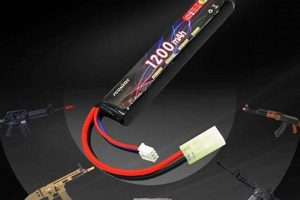
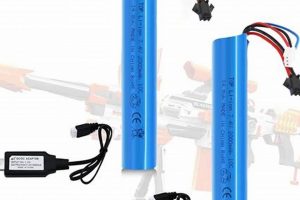
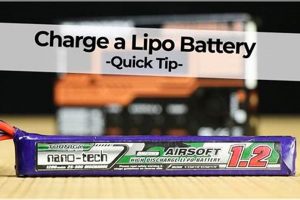
A power source designed for airsoft electric guns (AEGs), this component provides the electrical energy required for the AEG’s motor to operate. The specifications denote a 7.4-volt lithium polymer (LiPo) battery with a capacity of 1300 milliampere-hours (mAh) and a discharge rate of 30C. It includes a protective case and is identified by the model number LP013 and the manufacturer Vapextech.
The utilization of such a power supply offers a balance between runtime and power output, suitable for many airsoft AEGs. The 7.4V configuration is common for providing adequate trigger response and rate of fire. The 1300mAh capacity determines how long the AEG can operate before requiring a recharge. The 30C discharge rate indicates the battery’s ability to deliver sustained current, influencing the AEG’s performance during rapid firing. The protective case contributes to the battery’s safety by mitigating physical damage, and the Vapextech brand signifies a manufacturer specializing in battery technology.
Understanding the specifications of this type of battery is crucial for selecting the appropriate power source for an airsoft AEG. Several factors must be considered, including compatibility with the AEG’s wiring and motor, the desired balance between runtime and performance, and adherence to safety protocols during charging and storage. Furthermore, knowledge of different LiPo battery characteristics contributes to optimizing the AEG’s overall operational effectiveness and longevity.
Essential Usage and Maintenance Guidelines
The following guidelines aim to maximize the performance and lifespan of the specified power supply, while emphasizing safety during operation and storage.
Tip 1: Voltage Compatibility: Verify that the airsoft gun’s electrical system is rated for 7.4V. Using an incompatible voltage can cause damage to the AEG’s motor or other electrical components.
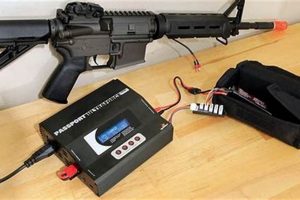
Tip 2: Appropriate Charger Selection: Utilize a LiPo balance charger specifically designed for 7.4V batteries. Employing an incorrect charger or failing to balance charge can lead to reduced battery life, overcharging, and potential fire hazards.
Tip 3: Monitor Discharge Levels: Avoid completely discharging the battery. Allow the AEG to cease functioning before significant voltage drop. Excessive discharge can permanently damage LiPo cells, rendering the power source unusable. Consider using a LiPo voltage alarm to prevent over-discharge.
Tip 4: Safe Storage Practices: Store the battery in a fire-retardant LiPo safe bag or container, away from flammable materials. Maintain a storage voltage of approximately 3.8V per cell to maximize longevity and minimize risks associated with long-term storage.
Tip 5: Temperature Considerations: Operate and store the battery within the recommended temperature range specified by the manufacturer. Extreme temperatures can negatively impact performance and increase the risk of thermal runaway.
Tip 6: Case Inspection: Routinely inspect the protective case for any signs of damage, such as cracks or punctures. A compromised case can expose the battery to physical stress and increase the likelihood of short circuits.
Tip 7: Cable and Connector Examination: Regularly check the wiring and connectors for fraying, corrosion, or loose connections. Damaged wires or connectors can impede current flow and cause performance issues or safety hazards.
Adhering to these recommendations promotes safer and more efficient operation of this power supply, ultimately extending its usability and mitigating potential safety risks. Prioritizing proper charging, storage, and maintenance practices are paramount for ensuring the longevity and optimal performance of LiPo batteries.
These considerations lay the groundwork for a thorough understanding of the proper application of this power source in airsoft applications.
1. Voltage Compatibility

Voltage compatibility represents a critical parameter when integrating the 7.4V LiPo battery into an airsoft electric gun (AEG) system. The AEG’s internal electrical components, including the motor, wiring, and electronic trigger unit (if present), are designed to operate within a specific voltage range. Deviation from this range can lead to detrimental consequences. Specifically, connecting the 7.4V battery to an AEG designed for a lower voltage, such as 6V, can result in overheating, accelerated wear, and potential failure of the motor or other components due to excessive current draw. Conversely, using the 7.4V battery in an AEG requiring a higher voltage, such as 9.6V, may result in underperformance, characterized by reduced trigger response, a slower rate of fire, and potential strain on the battery itself as it attempts to deliver more current than it is designed for.
Real-world examples underscore the importance of this compatibility. An AEG initially designed for an 8.4V NiMH battery, when improperly connected to a fully charged 7.4V LiPo without appropriate modifications (such as MOSFET installation), experienced premature wear on the motor brushes and a noticeable reduction in gearbox lifespan. In contrast, attempts to power an AEG equipped with a high-torque motor designed for 11.1V LiPo batteries with a 7.4V LiPo resulted in significantly reduced motor performance and operational inconsistencies, essentially rendering the AEG ineffective in a skirmish scenario. These scenarios highlight the direct cause-and-effect relationship between voltage mismatch and AEG functionality and longevity.
In conclusion, voltage compatibility is not merely a technical specification but a fundamental requirement for the safe and effective utilization of the 7.4V LiPo battery within an AEG. Overlooking this aspect can lead to equipment damage, performance degradation, and potential safety hazards. A thorough assessment of the AEG’s voltage requirements, coupled with adherence to manufacturer recommendations, is essential for maximizing the operational lifespan and reliability of both the battery and the AEG system.
2. Capacity and Runtime

The capacity of a battery, measured in milliampere-hours (mAh), directly dictates the runtime achievable with an airsoft electric gun (AEG). The specified battery, rated at 1300mAh, provides a finite amount of electrical energy. The AEG consumes this energy during operation, with the rate of consumption influenced by factors such as the motor’s efficiency, the gearbox’s mechanical resistance, and the frequency of firing. A higher capacity rating inherently translates to a longer operational period before requiring a recharge. However, the relationship is not strictly linear. Variables such as the AEG’s internal configuration and usage patterns significantly impact the effective runtime.
Consider two AEG configurations: one optimized for efficiency with low-resistance wiring and a high-efficiency motor, and another with a stock motor and standard wiring. The optimized AEG will demonstrably achieve a longer runtime from the same 1300mAh battery compared to the stock AEG, potentially by a factor of 20-30%. Real-world skirmishes illustrate this point clearly. An AEG user utilizing a 1300mAh battery in a stock rifle experienced depletion after approximately four mid-capacity magazine reloads (roughly 600 BBs). Conversely, another user with a similar battery in an upgraded rifle reported consistent operation for six magazine reloads (approximately 900 BBs) before voltage sag became noticeable. This highlights that while the 1300mAh figure sets an upper limit on available energy, the actual runtime is highly dependent on the AEG’s power draw.
Therefore, selecting a battery with sufficient capacity for the anticipated duration of gameplay is crucial. While a 1300mAh battery offers a reasonable balance between size, weight, and runtime for many users, individuals participating in extended skirmishes or operating power-hungry AEGs may require higher-capacity options. The choice must consider the AEG’s configuration, playing style, and the length of engagements to ensure adequate power is available throughout the duration of use. Neglecting this consideration results in mid-game power depletion, potentially compromising the user’s effectiveness. The interplay between capacity and runtime is a critical factor in optimizing AEG performance within airsoft scenarios.
3. Discharge Rate (30C)
The discharge rate, represented as “30C,” is a critical specification influencing the performance of the airsoft 7.4V 1300mAh LiPo battery. This metric quantifies the maximum continuous current the battery can safely deliver without degradation or damage. Understanding its implications is essential for matching the battery to the demands of an airsoft electric gun (AEG).
- Current Delivery Capability
The “30C” rating signifies that the battery can continuously discharge 30 times its capacity in amperes. For the 1300mAh battery, this translates to a maximum continuous discharge current of 39 amperes (1.3Ah x 30C = 39A). This current delivery capability is directly proportional to the AEG’s trigger response and rate of fire. Insufficient current can cause sluggish performance, while exceeding the battery’s discharge limit can lead to overheating, swelling, and potential failure.
- Impact on AEG Performance
An AEG requiring a high current draw for rapid firing cycles benefits significantly from a higher discharge rate. For example, an AEG equipped with a high-torque motor and a high-ratio gearset demands a substantial current surge during each trigger pull. A 30C discharge rate is typically adequate for many standard AEGs but may become limiting for highly upgraded platforms. If the battery cannot supply the required current, the AEG’s performance will be negatively impacted, resulting in a reduced rate of fire and inconsistent cycling.
- Thermal Management Considerations
The discharge rate is directly linked to the battery’s internal temperature. Discharging at or near the maximum 30C rate generates heat within the battery cells. Inadequate thermal management can lead to irreversible damage. While the “30C” rating specifies the maximum continuous discharge, sustained operation near this limit necessitates careful monitoring to prevent overheating. Overheating reduces the battery’s lifespan and increases the risk of catastrophic failure. Therefore, the battery’s operating temperature should be carefully monitored during prolonged use, especially in environments with elevated ambient temperatures.
- Balancing Discharge Rate and Capacity
Choosing a battery involves balancing the discharge rate and capacity. While a higher discharge rate provides improved performance, it does not compensate for insufficient capacity. A high-discharge-rate battery with low capacity will deplete quickly, limiting overall runtime. Conversely, a high-capacity battery with a low discharge rate may not provide sufficient current for optimal AEG performance. The 30C rating, paired with the 1300mAh capacity, represents a compromise that is suitable for a wide range of airsoft AEG configurations, providing an acceptable balance between performance and runtime.
The “30C” discharge rate specification for the airsoft 7.4V 1300mAh LiPo battery serves as a key indicator of its performance capabilities. It influences the AEG’s trigger response, rate of fire, and overall reliability. Matching the battery’s discharge rate to the AEG’s current demands is crucial for achieving optimal performance while preventing battery degradation. This parameter, in conjunction with capacity, determines the suitability of the battery for specific airsoft applications.
4. Protective Case Integrity

Protective case integrity is a paramount safety consideration concerning the “airsoft 7.4v 1300mah 30c lipo battery with case lp013 vapextech.” The case serves as a primary barrier against physical damage and environmental hazards, significantly influencing the operational safety and longevity of the LiPo battery.
- Physical Protection Against Impact and Puncture
The protective case’s fundamental role is to shield the delicate LiPo cells from physical trauma. Impacts from falls, collisions, or sharp objects can compromise the cell’s integrity, potentially leading to short circuits, thermal runaway, and fire. A robust case, constructed from durable materials, mitigates these risks. Field examples demonstrate that batteries without adequate case protection are significantly more susceptible to damage, resulting in premature failure and safety hazards. The case’s impact resistance directly correlates with the battery’s survivability under demanding conditions.
- Prevention of Short Circuits
The case provides electrical insulation, preventing external conductors from creating short circuits. A breach in the case exposes the LiPo cells to external metallic objects, increasing the risk of a short circuit, which can generate intense heat and potentially ignite flammable materials. The case’s material properties and design should prevent conductive materials from contacting the battery cells, minimizing the likelihood of this hazardous scenario. Consistent inspection is required to make sure the case isn’t damage.
- Mitigation of Environmental Exposure
The case guards against environmental elements, such as moisture, dust, and extreme temperatures, which can degrade battery performance and lifespan. Moisture ingress can cause corrosion and short circuits, while dust accumulation can impede heat dissipation. Extreme temperatures, both hot and cold, negatively impact the LiPo cells’ chemical stability and discharge characteristics. A well-sealed case minimizes these environmental stressors, preserving the battery’s performance and reliability. If the case starts to crack or split, environmental dangers starts to be a danger.
- Flame Retardant Properties
Some protective cases incorporate flame-retardant materials, providing an additional layer of safety in the event of thermal runaway. While not preventing a LiPo fire, a flame-retardant case can slow its propagation, providing valuable time to react and mitigate the situation. These materials are engineered to resist ignition and self-extinguish, minimizing the potential for collateral damage and injury. The presence of flame-retardant properties enhances the overall safety profile of the battery assembly.
The protective case is an integral component of the “airsoft 7.4v 1300mah 30c lipo battery with case lp013 vapextech,” directly influencing its safety, reliability, and longevity. Compromised case integrity undermines these benefits, increasing the risk of hazardous incidents and premature battery failure. Regular inspection and proper handling are essential for maintaining the case’s protective capabilities.
5. Manufacturer Reputation

The reputation of the manufacturer is a significant factor when evaluating the suitability of the “airsoft 7.4v 1300mah 30c lipo battery with case lp013 vapextech” for airsoft applications. A manufacturer’s track record provides insights into product quality, safety standards, and overall reliability, directly impacting the user experience and safety profile of the battery.
- Quality Control Standards
A reputable manufacturer adheres to stringent quality control procedures during the production process. These standards encompass material selection, cell matching, assembly precision, and rigorous testing protocols. The implementation of these measures minimizes the likelihood of defects, inconsistencies, and premature failures. For instance, a manufacturer with a proven history of quality control will subject each battery to capacity testing, internal resistance measurements, and cycle life assessments, ensuring adherence to stated specifications. In contrast, manufacturers with lax quality control practices often produce batteries with variable performance characteristics and elevated failure rates. Selecting a battery from a well-regarded manufacturer provides a higher degree of assurance regarding its adherence to specified performance parameters.
- Safety Certifications and Compliance
Manufacturers committed to safety obtain relevant certifications from recognized testing laboratories. These certifications, such as UL (Underwriters Laboratories) or CE (Conformit Europenne), indicate that the battery has undergone independent testing and meets established safety standards for electrical components. Compliance with these standards signifies that the manufacturer has implemented safeguards against overcharging, over-discharging, short circuits, and thermal runaway. The absence of these certifications raises concerns about the battery’s safety profile and its potential to pose hazards during operation or storage. A reputable manufacturer openly displays these certifications, providing transparency and demonstrating a commitment to consumer safety.
- Customer Support and Warranty Provisions
A reputable manufacturer typically provides responsive customer support and offers comprehensive warranty provisions. These provisions demonstrate confidence in the product’s reliability and provide recourse for consumers in the event of defects or malfunctions. Prompt and helpful customer support facilitates troubleshooting, resolving technical issues, and addressing warranty claims efficiently. Manufacturers with limited or unresponsive customer support often indicate a lack of confidence in their products and may be less inclined to honor warranty obligations. The availability of reliable customer support and a clear warranty policy provides added assurance and mitigates the risks associated with purchasing a potentially unreliable product.
- Product Consistency and Performance History
A consistent track record of producing reliable and high-performing batteries is a hallmark of a reputable manufacturer. This history can be assessed through independent product reviews, user testimonials, and long-term performance data. A manufacturer with a proven ability to consistently deliver products that meet or exceed expectations is more likely to provide a satisfactory user experience. Conversely, manufacturers with a history of inconsistent performance or negative user feedback should be approached with caution. Prioritizing manufacturers with a demonstrated commitment to product consistency minimizes the risk of encountering performance issues, safety hazards, and premature failures.
In conclusion, the manufacturer’s reputation serves as a crucial indicator of the overall quality, safety, and reliability of the “airsoft 7.4v 1300mah 30c lipo battery with case lp013 vapextech.” Evaluating a manufacturer’s adherence to quality control standards, acquisition of safety certifications, provision of customer support, and history of product consistency empowers informed decision-making, ensuring the selection of a battery that meets the specific performance and safety requirements of airsoft applications.
Frequently Asked Questions
The following section addresses common inquiries concerning the “airsoft 7.4v 1300mah 30c lipo battery with case lp013 vapextech,” providing concise and factual answers.
Question 1: What is the expected lifespan of this type of battery?
The lifespan of a 7.4V 1300mAh 30C LiPo battery is contingent upon usage patterns and adherence to proper charging and storage protocols. Typically, this battery can sustain between 300 and 500 charge cycles before experiencing significant performance degradation. Overcharging, deep discharging, and exposure to extreme temperatures will negatively impact the battery’s lifespan, potentially reducing the number of usable cycles.
Question 2: Is it safe to leave this battery charging unattended?
Leaving a LiPo battery charging unattended is strongly discouraged. While charging, LiPo batteries require careful monitoring to prevent overcharging, which can lead to thermal runaway and fire. Always utilize a LiPo-specific balance charger and remain present during the charging process to promptly address any anomalies.
Question 3: What are the optimal storage conditions for this battery?
Optimal storage conditions for a 7.4V LiPo battery involve maintaining a storage voltage of approximately 3.8V per cell, storing the battery in a cool, dry environment, and utilizing a fire-retardant LiPo safe bag. Avoid storing the battery in direct sunlight or in areas with extreme temperature fluctuations. Long-term storage at full charge or complete discharge will significantly reduce the battery’s lifespan.
Question 4: How do I dispose of this battery properly?
LiPo batteries require proper disposal due to their chemical composition. Do not dispose of them in (general trash). Discharge the battery completely in a safe environment and then recycle it at a designated battery recycling center or electronic waste collection facility. Many local recycling centers or hobby shops provide battery recycling services.
Question 5: What happens if the battery case is damaged?
A damaged battery case compromises the battery’s safety and structural integrity. If the case is cracked, punctured, or otherwise damaged, discontinue use immediately and dispose of the battery properly. A damaged case exposes the LiPo cells to physical and environmental hazards, increasing the risk of short circuits, thermal runaway, and fire.
Question 6: Can I use a higher voltage battery with my AEG if it fits?
Using a higher voltage battery than what the airsoft electric gun (AEG) is rated for is not recommended. Overvolting an AEG can lead to damage or failure of the motor, wiring, and electronic components. Always consult the AEG’s manufacturer specifications to determine the appropriate voltage range. Exceeding the recommended voltage voids any warranties and increases the risk of equipment damage.
These answers provide concise guidance on handling, storing, and maintaining the LiPo battery. Adhering to these recommendations promotes both safe operation and extended product longevity.
Consider these insights when making usage decisions. More information on battery safety and performance is available from battery specialists.
Conclusion
The preceding exploration of the airsoft 7.4v 1300mah 30c lipo battery with case lp013 vapextech highlights its specifications, usage guidelines, and safety considerations. Voltage compatibility, capacity for runtime, discharge rate for performance, protective case integrity, and manufacturer reputation are critical factors. The synthesis of these elements directly impacts the AEG’s operational efficiency and user safety.
Adherence to recommended practices for charging, storage, and disposal is paramount for maximizing lifespan and minimizing potential hazards. Understanding the nuances of LiPo battery technology empowers informed decision-making and fosters responsible utilization within the airsoft community. Continued diligence in battery management will ensure optimal performance and promote a safer playing environment.