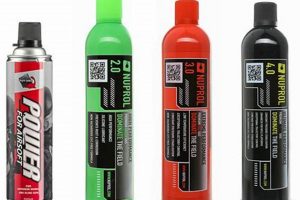
These replicas utilize a compressed propellant, commonly referred to as “green gas,” to propel projectiles. One popular platform for this type of airsoft replica is a specific pistol model known for its reliability and widespread adoption in both real-world applications and recreational simulations. Replicas of this particular pistol, powered by the aforementioned gas system, offer a realistic shooting experience due to their blowback action and comparable handling characteristics.
The appeal of these gas-powered replicas stems from their ability to closely mimic the operation of the firearm they are designed after. This realism extends to the recoil sensation, slide movement, and magazine capacity, providing users with a more immersive training or recreational experience. Historically, these types of airsoft replicas have been favored by players seeking a higher level of authenticity in their gameplay, as well as by individuals looking for a safe and controlled means of practicing firearm handling skills.
Further exploration will delve into the specific components of these airsoft devices, including the gas system mechanics, construction materials, and performance characteristics. A comparative analysis will also be conducted, evaluating the advantages and disadvantages against other airsoft propulsion methods, such as electric or spring-powered systems. Finally, considerations regarding safety, maintenance, and legal regulations surrounding the use of these replicas will be addressed.
Essential Usage and Maintenance Guidelines
Optimizing performance and ensuring longevity requires adherence to specific usage and maintenance protocols. Neglecting these guidelines may lead to diminished functionality or premature failure.
Tip 1: Utilize the Correct Propellant. Employing the designated gas type is crucial. Variations in pressure and composition of alternative propellants can damage internal components, affecting operational consistency.
Tip 2: Lubricate Regularly. Silicone oil, specifically formulated for airsoft replicas, should be applied to moving parts. Consistent lubrication minimizes friction, ensuring smooth operation and preventing wear.
Tip 3: Store Magazines Properly. Avoid storing magazines fully loaded for extended periods. Maintaining constant pressure on the internal gas seals can lead to leaks and reduced performance over time.
Tip 4: Clean the Barrel Periodically. Projectile debris accumulation within the barrel impacts accuracy. Regularly cleaning with a dedicated airsoft cleaning rod and patch removes residue, restoring optimal trajectory.
Tip 5: Inspect Gas Seals Regularly. Conduct frequent visual inspections of the gas seals for signs of damage, such as cracks or tears. Damaged seals compromise gas pressure, leading to inconsistent shots and potential leaks.
Tip 6: Adjust Hop-Up Appropriately. The hop-up system influences projectile range and trajectory. Fine-tune the hop-up setting to achieve optimal flight characteristics for the specific projectile weight and range.
Tip 7: Observe Temperature Limitations. Ambient temperature affects gas pressure and performance. Avoid using the airsoft device in extreme temperatures outside the recommended operating range, as this can lead to inconsistent velocity or damage.
By consistently implementing these guidelines, operators can maximize performance, extend the operational lifespan, and ensure consistent reliability. Adherence to these best practices mitigates potential malfunctions and preserves the intended functionality.
Further investigation will encompass troubleshooting common issues, exploring aftermarket upgrades, and reviewing relevant safety protocols for responsible usage.
1. Gas System Mechanics

The operational efficacy of airsoft replicas firing projectiles using compressed gas hinges directly on the integrity and functionality of its gas system. The specific pistol model reliant on this propellant system incorporates a series of interconnected components designed to regulate gas flow, pressure, and ultimately, projectile velocity. This intricate system dictates both the realism and the consistency of the replica’s performance.
- Gas Reservoir and Valve System
The magazine serves as the primary gas reservoir. It houses compressed gas and incorporates a valve mechanism that releases a metered amount of propellant upon trigger activation. The precision of this valve system directly influences the consistency of muzzle velocity. Variations in valve seal integrity or valve spring tension can lead to fluctuations in gas release, resulting in inconsistent projectile speeds. For instance, a worn valve seal may leak gas, reducing pressure and, consequently, lowering the projectile’s kinetic energy.
- Internal Routing and Nozzle
The gas, once released from the magazine, is channeled through a series of internal passages to the nozzle. The nozzle, positioned at the front of the magazine, interfaces with the hop-up unit and facilitates the transfer of gas behind the projectile. The nozzle’s design, including its diameter and sealing characteristics, is crucial for efficient gas utilization and minimizing gas wastage. A poorly sealed nozzle can lead to gas leakage, reducing the power available to propel the projectile.
- Blowback Mechanism and Recoil Simulation
A significant portion of the gas released is diverted to power the blowback mechanism. This mechanism cycles the slide rearward, mimicking the recoil action of a real firearm. The complexity of the blowback system contributes to the overall realism. However, an inefficient blowback system can consume excessive gas, reducing the number of shots obtainable per magazine fill. Optimizing the blowback mechanism for both realistic recoil and gas efficiency is a critical engineering challenge.
- Hop-Up Unit Interface and Projectile Stabilization
The gas system’s performance is intrinsically linked to the hop-up unit. As the projectile passes through the hop-up unit, backspin is imparted to stabilize its trajectory and increase its range. The consistency of gas pressure and flow affects the effectiveness of the hop-up. Fluctuations in gas pressure can lead to variations in projectile backspin, resulting in inconsistent range and accuracy. The proper alignment and sealing between the nozzle and the hop-up unit are essential for consistent performance.
These interconnected facets underscore the complexity of the gas system within the replica. The interplay between gas regulation, blowback action, and projectile stabilization defines the overall user experience. Achieving optimal performance requires careful attention to each component’s functionality, emphasizing the importance of regular maintenance and proper gas selection to ensure consistent and reliable operation of these airsoft devices.
2. Slide Reciprocation

Slide reciprocation in the context of gas-powered airsoft replicas designed to emulate a specific pistol model refers to the backward and forward movement of the slide assembly during operation. This mechanical action is a critical feature that contributes to the realism, user experience, and overall functionality of these devices. Understanding the intricacies of slide reciprocation is essential for appreciating its role in gas-operated airsoft systems.
- Cycle Initiation and Gas Pressure
The initiation of slide reciprocation occurs upon firing. Compressed gas, released from the magazine, propels a projectile forward. Simultaneously, a portion of the gas is diverted to the blowback system. This pressurized gas acts upon the internal components connected to the slide, forcing it rearward against spring tension. Insufficient gas pressure or leaks within the system directly impede slide reciprocation, potentially leading to malfunctions such as short stroking or failure to cycle completely.
- Ejection of Spent Magazine and Loading Mechanism
As the slide travels rearward, it extracts and ejects the spent projectile casing. This ejection process mirrors that of a real firearm, adding to the simulated realism. Concurrently, the rearward movement of the slide cocks the hammer or striker, preparing the firing mechanism for the subsequent shot. The slides motion also strips a fresh projectile from the magazine and positions it for chambering upon the slides return to the forward position. Malfunctions in the ejection or loading mechanisms are often directly linked to irregularities in the slides reciprocal movement.
- Recoil Simulation and User Feedback
The backward motion of the slide imparts a recoil sensation to the user. The magnitude of this recoil is influenced by factors such as gas pressure, slide mass, and recoil spring tension. Replicas designed to mimic the recoil characteristics of the actual firearm often incorporate heavier slides and stiffer recoil springs. The degree of simulated recoil contributes significantly to the perceived realism and user satisfaction. Reduced or absent recoil often diminishes the overall experience.
- Slide Lock Functionality and Empty Magazine Indication
Upon expending all projectiles from the magazine, the slide should lock in the rearward position. This slide lock functionality serves as a visual and tactile indicator to the user that the magazine is empty. The slide lock lever engages when the magazine follower rises fully within the empty magazine, preventing the slide from returning forward. Failure of the slide to lock back on an empty magazine can indicate issues with the magazine follower, slide lock lever, or the slides reciprocal travel.
These interconnected mechanisms demonstrate the critical role of slide reciprocation in the operation of these gas-powered airsoft replicas. Proper maintenance, lubrication, and gas pressure are essential for ensuring consistent and reliable slide cycling, thereby enhancing the performance and realism of the overall system. The slide’s movement is integral to projectile loading, ejection, and recoil simulation.
3. Magazine Capacity
In the context of airsoft replicas utilizing compressed gas as a propellant, and particularly those modeled after a specific, widely-used pistol design, magazine capacity significantly influences gameplay dynamics and the overall user experience. The magazine, serving as both a reservoir for the compressed gas and a housing for projectiles, establishes a direct correlation between the number of available shots and the frequency of required reloads. A higher magazine capacity typically translates to extended engagement times before reloading becomes necessary, offering a tactical advantage in simulated combat scenarios. Conversely, a lower capacity mandates more frequent interruptions in gameplay for magazine changes, potentially exposing the user to vulnerabilities.
Magazine capacity limitations are often dictated by design constraints inherent in replicating the dimensions and functionality of the firearm. Airsoft magazines must accommodate both the projectiles and the mechanisms for gas storage and release, requiring a delicate balance between capacity and realistic proportions. For example, extended magazines, while increasing projectile count, may deviate from the standard dimensions of the original firearm, potentially affecting handling and holster compatibility. Practical applications highlight this trade-off, as players often choose between standard-capacity magazines for authenticity and extended-capacity magazines for enhanced firepower. Furthermore, the capacity also interacts with the efficiency of the gas system; a larger magazine capacity might require a more robust gas system to maintain consistent projectile velocity across all shots.
The magazine capacity represents a critical design consideration that directly impacts the practical application and tactical implications of using airsoft replicas modeled after a renowned pistol. The decision between capacity and realism involves understanding the compromises inherent in balancing projectile volume with the authentic replication of a widely recognized firearm. Understanding this relationship is essential for optimizing the replica’s performance within the intended context of use, ranging from competitive gameplay to training simulations. Challenges remain in maximizing capacity while maintaining reliability, gas efficiency, and adherence to the original firearm’s design.
4. Accuracy Potential
Accuracy potential, in the context of compressed gas airsoft replicas modeled after a specific pistol design, dictates the consistency and precision with which projectiles can be directed towards a designated target. This facet is paramount for determining the replica’s effectiveness in simulated engagements and training scenarios. Several key factors contribute to achieving optimal accuracy potential in these systems.
- Hop-Up System Calibration
The hop-up system applies backspin to the projectile, counteracting the effects of gravity and extending its effective range. Precise calibration of the hop-up unit is critical for achieving consistent projectile trajectories. Over-hopping or under-hopping can result in erratic flight paths and reduced accuracy. Adjusting the hop-up mechanism to match the projectile weight and gas pressure is essential for maximizing accuracy potential. Improperly calibrated hop-up systems will exhibit unpredictable projectile behavior, regardless of other factors.
- Barrel Quality and Length
The internal barrel’s surface finish and overall length play a significant role in guiding the projectile and influencing its trajectory. Smoother barrel surfaces reduce friction, promoting more consistent projectile speeds. Longer barrels, within practical limitations, can provide increased guidance, potentially improving accuracy at extended ranges. Variations in barrel quality and length can lead to inconsistencies in projectile flight, diminishing overall accuracy potential. For example, a damaged or pitted barrel surface will disrupt the projectile’s smooth passage, introducing unpredictable deviations.
- Gas Pressure Consistency
Maintaining consistent gas pressure is paramount for achieving repeatable projectile velocities. Fluctuations in gas pressure directly impact the energy imparted to the projectile, leading to variations in its range and point of impact. High-quality gas regulators and magazines designed for consistent pressure output contribute to enhanced accuracy potential. Using lower-quality gas or magazines with inconsistent gas flow can lead to significant variations in projectile trajectory. Maintaining correct gas levels and proper storage of gas canisters is essential.
- Projectile Quality and Consistency
The quality and consistency of the projectiles themselves impact accuracy potential. Variations in projectile weight, shape, and surface finish can introduce inconsistencies in flight trajectory. Using high-quality, precision-manufactured projectiles minimizes these variations, promoting more predictable and accurate shots. Lower-quality projectiles often exhibit inconsistencies in size and shape, resulting in erratic flight patterns and reduced accuracy. Selecting the correct projectile weight for the replica’s gas pressure and hop-up settings is crucial for optimal performance.
These interconnected elements underscore the multifaceted nature of achieving optimal accuracy potential in compressed gas airsoft replicas modeled after a widely-used pistol. Maximizing accuracy requires careful attention to hop-up calibration, barrel quality, gas pressure consistency, and projectile selection. Optimizing these factors collectively enhances the replica’s effectiveness in simulated engagements. Practical examples show players adjust their set-up depend on the environment of use, selecting the different parameters to maximize accuracy in that case.
5. Material Durability
Material durability directly influences the operational lifespan and sustained performance of gas-powered airsoft replicas, particularly those replicating a specific pistol design. The repeated stress of gas cycling, slide reciprocation, and projectile propulsion subjects the components to constant wear and tear. Consequently, the selection of robust and resilient materials is essential for ensuring the replica’s ability to withstand these stresses over extended periods. The cause-and-effect relationship is straightforward: inferior materials lead to premature failure, while superior materials contribute to enhanced longevity. For example, a slide constructed from low-grade metal may exhibit cracks or fractures under the repetitive stress of blowback action, ultimately rendering the replica inoperable. Similarly, a gas magazine fabricated from substandard plastic may be prone to gas leakage or structural damage, negatively impacting performance and reliability. Material durability functions as a critical component in the overall value proposition of these airsoft devices, directly impacting their usefulness and cost-effectiveness over time.
Practical examples of the importance of material selection abound in the airsoft community. Replicas employing reinforced polymers for the frame and high-strength alloys for the slide and internal mechanisms generally demonstrate greater resistance to impact damage, wear from friction, and the corrosive effects of certain propellants. This translates to a reduced likelihood of component breakage or malfunction, minimizing the need for repairs or replacements. The significance of this understanding extends to both manufacturers and end-users. Manufacturers who prioritize material quality gain a competitive advantage by offering more durable and reliable products. Users who are informed about material properties can make more discerning purchasing decisions, opting for replicas that offer a superior balance of performance and longevity. Furthermore, proper maintenance procedures, such as regular lubrication and cleaning, can further mitigate the effects of wear and tear, extending the operational lifespan of the replica regardless of the intrinsic material properties.
In summary, material durability constitutes a foundational element in the construction and performance of these airsoft replicas. Choosing materials that can withstand the operational stresses ensures consistent performance and reduces the risk of premature failure. While challenges remain in balancing material cost with performance requirements, the long-term benefits of prioritizing durability are undeniable. Ultimately, a focus on material integrity contributes to a more reliable, cost-effective, and enjoyable airsoft experience.
Frequently Asked Questions
The following addresses common inquiries regarding gas-powered airsoft replicas modeled after a specific and widely-recognized pistol. This information aims to provide clarity and promote responsible usage.
Question 1: What type of gas is appropriate for these airsoft devices?
Specific compressed gas formulations are designed for airsoft use. Propellants such as propane or CO2 are incompatible and may cause damage or malfunction.
Question 2: How should these airsoft devices be stored?
Storing these devices with the magazine removed and a minimal amount of gas remaining helps prolong seal life. Avoid extreme temperatures during storage.
Question 3: How often should the airsoft device be cleaned and lubricated?
Cleaning the barrel and lubricating moving parts with silicone oil after each use is recommended. This practice maintains performance and prevents premature wear.
Question 4: What are the potential safety hazards associated with these devices?
Eye protection is mandatory when operating these airsoft devices. Misuse can result in injury. These are not toys and should be handled with caution and respect.
Question 5: How can the projectile velocity of the airsoft device be adjusted?
Projectile velocity adjustments, if available, are typically achieved through internal mechanisms. Modifying these systems may void warranties and compromise safety.
Question 6: What is the typical effective range of these airsoft devices?
The effective range varies depending on environmental conditions, gas pressure, and hop-up settings. Users should familiarize themselves with the device’s limitations.
The points outlined above emphasize safety and maintenance. A thorough understanding of these aspects contributes to responsible ownership and prolonged operational lifespan.
The subsequent section will explore advanced troubleshooting techniques and performance optimization strategies.
Concluding Remarks on Green Gas Airsoft Guns Glock
This examination of green gas airsoft guns Glock has illuminated key aspects related to their operational mechanisms, material properties, and maintenance requirements. The analysis has covered the significance of gas system mechanics, the impact of slide reciprocation on realism, and the role of magazine capacity and accuracy potential in practical application. These replicas demand a nuanced understanding to ensure safe and consistent performance.
Continued adherence to best practices in maintenance and responsible operation remains paramount. The long-term value derived from green gas airsoft guns Glock depends on users’ commitment to safety and a thorough understanding of their capabilities and limitations. Further exploration of advancements in this technology will undoubtedly shape the future of airsoft simulations.