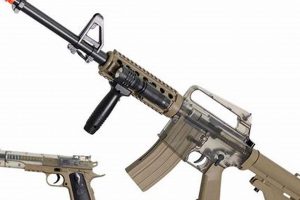
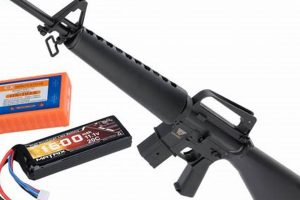
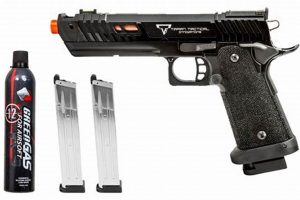
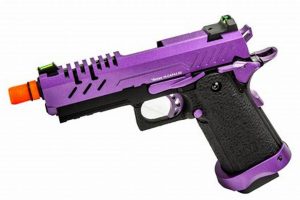
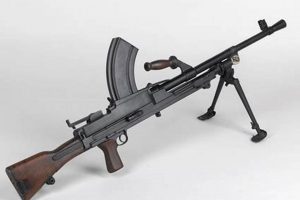
The query concerns the airsoft weapon capable of expelling the greatest number of BBs per unit of time, typically measured in rounds per minute (RPM). This metric reflects the weapon’s cycling speed, influenced by factors such as motor strength, gear ratios, and battery voltage. Certain models, modified or purpose-built, achieve significantly elevated RPM figures when compared to standard, unmodified airsoft guns.
A high rate of projectile discharge can provide a tactical advantage in certain airsoft scenarios. It may allow for increased suppressive fire capabilities and a greater probability of hitting a moving target. The pursuit of higher rates of fire has also driven innovation in airsoft technology, leading to advancements in motor design, gearbox construction, and battery performance. Historically, achieving higher RPM required significant modifications and upgrades, but advancements have led to commercially available options with impressive rates of fire.
Subsequent sections will explore the types of airsoft guns that are known for their potential for high rates of fire, the modifications that contribute to this capability, and the considerations one should take into account when selecting an airsoft gun prioritizing such performance characteristics. This will involve analysis of both stock configurations and common upgrade paths.
Maximizing Projectile Discharge in Airsoft Weapons
This section provides guidance on enhancing the rate at which an airsoft gun expels projectiles, often expressed as rounds per minute (RPM). Achieving optimal results requires careful consideration of component compatibility and technical expertise.
Tip 1: Battery Selection: Implement a high-discharge battery. Lithium Polymer (LiPo) batteries typically provide a higher discharge rate compared to Nickel-Metal Hydride (NiMH) batteries, resulting in a faster motor response. Voltage should be carefully matched to the motor and other components to avoid damage.
Tip 2: Motor Upgrade: Exchange the stock motor for a high-torque or high-speed variant. High-torque motors offer greater pulling power, while high-speed motors prioritize rapid cycling. The selection should align with the intended gear ratio and spring strength.
Tip 3: Gear Ratio Optimization: Modify the gear ratio within the gearbox. Lower gear ratios (e.g., 13:1) facilitate faster cycling compared to higher ratios (e.g., 18:1). This modification necessitates compatible gears and may affect trigger response.
Tip 4: Spring Tension Adjustment: Utilize a lighter spring. Reducing spring tension decreases the load on the motor, enabling faster cycling. However, this may also reduce the muzzle velocity of the projectile.
Tip 5: Trigger Contact Enhancement: Install a MOSFET (Metal-Oxide-Semiconductor Field-Effect Transistor). A MOSFET improves trigger response and protects the trigger contacts from damage caused by high current flow, contributing to more consistent and reliable firing.
Tip 6: Piston Weight Reduction: Employ a lighter piston. A reduced piston weight decreases the inertia the motor must overcome during each cycle, contributing to a faster rate of fire. Ensure the piston is durable enough to withstand the repeated impacts.
Tip 7: Air Seal Optimization: Ensure an optimal air seal within the cylinder assembly. Any air leaks will reduce efficiency and potentially slow down the rate of fire. Inspect and replace the cylinder head, piston head, and O-rings as needed.
Achieving an elevated rate of projectile discharge involves a multifaceted approach, balancing power, efficiency, and component compatibility. Careful consideration of these factors is crucial for achieving the desired performance gains without compromising the reliability or longevity of the airsoft gun.
The concluding section will summarize the key aspects discussed, emphasizing the practical considerations for selecting and modifying airsoft guns.
1. Motor Strength

Motor strength directly correlates to the rate of projectile discharge in airsoft guns. A motor’s ability to rapidly cycle the gearbox mechanism is fundamental to achieving a high rate of fire (ROF). The motor’s torque dictates its ability to overcome the resistance of the mainspring and piston assembly, while its rotational speed defines how quickly it can complete a cycle. A weak motor will struggle to compress a strong spring or to cycle the gearbox rapidly, thus limiting the attainable ROF. Stronger motors, particularly those employing high-torque designs, offer the necessary power to cycle against stiffer springs, enabling higher ROF figures when combined with appropriate gear ratios and power sources.
The selection of motor impacts other components as well. A more powerful motor often necessitates a higher-discharge battery to supply the required current. Similarly, the gears within the gearbox must be robust enough to withstand the increased stress imposed by a high-torque motor. Examples include the use of neodymium magnet motors in high-performance airsoft builds, which provide significantly greater torque compared to standard ferrite magnet motors. These motors are commonly paired with reinforced gearsets and high-capacity batteries to maximize their effectiveness and to prevent premature component failure. Conversely, attempting to significantly increase the ROF without upgrading the motor will likely result in motor burnout or gearbox damage.
In summary, motor strength is a critical factor determining an airsoft gun’s potential rate of fire. Upgrading to a high-performance motor is often the first step in increasing ROF, but it is essential to consider the compatibility and durability of other components to ensure a reliable and effective upgrade. The benefits of increased rate of fire must be weighed against the potential for increased wear and tear on the airsoft gun’s internal mechanisms.
2. Gear Ratio
Gear ratio plays a pivotal role in dictating the projectile discharge rate of an airsoft gun. It defines the relationship between the motor’s rotations and the completion of one full cycle of the gearbox. A lower gear ratio translates to fewer motor rotations required to complete a cycle, thereby potentially increasing the rate of fire (ROF). Conversely, a higher gear ratio necessitates more motor rotations per cycle, typically resulting in a slower ROF but potentially increasing torque and trigger response. The precise impact of the gear ratio is further influenced by motor strength and battery output.
The selection of a suitable gear ratio involves carefully balancing desired ROF with other performance considerations. For instance, a very low gear ratio coupled with a high-speed motor could result in an extremely high ROF but may also strain the motor and other internal components, potentially leading to premature wear or failure. Conversely, a high gear ratio provides greater mechanical advantage, making it easier for the motor to compress a stiff mainspring, and enhancing trigger response but can drastically reduce the ROF. Real-world examples include the use of 13:1 gears in speed builds prioritizing high ROF, while 18:1 or 32:1 gearsets are often preferred in builds emphasizing torque and durability. The practical significance of understanding gear ratios lies in the ability to tailor an airsoft gun’s performance characteristics to specific playing styles and scenarios.
In summary, gear ratio is a key determinant of an airsoft gun’s ROF, influencing both speed and power. Its selection requires careful consideration of the motor, battery, spring strength, and intended use case. A properly chosen gear ratio enhances overall performance, while an unsuitable ratio can lead to performance bottlenecks or component failure. Ultimately, the goal is to achieve a harmonious balance among all components to optimize the rate of fire within the bounds of reliability and durability.
3. Battery Voltage

Battery voltage directly influences the projectile discharge rate of an airsoft gun by governing the speed at which the motor operates. Higher voltage translates to greater electrical power delivered to the motor, resulting in faster cycling of the gearbox and a corresponding increase in the rate of fire (ROF). Conversely, lower voltage restricts the motor’s performance, hindering its ability to rapidly cycle the gearbox and thus limiting ROF. Selection of an appropriate battery voltage is critical for maximizing ROF without damaging internal components.
- Motor Speed and Torque
Higher voltage batteries increase the motor’s rotational speed and, to a lesser extent, its torque. This allows the motor to overcome the resistance of the mainspring and piston assembly more quickly, leading to a higher ROF. However, exceeding the motor’s voltage rating can cause overheating and premature failure. Conversely, operating at a voltage below the motor’s optimal range will result in reduced performance. Selecting the appropriate voltage is crucial for balancing performance and reliability. Real-world examples include using 11.1V LiPo batteries with motors designed for high-speed operation to achieve exceptionally high ROF figures, while sticking to 7.4V LiPo batteries for motors not designed to handle the extra power.
- Gearbox Stress
Elevated ROF, achieved through higher voltage, places greater stress on the gearbox components. The increased cycling speed subjects gears, pistons, and tappet plates to more frequent and forceful impacts. If the gearbox is not designed to withstand this increased stress, it can lead to premature wear or even catastrophic failure. Reinforcing the gearbox with stronger components, such as steel gears and durable pistons, is often necessary when using high-voltage batteries to achieve high ROF. Examples include using reinforced gearboxes with high-speed builds that utilize 11.1V LiPo batteries.
- Trigger Response
Higher voltage batteries improve trigger response by enabling the motor to spin up more quickly when the trigger is pulled. This reduces the delay between pulling the trigger and the airsoft gun firing, leading to a more immediate and responsive feel. This is particularly beneficial in close-quarters combat situations where quick reactions are essential. However, improving trigger response through higher voltage must be balanced against the potential for increased wear and tear on the trigger contacts. MOSFET units are commonly installed to mitigate this risk.
- Battery Discharge Rate
The battery’s discharge rate, measured in C-rating, must be sufficient to supply the current demanded by the motor, especially when operating at higher voltages. A battery with an insufficient discharge rate will struggle to maintain voltage under load, leading to reduced ROF and potential damage to the battery. Selecting a battery with an appropriate C-rating ensures that the motor receives a consistent and adequate supply of power. An example is choosing a high C-rated LiPo battery for a high-speed airsoft gun to ensure consistent and reliable performance during sustained fire.
In summary, battery voltage is a critical factor influencing the projectile discharge rate of an airsoft gun. Achieving the highest possible ROF requires careful consideration of motor compatibility, gearbox reinforcement, trigger response, and battery discharge rate. Balancing these elements allows for maximizing performance while mitigating the risks associated with overvolting or stressing internal components. The careful selection and management of battery voltage contribute significantly to an airsoft gun’s overall effectiveness and longevity.
4. Air seal
The integrity of the air seal within an airsoft gun’s compression assembly is a critical determinant of its potential projectile discharge rate. Inefficient air seal compromises energy transfer to the projectile, directly impacting both velocity and the consistency of the firing cycle. A system with a compromised seal requires more energy to achieve equivalent results, thus slowing the overall cycle and limiting the attainable rounds per minute (RPM).
- Cylinder Head Seal
The cylinder head seal prevents air from escaping between the cylinder head and the cylinder itself. A damaged or improperly installed cylinder head seal allows air to leak, reducing the pressure behind the BB. In a high-rate-of-fire setup, this leakage exacerbates inconsistencies in each shot, resulting in velocity fluctuations and a decreased RPM due to the motor needing to work harder to compress the air. Examples of compromised cylinder head seals include cracked rubber O-rings or incorrectly sized components.
- Piston Head Seal
The piston head seal, typically an O-ring, ensures that air compressed within the cylinder propels the piston forward efficiently. Leakage around the piston head necessitates increased motor effort to achieve the same level of compression. This inefficiency manifests as reduced velocity and a slower cycle rate. In high-RPM configurations, even minor piston head seal issues can significantly diminish performance. Material degradation or improper sizing of the O-ring are common causes of piston head seal failures.
- Nozzle Seal
The nozzle’s seal against the hop-up bucking is crucial for directing the compressed air efficiently behind the BB. A poor seal at this point allows air to escape, reducing the pressure behind the projectile and introducing inconsistencies. In high-ROF systems, a compromised nozzle seal results in variations in projectile trajectory and diminished range. Nozzle damage or misalignment are frequent causes of nozzle seal issues, particularly when using aftermarket nozzles.
- Hop-Up Bucking Seal
The hop-up bucking must create an airtight seal around the BB to ensure proper backspin and trajectory. Air leaks around the bucking diminish the pressure available for propulsion and reduce the effectiveness of the hop-up system. In high-ROF scenarios, this leads to inconsistent shot patterns and a reduction in effective range. Bucking tears or improper installation can cause hop-up seal failures.
These air seal considerations, when optimized, ensure that the maximum amount of compressed air propels the BB forward with each cycle. Airsoft guns designed or modified to achieve the highest projectile discharge rate require meticulous attention to these seals. Maximizing efficiency and minimizing energy loss ensures that the motor can maintain the fastest possible cycling speed. The relationship between an air seal and projectile discharge underscores the importance of precision assembly and component selection in high-performance builds.
5. Piston weight
Piston weight is a critical factor impacting the maximum achievable projectile discharge rate in airsoft guns. The piston, propelled by compressed air, initiates the firing cycle. A heavier piston possesses greater inertia, demanding more energy and time to accelerate and decelerate within the cylinder. This increased inertia slows the cycling process, reducing the potential rounds per minute (RPM). Conversely, a lighter piston requires less energy to move, allowing for faster cycling and a higher potential rate of fire. However, decreasing piston weight too drastically can compromise its durability and impact resistance, leading to premature failure. For instance, the use of lightweight polycarbonate or carbon fiber pistons is common in high-speed airsoft builds to reduce inertia and increase RPM. The balance between piston weight and durability is thus a crucial consideration when optimizing airsoft gun performance.
The selection of an appropriate piston weight also necessitates careful consideration of other internal components, particularly the motor and spring. A lighter piston, while beneficial for increasing RPM, may not effectively compress a heavy spring, potentially leading to reduced muzzle velocity and inconsistent performance. A stronger motor is often required to compensate for the reduced piston mass and ensure adequate compression. Similarly, the gearbox must be sufficiently robust to withstand the increased stress from the faster cycling rate. Real-world examples of this can be seen in competitive speedsoft builds, where carefully matched lightweight pistons, high-torque motors, and reinforced gearboxes are used in conjunction to maximize ROF without sacrificing reliability.
In summary, piston weight is a significant variable influencing the projectile discharge rate in airsoft guns. Reducing piston weight can increase RPM, but this must be balanced against potential compromises in durability and the need for complementary upgrades to other internal components. Optimizing piston weight is essential for achieving a high rate of fire without sacrificing overall performance or long-term reliability. The careful selection of components is vital for high-performing builds.
6. Spring tension
Spring tension within an airsoft gun directly influences the rate at which it expels projectiles. The spring’s strength dictates the force applied to the piston, which in turn compresses air to propel the BB. A stiffer spring requires greater force and more time to compress fully, thus slowing the firing cycle and reducing the potential rate of fire (ROF). Conversely, a weaker spring compresses more easily, enabling faster cycling and a higher ROF. However, excessively reducing spring tension may compromise muzzle velocity, thereby reducing effective range and impact force. For example, competitive speedsoft configurations often utilize relatively weak springs combined with high-speed motors and low gear ratios to maximize ROF at the expense of outright power.
The relationship between spring tension and ROF is further modulated by other components, including the motor, gears, and battery. A high-torque motor can overcome the resistance of a stiffer spring more efficiently, mitigating the reduction in ROF. Similarly, lower gear ratios can compensate for the increased load imposed by a stronger spring. Battery voltage also plays a critical role, providing the necessary power to drive the motor. Selecting components that are properly matched ensures optimal performance. Modifying spring tension without considering the impact on other components can lead to suboptimal performance or even damage. It is often observed that changes in spring tension require compensatory adjustments to the motor, gears, and battery to maintain a balanced system.
In summary, spring tension is a key determinant of an airsoft gun’s projectile discharge rate. Reducing spring tension can increase ROF, but it is crucial to consider the impact on muzzle velocity and the compatibility of other internal components. Optimizing spring tension is a delicate balancing act, requiring careful selection of components and meticulous tuning to achieve the desired performance characteristics. The relationship between spring tension and projectile discharge highlights the importance of a holistic approach to airsoft gun modification.
Frequently Asked Questions
This section addresses common inquiries regarding projectile discharge rate, typically measured in rounds per minute (RPM), in airsoft weapons. The information provided aims to clarify misconceptions and offer a factual understanding of the factors influencing this performance metric.
Question 1: Does a higher projectile discharge rate automatically equate to superior performance in all airsoft scenarios?
No. While an elevated RPM can provide a tactical advantage in certain situations, such as suppression, it is not universally beneficial. Accuracy, range, and ammunition conservation remain critical factors. A weapon with a high RPM but poor accuracy may be less effective than one with a lower RPM but greater precision.
Question 2: Is it possible to achieve extremely high RPM figures in airsoft guns without sacrificing reliability?
Achieving extremely high RPM figures typically necessitates significant modifications and can increase stress on internal components. While it is possible to build a reliable high-RPM airsoft gun, it requires meticulous attention to component selection, proper assembly, and regular maintenance. Compromises in durability are common in extreme builds.
Question 3: What is the primary limiting factor preventing airsoft guns from achieving even higher projectile discharge rates?
Several factors contribute, including motor speed, gearbox cycling efficiency, and ammunition feeding mechanisms. The physical limitations of propelling BBs at high velocities and the mechanical constraints of the gearbox design impose practical limits on achievable RPM figures. Technological advancements continue to push these boundaries.
Question 4: Are there any legal restrictions on the maximum projectile discharge rate of airsoft guns?
Legal restrictions on airsoft guns typically focus on muzzle velocity (measured in feet per second, or FPS) rather than RPM. However, certain jurisdictions may have regulations regarding the classification of airsoft guns based on their power or rate of fire, potentially impacting ownership or usage. Local laws should be consulted to ensure compliance.
Question 5: Can increasing the battery voltage alone significantly increase the projectile discharge rate?
Increasing battery voltage can increase RPM, but it also carries the risk of damaging the motor and other internal components if they are not designed to handle the increased voltage. Careful matching of components is required. Simply increasing battery voltage without considering component compatibility is not a recommended approach.
Question 6: What type of maintenance is particularly important for airsoft guns modified to achieve high projectile discharge rates?
Regular inspection and lubrication of internal components are essential. Given the increased stress on the gearbox, frequent inspection for wear and tear on gears, pistons, and other moving parts is crucial. Prompt replacement of worn components can prevent more significant damage and maintain optimal performance. Proper motor maintenance and upkeep is recommended for high voltage components.
In conclusion, optimizing the rate at which an airsoft weapon expels projectiles is a complex procedure involving a balance of components, adjustments, and maintenance. While achieving high RPM figures can be advantageous in specific scenarios, the tradeoffs in accuracy, reliability, and component longevity must be carefully considered.
The following section will elaborate on real-world examples of “what airsoft gun has the highest rate of fire” and the technologies that drive their performance.
Achieving Peak Projectile Discharge in Airsoft Weapons
The preceding analysis has dissected the elements contributing to maximizing projectile discharge rate within airsoft platforms. Motor strength, gear ratio, battery voltage, air seal efficiency, piston weight minimization, and spring tension optimization are all identified as critical parameters. Manipulation of these factors, however, necessitates careful consideration of component compatibility and potential trade-offs in durability. Identifying “what airsoft gun has the highest rate of fire” is less a matter of pinpointing a single make and model, and more an exercise in evaluating systems-level engineering and meticulous component selection. The pursuit of elevated rounds-per-minute figures invariably demands a holistic understanding of the interplay between mechanical and electrical components.
Continued innovation in motor design, battery technology, and gearbox construction will undoubtedly push the boundaries of achievable projectile discharge rates. Individuals seeking to optimize an airsoft weapon for this performance characteristic should prioritize a thorough understanding of the underlying principles and proceed with careful attention to detail. The ultimate objective remains a balance between maximizing rate of fire and maintaining operational reliability, ensuring a functional and durable weapon system. Further research and development are critical in increasing the rounds-per-minute. The quest for projectile discharge rate pushes engineering boundaries and innovations.