![Airsoft vs. Real: How to Tell the Difference [Guns Guide]](data:image/svg+xml;base64,PHN2ZyB4bWxucz0iaHR0cDovL3d3dy53My5vcmcvMjAwMC9zdmciIHdpZHRoPSI0NzQiIGhlaWdodD0iNTYiIHZpZXdCb3g9IjAgMCA0NzQgNTYiPjxyZWN0IHdpZHRoPSIxMDAlIiBoZWlnaHQ9IjEwMCUiIHN0eWxlPSJmaWxsOiNjZmQ0ZGI7ZmlsbC1vcGFjaXR5OiAwLjE7Ii8+PC9zdmc+ "Airsoft vs. Real: How to Tell the Difference [Guns Guide] Ultimate Airsoft Guide for Beginners, Tactics & Gear Reviews")
Distinguishing between imitation firearms and authentic weapons is crucial for safety, legal compliance, and responsible handling. Misidentification can lead to dangerous situations and misunderstandings with law enforcement. Key differentiators include examining markings, construction materials, and the presence of safety features unique to replicas.
The ability to accurately identify whether a firearm is real or an airsoft replica has significance across various sectors. It aids law enforcement in assessing threats, informs responsible recreation, and contributes to public safety awareness. Historically, the increasing realism of airsoft devices has heightened the need for clear methods of distinguishing them from actual firearms.
The following sections will outline specific visual and functional cues that enable the accurate differentiation between airsoft devices and real firearms. These include detailed examinations of external markings, internal mechanisms, projectile types, and operational characteristics.
Methods for Distinguishing Replicas from Authentic Firearms
Accurately discerning between airsoft replicas and real firearms is paramount. The following tips provide guidance on identifying key differences.
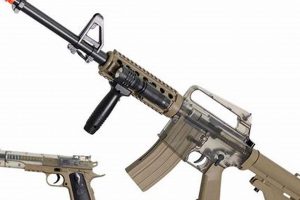
Tip 1: Examine Markings and Trademarks: Airsoft devices often feature orange tips, manufacturer logos specific to the airsoft industry, or warnings indicating they are not real firearms. Real firearms will have specific manufacturer markings, serial numbers, and caliber designations.
Tip 2: Assess Construction Materials: Many airsoft replicas utilize polymer or lightweight alloy frames. Real firearms typically employ steel, high-grade aluminum alloys, or reinforced polymers engineered for ballistic pressures.
Tip 3: Inspect the Barrel: Airsoft barrels are typically smaller in diameter than those of real firearms. They are designed to fire plastic BBs, not live ammunition. The bore of a real firearm will be sized for the intended cartridge.
Tip 4: Check Projectile Type: Airsoft guns fire plastic BBs (typically 6mm or 8mm). Real firearms fire metal bullets housed in cartridges. Examining any visible ammunition or attempting to chamber a real cartridge in an airsoft gun will reveal the difference.
Tip 5: Observe the Trigger Mechanism: Airsoft triggers often have a lighter pull and a less defined break than real firearms. The internal mechanisms differ significantly, reflecting the difference between compressed gas or spring propulsion versus controlled explosion.
Tip 6: Scrutinize the Hop-Up System: Airsoft guns utilize a hop-up system to impart backspin on the BB, increasing its range. Real firearms do not have this feature.
Tip 7: Consider Weight and Balance: Real firearms generally possess a heftier weight due to the use of steel and denser materials. The balance point may also differ compared to airsoft replicas.
These distinguishing characteristics provide crucial information for differentiating between airsoft replicas and authentic firearms, contributing to improved safety and awareness.
The following sections will address legal implications and safe handling practices related to both airsoft devices and real firearms.
1. Orange tip

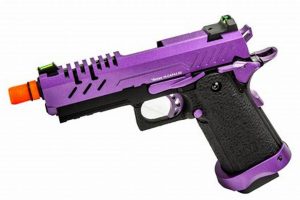
The presence of an orange tip on a device resembling a firearm serves as a readily identifiable visual indicator intended to differentiate it from an actual weapon. This brightly colored marking, typically affixed to the barrel’s muzzle, aims to prevent misidentification during casual observation or law enforcement encounters. Federal regulations in certain jurisdictions mandate or encourage the use of orange tips on imitation firearms, including airsoft guns, to mitigate the risk of accidental shootings or escalated situations arising from the misperception of a threat.
However, the orange tip is not a foolproof method of differentiation. It can be easily removed, painted over, or absent altogether, particularly in older models or in jurisdictions without specific regulations. Reliance solely on the presence of an orange tip to determine whether a device is an airsoft gun or a real firearm is therefore discouraged. Law enforcement personnel, for instance, are trained to assess a range of factors beyond the orange tip, including the weapon’s weight, materials, markings, and visible internal mechanisms. A real-world example includes instances where criminals have painted over orange tips to disguise airsoft guns and commit crimes, thus highlighting the limitations of relying solely on this visual cue.
In summary, while the orange tip serves as an initial indicator, it is not a definitive method for differentiating between airsoft guns and real firearms. Comprehensive assessment necessitates a combination of factors, including material analysis, the presence of manufacturer markings, an inspection of the projectile type, and an understanding of the device’s operational characteristics. A singular reliance on the orange tip can be misleading and potentially dangerous.
2. Construction Material

The materials used in the construction of a device resembling a firearm provide critical clues in differentiating between airsoft replicas and authentic weapons. Material analysis is a fundamental aspect of accurate identification.
- Metal Composition and Density
Real firearms typically employ steel alloys, high-grade aluminum, or titanium in their construction, imparting significant weight and durability. These materials are selected for their ability to withstand the high pressures and temperatures generated during firing. Airsoft guns, conversely, often utilize lighter, less dense metals such as pot metal alloys or aluminum with lower tensile strength. Examining the material composition and overall density offers a key point of differentiation. For instance, a slide made of stamped steel, as found on many real pistols, will exhibit a different texture, finish, and heft than an airsoft slide cast from a zinc alloy.
- Polymer Usage and Grade
While both real firearms and airsoft devices may incorporate polymer components, the grade and type of polymer differ considerably. Real firearms frequently use glass-reinforced polymers designed for exceptional impact resistance and heat stability, ensuring structural integrity under demanding conditions. Airsoft replicas generally employ commercial-grade plastics or lower-grade polymers that exhibit less durability and heat resistance. The presence of visible fiber reinforcement, a characteristic of high-grade firearm polymers, can serve as a differentiating factor. A comparison can be made between a Glock frame made from high-impact polymer and an airsoft pistol frame constructed from ABS plastic.
- Surface Finish and Manufacturing Techniques
The surface finish and manufacturing techniques employed in the construction process also provide insights. Real firearms often undergo specialized surface treatments such as bluing, parkerizing, or nitride coating to enhance corrosion resistance and durability. Airsoft guns typically receive simpler surface treatments like paint or anodizing. The precision of machining and assembly is generally higher in real firearms due to the tighter tolerances required for safe and reliable operation. Identifying differences in machining quality, the presence of tool marks, and the complexity of surface coatings can aid in discerning a real firearm from a replica. An example is comparing the smooth, even finish of a factory-blued firearm slide to the textured, painted surface of an airsoft counterpart.
In summary, the careful examination of construction materials, including metal composition, polymer grade, and surface finishes, offers a reliable method for distinguishing airsoft replicas from authentic firearms. The selection of materials directly reflects the intended purpose and operational requirements of each device, providing a crucial element in accurate identification.
3. Markings/Serial numbers
The presence, type, and characteristics of markings and serial numbers are crucial indicators when differentiating between airsoft devices and real firearms. Authentic firearms are subject to stringent regulations mandating specific identifying marks, while airsoft replicas often feature different, less regulated markings or lack serial numbers altogether.
- Mandatory Manufacturer Markings on Firearms
Federal regulations require licensed firearm manufacturers to engrave specific information on each firearm produced. This includes the manufacturer’s name, city and state of origin, model designation, caliber or gauge, and a unique serial number. The absence of these markings, or inconsistencies in their format, strongly suggests the item is not a real firearm. An example is a Glock pistol, which must have “Glock Ges.m.b.H., Deutsch-Wagram, Austria,” “9×19,” a model designation, and a unique serial number engraved on its frame. Airsoft replicas of Glocks may have similar-looking markings, but they are typically less precisely applied and may use different fonts or abbreviations.
- Serial Number Format and Uniqueness
Serial numbers on real firearms are unique identifiers assigned to each individual weapon. They follow specific formats dictated by regulations, ensuring traceability and accountability. Law enforcement agencies maintain databases of firearm serial numbers, facilitating the tracking of weapons used in crimes. Airsoft replicas may lack serial numbers entirely, or they may have serial numbers that are duplicated across multiple units or that do not conform to standard formats. The duplication of a serial number or its non-compliance with established formatting rules is a strong indicator of an airsoft replica. For instance, the serial number on an AR-15 rifle manufactured by Colt must conform to a specific alphanumeric sequence; deviations from this sequence suggest a replica.
- Airsoft-Specific Markings and Disclaimers
Airsoft manufacturers often include specific markings and disclaimers on their products to distinguish them from real firearms and comply with legal requirements. These markings may include manufacturer logos specific to the airsoft industry, warnings indicating that the device is not a real firearm, or statements regarding its intended use. The presence of these airsoft-specific markings is a clear indicator that the device is a replica. For example, an airsoft M4 rifle may have a Cybergun logo prominently displayed, along with a disclaimer stating “This is an airsoft replica. Do not attempt to modify for use with live ammunition.”
- Tampering and Alteration of Markings
Any evidence of tampering, alteration, or removal of markings on a device resembling a firearm raises significant concerns. While criminals may attempt to obliterate or alter markings on real firearms to conceal their origin, such alterations are uncommon on airsoft replicas. However, both may be altered to resemble the other depending on the intent. If markings appear to have been deliberately defaced or modified, it warrants careful scrutiny and may indicate an attempt to deceive. For instance, if a serial number appears to have been scratched off or obscured, further investigation is warranted to determine the item’s true identity.
In summary, the careful examination of markings and serial numbers is a critical step in differentiating between airsoft devices and real firearms. The presence of mandatory manufacturer markings, the format and uniqueness of serial numbers, the presence of airsoft-specific disclaimers, and any evidence of tampering with markings all provide valuable clues. Analyzing these characteristics helps establish whether a device is a regulated firearm or a recreational replica, thus enhancing safety and reducing the risk of misidentification.
4. Projectile type
The projectile type is a definitive characteristic that distinguishes airsoft devices from real firearms. Airsoft guns are designed to fire spherical plastic projectiles, commonly referred to as BBs, typically 6mm or 8mm in diameter. Real firearms, conversely, discharge metallic projectiles, typically lead or copper-jacketed bullets, which are propelled by the rapid expansion of gases produced by the combustion of gunpowder within a cartridge. This fundamental difference in projectile type serves as an immediate and unambiguous indicator of the device’s nature. Attempting to chamber a real cartridge in an airsoft gun is physically impossible due to dimensional incompatibilities. Conversely, airsoft BBs cannot be loaded or fired from a real firearm.
The distinction in projectile type has critical implications for safety and potential harm. Airsoft BBs, while capable of causing minor injuries at close range, lack the mass and velocity to inflict life-threatening wounds. Metal bullets, on the other hand, possess significantly greater kinetic energy and are designed to penetrate tissue, causing severe injury or death. The use of plastic BBs in airsoft ensures a relatively safe environment for recreational activities, provided appropriate safety gear is worn. Furthermore, the projectile type directly influences the internal mechanism of the device. Airsoft guns utilize compressed gas (CO2, green gas, or HPA) or spring-powered mechanisms to propel the BB, while real firearms employ a controlled explosion within the cartridge to propel the bullet. The absence of a firing chamber designed to contain an explosion in an airsoft gun reinforces its differentiation from a real firearm. The presence of cartridges, whether loose or in a magazine, is also a strong sign of a real firearm.
In summary, the projectile type serves as a primary and reliable method for differentiating airsoft guns from real firearms. This distinction is readily observable and is a fundamental characteristic influencing the design, operation, and potential for harm associated with each type of device. Recognizing the projectile type is crucial for responsible handling, storage, and public safety awareness. In ambiguous situations, examination of any available projectiles remains a definitive means of identification.
5. Trigger mechanism

The trigger mechanism, integral to the functionality of both airsoft devices and real firearms, provides valuable insights for differentiation. Analysis of the trigger pull, internal components, and overall operation reveals key distinctions between the two.
- Trigger Pull Weight and Feel
Real firearms are typically designed with specific trigger pull weights, measured in pounds, to ensure safe and controlled operation. These pull weights vary depending on the firearm type (e.g., pistol, rifle, shotgun) and intended use. Airsoft devices, however, generally have lighter trigger pulls with less tactile feedback due to the lower forces involved in actuating the firing mechanism. For example, a Glock pistol may have a trigger pull weight of around 5.5 pounds, while an airsoft Glock replica might have a trigger pull of 2-3 pounds with a less defined break. This difference arises from the contrasting operational principles: the real firearm initiates a controlled explosion, whereas the airsoft device releases compressed gas or a spring.
- Internal Components and Construction
The internal components of the trigger mechanism differ significantly between airsoft and real firearms. Real firearms employ complex arrangements of sears, hammers, and springs manufactured from hardened steel and precisely machined to ensure reliable and safe ignition of the cartridge. Airsoft devices utilize simpler mechanisms, often constructed from plastic or less durable alloys, designed to release a burst of compressed gas or a spring-loaded piston. Observing the internal components, if visible, will reveal these differences in material quality and complexity. For instance, comparing the sear of an AR-15 rifle, made of hardened steel, to the plastic trigger assembly of an airsoft M4 replica highlights the disparity in construction.
- Safety Mechanisms and Functionality
Real firearms incorporate various safety mechanisms, such as manual safeties, grip safeties, and trigger safeties, designed to prevent unintentional discharge. These safeties are often complex mechanical devices that require deliberate engagement and disengagement. Airsoft devices may have similar-looking safety mechanisms, but their functionality is often simpler and less robust. The engagement and disengagement of the safety on a real firearm will typically provide more tactile and audible feedback compared to an airsoft replica. The presence and functionality of these safety mechanisms offer further clues for differentiation. A 1911 pistol features both a grip safety and a manual thumb safety, both of which require positive engagement to allow the firearm to fire; an airsoft version may mimic these safeties but lack the precise engineering and robust construction.
- Audible and Tactile Feedback
The audible and tactile feedback produced by the trigger mechanism also differs between airsoft devices and real firearms. Real firearms often produce a distinct “click” or “snap” when the trigger is pulled and the firing mechanism is released. This feedback is more pronounced due to the greater forces involved. Airsoft devices tend to have quieter and less distinct trigger sounds. The reset of the trigger after firing may also feel different, with real firearms often having a more positive and defined reset. For instance, the crisp “click” of a 1911 trigger as it breaks is markedly different from the softer sound of an airsoft replica’s trigger mechanism.
In summary, the trigger mechanism provides valuable insights for distinguishing between airsoft devices and real firearms. Analyzing the trigger pull weight and feel, examining the internal components and construction, assessing the functionality of safety mechanisms, and observing the audible and tactile feedback contribute to a more accurate identification, improving safety and awareness.
6. Weight
Weight, as a physical property, offers a tangible means of differentiating between airsoft devices and authentic firearms. The variance in weight stems from differences in construction materials and internal mechanisms, providing a valuable indicator when visually assessing an item’s authenticity.
- Material Density and Component Composition
Real firearms predominantly utilize steel alloys, high-grade aluminum, and, in some instances, titanium. These materials possess inherent density, contributing to a substantial overall weight. Conversely, airsoft replicas frequently employ lighter materials like ABS plastic, zinc alloys (often termed “pot metal”), and lower-grade aluminum. Consequently, the differing densities directly impact the overall weight. For example, a real steel-framed 1911 pistol will weigh significantly more than an airsoft replica with a zinc alloy frame.
- Internal Mechanism Complexity and Mass
Authentic firearms incorporate intricate internal mechanisms designed to withstand the high pressures and forces generated during the firing of live ammunition. These mechanisms include hardened steel components such as the bolt, firing pin, and trigger assembly, all contributing to the firearm’s weight. Airsoft devices, relying on compressed gas or spring power, possess simpler internal mechanisms with less massive components, reflecting their lower operating stresses. The internal workings of a real AR-15, with its steel bolt carrier group and buffer, significantly increase the weight compared to an airsoft AR-15 utilizing a lightweight plastic piston.
- Magazine and Ammunition Contribution
The weight differential extends to magazines and their contents. Real firearm magazines are constructed from steel and are designed to hold metallic cartridges, each contributing to the overall weight. Airsoft magazines are often plastic and hold lightweight plastic BBs. A fully loaded magazine for a real firearm will weigh substantially more than a fully loaded magazine for an airsoft replica. A fully loaded magazine of 9mm cartridges will weigh considerably more than a magazine of 6mm plastic BBs designed to fit in an airsoft pistol.
- Balance and Handling Characteristics
Beyond the absolute weight, the distribution of weight and overall balance differ between real firearms and airsoft replicas. Real firearms are engineered for ergonomic handling during live fire, influencing the distribution of mass. The balance point of a real firearm is often different than that of a replica, impacting how it feels in the hand. The balance and handling characteristics of a real shotgun, with its weight distributed along the barrel and receiver, will feel different compared to an airsoft shotgun made with a lighter polymer construction.
Ultimately, an awareness of these facets concerning weight, provides a tangible tool for discriminating between airsoft devices and authentic firearms. A comparative assessment, incorporating material density, internal complexity, ammunition weight, and balance, allows for a more informed judgment regarding an item’s true nature.
Frequently Asked Questions
The following questions and answers address common concerns and misconceptions regarding how to tell the difference between airsoft and real guns. The goal is to provide clear and informative guidance for accurate identification.
Question 1: Is the presence of an orange tip a definitive indication that a device is an airsoft gun?
The presence of an orange tip is a visual indicator but not a definitive one. Orange tips can be removed or painted over. Reliance on the orange tip alone is insufficient for accurate identification.
Question 2: How significant is the construction material in differentiating between airsoft and real guns?
Construction material is a highly significant factor. Real firearms utilize steel, high-grade aluminum, or reinforced polymers engineered for ballistic pressures. Airsoft replicas frequently use lighter, less durable materials like ABS plastic or zinc alloys.
Question 3: Are manufacturer markings and serial numbers reliable indicators?
Yes. Real firearms are legally required to have specific manufacturer markings and unique serial numbers. Airsoft replicas may lack serial numbers or have markings that do not conform to standardized formats.
Question 4: How does the projectile type help differentiate between airsoft and real guns?
Airsoft guns fire plastic BBs. Real firearms fire metal bullets contained within cartridges. This is a fundamental difference that allows for immediate differentiation.
Question 5: Can the trigger mechanism be used to tell the difference?
Yes. Real firearms generally have heavier trigger pulls with a more defined break. Airsoft triggers often have lighter pulls and less tactile feedback due to the different operating mechanisms.
Question 6: Is weight a reliable indicator of a firearm’s authenticity?
Yes. Due to the use of heavier materials in their construction, real firearms typically weigh more than airsoft replicas of similar size and design.
In summary, accurate identification requires considering multiple factors, including markings, materials, projectile type, trigger mechanism, and weight. No single feature is entirely reliable, but a comprehensive assessment provides a more definitive conclusion.
The following section will discuss the legal implications of misidentifying airsoft devices and real firearms.
Conclusion
The preceding discussion has detailed multiple methods to accurately distinguish between airsoft replicas and authentic firearms. Key differentiating factors include manufacturer markings, construction materials, projectile type, trigger mechanism characteristics, and overall weight. Reliance on a single characteristic is inadvisable; a comprehensive assessment considering several factors is necessary for reliable identification. The significance of accurate identification cannot be overstated, impacting public safety, legal compliance, and responsible handling practices.
The responsibility for accurate differentiation rests with individuals, law enforcement, and regulatory bodies. Ongoing education and awareness campaigns are essential to minimize the risks associated with misidentification. As airsoft technology advances, vigilance and updated training protocols are paramount. The consistent and responsible application of these guidelines will contribute to a safer and more informed environment for all stakeholders.