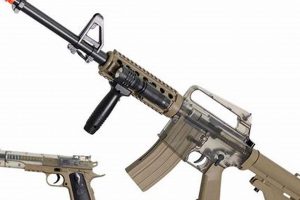
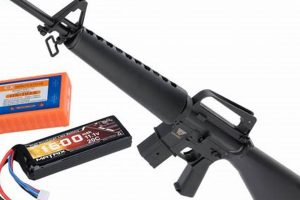
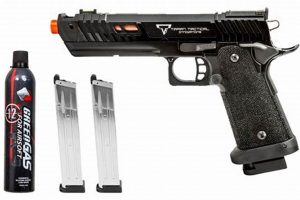
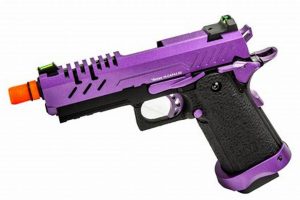
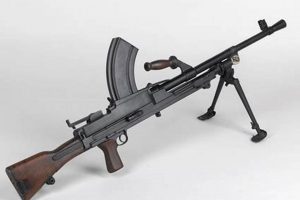
Airsoft weaponry, distinguished by superior construction and performance, replicates the form and function of real firearms. These devices propel plastic projectiles using compressed gas or electric mechanisms, providing a realistic simulation for training, recreational activities, and competitive sports. Durability, accuracy, and reliable operation are hallmarks of this classification. An example would be a meticulously crafted rifle that consistently delivers precise shots over extended use.
The employment of airsoft replicas demonstrating elevated build standards and operational efficiency offers numerous advantages. Such equipment provides enhanced realism for training exercises, improves user experience through consistent performance, and increases longevity, reducing the need for frequent replacements. Historically, the pursuit of higher performance and durability has driven innovation in airsoft technology, leading to the development of advanced materials and manufacturing processes.
The following discussion will examine the specific features and characteristics that differentiate high-caliber airsoft devices, focusing on construction materials, internal mechanisms, and performance metrics. This analysis will provide a framework for evaluating different options and identifying appropriate choices based on individual needs and intended use.
Selecting High-Performance Airsoft Replicas
Selecting airsoft devices that demonstrate superior quality requires careful evaluation of several critical factors. Focusing on these aspects will enhance the user experience and ensure long-term reliability.
Tip 1: Material Composition Assessment: Examine the materials used in the construction of the airsoft device. High-grade metal alloys, such as aluminum and steel, are preferred for critical components like the receiver, barrel, and gears. Polymer components should be constructed from durable, impact-resistant materials like reinforced nylon. For example, a full metal receiver provides superior durability compared to plastic alternatives.
Tip 2: Internal Mechanism Evaluation: Scrutinize the internal components, particularly the gearbox. Gearboxes should feature reinforced gears, metal bushings or bearings, and a durable piston. A high-torque motor is also crucial for consistent performance. For example, a gearbox with steel gears and ball bearings will offer enhanced reliability and reduced wear.
Tip 3: Hop-Up System Analysis: The hop-up system significantly impacts accuracy and range. Look for adjustable hop-up units that allow for precise tuning. Rotary hop-up systems often offer greater precision than traditional lever-based systems. For example, an adjustable rotary hop-up unit enables users to fine-tune the trajectory of the BB for optimal range and accuracy.
Tip 4: Performance Testing and Data: Review performance metrics such as feet per second (FPS) and rounds per minute (RPM). Ensure these values align with the intended use and regulatory restrictions. Independent testing and reviews can provide valuable insights. For example, a chronograph test can verify the FPS consistency and accuracy of the device.
Tip 5: Battery and Power Considerations: For electric airsoft guns (AEGs), the battery is a critical factor. Opt for high-quality batteries with sufficient voltage and capacity to support the desired rate of fire and trigger response. Lithium polymer (LiPo) batteries are often preferred for their power density and performance. For example, a 11.1V LiPo battery can provide improved trigger response and rate of fire compared to a standard NiMH battery.
Tip 6: Brand Reputation and Warranty: Consider established manufacturers with a proven track record of quality and customer support. A comprehensive warranty can provide peace of mind and protection against defects. For example, selecting a reputable brand with a history of producing durable and high-performing airsoft replicas minimizes the risk of encountering issues.
Tip 7: Accuracy and Range: The ultimate measure of its performance lies in its accuracy and range. Field test the airsoft device, if possible, to assess its ability to consistently hit targets at various distances. An accurate replica allows for tactical advantages and greater enjoyment of the sport.
By carefully considering these factors, individuals can make informed decisions and select airsoft devices that provide superior performance, durability, and overall value. Investing in quality ensures a more satisfying and reliable experience.
The subsequent sections will delve into specific airsoft models and brands that exemplify the principles outlined above, providing practical recommendations for a variety of applications.
1. Material Durability

Material durability is a cornerstone in the assessment of the airsoft device quality. The inherent resistance of constituent materials to degradation under stress directly impacts the lifespan, performance consistency, and overall value of these devices. Selection of appropriate materials is thus critical in manufacturing robust and reliable airsoft platforms.
- Impact Resistance
The ability of materials to withstand sudden forces without fracturing or deforming is paramount. Airsoft devices are frequently subjected to impacts from drops, collisions, and BB strikes. Polymers, such as reinforced nylon and ABS plastic, are used for external components like stocks and handguards due to their impact resistance. Internal components, however, often necessitate metal alloys. A polymer receiver, while lightweight, is more susceptible to cracking upon impact compared to a metal counterpart. This difference significantly affects the device’s resilience in demanding scenarios.
- Corrosion Resistance
Exposure to environmental elements, including moisture and humidity, can lead to corrosion in metallic components. Corrosion compromises structural integrity, potentially causing malfunctions or complete failure. Stainless steel and anodized aluminum are commonly employed to mitigate corrosion. Gearboxes, often constructed from cast metal, are particularly vulnerable if not properly treated with protective coatings. A corroded gearbox can exhibit reduced performance due to increased friction and compromised tolerances.
- Wear Resistance
The capacity to endure repeated friction and abrasion is crucial for internal moving parts. Gears, pistons, and bearings are subject to constant contact and pressure during operation. Hardened steel and specialized alloys are often utilized to minimize wear. Low-quality materials can exhibit rapid wear, leading to reduced FPS, increased noise, and eventual failure. Well-maintained internal components made from wear-resistant materials ensure consistent performance and extended service life.
- Temperature Stability
Fluctuations in temperature can affect material properties, potentially impacting performance. Extreme heat can cause polymers to soften and warp, while cold temperatures can render them brittle. Metals also exhibit expansion and contraction with temperature variations. Materials with minimal thermal expansion coefficients and high-temperature resistance are preferred. This is particularly important for gas-powered airsoft devices, where temperature directly affects gas pressure and performance.
The strategic selection of materials based on their specific properties is essential for producing high-caliber airsoft devices. Material durability directly translates to enhanced reliability, prolonged lifespan, and consistent performance under diverse operating conditions. Compromises in material quality often result in reduced longevity and increased maintenance requirements, negating any initial cost savings. Therefore, material durability is an indispensable attribute of airsoft weaponry designed for sustained use and optimal performance.
2. Internal Precision

The correlation between internal precision and the overall quality of airsoft weaponry is fundamentally causative. Imprecise manufacturing tolerances within the internal mechanisms inevitably lead to inconsistent performance and diminished reliability, directly compromising the device’s effectiveness. This precision governs critical aspects such as air seal, gear meshing, and barrel alignment. An airsoft gun with meticulously crafted internal components ensures consistent compression, smooth gear operation, and accurate projectile trajectory, all of which are essential hallmarks of superior quality. For example, a gearbox with precisely machined gears and bearings minimizes friction and ensures reliable cycling, contributing to a higher rate of fire and increased durability. Conversely, poorly manufactured internal parts can lead to air leaks, gear stripping, and erratic shot patterns, rendering the device unreliable and inaccurate.
The significance of internal precision extends beyond mere operational functionality; it impacts the user’s experience and the long-term viability of the device. Consider the hop-up unit, a crucial component for adjusting projectile trajectory. A precisely manufactured hop-up unit allows for fine-tuning the backspin applied to the BB, thereby extending its range and improving accuracy. An inaccurately manufactured hop-up unit, however, may apply inconsistent or excessive backspin, leading to unpredictable shot patterns and reduced effective range. Furthermore, the internal tolerances affect the lifespan of the device. Precisely fitted components experience less stress and wear during operation, extending the time between maintenance and reducing the likelihood of catastrophic failure. This is particularly relevant in high-stress environments, such as competitive airsoft matches or military simulations, where reliability is paramount.
In summary, internal precision is an indispensable attribute of airsoft weaponry aspiring to high-quality standards. It directly influences performance consistency, accuracy, reliability, and longevity. Understanding the practical significance of this attribute enables informed decision-making, empowering users to select devices that meet their specific needs and performance expectations. While external aesthetics and branding may contribute to perceived value, it is the underlying precision of the internal mechanisms that ultimately determines the true caliber of an airsoft gun. Neglecting this aspect inevitably leads to compromised performance and a diminished overall experience.
3. Performance Consistency
Performance consistency is a critical attribute differentiating high-caliber airsoft devices from those of lesser quality. Sustained, predictable operation under varying conditions is paramount to achieving a competitive advantage and ensuring user satisfaction. Deviations from established performance parameters can negatively impact accuracy, range, and overall effectiveness.
- Velocity Stability
Maintaining a consistent projectile velocity, measured in feet per second (FPS), is crucial for accuracy and range. Fluctuations in FPS can lead to unpredictable shot trajectories and difficulty in targeting. High-quality airsoft devices employ precision-engineered internal components and robust air seal mechanisms to minimize FPS variations. For instance, a premium airsoft rifle may exhibit an FPS deviation of less than 5 FPS across multiple shots, whereas a lower-quality replica may exhibit fluctuations exceeding 20 FPS, significantly impairing accuracy at longer ranges. Maintaining stable velocity is a hallmark of superior construction.
- Rate of Fire Reliability
In automatic or burst-fire modes, a consistent rate of fire (ROF) is essential for maintaining suppressive fire and engaging multiple targets effectively. Variations in ROF can disrupt firing patterns and reduce the accuracy of follow-up shots. High-performance airsoft devices utilize robust motors, high-capacity batteries, and precisely timed electronic control systems to ensure a stable ROF. A top-tier AEG might maintain a consistent ROF of 20 rounds per second, while a less-refined model may exhibit significant ROF fluctuations, leading to inconsistent performance and potentially causing jams or malfunctions.
- Hop-Up Consistency
The hop-up unit applies backspin to the projectile, extending its range and improving accuracy. Consistent hop-up performance is essential for maintaining a flat trajectory and predictable shot placement. High-quality hop-up units feature precise adjustability and consistent pressure application, ensuring uniform backspin. An accurately constructed hop-up unit will allow for minute adjustments that directly correlate to predictable changes in BB trajectory, enhancing long-range accuracy. Conversely, a poorly designed hop-up unit may apply inconsistent or uneven backspin, resulting in erratic shot patterns and reduced effective range.
- Trigger Response Uniformity
The speed and consistency of trigger response are critical for quick target acquisition and engagement. A sluggish or inconsistent trigger response can hinder reaction time and reduce effectiveness in close-quarters combat situations. Superior airsoft devices feature responsive triggers, low-resistance wiring, and high-torque motors to ensure immediate and consistent trigger activation. High-end models often incorporate electronic trigger units (ETUs) that further enhance trigger response and provide programmable firing modes. In contrast, entry-level airsoft guns may exhibit noticeable trigger delay and inconsistent activation, hampering the user’s ability to react quickly and accurately.
The facets outlined above converge to define performance consistency as a fundamental criterion in evaluating high-caliber airsoft weaponry. Sustained velocity stability, reliable rate of fire, consistent hop-up performance, and uniform trigger response are interconnected attributes that distinguish top-tier devices from those of lesser quality. These performance characteristics contribute directly to enhanced accuracy, extended range, and improved overall user experience, solidifying the importance of performance consistency in the selection of quality airsoft equipment.
4. Hop-Up Efficiency

Hop-up efficiency directly correlates with the performance and designation of superior airsoft weaponry. The hop-up unit imparts backspin to the BB, counteracting the effects of gravity and extending the projectile’s range and accuracy. A high-efficiency hop-up system maximizes this effect, enabling flatter trajectories and greater effective distances. Inferior systems may produce inconsistent or insufficient backspin, leading to reduced range and accuracy. A tangible example is evident in comparing two otherwise identical airsoft rifles: one equipped with a precision-engineered hop-up unit and the other with a standard, mass-produced unit. The rifle with the precision hop-up will exhibit noticeably improved range and grouping consistency. Consequently, the hop-up system’s effectiveness is a critical determinant of an airsoft device’s overall quality and suitability for competitive or tactical applications.
Further analysis reveals that hop-up efficiency is not solely dependent on the unit itself but also on the interplay between the hop-up rubber (bucking) and the BB weight. A mismatched combination can severely limit performance. For instance, using excessively heavy BBs with a hop-up unit designed for lighter projectiles can result in over-hopping, causing the BB to curve upward excessively and drastically reducing its range. Conversely, using too light BBs may not engage the hop-up mechanism effectively, leading to insufficient range. Practical applications demand careful calibration of the hop-up setting and BB weight to achieve optimal trajectory and distance. Advanced airsoft enthusiasts often experiment with different hop-up buckings and BB weights to fine-tune their devices for specific playing conditions.
In summary, hop-up efficiency stands as a pivotal aspect of superior airsoft gun construction. The effectiveness of the hop-up system in imparting backspin directly impacts range, accuracy, and overall performance. Achieving optimal hop-up efficiency requires careful consideration of component quality, compatibility, and calibration. While challenges exist in finding the ideal combination of hop-up unit, bucking, and BB weight, the pursuit of hop-up optimization is essential for maximizing the potential of any airsoft device and elevating its classification into the category of quality airsoft weaponry.
5. Reliable Operation

Reliable operation constitutes an indispensable characteristic of superior airsoft weaponry. The term encapsulates the device’s capacity to consistently perform its intended function without malfunction or failure under anticipated operating conditions. A direct causal relationship exists between the quality of an airsoft gun and the reliability of its operation. Higher quality materials, precise manufacturing tolerances, and robust design principles directly contribute to increased operational reliability. Conversely, cost-saving measures that compromise material selection or manufacturing processes invariably lead to diminished reliability. A device exhibiting consistent misfeeds, frequent jamming, or premature component failure cannot be legitimately classified as high quality, irrespective of its aesthetic appeal or theoretical performance specifications. A notable example is an airsoft rifle intended for competitive use; if it fails to consistently cycle rounds during rapid firing sequences, its practical value is substantially diminished.
The significance of reliable operation extends beyond mere functionality; it encompasses safety and tactical effectiveness. An airsoft gun that malfunctions unexpectedly can pose a safety risk to the user and bystanders, particularly in close-quarters environments. Furthermore, in simulated combat scenarios, a failure to operate reliably can create tactical vulnerabilities, compromising team objectives and potentially leading to simulated defeat. Therefore, reliability is not merely a desirable attribute but a fundamental requirement for any airsoft device intended for serious use. The practical implication of this understanding lies in the necessity for thorough pre-use inspection, diligent maintenance, and informed purchasing decisions that prioritize quality over superficial features. Understanding the construction and proper care for the inner machanisms of airsoft replicas will greatly reduce chances of malfunction or damage.
In summary, reliable operation is inextricably linked to the designation of best quality airsoft guns. It stems directly from the intrinsic properties of the materials, manufacturing processes, and design considerations employed in the device’s creation. The pursuit of enhanced reliability necessitates a comprehensive understanding of the interplay between these factors, enabling informed decision-making and promoting safe and effective utilization of airsoft weaponry. While numerous factors contribute to the overall assessment of quality, reliable operation remains a paramount consideration, underscoring its importance in the context of competitive, recreational, and training applications.
Frequently Asked Questions
This section addresses common inquiries regarding the characteristics and selection of superior airsoft weaponry.
Question 1: What constitutes the primary difference between standard and “best quality airsoft guns?”
The key distinction lies in the materials used, manufacturing precision, and overall reliability. Premium airsoft devices typically employ high-grade metals, reinforced polymers, and meticulously engineered internal components to ensure longevity and consistent performance. Standard models often compromise on these aspects, resulting in reduced durability and operational inconsistencies.
Question 2: How does internal precision contribute to the enhanced performance of these types of airsoft devices?
Internal precision directly impacts factors such as air seal, gear meshing, and barrel alignment. Tighter tolerances minimize air leaks, reduce friction, and ensure consistent projectile trajectories. These elements translate to improved accuracy, increased range, and a lower likelihood of mechanical failure.
Question 3: Why is material durability a critical consideration in the context of airsoft weaponry?
Airsoft guns are subjected to considerable stress during use, including impacts, temperature fluctuations, and repeated mechanical stress. Durable materials, such as high-strength alloys and reinforced polymers, resist degradation and maintain structural integrity under these conditions, extending the lifespan of the device and preserving its performance characteristics.
Question 4: What role does the hop-up unit play in determining the overall quality of an airsoft gun?
The hop-up unit imparts backspin to the projectile, counteracting gravity and extending its range and accuracy. A well-designed and precisely adjustable hop-up system enables users to fine-tune the trajectory of the BB, optimizing its performance for various distances and environmental conditions. Inconsistent or poorly designed hop-up units can significantly impair accuracy and range.
Question 5: How does performance consistency factor into the evaluation of airsoft gun quality?
Performance consistency refers to the device’s ability to maintain stable projectile velocity, a reliable rate of fire, and uniform trigger response over extended use. Consistent performance translates to predictable shot placement, enhanced tactical effectiveness, and a more satisfying user experience. Devices exhibiting significant performance fluctuations are generally considered to be of lower quality.
Question 6: Is there a direct correlation between the price of an airsoft gun and its inherent quality?
While a higher price point often correlates with improved quality, it is not an infallible indicator. Certain manufacturers may inflate prices without providing commensurate improvements in materials, manufacturing, or performance. It is advisable to conduct thorough research, consult independent reviews, and compare specifications before making a purchase decision.
In essence, the selection of “best quality airsoft guns” necessitates a comprehensive evaluation of materials, manufacturing precision, performance characteristics, and overall reliability. Informed decision-making, guided by objective criteria, is crucial for ensuring long-term satisfaction and maximizing the value of the investment.
The subsequent section will provide guidance on maintaining and preserving the condition of high-caliber airsoft equipment.
Concluding Remarks on Superior Airsoft Weaponry
The preceding analysis has elucidated the multifaceted characteristics defining the apex of airsoft devices. Material durability, internal precision, performance consistency, hop-up efficiency, and reliable operation emerge as interdependent cornerstones of this classification. The integration of these attributes distinguishes high-caliber devices, facilitating enhanced user experiences and contributing to demonstrably superior performance in diverse applications.
The pursuit of superior airsoft weaponry mandates diligent evaluation and informed decision-making. Continued advancements in materials science and manufacturing techniques promise to further refine the performance and reliability of these devices. It is incumbent upon both manufacturers and consumers to prioritize quality and innovation, ensuring the ongoing evolution of airsoft technology. The discerning application of these principles will undoubtedly shape the future trajectory of the field.